The 2024 Washington Seminar: Back in the Groove Again
by Gary Wunder
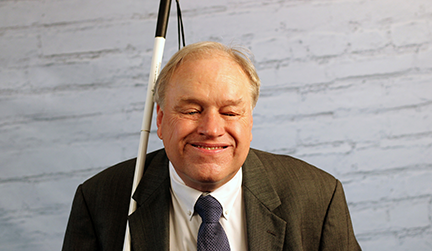 After holding our Washington Seminar virtually for two years and returning in person for 2023, our 2024 seminar affirms once again how good it is to walk the halls of Congress, revisit the Holiday Inn Capitol, and meet all of our colleagues and friends for another year of progress. Although we normally fit in one hotel, we underestimated the crowd who would attend and had to use two auxiliary hotels. This was a good problem to have.
The seminar began on January 29, 2024, with a productive student seminar and an active and upbeat job fair. We hope that articles about these events will be forthcoming, for each of these events deserves the space, exposure, and celebration of Braille Monitor readers.
The Great Gathering-In
President Riccobono opened the Great Gathering-In with the keynote speech “The Significance of Washington Seminar 2024.” Its message focused on and clarified why we come, what we intend to do, and the future that will come from our work. His remarks immediately follow this article.
He next acknowledged the officers and the Board of Directors of the National Federation of the Blind, and their names evoked a hearty cheer for the work they do on behalf of all of us. The President also recognized Sachin Pavithran, the executive director of the United States Access Board, a former scholarship winner and a man who has done so much to advance the work we do.
Stephanie Cascone is the director of communications and marketing, and President Riccobono noted that she's become a key leader on our staff who contributes so much to what we do. She began by highlighting the work we are continuing to do on President Riccobono’s Artificial Intelligence presence, and our progress was highlighted by a short conversation. She asked the AI model of our President about the most significant experience he had in Washington, DC. “The most interesting experience I had in Washington, DC, was during the NFB Youth Slam in 2009. I had the opportunity to be part of a rally of blind students at the Lincoln Memorial and a march to the Capitol Visitor Center. Additionally, thanks to the Federation, Melissa and I had the unique opportunity to take our children to the White House for the Easter Egg Roll. It was not only a fun time but a special way to represent blind Americans.” This sentiment was expressed in his voice, and, given all of the memories we have not yet inserted into the model, we don’t know whether this was really his favorite memory of being in DC. The purpose of the AI model, of course, is not to discourage people from talking to the real Mark Riccobono, but if we can come up with realistic answers to the most commonly asked questions, this will be yet another way for us to do outreach and let people interact more with our President. Stephanie reminded us that our hashtag for the week would be #nfbindc, and anyone can use this tag to see the conversations that were held on the various social platforms on which we are active. Whether you are active on social media or not, we are always looking for your stories, so feel free to send them to us at [email protected] or call us and leave a message at 410-659-9314, extension 2444.
Stephanie concluded her presentation by asking that we all take part in a video. The line we had to speak was simple, and the real art was in the passion we brought to it. On the count of three we all said “Thank you,” and unlike many of the videos she does, she thought we were fine on the first take.
 Nothing as complicated as the Washington Seminar happens without a lot of logistical work, and the part of it that involves getting people into rooms, doing the recordkeeping for congressional responses, and making sure everything runs smoothly falls to the crew who heads up room 275. To speak on their behalf, President Riccobono introduced Lisa Bonderson. She began by acknowledging the staff of room 275: Buna Dahl, Sandy Halverson, Kris Colcock, Brook Sexton, and Judy Sanders. Since our seminar runs on both enthusiasm and food, Lisa outlined the dining options in the hotel and when they would be available. She made it clear that whether you need packets, canes, cane tips, or technical help in working out appointments, room 275 is always the place to go.
Our District of Columbia affiliate and its president, Shawn Callaway, were recognized for upholding the tradition that finds doughnuts in the lobby on Tuesday morning. Some claim to run on coffee, but when nothing less than a solid, sugary substance will do, we can always count on our District of Columbia affiliate to give us the energy for a day on the Hill.
President Riccobono briefly touched on the Museum of the Blind People’s Movement and noted that 100 percent of our Board of Directors are active contributors. We are still in the beginning stages of fundraising, and while the museum is deserving of contributions from each of us, of equal or greater importance is putting our minds to who we know and working on making the ask for the project. All of us have friends and relatives, and many of us have some contact with corporations. Remember that they can’t say yes unless we ask, and the accomplishments of the Blind People’s Movement is definitely worthy of significant support both to honor those who have come before, help those of us who are living in the present, and set the direction that will influence the opportunities for blind people in the future. Please send your prospects to Rachel Held who can be reached at [email protected] or at 410-659-9314, extension 2423.
Anil Lewis, the director of blindness initiatives at our Jernigan Institute, was called to the podium on the day before the twentieth anniversary of the Institute’s opening. In his presentation he mentioned a number of programs carried on through blindness initiatives, and there will soon be a full-length article in celebration of the twentieth anniversary published in this magazine. The theme of his presentation and one that I am sure will be present in his article is, “We strive to learn, and we yearn to teach.”
The President took the time to acknowledge Lou Ann Blake, the person who has coordinated our Jacobus tenBroek Law Symposium since its beginning. After eighteen years of service on the staff, Lou Ann is retiring to Hawaii with her husband Maurice Peret. We thank both of them for their service and wish them well in the land of paradise to which they are moving.
Everette Bacon is the chairman of the Dr. Jacob Bolotin Award. He came to remind people that we are always looking for individuals and organizations who are worthy of recognition by the National Federation of the Blind for carrying on the work of the blind doctor, Jacob Bolotin. Nominations may be submitted at nfb.org/Bolotin and will be accepted until April 15. One letter of recommendation is required, and if the person or organization you nominate wins, it will be a special day for you when the chairman takes the stage at the national convention to recognize our winners.
Eve Hill is now our General Counsel, and President Riccobono said there are many battles we are fighting, and he hopes to be able to report on some of them soon. We did have a major victory recently in our attempt to fight Section 14(C), and former President Maurer was acknowledged for the years of work he has put into this particular case in Ohio. Because of the special laws that apply to blind people in the administration of the Social Security system, we get a number of requests in dealing with Supplemental Security Income and Social Security Disability Insurance. Jesse Shirek is our main point person on the staff, and we have added some extra support for those matters which get particularly complicated or drawn out. A person who has long been a cornerstone of our Social Security work was acknowledged when President Riccobono recognized James Gashel for more than fifty years of service to the organization. In addition to the work that Jim does as a person now retired, we have enlisted the services of Andrew Sindler, a very competent lawyer who is quite familiar with the ins and outs of the law as it related to the blind and the regulations pertaining to us.
For several years now we have been fighting regulations that make it more difficult for blind people with guide dogs to fly using commercial air service. On the very day of this meeting, we filed a petition with the Department of Transportation asking that it recognize the unique position of guide dogs in the history and law of this country and exempt guide dog users from the paperwork required of others using service animals. We are just shy of a century since guide dogs were introduced in this country, and the idea that it would be more difficult now to engage in normal social activities with our dogs is repugnant. If we cannot find relief through the Department of Transportation, this may well find its way onto the agenda of primary issues we bring to Capitol Hill.
Attending his twentieth consecutive Washington Seminar, John Paré was present to do what he does best: making sure that the Federation and the power of people in our stories are recognized in every corner of Congress and the federal government where it needs to be. John gave a spirited presentation that found all of us in good voice as we responded to his questions. He was reciting some of the history he played a part in over the past twenty years, and the enthusiasm in the room as we talked about everything from pedestrian travel to the availability of books was tremendous for those of us who played a part as members of the National Federation of the Blind.
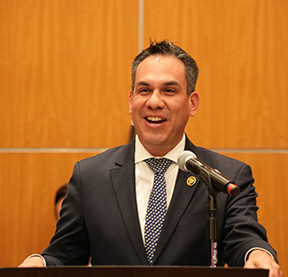
John’s spirited oration was interrupted by President Riccobono with the news that representative Pete Aguilar, the vice chairman of the Democratic Caucus representing the Thirty-First District from California, was present. He has been a true friend since his election in 2015 and was present at our first congressional reception. Representative Aguilar cares a lot about issues involving blind people, and one reason may be that his grandfather was a blind vendor and, at the age of twelve, Pete worked in his grandfather’s vending facility. In the audience was Max Duarte, a retired vendor, who worked at the same facility. The congressman assured Max that, if he found the conditions in the facility he inherited anything less than pristine, the congressman is certain that his grandfather would say it was Pete’s fault. Because of his background, the congressman is a true believer in the Randolph-Sheppard program and in the belief of blind people to become entrepreneurs. He continues to push all of the federal departments he can to expand job opportunities, because he knows that the productivity of blind people is good for us and good for the American economy.
When John Paré again took the mike, he called on Jeff Kaloc to talk about H.R. 5813 and S. 2984, the Website and Software Application Accessibility Act. Jeff reminded us that the Congress gets seen by many groups every day, and all of them believe that their bills are important. We have to show how critical it is that we be able to have independent access to our medical records, financial statements, credit card information, Social Security numbers, and be able to book transportation or navigate a website portal to find housing. Tony Coelho, the father of the Americans with Disabilities Act and Newt Gingrich, Speaker of the House from 1995 to 1999, published an article on the Website and Software Application Accessibility Act. They said, and I quote, "It's about time that business embraced digital accessibility as a key brand imperative and took ownership of the role that web and software design play in employee and customer experience. People with disabilities should be able to universally access technology even as new innovations occur."
Dr. Justin Young came to the microphone to address the Medical Device Nonvisual Accessibility Act. We are delighted that this bill has been introduced in the House and the Senate, the bill numbers being H.R. 1328 and S. 3621. As you will see in the fact sheet, this bill covers Class II and Class III medical devices, and in those rare cases in which making a device accessible would represent a fundamental change to what it does or how it is used, there are provisions to apply to the Food and Drug Administration for an exemption. Few things are more important than being able to use the tools required to keep us well, and Justin encouraged our strong support for this legislation.
Jesse Shirek was next introduced to talk about the Blind Americans Return to Work Act. He began by asking the crowd how many had at some point been the recipient of Social Security Disability Insurance, and most of the people in the room replied affirmatively. Jesse detailed the risks in seeking employment and the dangers in the earnings cliff which keep many people from working up to their potential. The fact sheet that appears later has some astonishing percentages about people who do not seek work and the number of working blind people who turn down promotions and raises. “While we simultaneously strain our muscles to cling to the edge of the earnings cliff, we hold back from living our dreams.”
Kyle Walls handles the logistics for the legislative part of the seminar, and he was invited for a few remarks. Here is some of what he said:
“For those of you who were in the Affiliate Presidents and Legislative Directors meeting this morning, you heard John tell you about his four P’s for a perfect meeting: be polite, be professional, be persuasive, and be persistent. Well, after working with the man for eight years, the idea of having a mnemonic that’s easy to remember has rubbed off on me. Except, I have five P’s, because that’s what I can count on one hand.
My P’s are proper planning prevents poor performance, and as you’ve probably presumed, it takes a prodigious amount of planning and preparation in order to perform at the premier level that people have come to expect from a program produced by a party as prestigious and profoundly life-altering as the predominant transformative membership and advocacy organization of blind Americans, the National Federation of the Blind. And while our production may not be perfect, considering some of the problems and pitfalls that we have encountered along this path, I propose that we have put together a particularly pleasant presentation for our proud participants this evening. But, please pardon my persistent prattling and let us proceed with our previously proclaimed topic: Logistics.” Kyle is quite a good writer, and after this fantastic introduction, he made remarks that were helpful to those who would be visiting the Capitol on Tuesday, Wednesday, and Thursday.
Denise Avant gave us an update on the efforts of the Membership Committee which she chairs along with Tarik Williams. She talked briefly about the onboarding process for new members, the ability for each of us to update our own profile, and the ability of chapters and affiliates to determine those who are members of their chapter. Anyone needing more information should contact Danielle McCann by writing to [email protected] or by calling her at 410-659-9314, extension 2421.
Because of the workload of Ryan Strunk, the President has appointed Marilyn Green to act as our co-chair of the Preauthorized Contribution Program. Marilyn acknowledged both Scott LaBarre and Ryan Strunk, and she is flattered to take on the work they pursued in helping this program to fund our movement. She highlighted a number of programs that are made possible through the PAC Plan and encouraged everyone who can to join either by calling 877-632-2772 or by going to nfb.org/pac. We stand ready to answer any questions you have and appreciate the commitment your participation in the program demonstrates.
The Performing Arts Division made an announcement directed at those interested in songwriting. “Do you want to contribute to new music for the National Federation of the Blind? Then please consider entering the 2024 Federation Song Contest. Submit your material by March 15th, 2024. Both music and lyrics are welcome. Top contestants will be invited to a songwriting retreat in Baltimore this summer. All information can be found on our website, NFBPAD.org.”
Patti Chang spoke briefly about the Dream Makers Circle and the ways that members and those who are friends of members can make donations to the Federation when they pass. To learn about all of the options, contact Patty at 410-659-9314, extension 2422, or write to her at [email protected].
After several announcements about activities later in the evening, President Riccobono adjourned the Great Gathering-In and the rooms emptied as people went to find dinner and plan their next three days on the Hill.
The Congressional Reception
Since 2015, every in-person Washington Seminar has featured a Congressional reception. This one occurred in the Cannon Caucus Room located in the Cannon House Office Building. The event was sponsored by Waymo, a company actively working on the development of an autonomous vehicle that riders, including blind people, will be able to direct. The spread they provided was fantastic for those wanting food and a bit of drink.
This year we were greeted by fourteen members of Congress who came to make short presentations and to encourage us to bring the message of the dreams, desires, and needs of the blind to Congress. They believe that there is no progress without “showing up,” and they know this is the one thing that the National Federation of the Blind does without question. The first presenter was Senator Roger Wilson of Kansas. Not only is he impressed with the work we do as an organization, but he is also very proud of the Kansas School for the Blind for all of the work they do in educating preschool children, those in grades K-12, and the focus on transition that is becoming ever more important in their programming. He is also proud of Envision, a place of industrial employment for people who are blind that is located in Wichita, Kansas. Senator Wilson understands the need for ensuring that blind people have access to digital equipment because it is now the foundation of so much of what we do in the workaday world in which we live. The senator was also a cosponsor of the Able Age Adjustment Act that expands the number of people who can participate in the establishment of savings accounts without terminating their ability to receive Supplemental Security Income. The senator left us with this message: “If you can just leave with those members of Congress one message, let it be that we don't want our disability to define who we are, and Congress can help make a difference.”
The next member of Congress to address us happens to be a cosponsor of the Medical Device Non-Visual Accessibility Act and a cosponsor of the Access Technology Affordability Act. Representative John Rutherford of Florida always appreciates meeting with us because he has a special interest in blind people as a result of having a blind roommate in college. “I happen to live in the district for the Florida School for the Deaf and Blind … I've met with many of them [administrators] over the years, and by focusing on improvements to accessible education and equipping our workforce for blind and low vision professionals, we can tap into a reservoir of workforce-ready talent who is already out there and ready to go. In fact, I've been working hard to make the United States Congress a competitive environment for blind and visually impaired individuals to work and expand their skills. I worked with Gallaudet University to host a deaf and blind student in my office, a fellow named James, who came in, worked as a congressional intern, and I can tell you we had some amazing times together with James. So, one of the things that I learned was that the Congressional Administrative Office had absolutely nothing to assist James in doing his job in my office. So we've since worked on that, and there's now some equipment that is available for those who may want to have internships within a congressional office. … Thank you for all that you do in the Federation to empower blind individuals through your programs, your services, your resources, and by building a community that creates a true future filled with opportunities. I'm so proud to partner with you. Thank you and God bless.”
Representative Jim Clyburn of South Carolina was next to address the assembly. He prides himself on staying in touch with the National Federation of the Blind and other entities that operate in South Carolina. He believes that his work prior to coming to Congress has had a great deal to do with shaping his opinions about what accessibility should be, and these experiences motivate him to make America, “which is already the greatest nation in the world,” the best that it can be. … “I'll close with telling you that I call my memoirs published back in 2012 Blessed Experiences, and I say in the introduction to that book that all of my experiences have not been pleasant, but I've considered all of them to be blessings. And among those blessed experiences have been working with people like you—people with certain experiences that I have not had, and using the experiences that I have had to bring our backgrounds—our day-to-day lives together—to make for a better existence for all of us.”
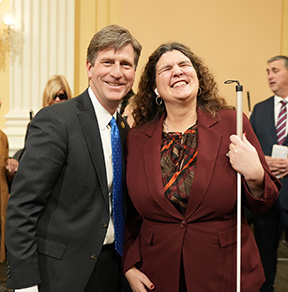 Representative Greg Stanton of Arizona was the next to take the microphone and started by saying:
Thank you so much. Thank you. Good evening, everyone. The Federation has taken over Capitol Hill with five-hundred great advocates. I saw you everywhere today, up and down the Capitol. … I serve on the Transportation and Infrastructure Committee. … Your advocacy matters because just today, in partnership with this Federation, in partnership with my Republican colleague, Representative Brian Mast, I was proud to introduce the Autonomous Vehicle Accessibility Act. My home state of Arizona is a pioneer in AV technology, with more than a dozen companies there testing driverless vehicles on our streets, but we have to be more innovative. We have to be more mindful and be more inclusive. We need to make sure everyone feels empowered and safe to ride in AVs. Our bill ensures that America's people with disabilities have access to AVs—ride-hail vehicles specifically get rid of any discrimination against passengers that may not have a driver's license if an AV is pulled over. If an AV is pulled over or happens to have an issue with the car, the passenger would not face liability simply because they do not possess a driver's license. The bill also requires the Secretary of Transportation to study infrastructure where there may be barriers to people with disabilities using AV vehicles. We want to make sure that these AVs are accessible to everyone, whenever and wherever you, the community, want to go. Making our transportation network more accessible is a top priority of mine.
Representative Nathaniel Moran from Northeast Texas was the next congressman to bring us remarks. He said, “I want to tell you thank you for your advocacy. Since 1940, the National Federation of the Blind, as you know, has been the advocacy group for those that are blind. Over 50,000 members—you make a difference, and if you didn't know it, I want to tell you. You make a difference when we see you in the halls, when we hear you in our offices, when we talk to you and engage with you. … The advocacy work that you do here matters. It changes our positions, it keeps us educated, and it keeps us in touch with what's important to you. I know that your mission statement is that we are changing what it means to be blind. Well, I can tell you, I'm trying to change what it means to be a member of Congress. (laughter) And I am thankful that I can stand side-by-side with each one of you. I want to say thank you, especially also to folks like Norma Crosby, the president of the Texas Board of Directors, and Raul Gallegos and Dr. Kimberly Aguilar and Luis Amar and Lara Sowell. Thank you all for the work that you're doing in my home state of Texas because you are making a difference there. So keep it up, be encouraged, because your work matters, your work influences what we think and what we do here in Washington, DC, and I wish you Godspeed in your journey ahead.”
President Riccobono said,
Representative John Sarbanes from Maryland was planning to be here. He sends his regrets that he cannot. He has been a great friend of the National Federation of the Blind. His district used to cover our national office, but now doesn't. But he's been a tremendous advocate. He's, of course, a sponsor of the Website and Software Applications Accessibility Act. He is a cosponsor on our Medical Devices Act. He's cosponsor on access technology. He's cosponsor on the Transformation To Competitive Employment Act. So, if you happen to come across Congressman Sarbanes on the Hill later this week, please thank him for his support of the National Federation of the Blind.
Representative Alma Adams from North Carolina came to greet the National Federation of the Blind. “I am Congresswoman Alma Adams, and I represent the Twelfth Congressional District, which covers Mecklenburg County and Cabarrus in North Carolina. I bring you greetings today from 700,000 citizens I have the privilege of representing, and some of them are probably in here tonight. I'm also honored to join you for the National Federation of the Blind's Congressional Reception. Thank you for coming to your US Capitol, and thank you so much to the NFB for inviting me to speak today and for the excellent reception.
“I am so grateful for the opportunity to learn more about your federal policy initiatives, the work that you're doing in the community, and how we in Congress can support that work. As a member of the Education and Workforce Committee and ranking member of Workforce Protection Subcommittee, much of my work intersects with your legislative priorities. There are so many ways that we need to work together: to improve accessibility in the workforce, in educational institutions, and in our healthcare systems. So, thank you to the advocates and for all of you and for your tireless work to increase accessibility and to combat the daily discrimination that many Americans face because of their disabilities. Let us continue to work hard because the community can only grow great when old men and old women plant trees under which we know we'll never sit. I'm going to continue to plant those seeds and hope that we'll have an opportunity to continue to watch them grow. Thank you so much. God bless.”
Representative Tim Burchett of Tennessee was next to bring remarks. He believes in our issues because his career found him saving vending facility operations in Tennessee and brought him face-to-face with one of his first battles in the legislature. He believes that we all have a right to work and the dignity it provides, and he pledges to be on our side as we work to become productive citizens of this country. “Washington will do the right thing if you make us, so why don’t y’all make us? Thank you and go get’em, brother!”
Representative Gregory Murphy of North Carolina was the next to address us. This gentleman and the one previous spoke with southern accents, each making fun of others whom we might find hard to understand and offering to translate. The Congressman has been a practicing physician for thirty-five years and sees one of his roles in Congress being to act as a doctor and highlight his expertise when medical issues are being discussed. He has great hopes for the technology that may emerge from artificial intelligence and has great admiration for our ability to both deal with circumstances as we find them and plan for the future we want. He says he draws great energy from our advocacy and looks forward to our continued work together.
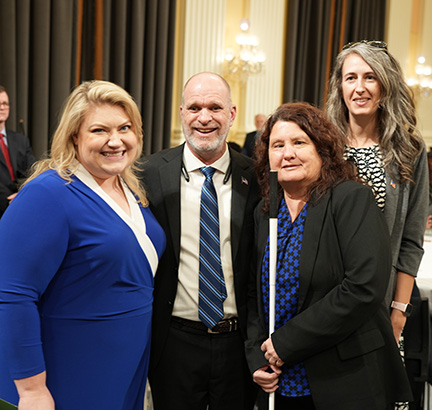 Representative Kat Cammack of Florida was the next congresswoman to the microphone. “I just wanted to stop by and say thank you. The work that you do is more meaningful than you can imagine. No one, but no one works harder than your Federation, and your stories are inspiring. You're inspiring teams, you're inspiring members of Congress, you are inspiring a movement to tackle new technologies to make this country and our systems more accessible. We are very much dedicated to this work because of you, because of your stories and your advocacy. So I just want to say how grateful I am to be here and really thank you for the work that you're doing to ensure that opportunities are available for all. I'm excited for your time here on Capitol Hill. It is more than just a day. It is more than just a week. Your presence will be felt for many, many days, weeks, and years to come.”
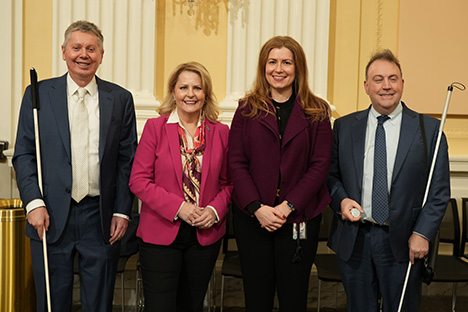 President Riccobono temporarily interrupted the presentations by members of Congress to talk a bit about the twenty years of the Jernigan Institute and, in particular, the work we have done to bring closer the day when blind people can independently operate vehicles on our own. Michelle Peacock, who previously addressed our national convention, came to the podium to make some remarks on behalf of our reception sponsor. She said that Waymo is making great progress in putting vehicles on the road in various cities around the country. A cornerstone of their development philosophy is accessibility to all, and the National Federation of the Blind has been the premier organization in their work. Obviously, we need a way to tell the car where we want to go, but there are many other steps involved. What techniques can we use in finding the car? What cues should the car give us as it traverses the route we have told it to travel? Above and beyond all of the technical issues, we have to deal with getting laws and regulations that support these vehicles being driven by people who do not have a driver’s license. The introduction of the bill noted earlier, H.R. 7126, is a tremendous start on this process. When Miss Peacock ended her presentation, President Riccobono noted that we could certainly use a couple of her cars during convention in Orlando.
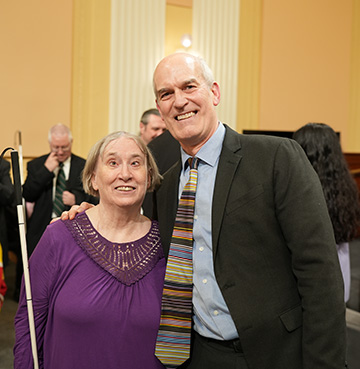 Returning to members of Congress, President Riccobono introduced a man who is responsible for cosponsoring the Medical Device Nonvisual Accessibility Act and the Access Technology Affordability Act. With these words and a warm welcome, Representative Rick Larsen of Washington was introduced. He is very proud of his service on the House Transportation Committee and believes that recent legislation has done a great deal to improve the transportation infrastructure in our country. Airports are being upgraded to incorporate wayfinding technology, and more emphasis is being placed on the treatment of specialized devices used for people with mobility disabilities. The Congressman is well aware of our difficulty in dealing with the Department of Transportation as we travel with our guide dogs, and he vows that this is an issue that will continue to get congressional scrutiny. He also understands how critical it is to have kiosks we can use in public places, as well as websites and applications that will allow us to take advantage of all the options sighted people have when traveling. The Congressman says that the House has passed a reauthorization for the Department of Transportation that includes very strong provisions for people with disabilities, and his hope is that we will press the Senate to see that similarly strong provisions come out of that body.
Representative Rashida Tlaib of Michigan is a cosponsor of our Medical Device Nonvisual Accessibility Act, and she was the next congressperson to address the crowd. Congresswoman Tlaib says that we were one of the first organizations to visit her when she was elected and have been one of the most consistent advocates in communicating our needs. She understands the disparity we face in being unemployed and underemployed. She understands the role that harsh rules implementing Supplemental Security Income and Social Security Disability Insurance play in keeping us out of the workforce, and she knows the problems that are caused by the economic disparity between those who are employed, underemployed, and unemployed. She also understands that many of us are employed and underpaid because the minimum wage does not apply to all of us who are blind. She believes strongly in better enforcement of the Americans with Disabilities Act, in the work we are doing to change the public perception of those who do the hiring, and the role of the federal government in providing assistance as we do this work. She believes we need more and safer transportation, and she observes that if the federal government can find money for unending wars, certainly there must be money to help our blind citizens.
President Riccobono began the introduction of our next honored guest in this way: “This next gentleman is also from Texas, and though I didn’t do an official count, I believe it would be easier to count the bills he’s not a part of than those on which he has joined us. I think he's a cosponsor on all of our bills in the National Federation of the Blind, although there is one, which is the Websites and Software Applications Accessibility Act, where he's the lead sponsor. We've had a longstanding relationship with him over the years. We really appreciate his leadership and how he listens to the priorities of the organized blind movement. Please welcome a very longtime friend of mine and a friend of the National Federation of the Blind from the Seventeenth District of Texas. Here's Representative Pete Sessions.”
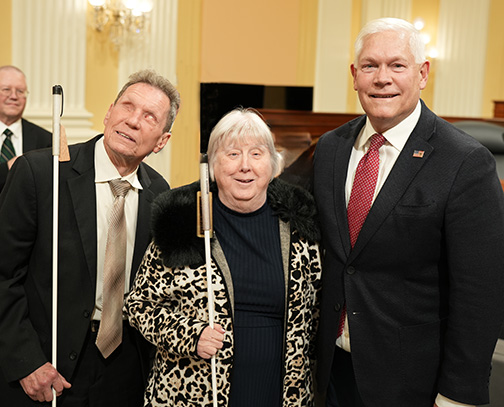 Representative Sessions has a son with retinal problems but who has nevertheless dealt with this issue. After parking his truck twelve years ago and going to college, he has now become a medical doctor who is married with one brand-new baby daughter. In addition to all of the work that Representative Sessions does for us, he is highly involved in retina research as one can easily understand this passion. He says, “So please know this, that there are people who place great value not only on you, not only on your story, not only on every one of you in the group, but on the valuable asset and resource that you are for our country. You are people who overcome challenges, who live with them every day. You don't sit around and gripe or moan or feel sorry for yourself. You're well-adjusted people who care deeply about each other, and it is an amazing thing to watch each of you individually and collectively. … We are proud of you, that you have taken time to come and meet your member of Congress. It's my real belief that your member of Congress heard you, and we're going to follow up, and we're going to make progress. And I'm very proud of you and I'm going to tell you I love you. So for those of you who will leave here and go back home, I would like for you to say that you went to Washington and that people did listen, people do care, and know that we will make the progress. May God be with you.”
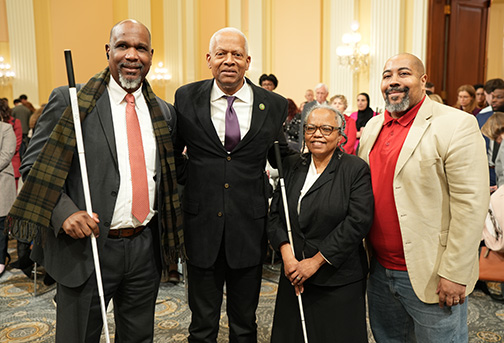 Representative Hank Johnson representing the state of Georgia began by recognizing two people in the audience. One was Michael Armstrong, the first black chairman of the blind vendors in Georgia and a man the Congressman credits with helping to get him elected in 2006. The other was the president of our Georgia affiliate, Dorothy Griffin. “I'm happy to cosponsor the Websites and Software Applications Accessibility Act of 2023, a long overdue measure that would establish clear and enforceable accessibility standards, because without the proper action and protections that guarantee rights to all blind people, the principles of our nation are nothing more than meaningless words.” The Congressman said that our advocacy was key in the functioning of our government, and he pledges to continue to be a strong ally who respects those elected by the blind to speak for the blind.
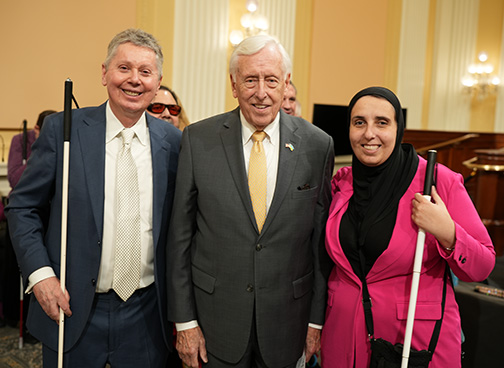 Our last presenter of the night was greeted with tremendous admiration and respect for all that he has done to help the National Federation of the Blind. Representative Steny Hoyer of Maryland was introduced by President Riccobono as a man with whom we have had a relationship for more than forty years. He is a man who has always shown up, and he says this is because we have always shown up. In his spirited conversation, here are some of the things the Congressman said: “Democracy works better when people who have experiences that are impacted by legislation talk to members of Congress. … One person can make a difference as how a member votes if a member believes that what has been said to them by that individual is accurate and is in need of being addressed. … I said all of you have abilities. If you're shut out, America loses. You may lose, but America loses if we do not have full inclusion of everybody using their skills, their brains, their enterprise in making us a better country. John Kennedy gave an inaugural speech and in it he said, ‘The energy, the faith we bring to this endeavor, will light our country and all who serve it, and the glow from that fire can truly light the world.’ The energy and faith and devotion you brought to Congress this day and that you bring every day will light our country and make it better and more inclusive. God bless you.”
With a few concluding remarks by President Riccobono thanking us for our time and urging greater success on the Hill in the days to come, the meeting was adjourned.
In the last formal meeting of the Washington Seminar, many of us met once again at the Holiday Inn Capitol for a wrap-up. Reports of progress were given from many states, and a number of us who were on Capitol Hill shared strategies for moving our senators and representatives to a place of understanding they had not been before. The fact that we make a difference when we travel to DC is made clear in the numbers that result. On the Websites and Software Applications Accessibility Act, we came with three sponsors and left with twenty-three. The Medical Device Nonvisual Accessibility Act had fifty-three cosponsors when we came and increased by nineteen, to put the count at seventy-two. For several years one of our priorities has been the Accessible Technology Affordability Act. Though it was not one of the highlighted issues this year, we mentioned it whenever time allowed, and again the numbers are impressive. The bill had seventy-four sponsors in the House, and at the time of this writing it now has eighty-one. Support in the Senate also increased by one, so we now have eighteen senators on board. Also mentioned but not figuring prominently in our presentations was the Transformation to Competitive Integrated Employment Act. Its support in the House also increased by one and now stands at twenty-eight.
Although we are nearing the end of this article, our work on all of this legislation is not even close to being complete. The secret in the sauce is that much of our success is found in what we do once we come back home. We must continue to emphasize that John Paré and his crew are our representatives in DC, and we must funnel to them or answer ourselves the questions we got while on Capitol Hill. Our presence is impressive, but our follow-up is even more so. We are in this for the long haul, and we expect our congressmen and women to be the same. While everyone involved is inspired, the Congress because we came, and our members encouraged by getting to deal with people who exercise the levers of power, the real objective is to make the changes in laws, regulations, and attitudes that will bring us ever closer to living the integrated lives we want. Getting the ball in the red zone is not enough: we will settle for nothing less than a touchdown that leads us to victory.