Blind Courtesy
by Marc Maurer
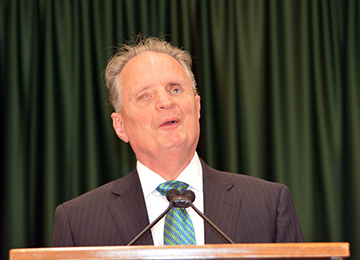 From the Editor: At the 2024 Maryland State Convention, former state presidents of the affiliate were asked to offer reflections for the convention. Here are the ones that Past President Maurer offered. They remind me very much of the comments we have made about "The Day After Civil Rights” and what the end goal of all the fighting we do for equal treatment in our society is and where we hope to be at the end of the day.
Sometimes simple changes make profound differences. This thought came to mind recently when I was asked to make a presentation about the National Federation of the Blind to a state convention. I wondered what I could say that had not already been covered multiple times by dozens of others. It occurred to me that the National Federation of the Blind creates opportunity for blind people (at least in part) by teaching courtesy.
The way I look at it, courtesy consists of giving to somebody else something that you would like to have yourself—and then feeling good about it. Often the thing you give is your time. Sometimes it is a product, but often it is your skill or your concern. Everybody would recognize that if there are two cookies and three people, it is courteous to let others have them. However, courtesy also occurs when there is time to do only one thing, and the person offering courtesy agrees to let it be what somebody else wants to do.
Courtesy is at least as much a habit of mind as it is a skill. One of the ways that we create advantages for our own members is by teaching this habit of mind.
Our society sometimes believes that blind people have nothing to give. It is not that blind people are a nullity; our lives demand that we have interaction with others. However, the position that we occupy is frequently thought to be that of taking what other people have to give—we are the objects of charity. Our neediness can be supplied from other sources if the people we meet feel inclined to grant us the products, services, or time that we might need. However, this is not an interaction that ordinarily creates friendship. Relationships that develop friendship and beyond require that those who are in them recognize and cherish the value that the other party in the relationship has. Those who possess the opinion that blind people have nothing to give do not often recognize the value that is present in the lives of the blind. However, when we practice courtesy, we give something to somebody else. This courtesy demands that those who get it must confront the reality of value in the lives of those who give.
Of the types of commentary that exist with respect to the blind, it seems to me that two of them have major effect upon the notion that blind people are courteous. First, if blind people have nothing to give, how can they be courteous? They have nothing to be courteous with. In fact, why think about it at all? People who can't be courteous can be written off.
Then, in certain segments of social life blind people are told repeatedly that they are entitled. What is it that they are entitled to get? The list can be extensive. My own presentations have often contained detailed descriptions of what I believe blind people are entitled to get. However, being entitled occurs only in a certain context. Those who want to receive must be willing to give.
To become aware of a proper understanding of the position of blind people in our culture, it is necessary for blind people to know how to give something to others. Sometimes those receiving courtesy from blind people are unaware that they would like to have it. Have you held a door open for sighted people when you were entering a building? Has it been difficult to have your courtesy accepted? If blind people calmly acquiesce in the thought that they may receive courtesy but not give it, this entrenches in cultural practice the inferior position of the blind and prevents equality and independence. To change this, we must offer courtesy.
The habit of many blind people to accept from others what they are willing to give without thinking about the requirement that courtesy be returned creates a barrier to the kind of independence that can only be created by mutual understanding.
When considering what people receive for the services they provide, it is evident that they get paid most of the time for what they give to somebody else. Actors provide entertainment; football players do the same by smashing into each other with incredible force. The CEOs of major corporations produce products that people want and create wealth for the investors. If blind people are going to get paid, they must provide something that others want. Courtesy is the beginning of this process, and the habit of courtesy creates the kind of independence that we can use to make our future bright with promise.