How I Became a Blind Home Owner in Fifty Short Days
by Daniel Garcia
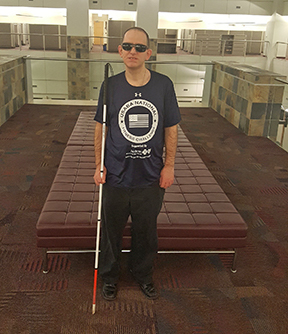 From the Editor: Buying one’s first home is a significant experience for anyone. The thought of the money one is committing to pay and the number of signatures required can sometimes feel overwhelming. Blindness sometimes adds to this when people question our ability to sign documents and even express reservations about our ability to live independently and maintain the space we want to buy.
Daniel Garcia is one of the kindest and most energetic people I know. It is wonderful to see him celebrate the purchase of a house and even more wonderful that he shares his experience with us. Here is what he says:
On February 26, 2024, I was walking into a medical appointment with my primary care doctor, and I received an email message. When I checked this message, I was annoyed about the fact that my apartment complex was informing me that they would not renew my lease because they are in the process of remodeling. They offered me the choice to move into another apartment, but I decided right there and then that I would not go through the trouble of moving just to swap apartments. I decided then that I needed to buy a house, even if it was not on my original timetable. Needless to say, that when they took my blood pressure that day, it was quite high.
The next day, I spoke with my affiliate president, Shelia Wright, who lives only a couple of miles from me. She recommended a realtor, Paul, who used to be her neighbor who is very familiar with the “Northland,” the part of Kansas City, Missouri, north of the Missouri River where I wanted to purchase a home. I called Paul on Thursday, February 29, right before the live Presidential Release was about to start, and we agreed to meet on Thursday, March 7, to start the home-buying process. On Friday, March 1, I contacted the credit union that I bank with and started the process of getting preapproved for a loan. Over the weekend, I worked on getting the requisite documents, and on March 5, I had been preapproved for a loan.
On March 7, I met with Paul, and he explained how the home-buying process would work. He also asked me the type of home I was looking to buy. The next day he sent me some listings. Two of these listings interested me very much, and Paul arranged for me to go see these properties on Sunday, March 9. I forwarded the email message with the listings to my friends and family to have them look at these houses. They told me that both looked wonderful and gave me descriptions of various features of the houses. I took along my friend and chapter treasurer Jeff Giffen and his wife Kathy to see these houses. Kathy is sighted, and I wanted her there to give me an opinion of how these houses look and to make sure there were no glaring issues such as structural damage, peeling paint, etc. Of course, the house inspector would later on give a more detailed report if I decided to make an offer. I immediately fell in love with the first house we toured. The second house seemed cramped. Though people kept telling me not to bid on the first house I saw, I felt in my gut that this was the right house for me. There was a question about whether the house was in the ADA service area which would allow me to continue to get access to Kansas City’s complementary paratransit service. When I first inquired that day, I was informed that this property was not in the service area. On Monday I contacted various individuals in the Kansas City Area Transit Authority and got a confirmation in writing that this property was indeed in the service area. I had put in an offer with the provision that I would find out this crucial piece of information. On Wednesday, March 13, there was a house inspection which was positive, so I gave Paul the go-ahead to go forward with purchasing the home.
Let me digress at this point to provide some important information to help put things in context. I had originally moved to Kansas City on March 3, 2014, and started working for the Internal Revenue Service on March 10. I have been living in the same apartment since then, and during the first few years, my goal was to pay off my student loans, which I finally managed to do on April 16, 2021. After this, I finally decided to open an ABLE account, and I started to put as much money into it as I could. ABLE Accounts are a wonderful vehicle for blind people and people with disabilities to put money away and then take tax-free distributions for any purchase related to one’s disability. These tax advantage accounts were created by the passage of the Stephen Beck Jr, Achieving a Better Life Experience Act of 2014. Also, since I began working for the federal government, I had started to put money away on my Thrift Savings Plan (TSP), which is the equivalent of the private sector 401(k) plan. This means that as I was celebrating my tenth anniversary of my move to Kansas City and my career with the IRS, I had to start planning, on an emergency basis, to move out of this apartment and into a house. One more thing to keep in mind is that the Kansas City Chapter (of which I am currently the president) and the Ivanhoe Chapter of the NFB of Missouri would be hosting the sixty-second Annual Convention of the National Federation of the Blind of Missouri which would be held from April 11 to April 14. Needless to say that this time period has been very stressful for me.
Once I gave Paul the go-ahead to move forward, I started to line up the financing for the 20 percent down payment I wanted to put down. I had wanted to make such a large down payment to avoid having to pay the fee for private mortgage insurance (PMI). I made arrangements to borrow from my TSP and to withdraw money from my ABLE account. I had the money in my bank account the next week. All that was needed now was to wait on the closing, which was scheduled for April 9.
My mortgage officer Tanya said that everything was running smoothly and not to worry. She also said that the underwriter needed a statement from my ABLE account to ensure that the money that I was putting down is coming from a legitimate source. These statements are quarterly, and I was first advised I would receive it during the first week of April. I had also requested an alternative document from them in case the statements did not arrive. This alternative document did not contain the right information. So, on April 8, while the rest of the country was captivated by the solar eclipse, I again tried to get some alternative documents while waiting for the quarterly statements. By now we had decided that the closing needed to be moved to April 16, which would be the third anniversary of me paying off my student loans. Tanya made arrangements to get the loan approved without the quarterly statements, but I did send them to her for the principle of the thing on Monday morning after our state convention. I closed on the house on April 16. I have never written such a large check in my life, and I hope never to have to do the same again.
Paul went out of his way to help me purchase this house. He never doubted that as a blind person I could own a home. He was also thrilled to have me as his first blind customer. Considering the fact that 70 percent of blind people are unemployed and that some of the other 30 percent are underemployed or might be earning below the minimum wage, I consider myself lucky that I was able to go out and buy a house on an emergency basis and that I was able to make such a huge down payment. Had I waited one or two more years to save more money, I may not have been able to purchase a house for the price I did in the quiet Northland neighborhood where my house is. Although I was angry at first, I think my apartment complex did me a huge favor by pushing me out of my apartment now. I thought that when I started my house-buying process, I would have much trouble finding a house near the bus line and that I might have to get into a bidding war with individuals who did not care at all about having a bus line nearby.
When I moved to Kansas City in 2014, I took it for granted that I was able to rent an apartment and get insurance. What I know now is that this would not have been possible before the passage of the White Cane Laws. I am sure that buying a house before the passage of such laws would not have been as easy since there were no anti-discrimination laws in those days and the underwriter would have concluded that it would have been a risk to loan such a large amount of money to a blind person.
I had to sign several documents while applying for the loan and for the contract to purchase the home and the various amendments. This process was generally very accessible. The one place I needed help was with the borrower certification. This requires you to print out a paper document, sign it, scan it, and upload it to the portal again. I was able to get remote help from my family by doing a FaceTime call and by using a signature guide. The portal to sign the paperwork to authorize the inspection was not fully accessible because it required me to draw my signature in the screen, so Paul had to bring the paper copy which I signed onsite the day of the inspection. I never had any doubts about what I was signing because the documents are in PDF format which were well-tagged. Even the inspection authorization was readable, though I could not sign it online. As time goes by, more and more entities are accepting electronic signatures, so it was not an issue for me to provide electronic signatures. During the day of the closing, I had to physically put my initials or sign various documents, but I had already reviewed them, so I knew exactly what I was signing and could ask questions about any of them.
Many blind people I know at work and in the Federation are already homeowners, so I know I have a network of support in case I run into any problems. This is in addition to Paul saying that we will keep in touch and that he can recommend people who can help with home maintenance. Being blind does not prevent us from buying and maintaining a house. Buying a house is a scary undertaking for anyone, regardless of eyesight.
Ever since I began telling people that I would eventually buy a house someday, people kept telling me that it would be difficult for me to maintain a house because I am blind. I believe that it is no more difficult as a blind person to maintain a house than a sighted person. Not all sighted people have the talent and ability to fix things around the house, and many times they hire people to take care of them. Being blind does not prevent you from using tools and from having the ability to fix up things around the house. At the beginning, I am sure that I will hire more people to help me fix things, and as time goes by, I am sure that I will learn to fix some things myself with the proper alternatives techniques that a blind person uses.
Make sure that when you embark on your own house-buying journey, you get the right realtor and that you reach out to your Federation family for support. I am grateful for all the support I have received over the past fifty days.