Graduating from the Colorado Center for the Blind Means More Than Skills
by Jeremy Smith
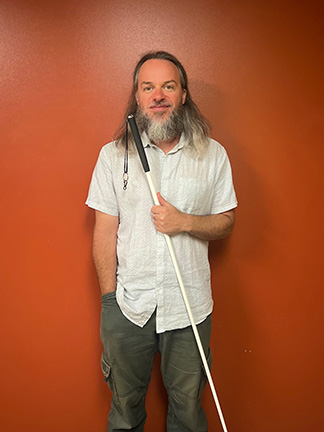 From the Editor: Jeremy Smith is a recent graduate of the Colorado Center for the Blind (CCB), one of the training centers affiliated with the National Federation of the Blind. At his graduation ceremony, he read a letter to his fellow students. He was generous in agreeing that it could be shared with me for possible publication and gracious in expanding upon the original piece when I asked him to give our readers more context. Here, then, is Jeremy’s adapted version of the thoughts that he shared with the CCB students and staff:
I was possibly the most reluctant student to ever walk through the doors at 2233 West Shepperd Avenue. I knew when I left Kentucky for the Colorado Center for the Blind (CCB) on January 8, 2025, that the trip would be costly. It was. Since being in Colorado, I’ve parted from my long-time partner. The next time I set foot in my house, it will likely be to pack my things and leave forever. I loved that little house. What’s more, I don’t think I’ll ever call Kentucky home again. My whole life I’ve tried to love a place that could never love me in return, not the way I needed. It’s time to move on.
I have retinitis pigmentosa. My eyesight has been vanishing bit by bit since I was ten years old, though it wasn’t until my early forties when genetic testing finally provided a proper diagnosis. As a kid, what I needed was comfort, an honest explanation of what was happening to me and what it might mean for the future. I received none of this. What I had was a void, a mystery filled with every source of evil a vivid young imagination could produce. In short, I was deeply traumatized by the lack of emotional support. No one was there for me, and so I’ve spent my entire life feeling abandoned, believing my eyesight was something to hide. I’ve been exploring this terrain for years. I wrote a 259-page yet-to-be-published memoir on the many ways I struggled to adapt to my sight loss and what mental health professionals now recognize as classic symptoms of Complex Post Traumatic Stress Disorder (CPTSD).
Searching for the answers I needed early in life, I became a therapist. Today, as a middle-aged man, I still seek safety. I still lose myself in the swirl of stress and all those false gods—the things I thought would bring me peace, validation, and a sense of security. Accomplishment will not do this. Logic and reason, intellect and competence, our presentation to the world will not do this. Until the self is healed, not even the love of a partner or children will overcome the trauma that dictates our response to everyday events. I’m not in the habit of making big blanket statements about the human condition, but I stand by this one both personally and professionally. Our highest human potential cannot be realized while this type of wound goes untreated.
As a CCB graduate, I have hard skills now, useful, tangible ways of getting around and taking care of business: cane skills, mass transit, Braille, access technology, screen readers, and AI. Hell, I’m even in better shape, and I was never not “in shape.” But these are not what I value most about my time in Colorado.
In the decades it has taken for my sight to disappear, my confidence went with it—believing in me, trusting myself. All the ways we might think well of ourselves leaked and flowed away like a punctured water balloon. The person I wanted to be drifted out of sight long ago. But since being in Colorado, I have taken on a mission: restore the man I’ve believed I could be.
I did my own counseling to heal that original wound, to purge my central nervous system of the 380,000 volts that have lived in me, wild and unpredictable. Like downed power lines, my emotions have been dysregulated and reactive, thrashing this way and that with every new trigger. The slightest sign of danger would send sparks flying, my mouth spitting a thousand burning embers ready to create more destruction. Since I was a little kid, my body has been poised for a fight. I have no flight response. I advance. I fight. I know this effort has no end. I will be doing this work for as long as I walk this earth. But I’ve come a long way. Hands in my pockets now, I’ve finally taken off the gloves I’ve used to punch my way through the world.
Bless you, Colorado, for realizing that ketamine is more than just an escape from reality. It’s also a tool, medicine to reset and rediscover our truest self. To oversimplify the process, ketamine and other psychedelic medicines allow for greater neuroplasticity, which refers to the brain’s ability to forge new connections and break free of long-standing patterns of thought. This change in me, brought forth from my own hard work, from conversations with professionals and trusted friends, and through a fundamental reprogramming of my brain, has coincided with rediscovering the power of community.
I have known what it’s like to be “in community” over the years. In college, I belonged to a group of good-deed-doers called Students for Appalachia, idealistic young people who fought hard for social justice, for kids in our small town, and for the health of this planet. That community in many ways made me thoughtful. It made me feel like I was part of something, less alone in the world. Community shaped and molded me, but it has been years since I felt at home among a group of people like me. As much as I learned from individual instructors, my primary teacher at CCB was the community.
From a spunky eighteen-year-old, I learned to be truly brave, to go and keep going. To the outside observer, my friend Zoe has no fear. Getting lost is a gift, a chance to find yourself. For Zoe, riding the rails to some remote corner of the Denver Metro means pushing boundaries. It is the exercise of their freedom. For too many blind people, our boundaries are the four walls we live within. Without skills, without the capacity to manage our anxiety, there is no world outside. Zoe reminds me that opportunity is the adventure. To be able to go and do is not a chore. It’s not something else to be angry about. Outside is where the light is. I want to absorb that sun on my face, to fill my heart with it.
At CCB, we generally travel in packs—our travel groups consisting of an instructor and one or two of your classmates. From my travel bros, I learned that the journey will rarely be easy. There are no straight lines when you’re blind. You’ll hit every obstacle—trees, poles, jagged road signs. You might fall down escalators going the wrong direction or cross the street diagonally (very bad). But you can still arrive where you want to go.
In this, the middle stage of my life, I’ve learned to ask for help, to feel no shame, to cry more freely, and to be open, to know that the less desirable parts of me do not spoil the whole. I’ve learned what people can survive, and how positive it is possible to remain. So many of the staff and students at CCB face challenges beyond the loss of their sight. They do so with a grace and poise I can only aspire to. To those who avoid the bitterness and resentment, to you who refuse to hate the sighted world, you are bigger and better for it. We ask the world for grace and patience. We must give the same in return. It is, after all, human nature to take for granted our blessings.
To those who wonder if an Independence Training Program like the one at CCB is right for you, my answer is—maybe. Are you prepared to seize this opportunity? I’m old enough to know that life only affords us so many opportunities to be part of something magical. No one gets a second chance to do something as special as CCB. There is love and belonging to be found here. Though freely offered, it must be earned. Few things are handed to you at CCB. Not everyone will become a close friend. Participants don’t just come from all over the world, but we also come from a million varied situations. We cross the lifespan, socioeconomic status, education, life experience, and identities. But blindness is the great equalizer. To each and every person who dares to accept this mission, anyone who comes to be part of this community and to do this hard work, you have my utmost respect.
Completing the nine-month program at CCB is the hardest work any of us will ever do. Every obstacle you’ve ever faced will return to taunt you. Fear and mistrust, all your anger and anxiety, will be thrown in front of you like a hundred sandwich boards on Main Street. Whack every one with your white cane if you have to and keep moving. Remember the words of a very wise old puppet: Fear is the path to the Dark Side. Only you can stop that momentum.
There are many debates that take place at CCB-—about the virtues of a guide dog, on how to communicate and educate a sighted world that often doesn’t understand our needs or how to offer support. A portion of every day called “Philosophy” is devoted to exploring what it means to live inside this blind wrapper. One such debate is about how we prove our capability to a world that believes we are fundamentally diminished. I return over and over again to this question, and for me it has one answer: We prove what we are capable of by being part of the world, by defiantly engaging, by asking for, or if necessary, demanding space. We must be visible, whether through our advocacy or simply using the bus to commute back and forth to work. Being seen confidently living our lives is essentially shouting a message of freedom from the rooftops.
When you graduate from CCB, the parting gift each of us is given is a bell. They call it the bell of freedom. The message long expressed at CCB is that when one blind person moves through the world with greater freedom, that act helps to liberate the rest of us. Implied in that sentiment is a responsibility to one another. I for one appreciate that message. As a blind community, particularly one that is well trained, we must continue to use our skills. We must carry the torch until the next generation of bellringers leaves with the tools they need to take charge.
To everyone I have encountered along the way at CCB, all of you queens and kings of West Shepperd Avenue, I say thank you. Trade nothing for knowing who you are, for knowing and showing that to the world. Each and every one of us deserves to be seen, heard, and valued. Do this hard work, then go share your light with the world.