The Continued Fight to Protect Section 504 and the Integration Mandate
by Sanho Steele-Louchart
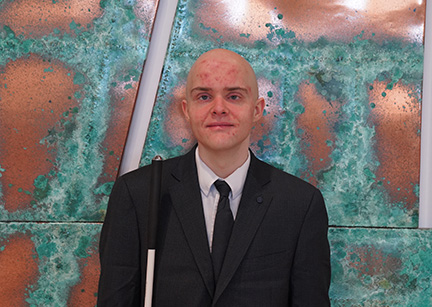 From the Editor: Sanho Steele-Louchart coordinates the legal program of the National Federation of the Blind. In this article, he updates us on a case that, sadly, is still in the court system and threatens our rights and the steps we are taking to counter that threat. Here is his update:
A year ago, the Braille Monitor reported on the case of Texas v. Kennedy, which attacked the Constitutionality of Section 504 of the Rehabilitation Act of 1973 and thus sought to undermine one of the foundations of modern jurisprudence concerning people with disabilities. A year later, the parties and their allegations have changed slightly, but the core is the same. The right of blind people and other people with disabilities to live in our communities is threatened now more than ever.
The good news is that eight states dropped out of Texas v. Kennedy entirely, and the remaining nine (Texas, Alaska, Florida, Indiana, Kansas, Louisiana, Missouri, Montana, and South Dakota) said that they would no longer ask that Section 504 or its enforcement be ruled unconstitutional. The bad news, however, is that those same nine states began to attack Section 504 as it pertains to the integration mandate from the landmark United States Supreme Court decision of Olmstead v. L.C., 527 U.S. 581 (1999). Olmstead’s integration mandate requires that states make specialized services available to us in our local communities. These services include Braille instruction, Orientation and Mobility, activities of daily living, training to use accessible technology, and services from rehabilitation counselors.
The careful reader may note that overturning Olmstead’s integration mandate does not automatically alleviate the government’s need to provide those services. Instead, it would alleviate the government’s need to provide those services in our local communities. The question then becomes: Where might the government provide such services? And therein lies the rub.
The expectation is that blind people and other people with disabilities would travel to specialized centers to receive training in specialized skills. Consider for a moment all of the services we receive in our communities. The vast majority of blind students receive itinerant services in their local schools, colleges, and universities. Blind adults receive services in their homes and workplaces. All of those revolve around Olmstead’s community integration mandate. If the integration mandate is overturned or unenforced, the reality is that funding for these vital, community-based services would disappear, and with them, the services themselves. Importantly, we are not talking about cutting-edge facilities like the Federation’s affiliated training centers or certified Structured Discovery centers. Blind people could instead be forced to attend schools for the blind or state-run rehabilitation centers for everything. It is not inconceivable that many blind people would be forced into long-term care facilities if they were ineligible for training or if that training didn’t lead to their living independently and autonomously at home.
What’s more, the community integration mandate doesn’t stop at the provision of services like Braille, mobility, and technology. There’s also an argument to be made that it applies to access to information. What would happen to government websites, software, and mobile applications? What would happen to a disabled person’s right to request reasonable accommodations and effective communication from local agencies? It’s true that those things should be protected under Title II of the ADA, but remember that the ADA is an extension of Section 504 of the Rehabilitation Act. It is not a great leap to wonder if the overruling of the community integration mandate would dovetail with the rolling back of the DOJ’s Title II rule currently set to go into effect in April 2026.
The National Federation of the Blind is hard at work defending Olmstead, Section 504, and Title II at every level. In February, nine of our affiliate presidents wrote a letter addressing the attorneys general of the remaining plaintiffs. Here is the full text of that letter:
February 12, 2026
Dear Attorneys General Paxton, Cox, Uthmeier, Rokita, Kobach, Murrill, Hanaway, Knudsen, and Jackley:
The National Federation of the Blind, the transformative membership and advocacy organization of blind Americans, urges Attorneys General throughout the United States to acknowledge the full importance of Section 504 of the Rehabilitation Act of 1973 (“Section 504”) and Olmstead v. L.C., 527 U.S. 581 (1999) (“Olmstead”) by immediately withdrawing their support for Texas v. Kennedy and its attacks on the integration mandate in the United States.
On January 23, 2026, the nine remaining plaintiffs in Texas v. Kennedy filed to overturn the Olmstead decision’s community integration mandate, thereby laying the groundwork for the forced institutionalization of disabled people nationwide.
Specifically, the January 23 filing again seeks to declare the entire Section 504 rule as illegal, stop the Department of Health and Human Services (HHS) from enforcing the rule, and stop HHS from instructing states not to take actions which place people with disabilities at “serious risk” of institutionalization. The National Federation of the Blind unequivocally condemns this action and is inherently opposed to the forced institutionalization of people with disabilities or any action which may lead to forced institutionalization.
As the National Federation of the Blind indicated in our letter from February 2025, “The United States has long recognized a disabled person’s value as a student, employee, and a member of the public.” Overturning Olmstead would mean that rather than receiving services in our homes, neighborhood schools, and local communities, we would be forced out of public life entirely and into institutions which neither value nor serve us. Such a move could neither be interpreted as equitable nor as equal treatment under the law. Americans with disabilities are not inferior to our non-disabled peers and we will not be hidden away.
The ultimate goal of the National Federation of the Blind is complete integration of the blind into society. Throughout the course of our eighty-six-year history, the Federation has worked diligently and tirelessly to combat discrimination based on misconceptions and low expectations.
We believe that disabled Americans have the right to receive the education, training, and opportunity required to lead productive lives, and we do not believe that law-abiding people with disabilities who are simply trying to live the lives we want should be forced into any facility against our will. Such a move would not only be legally wrong, but also morally reprehensible.
We urge you to immediately withdraw your support for Texas v. Kennedy and the dismantling of Olmstead, including its community integration mandate and Section 504.
Sincerely,
Norma Crosby, President
National Federation of the Blind of Texas
Kevin Whitley, President
National Federation of the Blind of Alaska
Camille Tate, President
National Federation of the Blind of Florida
R. Diane Graves, President
National Federation of the Blind of Indiana
Tom Page, President
National Federation of the Blind of Kansas
Pam Allen, President
National Federation of the Blind of Louisiana
Shelia Wright, President
National Federation of the Blind of Missouri
Jim Marks, President
National Federation of the Blind of Montana
Ismael Collazo, President
National Federation of the Blind of South Dakota