My Walk with Astronomy as a Blind Scientist
by Cary Supalo
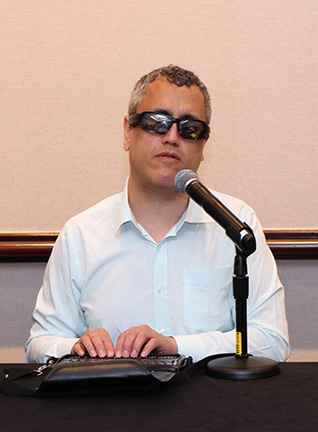 From the Editor: Cary Supalo is a blind chemist. He has a faculty appointment as an honorary professor of chemistry at the University of Sydney in Australia and founded Independence Science, an access technology and consulting firm that specializes in the development of talking scientific data loggers for the blind. In this article, adapted from remarks he delivered as part of a panel discussion entitled Sharing Astronomy with Blind and Low-Vision Audiences at the 2025 American Astronomical Society’s national meeting held in Anchorage, Alaska, on June 10, 2025, he shares his story about some of his earliest days as a budding scientist, which we now share with our readers in celebration of National Astronomy Month:
Imagine a time when you dreamed about traveling to the stars. Or a time when you looked up into the night sky and had visions of faraway places with species from other worlds. From those dreams of distant stars and alien worlds, you then took a liking to science-fiction shows and movies where your imagination thrived. In my case, I took an interest in Star Trek and Star Wars. These shows fueled my curiosity about the universe, and in fourth grade I had the transformative experience of exploring the universe through my first planetarium show at a community college in Joliet, Illinois. I could not see much of the visual content projected on the dome above me. I relied on the narration to imagine the stars I was hearing about.
This immersive experience motivated me to choose the topic of planets in the Milky Way solar system for my fourth-grade science project. I took a piece of black burlap and glued construction paper, cardboard, and Styrofoam half-spheres to represent the planets in a tactile way. (At that time, we had nine planets. Now we just have eight.) Then I stapled orange and yellow tissue paper on the far end of the black burlap to represent the sun. I then gave estimates in miles for the distances from the sun to Mercury to Venus to the Earth and beyond.
Building that tactile model deepened my fascination with the cosmos. Next school year was my first visit to the Adler Planetarium in Chicago, which opened my mind to even more wonders of the universe. I remember its dome theatre, where I saw a planetarium show that taught me about other moons, constellations like the Big and Little Dippers and Orion, and whether there was water and ice on other planets. The wonders I discovered at Adler motivated my fifth-grade term paper on the Milky Way solar system. I even did library research to use data from the original Voyager mission for much of the evidence in this report. Learning about the stars really inspired my imagination and love of science. I wanted to find planets around stars light-years from Earth. My hometown newspaper even wrote an article featuring me, in which I was quoted stating I wanted to be an astronomer when I grew up!
However, in sixth grade, our science curriculum had very little content about space or astronomy. I was introduced to general science, life science, and physical science. This trend in my school curriculum continued into high school, where I enrolled in the biology, chemistry, and physics science course sequence. I never had the chance to return to my initial love of astronomy.
While my journey in studying astronomy diverged in middle school, my love for the subject never faded. In college, I pursued chemistry. However, my fascination with space exploration remained a constant source of inspiration. I took immense pride in seeing technological innovations related to space exploration. I marveled over Space Shuttle missions and later the construction of the International Space Station as accomplishments by humanity to try to learn more about the cosmos. As an adult, I experienced a half-day program at the US Space and Rocket Center in Huntsville, Alabama, where I engaged in a simulated Space Shuttle mission with other blind participants. Braille-labeled controls in the shuttle simulator and Braille and tactile documents brought to life the specific scenarios we were investigating. This experience sustained my dream of someday travelling to the stars and beyond. I realize this aspect of my experiential learning was make-believe; however, I do love to imagine.
We as blind scientists want to be inspired by astronomy. This subject triggers us to imagine and dream about what is out there. We do not need to see the stars to feel their pull. We just need the freedom to dream. It is the audacious power of the dream that inspires children—sighted or blind—to explore astronomy. These dreams may be the first seeds planted for a lifelong journey towards scientific discovery.
Yet today’s planetarium shows, as inspiring and breathtaking as they are, often leave blind learners like me in the shadows. Now, when I visit planetaria and observe various shows, it is more difficult for me because modern displays lean heavily on dazzling visuals, sidelining the rich, descriptive narration that once brought the cosmos to life for me. While audio sonification can give a qualitative representation of astronomical phenomena through sound, it can put the observer one step further removed from the visual representations used to convey astronomical phenomena and distances between stars. These and other challenges for blind learners, and the need for more accessible tools to bring astronomy to life for the blind, fuel my resolve to contribute to change. Astronomy belongs to everyone, not just the able-bodied.
Imagine a world where blind students can trace the contours of constellations with their fingertips, feeling the universe come alive through two-dimensional and three-dimensional tactile models. These tools are no longer a distant hope—they’re here, ready to revolutionize how we engage with astronomy. We can pair meticulously crafted and properly scaled 3D representations of constellations and other astronomical structures and phenomena with detailed raised-line drawings and tactile graphics. With the advent of the new paradigm-shifting access technology of refreshable tactile displays (RTDs), we can deliver real-time data from NASA and global space agencies directly to the fingertips of blind learners. By embracing these innovative accessibility solutions and quality enrichment programs that are inclusively designed for maximum participation, it is my hope we can unlock a universe of knowledge, inspiring a new generation of blind children to not just dream of the stars but to reach for them as future scientists, engineers, and explorers.
As humanity returns to the moon and figures out how to travel to Mars and beyond, astronomy can become a field where blind individuals are not just inspired but empowered to contribute meaningfully to humanity’s cosmic journey. Many in the STEM ecosystem get hung up on how we as blind people can comprehend and understand astronomical and scientific phenomena. It is our responsibility to educate these individuals as to our true capabilities. We also must raise the expectations of the blind as to what is possible and how we can visualize, interpret, and most importantly, communicate scientific principles to our sighted colleagues. The contributions we can make as blind scientists and engineers should not be diminished or marginalized. These contributions and accomplishments can and should be included in this crack-in-time moment in human history. Astronomy’s call to dream without limits and reach for the stars beckons the blind as it does the sighted. By harnessing the unique perspectives and talents of blind individuals, we can enrich the scientific community and redefine what is possible.
I leave you with this famous quote from one of my favorite movies of all time, Back to the Future. The character Dr. Emmett Brown says, “If you put your mind to it, you can accomplish anything.” I believe that if we can inspire current and future generations of blind children, we can make real a more inclusive STEM workforce that welcomes the blind. Let us build a future where every child, regardless of disability, can touch the cosmos and claim their place in the grand adventure of discovery. The stars are calling us all. Let us ensure that no one is left behind.