Braille Monitor June 2006
Building an Education Program at the Jernigan Institute: Reviewing Progress and Imagining the Future
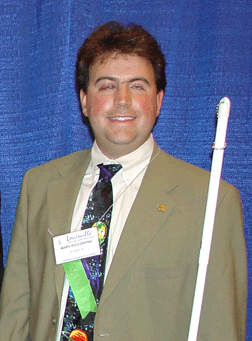
by Mark A. Riccobono
From the Editor: Mark Riccobono is director of education at the NFB
Jernigan Institute. More than any other single individual, he has his finger
on educational programs being planned and conducted in the Institute. Because
it is difficult to keep all of them in mind, I asked Mark to report to our readers
on the various programs now being conducted. Here is that report:
|
Recently we celebrated
the second anniversary of the National Federation of the Blind Jernigan Institute.
Two years is a relatively short time, and it seems even shorter when you consider
the educational programs we have built in that time. It can be difficult to
keep up with the pace of development at the Institute, even for those working
here every day. While articles have previously appeared in the Braille Monitor
about various educational programs of the Jernigan Institute, the purpose
of this article is to provide a comprehensive look at the educational initiatives
established by the blind through the Institute and to provide a brief overview
of each program.
National Center for Blind Youth in Science (NCBYS)
This initiative is a cornerstone of the Jernigan Institute's education programs.
During the grand opening for the Institute, we launched the initiative with
the announcement of the first NFB Science Academy. The Science Academy consists
of two one-week summer sessions that provide blind middle and high school students
with a challenging opportunity to broaden their experience and expectations
in science-related courses and careers. During the summer of 2006 we will hold
the third annual Science Academy. Twelve blind middle school students will again
come to Baltimore for the Circle of Life Academy, which focuses on earth science.
In addition twelve high school students will attempt to be the third NFB team
to launch a 10-1/2-foot sounding rocket during the Rocket On! Academy. Will
this Rocket On! mission fly higher, farther, or faster than the previous two?
All dreams are possible in the NFB Science Academy. To learn more about this
program, read the article entitled "Two Small Camps, One Giant Leap into the
Future for Blind Youth: The Next Generation of Rocket Scientists" from the November
2004 issue of the Braille Monitor.
Using the Science Academy as a starting point, we brought together an advisory work group to help us focus on the most pressing needs in the area of education and employment in science, technology, engineering, and math. The NCBYS advisory work group includes scientists, educators, parents, researchers, and other partners. As with all NFB programs the NCBYS advisory work group includes the perspectives of many blind individuals. The work group helped develop a strategic plan for the NCBYS, which highlighted a number of important priorities. One central theme was positioning the NCBYS as a central clearinghouse of information and resources for the rest of the country. In this way the Institute could help drive innovation in the field and focus resources in the most critical areas of need. As a result of the clearinghouse priority, the Jernigan Institute pursued and was awarded a grant from the National Science Foundation to establish the NCBYS Web portal, <www.blindscience.org>. As of May 1, 2006, the portal became available for public use and feedback. During the initial evaluation period of the portal, through August 31, 2006, visitors to the site can complete a brief survey and have a chance to win a gift certificate from the NFB Independence Market. Please visit the site and provide your feedback.
While the Science Academy focuses on modeling educational practices for engaging blind youth in science, we have also taken steps to encourage employment opportunities. In the summer of 2005 the Institute established the Excellence through Challenging Exploration and Leadership (EXCEL) internship program in collaboration with the National Aeronautics and Space Administration (NASA). This program provides rising college freshman and sophomores who are blind with an opportunity to receive mentoring from blind professionals through the NFB while working in scientific jobs at NASA. This year EXCEL has been expanded from six weeks to eleven weeks, and it again includes an opportunity to attend the NFB national convention. To read about the 2005 EXCEL program, see the article entitled "Blind Students Excel at NASA" from the October 2005 issue of the Braille Monitor.
Other activities of the
NCBYS include the Goals for Achieving Math Accessibility (GAMA) Summit, book
launches, videos, and workshops. First, the GAMA meeting brought together those
working on technologies to allow blind people greater access to powerful math
tools. A number of projects have grown out of the partnerships established at
the meeting. We have also helped launch the latest NASA Braille book, Touch
the Sun, and have sparked a project to create a prototype Touch the Earth book
using innovative technologies from Somatic Digital. In addition we have also
created a new video providing science teachers with tips on working with blind
students, and we will be disseminating it to schools across the country this
spring. Last, this summer the Institute will be a partner in the Vertical Mentoring
Workshop for the Blind at the University of Washington. This workshop will bring
blind professionals together with blind students interested in careers in the
sciences in order to help build a community of expertise about how blind people
succeed in science and engineering. The NCBYS is fulfilling its mission of driving
innovation and building partnerships to improve opportunities for the blind.
In June of this year a summit meeting will be held at the Jernigan Institute
to chart future innovations of the NCBYS initiative including big ideas expected
to come out of the Institute in 2007 and beyond.
NFB Transition to Independence Club and Youth Excellence Seminars Program
The NFB Jernigan Institute has taken on previous work of the Federation in order
to continue its development and help disseminate it across the country. The
first initiative the Institute took on was to jump start the Transition to Independence
Club, previously operated by the NFB of Maryland and the Maryland Parents of
Blind Children, by connecting it to the NCBYS initiative through a grant from
the High School High Tech Program (HS/HT) operated by the Maryland Department
of Education, Division of Rehabilitation Services, through support from the
U.S. Department of Labor, Office of Disability Employment Policy. For a year
now the Institute has been building the Transition Club by working with blind
teenagers in Baltimore City and Baltimore County. These at-risk youth are receiving
mentoring, training in blindness skills, and exposure to employment opportunities
in high-tech fields. They would not otherwise have the tremendous opportunities
they are receiving in the Transition Club. The Institute's goal is to take what
it is learning in the operation of the club and disseminate it to local NFB
chapters to assist with the establishment of a network of Transition to Independence
Clubs. This network will include the development of a database of resources
housed at the Institute to assist chapters in building their outreach and empowerment
of transition-age blind youth in their communities.
In order to support the Transition to Independence Club and the goals of the NCBYS, the Institute held its first Transition to Independence Career Fair on February 23, 2006. With support from a variety of community partners, including the Maryland Division of Rehabilitation Services, the Whiting School of Engineering at Johns Hopkins University, Blind Industries and Services of Maryland, NFB training centers, and local educators, the Institute hosted sixty-five students at the first fair. Students from Maryland, Virginia, New York, and even Washington State were on hand for a full day of workshops, mock interviews, and exhibits. Participants were surrounded by successful blind role models who are employed in everything from engineering to the Randolph-Sheppard Program to government and politics. Anil Lewis, member of the NFB board of directors and president of the NFB of Georgia, got everyone thinking positively with a rousing keynote address at lunch. Additional presentations by Betsy Zaborowski, executive director of the Jernigan Institute; Kristin Cox, secretary of the Maryland Department of Disabilities; and many other inspiring individuals kept the youth in attendance engaged and thinking about their futures. The Career Fair is also intended to be a model that NFB chapters can use to reach out and affect blind youth in their communities. Through the Transition Club and the Career Fair, we continue to build opportunities for blind youth to be better prepared for life after high school.
Also the Institute has taken on responsibility for coordinating youth visits to the National Center for the Blind. These Youth Excellence Seminars are a powerful way for young blind people to receive mentoring from blind adults and learn about opportunities for their future. Recently the Institute hosted a group from the New York Commission for the Blind. The New York visit has become an annual occurrence during the week of President's Day in February. This year the New York teens were fortunate that their visit fell during the same time as the Career Fair. In addition to attending the Career Fair, the teens participated in activities to expand their experience in daily living skills, technology, travel, and examination of critical topics related to blindness. Many of the teens particularly enjoyed learning to cook on a barbecue grill under the direction of blind mentors and sitting through a lively session of the Dating Game that taught all sorts of lessons about what it means to be blind. Similarly, a group of New Jersey teens visited the National Center in April. During their weekend trip the New Jersey teens examined the life of a training center student by participating in a variety of activities under the direction of blind mentors.
The Institute hopes to
expand these youth opportunities to other groups who wish to bring students
to the National Center for intense training experiences. Eventually the Institute
would like to take these seminars on the road to reach out to those who cannot
travel to Baltimore. By providing training and leadership from blind mentors,
we can help educators keep blind students on the road to success. Blind youth
have few opportunities to work with positive blind mentors in challenging training
situations in which they can understand their blindness better. These experiences
help educators reinforce the importance of skills they are attempting to teach
students at home. They also help to counteract the negative messages about blindness
these students receive from teachers, peers, the general public, and sometimes
their own families. By teaching these youth to expect excellence and empowering
them to reach for it, we are positively affecting the next generation of blind
leaders and mentors. Both the Transition Club and the Youth Excellence Seminars
at the Institute demonstrate the power of blind mentors working closely with
educators and rehabilitation professionals to help blind youth raise expectations
for themselves and embrace the techniques that successful blind adults have
mastered.
National Center for Mentoring Excellence (NCME)
Mentoring has been a cornerstone of the NFB since its beginning. It is part
of everything we do in the Federation, something that we can do better than
anyone else in the blindness field. It should be no surprise that mentoring
is an important component of the Institute. A five-year grant from the U.S.
Department of Education Rehabilitation Services Administration has allowed the
Institute to develop the National Center for Mentoring Excellence (NCME). The
goal of the NCME is to design, develop, implement, and evaluate a comprehensive
national mentoring program to connect young blind people with successful blind
adults. The NCME project is equipping the Institute with greater expertise in
mentoring and a model that demonstrates the important role blindness-specific
mentoring plays in encouraging blind youth to break through barriers and reach
greater heights.
A demonstration mentoring
project is currently underway in two states, Louisiana and Nebraska. In the
fall of 2007 the project will be expanded into four additional replication states.
Through the NCME we the blind will continue to build our own futures by passing
our knowledge, experience, and perspectives to the next generation of blind
youth. Through mentoring, blind youth will most certainly experience a greater
future full of opportunities. Read more in the article entitled "Introducing
the National Center for Mentoring Excellence" from the October 2005 issue of
the Braille Monitor.
National Literary Braille Competency Test (NLBCT)
On the horizon in 2006 is the conclusion of a long awaited product to help ensure
higher levels of competency in the Braille code among those charged with teaching
Braille. For a more extensive history refer to the January 2006 issue of the
Braille Monitor and the article entitled "National Literary Braille
Competency Test: New Partnerships, New Possibilities." The NFB has supported
the initiative to create a national examination of competency in the Braille
code since it was first discussed in the late 1980's. Furthermore, the NFB has
led a significant revolution in Braille literacy over the past twenty years.
It seems natural then that the NLBCT will have a place in the Jernigan Institute.
Over the past year the Jernigan Institute has been working closely with a steering
committee of experts to pilot and launch the test that has been in development
of one kind or another for better than a decade.
We anticipate that by the
time of the 2006 NFB national convention a final version of the National Literary
Braille Competency Test will be ready for use by universities, states, and agencies
wishing to ensure that their staff or students are competent in the Literary
Braille Code. Soon individuals who took the pilot test and passed will be displaying
with pride their certificate of competency from the Jernigan Institute. In the
future this test will become a national measure for how well we are preparing
teachers to teach Braille and will help training programs improve and understand
what strategies work best in preparing educators to teach Braille. The NLBCT
is one more step on the long road to increasing Braille literacy in the United
States. The establishment of the final test and its ongoing administration will
undoubtedly be only the beginning of a series of Braille-literacy-related projects
at the Jernigan Institute in the future.
Lions Blindness and Low Vision Education Project
In a number of projects the Jernigan Institute is a partner rather than the
leader in the effort. One significant example is the Institute's partnership
in the Lions Blindness and Low Vision Education Project. The International Association
of Lions Clubs is well known in the field of work with the blind, and many blind
people have benefited in some way from the work of a Lions Club or an individual
member. The Jernigan Institute, the Lions Vision Research and Rehabilitation
Center at the Wilmer Eye Institute, and the Department of Health Policy and
Management in the Johns Hopkins Bloomberg School of Public Health are collaborating,
under the direction of the Lions Multiple District 22, to develop an educational
project to change and clarify knowledge, perceptions, and attitudes about blindness.
In this project the Jernigan Institute is helping develop an educational video
and training materials based on focus groups that were held with leaders of
clubs in Maryland, Delaware, and the District of Columbia.
During late April and the
first week of May, training was held at the Jernigan Institute to prepare Lions
to use the educational materials in presentations to their local clubs and other
community organizations. The Jernigan Institute staff hopes that the success
of this collaboration will lead to future opportunities to work closely with
local Lions Clubs around the country. Since many Federation members are also
contributing members of local Lions Clubs, this partnership is a natural extension
of work being done all over the country by Federationists and Lions with a passion
for changing what it means to be blind. Those attending the NFB national convention
in Dallas can look forward to learning more about this emerging project.
Early Childhood
Giving blind children the best resources at the earliest possible age has been
a priority of the Jernigan Institute from day one. The Institute is building
resources to help focus attention on the needs of our youngest blind children
and to help their parents map a future full of opportunity. In the July 2005
issue of the Braille Monitor, I highlighted the success of our first conference
on early childhood in the article entitled "Beginnings and Blueprints: Early
Education, Empowerment, and the Jernigan Institute." In the fall of 2005 the
Institute sponsored "Have Cane Will Travel" seminars at NFB state affiliate
conventions through support of the NFB Imagination Fund. These seminars featured
Joe Cutter and emphasized his promotion model of independent travel for blind
children. They continued to promote best practices in early education for the
blind child by focusing on the significant impact parents can have as the child's
first teachers.
Distribution of Future
Reflections: The Early Years continues to spread the word about the opportunities
parents have to ensure that their blind children get a good early start on the
development of blindness skills. Last, the Institute recently presented at the
Council for Exceptional Children's (CEC) national conference in Salt Lake City,
Utah. This presentation again featured Joe Cutter with support by Ron Gardner,
president of the NFB of Utah and past director of the Professional Development
and Research Institute on Blindness at Louisiana Tech University. These efforts
and more on the horizon will continue to promote greater learning opportunities
for blind children, beginning as early as possible. The sooner we can reach
out to blind children and their families, the more they will be able to benefit
from the rich resources available through the National Federation of the Blind
and its affiliated divisions such as the National Organization of Parents of
Blind Children.
Online Education Program
The Institute launched the Online Education Program as one of its inaugural
projects at the grand opening in 2004. This program currently consists of four
online courses that can be taken for a small fee and completed at the individual's
own pace. These courses are targeted at educators unfamiliar with teaching blind
students, paraeducators, parents, those interested in blindness topics, and
technology specialists and Web site designers seeking greater information about
nonvisual Web accessibility and technology used by the blind. Courses currently
available include:
The Institute is currently
reviewing the infrastructure of these courses and making improvements to the
system. The Institute's goal is to expand this program with an emphasis on content
to support parents of blind children. There are a number of other opportunities
for expanding this program in the future as needs and resources become available.
For more information about the online education program, visit <http://nfb.org/nfbji/onlineeducation.htm>.
Remember that we are always interested in getting feedback about critical online
education courses for professionals, parents, and others needing information
about blindness.
Research
The Jernigan Institute is committed to both performing and partnering in research
efforts that will improve practice and opportunities in education. Currently
the Institute is engaged in a number of research efforts related to educational
products. Additionally it is working on an Excellence in Teaching Blind Students
project with Dr. Matt Maurer of Butler University in Indiana. Through Professor
Maurer's work the Institute is examining instances of outstanding teaching in
the education of blind children in order to publish best practices and common
characteristics of outstanding educators. This research effort has also allowed
the Institute to reach out to educators and administrators across the country,
including those at a number of residential schools for the blind. The goal of
this research is to focus on those elements of the education of blind children
that are most outstanding and to build partnerships to enhance future projects.
The Jernigan Institute is committed to building a research agenda that moves
the field of blindness forward and addresses the most pressing issues related
to education and employment of the blind.
Outreach and Partnerships
Finally, the education staff at the Jernigan Institute spends considerable time
doing outreach; providing technical assistance to parents, educators, and blind
students; and building partnerships with other organizations. This also includes
presentations by Jernigan Institute staff at a number of conferences and meetings
across the country. These presentations help others to learn more about the
NFB, spread the work of the Institute, and increase dialogue around important
topics related to blindness education. Recently presentations have been given
at the Getting in Touch with Literacy conference, the Space Science the Special
Way conference, and the spring training conference of the National Council of
State Agencies for the Blind. This is central to the mission of the NFB, and
it assists Institute staff to stay grounded in the work that needs to happen
at the grassroots level. If you have opportunities to involve the Institute
in your local work or you know of individuals or organizations that you believe
could be synergistic to the Institute's mission, please refer them to us. Often
those seeds turn out to produce fruit over time. The Jernigan Institute is intended
to be a centralized resource and knowledge base for blind people across the
country to build upon. Please take advantage of your Institute and contribute
to its work.
There you have it, an exhaustive list of the activities of the Jernigan Institute Education Team. These activities have grown out of the expressed needs and priorities of the blind. It may be hard to believe that all of this has been built in just two years. Imagine what it will be like in 2009 on the Institute's fifth anniversary or in 2019 during the fifteenth anniversary. If we continue to dream and build together, as we will, we can feel confident that many more opportunities will exist for the blind, the Jernigan Institute will be further regarded as the central influence in the field of blindness, and the emerging generation of blind youth will be more confident and skilled than any previous generation. We will also be able to look back with pride to these pioneering efforts.
We can say with confidence, however, that much work will still be left to do. In reflecting upon the work of the Jernigan Institute in building an education program, I am reminded of Dr. Maurer's 2005 banquet speech. In concluding his remarks, he said in part, "Our perspective is not just for one day. It stretches back over the decades to the time of our beginning, and it reaches forward to the moment of the fulfillment of our dreams." In the perspective of two years, we have achieved quite a bit. From the perspective of our dreams, we have a long way to go. Our commitment to education is strong, and our collective will is deep. Let's continue building our education programs and spreading them across the country. Before we know it, the next two years will have passed, and we will have collectively achieved another milestone on the road to our dreams. Imagine.