It�s a Grand Slam
by Daniel B. Frye
Never before has anyone expected a group of blind students to launch fifty experimental rockets. Could reasonable adults ask aspiring blind engineers to design model bridges able to hold an average adult? How about blind would-be scientists conducting complex chemistry experiments, monitoring climate patterns through instruments on weather balloons, studying the mysteries of wind energy, inventing solutions for indoor navigation technologies, or exploring the deep reaches of space?
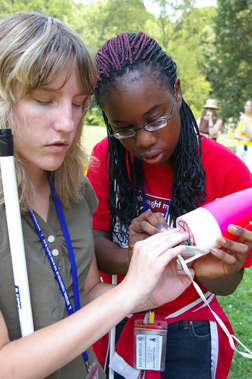 The
first-ever Youth Slam, sponsored by the National Federation of the Blind,
in collaboration with the Johns Hopkins University, Whiting School of Engineering,
and other partners, provided a rich scientific and personal experience for
youth. The event was the 2007 science, technology, engineering, and math (STEM)
leadership academy for blind high school-aged students. From July 30 to August
4, 2007, 180 blind youth along with 84 mentors and volunteers, the vast majority
of whom were blind, active members of the NFB, traveled from all corners of
the country to Johns Hopkins University in Baltimore to participate in a week-long
educational program offering access on an unparalleled scale to STEM-related
subjects for aspiring blind students. In addition to doing its part to shatter
the barriers regularly confronting blind youth who want to enter the STEM
professions, the powerful message that the 2007 Youth Slam conveyed to all
was that blind people can live self-confident, independent, successful lives.
This transformative spirit motivated students to tackle complex academic projects
and to master everyday tasks like navigating a university campus, carrying
a tray in a crowded cafeteria, and helping a friend resolve a personal problem.
The
first-ever Youth Slam, sponsored by the National Federation of the Blind,
in collaboration with the Johns Hopkins University, Whiting School of Engineering,
and other partners, provided a rich scientific and personal experience for
youth. The event was the 2007 science, technology, engineering, and math (STEM)
leadership academy for blind high school-aged students. From July 30 to August
4, 2007, 180 blind youth along with 84 mentors and volunteers, the vast majority
of whom were blind, active members of the NFB, traveled from all corners of
the country to Johns Hopkins University in Baltimore to participate in a week-long
educational program offering access on an unparalleled scale to STEM-related
subjects for aspiring blind students. In addition to doing its part to shatter
the barriers regularly confronting blind youth who want to enter the STEM
professions, the powerful message that the 2007 Youth Slam conveyed to all
was that blind people can live self-confident, independent, successful lives.
This transformative spirit motivated students to tackle complex academic projects
and to master everyday tasks like navigating a university campus, carrying
a tray in a crowded cafeteria, and helping a friend resolve a personal problem.
On
the opening day students had a rollicking time checking into the Charles Commons
dormitory, getting acquainted with their blind mentors, and unpacking their
bags in anticipation of an exciting week of learning. By Monday evening all
were assembled in the dormitory banquet hall for the opening ceremonies of
the 2007 Youth Slam. Mark Riccobono, executive director of the NFB Jernigan
Institute, addressed the boisterous audience, urging the students to pursue
their most ambitious, even unimagined dreams. Mr. Riccobono introduced the
evening�s keynote speaker, Michael Hingson, who described his harrowing escape
from the World Trade Center on September 11, 2001. Hingson explained that
his reliance on solid blindness skills and his calm determination to survive
enabled him to lead his staff to safety. He said that blindness was not an
obstacle in his life and tasked the Youth Slam students to take the steps
to ensure that blindness would not be an obstacle in theirs.
Midway through the evening Betsy Zaborowski, senior advisor to the NFB Jernigan
Institute and the one who first conceived the idea of bringing together the
largest number of blind youth in America to explore STEM possibilities, spoke
movingly about the essence of this campaign. She said in part:
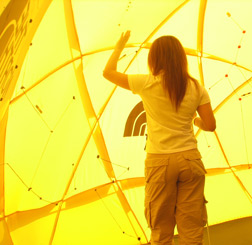 This
is the largest gathering of blind students in history. Do you realize that
you will be in an historic gathering? We want you to learn about science and
other careers to whet your whistle, but we also want you to learn about blindness.
We are going to give a lot to you this week. After the Youth Slam is over,
I hope you�ll go back to your homes and spread the word about positive attitudes
toward blindness to your friends and families.
This
is the largest gathering of blind students in history. Do you realize that
you will be in an historic gathering? We want you to learn about science and
other careers to whet your whistle, but we also want you to learn about blindness.
We are going to give a lot to you this week. After the Youth Slam is over,
I hope you�ll go back to your homes and spread the word about positive attitudes
toward blindness to your friends and families.
Experienced blind mentors served as counselors and role models for youth participants
while they worked on activities meant to stretch their imaginations, build
confidence, and increase science literacy. The students were separated into
nine tracks for different types of science. The featured scientific disciplines
included rocketry, astronomy, engineering, chemistry, wind energy, weather
balloon studies, chatbot design, scientific inventions, and science journalism.
Each student worked within his or her assigned track every day but also attended
short classroom sessions on blindness-related issues. Included were seminars
on defining blindness, advocacy, leadership, independent travel, the blind
and the law, and first impressions. On Wednesday afternoon Youth Slam students
and mentors visited the National Center for the Blind, where they toured our
facilities, including the International Braille and Technology Center. An
extensive exhibition of STEM-related vendors was also set up in Members Hall
for all to see and enjoy.
Youth Slam organizers found giants, both blind and sighted, to present in the fields of study featured throughout the week. Among others Dr. Geerat Vermeij, distinguished professor of geology at the University of California, Davis, and Dr. Dave Wohlers, professor of chemistry at Truman State University, taught classes or facilitated dialogue with Youth Slam students. Representatives attended from the National Aeronautics and Space Administration, the National Science Foundation, the UPS Foundation, the American Honda Foundation, and the NEC Foundation of America.
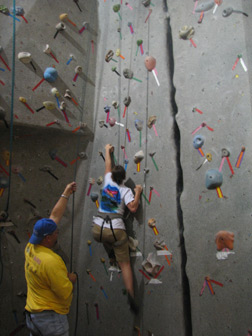
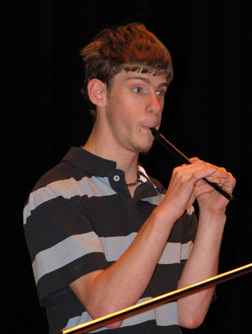
While Youth Slam students and their mentors spent six hours a day in intensive and interactive formal instruction, time was set aside each evening for fun and challenge recreation such as rock climbing, kick ball, swimming, and weight lifting. An impressive showcase of talent was held on Thursday evening in which students and mentors performed for their peers.
An
article in the Baltimore Sun on August 14, 2007, represents the tone
and positive message about blindness and science that characterized the press
coverage of this event. The text of this article follows:
Blind Youths Seek a Future in Science;
Camp Inspires Students toward Careers Once beyond Reach
by Chris Emery
Dave Wohlers leaned against the cold laboratory bench, gripping a white cane.
He listened as the three blind girls across the bench struggled with their
experiment.
"Oh, I dropped the wire," one girl said.
"I'll get it," replied another. Her stool screeched across the tile floor of the Johns Hopkins University chemistry lab as she climbed down to grope for the wire.
The girls were building an electrolytic cell, a power source of the sort that might one day fuel ultra-green cars. Such technical projects are difficult, even for students with good eyes. But Wohlers showed no pity for the twenty or so blind students under his tutelage that morning. His role as an instructor was to guide and inspire--not to coddle. The experiment was part of Youth Slam 2007, a science camp sponsored this month by the Baltimore-based National Federation of the Blind that attracted about two hundred blind students from around the country. It grew out of a larger initiative by the Jernigan Institute, an NFB program launched in 2004 to foster a culture of self-sufficiency in the blind community. Blind children are being pushed to pursue careers that even the most optimistic once thought beyond their grasp. "The big thing is to inspire them to do more than they previously thought possible," said Mark Riccobono, executive director of the institute.
Bolstering the initiative are new electronic devices that act as a blind person's eyes by turning visual information into sound or Braille text. IPod-sized translators can take photos of printed documents and read them out loud. Portable computers known as "notetakers" can store reams of information--novels, scientific data, and personal reminders--then reproduce it instantly as lines of Braille. And talking instruments can tell blind scientists the color, temperature, and weight of chemical compounds.
NFB officials say the combination of technology and hands-on lab experience will boost blind students' confidence. Wohlers hopes that will help them overcome hurdles similar to those that nearly kept him out of science. "If you can feed the thinking by doing it physically," he said, "somehow you have a recognition that `I can do this.'" Such surety was hard won for Wohlers, who was completely blind by age eight, the result of a genetic condition that caused cancerous tumors to form on his retinas.
He first developed a keen interest in chemistry while attending a school for the blind in Vinton, Iowa. "I loved the competition in the classroom," he recalled. "And I loved the idea of synthesizing something new that nobody had made before." Aptitude tests also showed he might make a good scientist. But Wohlers had never heard of a blind chemist and neither, it seemed, had anyone else. Back then "blind scientist" sounded like a virtual impossibility. When his high school guidance counselor told him it was too bad he couldn't go into chemistry, Wohlers didn't think to ask why he couldn't. "I just didn't know anybody who did that," he said. "If you were good, you were a teacher. If you were specially good, maybe you were a lawyer. Otherwise, you were a piano tuner or broom maker, or some other manufacturing job."
In 1970 he entered the University of Iowa as an economics and business major, thinking it was a practical field for a blind man. He soon discovered he had made a mistake. "I just couldn't stand reading that stuff, and I couldn't motivate myself," he said. "I realized that maybe I wasn't following my bliss."
After failing an economics exam, he switched to a double major in chemistry and mathematics despite his misgivings about science as a career. "There were no guarantees I could do the lab work," he said. "We didn't even have microcomputers then. I just had faith that someday there would be a solution, that the technology would catch up."
 Other
students acted as Wohlers's eyes in the laboratory. They handled the chemicals,
mixed the various reagents, and measured the products. Wolhers was the brains
behind the operation, telling the volunteers what to do at each step. He learned
a lesson about science that would carry him through his career: The lead scientist
doesn't have to do the laboratory grunt work. "It quickly became very
apparent that chemistry is a cerebral sport," he said, "and not
hand-to-hand combat."
Other
students acted as Wohlers's eyes in the laboratory. They handled the chemicals,
mixed the various reagents, and measured the products. Wolhers was the brains
behind the operation, telling the volunteers what to do at each step. He learned
a lesson about science that would carry him through his career: The lead scientist
doesn't have to do the laboratory grunt work. "It quickly became very
apparent that chemistry is a cerebral sport," he said, "and not
hand-to-hand combat."
Wolhers decided he would need to be the boss--managing the ideas, people, and data, while delegating the bench work to sighted assistants. He could be intellectually immersed in the work, if not physically connected to research. But not everyone was convinced a blind man could do science. Wolhers discovered this when he applied to the graduate program at Iowa State University's chemistry department. Iowa State was the professional home of Henry Gilman, a pioneering organic chemist who had gone blind in 1947, about a third of the way through his career. Known as a stern taskmaster who demanded much of his graduate assistants, Gilman published more than five hundred papers after losing his sight. In 1977 he was awarded the Priestley Medal, the American Chemical Society's highest honor.
Despite
that precedent, Iowa State turned down Wohlers's application. "They wrote
me back a rejection letter saying they didn't think people who are blind can
do chemistry," he said. "The recruitment committee must not have
known Henry was on their faculty."
The chemistry department at Kansas State University saw things differently
and accepted him into their graduate program. Wohlers's graduate research
focused on inorganic synthesis and photochemistry, the study of how light
alters a substance's chemical properties. As in his days as an undergraduate
science major, he directed the intellectual orchestra while assistants played
the laboratory instruments. "It took longer, no question," he said,
"and I didn't produce as much work as the next guy, but I did enough
to get the job done for a Ph.D." He parlayed his doctorate into a faculty
position in the chemistry department at Truman State University in Missouri,
where he still teaches.
"I'm not the first blind chemist, and I'm not the only blind chemist," said Wohlers, fifty-five, "but I'm one of the few blind chemists." He hopes programs such as the Youth Slam will help increase those numbers by raising blind students' expectations for themselves and giving them hands-on lab experience.
The students in the Johns Hopkins lab that muggy morning were working mostly on their own to construct the fuel cells. The three girls across the bench from him were making steady progress despite their early difficulties. Two were high school students, both seventeen and considering science careers. Courtney Lee, from Seattle, wanted to be a chemist, and Colleen McBride, from Madison, New Jersey, thought she would make a good biologist, or maybe a doctor. The third member of the group was Heather Oklak, twenty, a blind business major at Indiana University, who volunteered to act as the younger girls' mentor.
They found the dropped wiring and combined it with a battery and saltwater solution to simulate the storage of energy in a hydrogen fuel cell car. "It's going to smell like chlorine, and it's going to bubble," said Oklak as they applied electric current to the salt water.
"Oh, yeah, it's working," McBride said. "It smells like a pool!"
"It's sodium chloride," Lee said, "so that makes sense."
After a minute of charging their fuel cell, they hooked it up to a talking voltmeter, a device that measures the energy stored in the cell.
"Zero point zero nine four," the machine said in a computer voice.
"What'd it say�0.049?" McBride asked.
"No, I think it was 0.480," Lee replied.
Standing
farther away now, Wohlers remained silent, letting the young scientists learn
their lessons the hard way.
 That�s
the way the Baltimore Sun described Youth Slam 2007. It culminated
on Friday afternoon in an inspiring Youth March for Independence, with students,
mentors, and program administrators walking a one-mile route from Baltimore�s
Inner Harbor to the NFB�s national headquarters. Once all had arrived and
settled into the west side of Members Hall, Youth Slam students took charge
of the closing ceremonies, giving voice to their feelings about the week�s
programming with touching stories about rejuvenated hope and increased optimism
about the future. A sumptuous meal prepared by the NFB�s staff and a dance
capped the farewell celebration.
That�s
the way the Baltimore Sun described Youth Slam 2007. It culminated
on Friday afternoon in an inspiring Youth March for Independence, with students,
mentors, and program administrators walking a one-mile route from Baltimore�s
Inner Harbor to the NFB�s national headquarters. Once all had arrived and
settled into the west side of Members Hall, Youth Slam students took charge
of the closing ceremonies, giving voice to their feelings about the week�s
programming with touching stories about rejuvenated hope and increased optimism
about the future. A sumptuous meal prepared by the NFB�s staff and a dance
capped the farewell celebration.
Further information about Youth Slam activities and happenings can be found
at <http://www.blindscience.org>, where the Youth Slam news track posted
videos, blogs, and reports that chronicled items of note throughout the week.
Visit this Website for additional details.
In reflecting on the overall impact of the Youth Slam, Amy Phelps, an NFB
staff member and principal organizer of logistics for the event, offered her
perspective in an email message to friends. Here is what she said:
This is a great example of what the Jernigan Institute is all about and why
we work so hard to support the work of the National Federation of the Blind.
Through this week we changed the lives of nearly two hundred blind youth and
all the people who will come into contact with them. It was an amazing week.
We watched kids who didn't even know they could carry their lunch trays independently building rockets with NASA engineers, building invention prototypes that they came up with, developing alternative fuel cells, building better windmills, building bridges that they had designed to scale that would hold an adult--to name just a few things. Stop to think about how their lives have been forever changed. Kids who are often told you can't do something because you are blind were told you can do anything, and being blind doesn't really matter. We are going to show you the alternative techniques to get things done, and it happened. These blind youth were mentored and taught by blind people who are out there doing things and living life. This is what the National Federation of the Blind is all about. We are changing what it means to be blind.