Braille Instruction for Imilie
by James
Omvig
From the Editor: Braille literacy is important every day of the year,
but in the fall, when the new school year is beginning and the Braille Readers
Are Leaders contest gets underway, it seems particularly fitting to remind
ourselves and one another how vital strong Braille skills are to the education
of blind children and the success of blind adults. A couple of years ago members
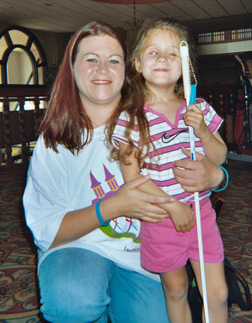
of the NFB discovered Rachael West and her twins, Imilie and Jackson. Imilie
was blind, and Rachael was determined to see that the education she received
was just as good as Jackson�s. With the encouragement and support of NFB members,
Rachael is achieving her goal, one victory at a time.
With the twins entering first grade this fall, Rachael set out to ensure that Imilie would receive sufficient Braille instruction in her classroom. The school started by agreeing to provide an hour a week of Braille to Imilie. No parent of a sighted child in her right mind would settle for that amount of print-reading instruction, so Rachael was not willing to agree to that amount for Imilie. She turned to Jim Omvig for advice and support. Here is the letter he sent her:
July 29, 2007
Dear Rachel,
 Amy
sent me a copy of your email about Braille instruction for Imilie, and I understand
and agree with your concern. This is a critical time in Imilie's educational
experience and development of life skills, including fundamental literacy.
The fact is that blind or low-vision children who learn to read and write
using Braille in the early, formative years are always more competent, fluent,
and literate than those who learn the skills later in life, and Imilie should
have the opportunity, inspiration, and encouragement now to become the best
she can be for the rest of her life.
Amy
sent me a copy of your email about Braille instruction for Imilie, and I understand
and agree with your concern. This is a critical time in Imilie's educational
experience and development of life skills, including fundamental literacy.
The fact is that blind or low-vision children who learn to read and write
using Braille in the early, formative years are always more competent, fluent,
and literate than those who learn the skills later in life, and Imilie should
have the opportunity, inspiration, and encouragement now to become the best
she can be for the rest of her life.
I wish you well in working with the school district, and I hope the district personnel understand the vital importance of true literacy for a blind person--Imilie is being prepared right now for adulthood. Remember, Imilie is not just learning Braille. She is learning to read and write (becoming literate) using Braille. There is a vast difference.
The philosophical answer to the question of Braille instruction for blind children is this: in the perfect school system Braille would be taught, stressed, and practiced to, for, and by blind children--including those with some residual vision--for the same amount of time during every school day that print is taught, stressed, and practiced to, for, and by sighted children every school day. In other words, the learning opportunities truly to become literate should be exactly the same for Imilie as a blind child as they are for sighted children in the district.
The reality, however, is that, in addition to the actual reading classes that they have, sighted children also see and are exposed to print throughout the entire day in all that they do outside of reading class, so they get actual, meaningful practice and learning toward true literacy that is not thought of by anyone as reading class. At least in the beginning Imilie can't realistically get exactly this same amount of practice and exposure, since she is not completely skilled in Braille yet. But the school district needs to do all that it possibly can (what the reasonable person would do) to equalize this deficiency.
Therefore, to get on the road to equality, Imilie should have at least one hour of actual Braille instruction each school day (she should also do independent practice at home during evenings and on weekends). Sometimes, you or your mom can read together with her using Twin Vision® (print-Braille) books so you can observe her actual accuracy and competence. Then, as her Braille skill improves and she masters it, her materials for her other classes (things that are provided in print by the school district for sighted children) should begin routinely to be made available in Braille. Eventually all of the other class materials provided by the school to sighted kids in print should be made available to Imilie in Braille, and she should also be required to turn in certain of her schoolwork assignments in Braille.
Then too, both you and the school district can do something a little more subtle. You can place Braille labels around in places Imilie is likely to touch with her hands or fingers so that, like sighted children who encounter print everywhere, she will encounter and feel Braille frequently when it is not thought of at all as a class or as study. Braille should become a natural part of life and as normal communication for her.
Finally,
as she develops and grows, Imilie should be encouraged to do as much pleasure
reading as possible using Braille books. Through reading Braille books, she
will become completely fluent, but she will also learn vocabulary, spelling,
punctuation, and paragraph structure, etc. In her early years don't let her
get into the habit of pleasure reading using tapes or computers. Give her
fun kids� books to read. The more she practices her Braille, the more fluent
and literate she will become. After she is truly literate, then who cares
whether she reads using tape or computers? It will make no difference then,
since she will already have become literate by mastering Braille.
I assume you know you can borrow all the Braille books you want for pleasure
reading from your state library for the blind. But remember, we of the American
Action Fund for Blind Children and Adults also give Braille books free to
blind children so that they may have and keep their personal collections of
books just as sighted children do.
I am delighted to learn from your note that Imilie's eye doctor is with you on the question of Braille instruction. The more allies you can get, the better. You might want to give him or her a copy of this email so that there is a complete understanding of the critical importance concerning good Braille instruction and real literacy for the blind or low-vision youngster.
In fact, in the hope you do share this email with your eye doctor or with other parents, let me offer an additional piece of my thinking (based on forty-seven years of experience) concerning literacy and children who have some loss of vision. If the child who has some vision loss can read regular-sized print--whatever size is age-appropriate at the time--at a competitive reading speed for a sustained period of time without tiring or developing discomfort, headaches, or other distress, and if there is no evidence that the vision loss is caused by a medical condition that can be expected to result in future deterioration of vision--then by all means learn and use print and forget about Braille.
On the other hand, if all of the conditions of the test I have laid out are not met, then see that the child learns and uses Braille, although it is also appropriate to learn print and use it whenever it is truly efficient or when no Braille is available. In my own case, the backward blindness professionals at my school for the blind thought it was perfectly appropriate for me to read and function using print (and to avoid learning Braille) when I could read only large--very large--print at about ten or fifteen words a minute for no more than fifteen minutes at a time before tiring and quitting, even though everybody knew I'd be totally blind one day from retinitis pigmentosa. This is not the ability to read normal print at a competitive pace for a sustained period of time I'm talking about.
Rachel,
this has become much more than I had intended to write when I began, but I
decided it is important to give you all the information I can at this critical
time in Imilie's life. Greet Imilie, Jackson, and your mom from Sharon and
me, and good luck in getting other parents in Mississippi to become concerned
about true literacy for their blind or low-vision children. We'll be in touch
soon.
Cordially,
Jim Omvig
Rachael, who has been elected president of the Mississippi affiliate�s parent
division, reported a few days later that she had taken Jim�s letter and some
other NFB literature about Braille literacy to her meeting with school officials.
The result of this discussion was that Imilie will be given an hour of instruction
in Braille every day. She will also be doing all of her math with the Braillewriter
and abacus and her Braille teacher right there to supervise, which means that
she will be getting a total of two hours of Braille instruction each day.
All of this will take place in the classroom, so that her Braille teacher
can convert what the class is doing in print into Braille for Imilie to use.
Mark up one victory in the ongoing battle for good Braille instruction. With
luck perhaps Imilie will be ready for the Braille Readers Are Leaders program
by November.