Healthy and Unhealthy Views of Disability
 From
the Editor: Those of us who think and write about disability are well aware
of the variety of views held by Americans about this complex subject. The
following column first appeared in the Columbus Dispatch on Sunday,
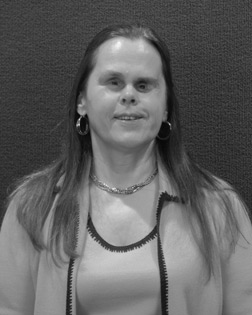
July 15, 2007. Its author, Deborah Kendrick, is a member of the NFB of Ohio
board of directors. The column was inspired by her recent experience and a
piece of hate-filled mail that she received. Here it is:
From
the Editor: Those of us who think and write about disability are well aware
of the variety of views held by Americans about this complex subject. The
following column first appeared in the Columbus Dispatch on Sunday,
July 15, 2007. Its author, Deborah Kendrick, is a member of the NFB of Ohio
board of directors. The column was inspired by her recent experience and a
piece of hate-filled mail that she received. Here it is:
I received an email a few weeks ago that made me shake my head and press the Delete key, but it hasn't quite been erased from my consciousness. I was OK with the part that called me a lousy writer and traitor to my country. (Well, not okay in the sense that I agreed, but everyone is entitled to an opinion.) And I was only mildly annoyed by the inaccurate grammar and politically incorrect (we no longer say �handicapped�) language. No, the part of that letter that I found troubling was the writer's claim that she knew people with disabilities and that they weren't anything like those I write about.
The implication was that real people with disabilities aren't ordinary people with a range of competencies and another range of additional challenges, but that they are instead a group apart, a group of, um, "the handicapped."
Hearing from readers who think I'm off-base or clueless comes with the territory. If everyone agreed with me, I'd be bored and probably unemployed. But to hear from someone who claims to be a professional, interacting on a regular basis with children and adults with disabilities, who believes that a portrayal of people with disabilities as positive, powerful, or competent is a fiction--well, it is more than a reminder that there is still much work to be done.
Two vital principles bear repeating:
* People with disabilities are probably the most diverse minority, representing not only an enormous variety of mental and physical disabilities, but also every segment of our population. In other words, there are some who are extraordinary achievers, some who are slackers, and some at every increment between the two extremes.
* If you or those around you believe you'll fail, you probably will. All good teachers know that high expectations are more likely to motivate students to set and achieve higher goals.
I wish the malcontent who sent that letter could have witnessed just two small slices of reality I've enjoyed in just the last two weeks. On July 3 in Atlanta, a thousand blind people participated in the National Federation of the Blind's first 5K March for Independence. Rep. John Lewis, D-GA, who worked alongside the Rev. Martin Luther King Jr., led the march and inspired the crowd with a rousing, impassioned speech connecting the 1960s� civil-rights effort for blacks with today's claiming of rights for people with disabilities. Participants included lawyers, teachers, business owners, scientists, mathematicians, and doctors--all of them blind. There were also retirees, factory workers, students, and people without jobs.
Just a few days later I had the privilege of speaking to about one hundred people at a conference in Cincinnati. Their focus was on self-advocacy, speaking for themselves, and claiming equality. To me they were warm, welcoming, and delightful. They laughed at my jokes, after all, and were glad that I had come. Some were in wheelchairs. Some had difficulty speaking. Most of them had developmental and/or intellectual disabilities. That means there probably wasn't a Ph.D. in the house, but I know enough to know that any assumptions about any group are usually wrongheaded notions.
Whether employed or living independently, in school or living with others, every person in that group felt empowered and was moving to the next level of dignity and independence.
About 54
million Americans have disabilities, and no two of those people are alike.
Happily, the number who believe in themselves and in their capabilities is
growing. The rest of the population--those who do not have disabilities--can
pull their weight by dropping antiquated stereotypes--and the accompanying
disparaging language--and believe in that equality and dignity too.
Deborah Kendrick is a Cincinnati writer and advocate for people with disabilities.
<[email protected]>
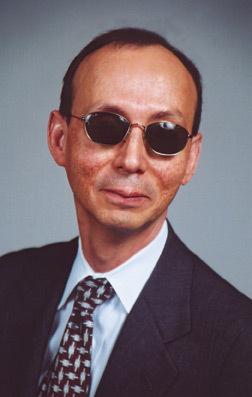
Now here is NFB First Vice President Fred Schroeder�s note to Deborah
after reading this column:
Deborah,
 I
just saw your article, and it touched a chord in me. One of the greatest frustrations
in trying to make fundamental change in the rehabilitation system is the denial
that change is needed. As with the person who wrote you, some say that we
have a skewed or unrealistic view of disability, that what we say about blindness
is false and dismisses the real experience of the majority of blind people.
The insistence that blindness is overwhelmingly disabling reflects the very
problem we are trying to address. It is the lack of belief in a better future
and the withdrawal from hope that is the true disability.
I
just saw your article, and it touched a chord in me. One of the greatest frustrations
in trying to make fundamental change in the rehabilitation system is the denial
that change is needed. As with the person who wrote you, some say that we
have a skewed or unrealistic view of disability, that what we say about blindness
is false and dismisses the real experience of the majority of blind people.
The insistence that blindness is overwhelmingly disabling reflects the very
problem we are trying to address. It is the lack of belief in a better future
and the withdrawal from hope that is the true disability.
I recently
conducted training for a group of rehabilitation professionals. As I left
the room at the end of the day, I heard one of the participants say to another,
"This would have been good training in the early '80s." The implication
was that they had heard all this before and that it had no serious relevance
in their day-to-day work. Even those professionals who say they have high
expectations for blind people mostly don't believe it. For them it is something
polite to say but not something real.
After experiences like yours and mine, it is easy to become frustrated and
easier still to become angry, but in this case I mostly felt a deep sadness.
When people become blind, they look to the system of professionals for answers.
When the answer comes back, "Your life is over," what more is the
person to do?
The good
news is that you do make a difference. I have followed your work for many
years and know that you have touched countless lives with a message of dignity
and opportunity for blind people. Some of this comes from your ability to
articulate your message in a clear and powerful way, and some is the outgrowth
of who you are as an individual. You are one of the most natural and giving
people I know. Your life reflects the truth of your words, and no one can
change that, lessen it, or write it off. Keep writing, keep speaking, and
most of all keep being who you are.
FKS