Braille Monitor
March 2008
(back) (contents)
(next)
The 2008 Washington Seminar
by Barbara Pierce
 In
years to come we may well look back on the 2008 Washington Seminar with particular
nostalgia, for it was both exciting and powerfully moving. Many of us are especially
fond of the Holiday Inn Capitol because of the simplicity of its layout and
its proximity to Capitol Hill. We managed somehow yet again to squeeze hundreds
of Federationists into the meeting rooms, and we were happy to discover that
additional fast-food restaurants have sprung up in the area.
In
years to come we may well look back on the 2008 Washington Seminar with particular
nostalgia, for it was both exciting and powerfully moving. Many of us are especially
fond of the Holiday Inn Capitol because of the simplicity of its layout and
its proximity to Capitol Hill. We managed somehow yet again to squeeze hundreds
of Federationists into the meeting rooms, and we were happy to discover that
additional fast-food restaurants have sprung up in the area.
Sunday, January 27, and Monday the 28th were overflowing with meetings and
seminars. Here is at least a partial list, actually beginning on Saturday, January
26:
- A leadership seminar for 2007 NFB scholarship winners and their student
mentors. This meeting took place at the National Center, and the students
then traveled to the Holiday Inn Sunday morning in time for the general student
seminar.
- The Research and Development Committee met at the National Center Saturday
evening, Sunday, and Monday.
- The National Association of Blind Students conducted its annual midwinter
seminar Sunday morning at the Holiday Inn.
- The National Organization of Parents of Blind Children conducted an intensive
two-day leadership seminar for parents committed to organizing or strengthening
their state parent divisions.
- A rehabilitation and orientation and mobility conference, complete with
a luncheon and keynote address, took place at the hotel until midafternoon
Monday.
- The National Association of Blind Merchants conducted an afternoon seminar
on building better businesses.
The Governmental Affairs and Affiliate Action Departments collaborated to present
the 2008 legislative seminar, including advice on making effective presentations,
mastering the facts of the legislative agenda, and presenting our position and
arguments effectively.
A weekend agenda with such diverse offerings would naturally attract hundreds
of people, but at the heart of this one and dominating everyone�s thoughts was
the Sunday afternoon memorial celebration of the life of Dr. Betsy Zaborowski,
the executive director of the NFB Jernigan Institute from its opening to last
summer. A full report of this event appears elsewhere in this issue.
On Monday morning at ten a.m. we called a press conference to make an electrifying
announcement. Everyone attending the Washington Seminar was invited, though
members of the press were up front. Columbia�the largest meeting room in the
hotel�was crowded when President Maurer and Ray Kurzweil stepped forward to
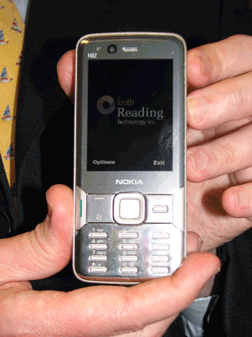
unveil the knfbReader Mobile. The Kurzweil-National Federation of the Blind
Reader, introduced to great acclaim less than two years ago, has now been replaced
by its powerful software loaded into a cell phone with a digital camera. Compact
as the original K-NFB Reader was, this is truly a reader that will fit into
a shirt pocket.
Jim Gashel demonstrated this amazing technology to an incredulous audience.
The controls have been simplified and speeded up. The camera can take photos
closer to the page than sixteen inches. The speech is as clear as in the larger
unit, and the currency identifier is very accurate.
The cell phone required by this reading software is a Nokia N82, which retails
for somewhat under $600 if you shop carefully. Jim Gashel assured the audience
that both the Talks and MobileSpeak software programs make this cell phone quite
accessible. It can accept or send calls even while the Reader is operating.
Users can also purchase a global positioning system that works well with both
access programs. The cost of the Reader software is $1,595, a significant reduction
in price from the original KNFB Reader, even adding in the cost of the cell
phone.
 The
knfbReader Mobile went on sale February 15. To find the vendor nearest you,
go to <www.knfbreader.com> for a complete list. Kurzweil-National Federation
of the Blind Reader users will find generous terms for upgrading to the knfbReader
Mobile.
The
knfbReader Mobile went on sale February 15. To find the vendor nearest you,
go to <www.knfbreader.com> for a complete list. Kurzweil-National Federation
of the Blind Reader users will find generous terms for upgrading to the knfbReader
Mobile.
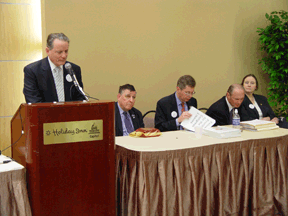
The five p.m. briefing was, as usual, standing room only, even though many
Federationists went straight to the overflow room to hear the proceedings relayed
to them through the public address system. Well over five hundred people attended
the great gathering-in meeting. Lord Colin Low of Dalston, CEO of the Royal
National Institute of Blind People in the United Kingdom, came to Washington
this year to observe our efforts to educate the Congress. During the briefing
he addressed the crowd in his usual charmingly understated way.
President Maurer announced that fifty of the fifty-two affiliates were present
this year. Before Jim McCarthy and Jesse Hartle discussed this year�s legislative
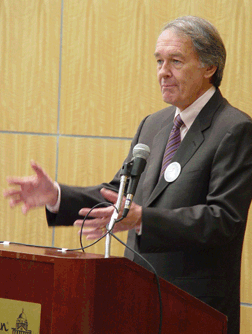
issues with the group, Congressman Edward Markey, representing the seventh district
of Massachusetts, stopped by to encourage us in our efforts to deal effectively
with quiet cars and described his efforts to increase video description on television
programming. He called special attention to the need to voice the print crawls
across the bottom of the TV screen.
 Our
legislative agenda this year included three items of pressing importance: building
Congressional support for legislation to require the National Highway Transportation
Safety Administration to formulate regulations insuring that hybrid and electric
vehicles can be heard in traffic; restoring the lost funding from last year
and protecting the full $19.1 million needed this year and in the three successive
years to complete the National Library Service for the Blind and Physically
Handicapped�s transition from cassette books to digital media and provide the
equipment needed to play them; and passage of H.R. 3834 and S. 2559, raising
the earnings limit for blind Social Security Disability Insurance recipients
ultimately to that of working retirees who have not yet reached full retirement
age. The full text of the legislative agenda and the three fact sheets appears
elsewhere in this issue. Please note that the Senate bill number does not appear
in the fact sheet because Senators Chris Dodd and John McCain only introduced
the bill on Friday, January 25.
Our
legislative agenda this year included three items of pressing importance: building
Congressional support for legislation to require the National Highway Transportation
Safety Administration to formulate regulations insuring that hybrid and electric
vehicles can be heard in traffic; restoring the lost funding from last year
and protecting the full $19.1 million needed this year and in the three successive
years to complete the National Library Service for the Blind and Physically
Handicapped�s transition from cassette books to digital media and provide the
equipment needed to play them; and passage of H.R. 3834 and S. 2559, raising
the earnings limit for blind Social Security Disability Insurance recipients
ultimately to that of working retirees who have not yet reached full retirement
age. The full text of the legislative agenda and the three fact sheets appears
elsewhere in this issue. Please note that the Senate bill number does not appear
in the fact sheet because Senators Chris Dodd and John McCain only introduced
the bill on Friday, January 25.
Federationists fanned out across Capitol Hill Tuesday, Wednesday, and Thursday
to discuss these issues with every member of the House and Senate and their
staffs. When the Nevada delegation met with Senate Majority Leader Harry Reed,
the senator came into the room talking about having heard that morning about
a reading machine the size of a cell phone. He was sure that his blind constituents
would be interested to hear about this new invention. When he stopped for breath,
NFB Executive Director for Strategic Initiatives John Paré stepped forward
and showed Senator Reed the only knfbReader Mobile in Washington that day. He
then successfully demonstrated its features, much to the senator�s delight.
That may have been our most dramatic encounter on Capitol Hill January 29 to
31, but important contacts were made and conversations held in offices all over
the Hill.
Now that we have returned home from Washington, the hard work begins. We must
follow up with the staffers responsible for the issues we discussed. We must
urge members of Congress to sign on as cosponsors to H.R. 3834 and S. 2559 and
to introduce the quiet car legislation we need. We must keep the pressure on
the Appropriations Committee in the House to protect the funding for the transition
to digital playback machines and books. The strength of the relationships we
forge with our legislators and their staffs in the weeks and months ahead will
determine our success on Capitol Hill during this election year. We have made
a start; now the work begins.