Braille Monitor
May 2008
(back) (contents)
(next)
Living a Miracle Every Day
by Barbara Pierce and Daniel B. Frye
 Our
travel plans for our visit to the Louisiana Center for the Blind (LCB) were
fine in theory: do a half day�s work in our offices in Oberlin and Baltimore,
leave for the airport in the early afternoon, meet in Atlanta by six, and arrive
in Monroe, Louisiana, at 7:30 that evening in time to pick up our rental car
and drive to Ruston for a good night�s sleep before walking to the center with
the students Wednesday morning. The problems began in Atlanta, which is the
transfer point for Monroe from most cities in the United States, including Cleveland
and Baltimore. Atlanta�s Hartsfield-Jackson International Airport closed for
about a half hour that afternoon, but the back-ups that delay caused took the
rest of the day to untangle. Both our flights were hours late, so we were relieved
to learn when we landed that the flight to Monroe had been postponed almost
two hours as well. We rendezvoused in the gate area of the Monroe flight, Barbara
and Sylvia from Ohio and Dan from Maryland.
Our
travel plans for our visit to the Louisiana Center for the Blind (LCB) were
fine in theory: do a half day�s work in our offices in Oberlin and Baltimore,
leave for the airport in the early afternoon, meet in Atlanta by six, and arrive
in Monroe, Louisiana, at 7:30 that evening in time to pick up our rental car
and drive to Ruston for a good night�s sleep before walking to the center with
the students Wednesday morning. The problems began in Atlanta, which is the
transfer point for Monroe from most cities in the United States, including Cleveland
and Baltimore. Atlanta�s Hartsfield-Jackson International Airport closed for
about a half hour that afternoon, but the back-ups that delay caused took the
rest of the day to untangle. Both our flights were hours late, so we were relieved
to learn when we landed that the flight to Monroe had been postponed almost
two hours as well. We rendezvoused in the gate area of the Monroe flight, Barbara
and Sylvia from Ohio and Dan from Maryland.
As the hours crept by, Sylvia, Barbara�s secretary and for this
project both photographer and driver, decided to check on the rental car she
had ordered for pick-up in Monroe. She was told quite casually that because
of the storm they had no more cars at the airport; we were out of luck. So Dan
swung into action, and within five minutes he had rented a car from Avis and
had a promise from the staff person in Monroe that he would wait till our flight
arrived, even though it was due to land a little while after the desk was scheduled
to close. In the end we did not take off till after midnight Eastern time and
did not land in Monroe until nearly one a.m. Central. As we waited to deplane,
we speculated about whether or not Avis would still be open, and, if it was
closed, how we would get to Ruston. We decided on a taxi, no matter the price
rather than disturbing any of the Louisiana Center folks.
At that point the woman standing in the aisle in front of us turned
around and said that she was going to the far side of Ruston. She asked if we
were going to LCB and offered all three of us and our luggage a ride. She explained
that she has volunteered as a reader at the center and that everyone in Ruston
loves the LCB folks. This exchange made it clear, if we had had any doubt, that
we had arrived in a small southern town.
We were glad to receive this spontaneous testimonial to the standing
of the LCB in the community, and we were deeply grateful for the offer of a
ride. We explained that we felt obligated to use the rental car if the Avis
man had stayed open for us. She agreed to wait to be sure that we had been taken
care of. After a bit of a struggle, we got our car and bid farewell to our very
own Good Samaritan. Ruston is located about forty minutes from Monroe, so it
was almost 2:30 in the morning before we picked up the key to the apartment
designated for our use from Janette Woodard, the apartment manager, who had
been waiting patiently for us for many hours. We walked into a warm, beautifully
appointed four-bedroom apartment with a fully equipped kitchen. Sylvia and Barbara
claimed the upstairs bedrooms and baths while Dan moved into one of the downstairs
bedrooms. We agreed that, having driven from Monroe in the middle of the night,
Syl should sleep in a bit and bring the car to the center midmorning, but Dan
and Barbara, who are well used to going without sleep and even meals when Federation
work is to be done, got up in time to have breakfast from the provisions specially
laid in for their use and then join the students at 7:45 for the walk to the
center. Janette assured us that we were welcome to get a ride from Jerry Darnell
(JD), who stops at the apartments each morning to pick up brand new students
or those with medical reasons for riding. But we were there to observe the LCB
experience, so we slipped out the door and crossed the street, hoping that we
would find some students to show us the way to the center. We need not have
worried. Several had gathered, and Aisha, who is fairly close to graduating
from the program, took the lead on the way to the center, describing what we
were passing and how to tell which streets we were crossing.
The day at LCB begins for everyone with a brief gathering at 8:00
in the second-floor library. Miss Neita (Ghrigsby), the office manager, calls
roll, and center director Pam Allen makes announcements. She then rings the
indoor freedom bell if there are any landmark accomplishments to be celebrated.
For example, while we were there the bell was rung for one student who was leaving
after some weeks of intensive training and for two students who had ordered
airline tickets online for the first time. Other staff members and students
can also make announcements. Then, after listening to the word of the day with
definition, the fact of the day, and the thought for the day, everyone scatters
to his or her assigned work.
The day is divided into four two-hour blocks and a one-hour lunch
period: 8:10-10:00, 10:10-noon, lunch till one, 1:00-3:00, and 3:00-5:00. Each
student has an individual schedule and is responsible for being at each class
at the correct time. Students who are tempted to skip classes or tend to be
tardy find their small monthly stipends docked. This rule adds a real-world
inducement to developing habits of punctuality and organization. The system
seems to work well. Braille and computers/keyboarding share one two-hour block
of time; travel, shop and home maintenance, and home ec and daily living skills
each get two hours a day. Twice a week everyone gathers for seminar�a time when
the group wrestles with the basic, sometimes painful issues of blindness. Remedial
coursework, college preparation, and job readiness classes are worked in as
appropriate. Students often complete their shop and home ec projects early,
which allows them to devote that time to the classes requiring extra effort.
We were impressed at how dedicated students were to getting where they needed
to be on time and settling right down to work. We never observed students standing
around or wasting time.
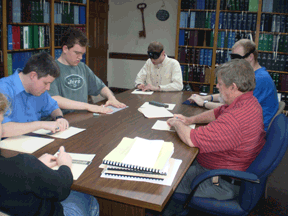 The
first order of business for us was a tour of the entire facility. Our guide
was a student who had been at the center since January. She was quite knowledgeable,
but every instructor was also happy to answer questions, and students seemed
pleased to demonstrate what they were doing. It is obvious that lots of visitors
tour the center. The best way to communicate what we found at the Louisiana
Center for the Blind is to describe the various classes we observed. The resulting
report may seem excessively anecdotal, but our clear impression is that what
we observed during these three days was reflective of the ongoing activity at
the LCB week in and week out.
The
first order of business for us was a tour of the entire facility. Our guide
was a student who had been at the center since January. She was quite knowledgeable,
but every instructor was also happy to answer questions, and students seemed
pleased to demonstrate what they were doing. It is obvious that lots of visitors
tour the center. The best way to communicate what we found at the Louisiana
Center for the Blind is to describe the various classes we observed. The resulting
report may seem excessively anecdotal, but our clear impression is that what
we observed during these three days was reflective of the ongoing activity at
the LCB week in and week out.
Braille Class: Jerry Whittle, the Braille teacher,
sits at a long table in a fairly small room on the second floor. An Arkansas
black whetstone and lots of Braille documents litter the table in front of him.
Students use the whetstone to sharpen styluses. Stacked and shelved around the
room are volumes and volumes of Braille that the center has acquired over the
years. Jerry, like all the instructors, is a sort of juggler. His students come
and go. They drop in with questions and problems. At any given moment he may
be timing the reading speed of a student or two, assigning a couple of people
the task of writing out a list of things that make them mad or musicians they
admire or foods they do not care for�anything that provides a topic to write
about. The object is to give them practice writing with a slate and stylus.
He might also be dictating one-line sentences from memory to a student to determine
how rapidly he or she takes dictation with a slate.
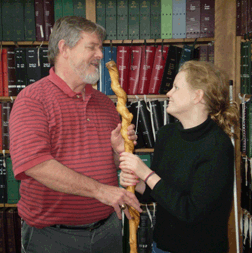
 Through
it all Jerry remains calm and organized. Sometimes students read aloud; other
times they are asked to read silently. We did not actually observe him teaching
the Braille code to anyone, but as he came across interesting signs, he pointed
out unusual configurations and illustrations of rare rules. He was matter-of-fact
and accurate in pointing out errors made, but encouraging as he sent people
back to work. Once a week Jerry conducts a college preparation class for those
getting ready to enroll in courses at Louisiana Tech University. He may use
the time to discuss study techniques or to deliver an impromptu lecture on something
like the literary masterpieces of William Faulkner, expecting the students to
take detailed notes with slate and stylus, of course. Students who raise their
Braille reading speed to over 300 words a minute or who meet some other impressive
personal Braille-connected goal receive a whittle stick, a wonderful walking
stick that Jerry has smoothed and whittled into a unique token of his esteem.
His wife Merilynn, who is something of an expert in gems and stones, sets a
decorative stone in the top of each one.
Through
it all Jerry remains calm and organized. Sometimes students read aloud; other
times they are asked to read silently. We did not actually observe him teaching
the Braille code to anyone, but as he came across interesting signs, he pointed
out unusual configurations and illustrations of rare rules. He was matter-of-fact
and accurate in pointing out errors made, but encouraging as he sent people
back to work. Once a week Jerry conducts a college preparation class for those
getting ready to enroll in courses at Louisiana Tech University. He may use
the time to discuss study techniques or to deliver an impromptu lecture on something
like the literary masterpieces of William Faulkner, expecting the students to
take detailed notes with slate and stylus, of course. Students who raise their
Braille reading speed to over 300 words a minute or who meet some other impressive
personal Braille-connected goal receive a whittle stick, a wonderful walking
stick that Jerry has smoothed and whittled into a unique token of his esteem.
His wife Merilynn, who is something of an expert in gems and stones, sets a
decorative stone in the top of each one.
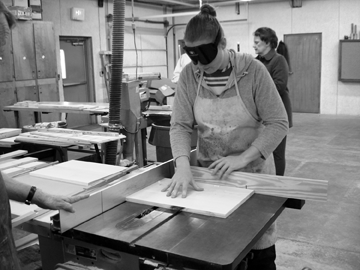
 Industrial
Arts and Home Maintenance: The wood-working shop now occupies space
in a building across a quiet side street beside the main building. This is Jerry
Darnell�s kingdom. Working with JD is James Mays, who graduated himself from
the center several years ago. Before his blindness James held a job that required
him to measure metal parts with extreme accuracy and build his own machines.
Now he teaches LCB students to measure wood and operate the shop equipment safely,
and together they design student projects.
Industrial
Arts and Home Maintenance: The wood-working shop now occupies space
in a building across a quiet side street beside the main building. This is Jerry
Darnell�s kingdom. Working with JD is James Mays, who graduated himself from
the center several years ago. Before his blindness James held a job that required
him to measure metal parts with extreme accuracy and build his own machines.
Now he teaches LCB students to measure wood and operate the shop equipment safely,
and together they design student projects.
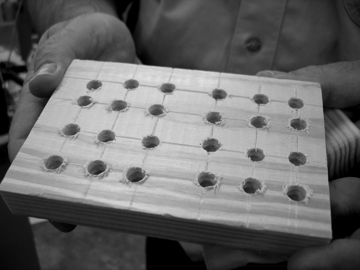
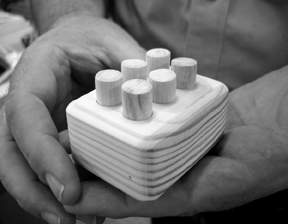
JD and James do all the teaching in the shop rather than depending
on more advanced students to show new ones the ropes. The curriculum requires
that each student complete two important projects: creating grid blocks and
making a number of Braille blocks. They keep working on these projects until
they have mastered the accurate measuring (within a thirty-second of an inch)
and operation of the router, sander, saws of various types, and other wood-working
equipment that the students� final projects will require.
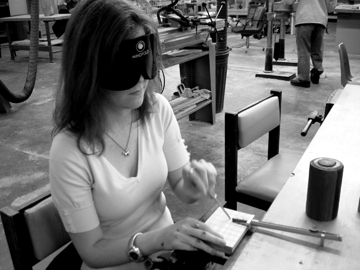 Central
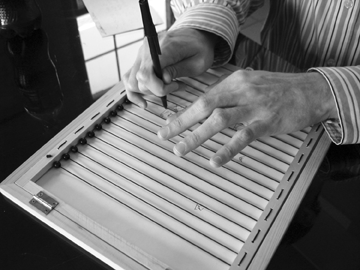
to accurate measuring for LCB students is the click rule, a clever gadget about
a foot long. Extensions to the rule allow one to measure larger distances, but
half of the basic foot-long rule is divided into sixteenth-inch lengths with
a mechanism that makes an audible and tactile click at each division and stops
unless intentionally pushed further. With practice a blind person can measure
distances to a thirty-second of an inch accuracy.
Central
to accurate measuring for LCB students is the click rule, a clever gadget about
a foot long. Extensions to the rule allow one to measure larger distances, but
half of the basic foot-long rule is divided into sixteenth-inch lengths with
a mechanism that makes an audible and tactile click at each division and stops
unless intentionally pushed further. With practice a blind person can measure
distances to a thirty-second of an inch accuracy.
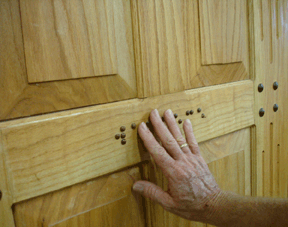 In
addition to observing students working on grid blocks and Braille blocks, we
examined and admired a number of final student projects. One was a two-inch-thick
red oak front door, made to grace a home in New Orleans which was destroyed
by Katrina, before its three-hundred-pound bulk could be hung. Now it awaits
hanging at the Louisiana Center for the Blind. Another magnificent project presented
to the center is a seven-foot grandfather clock that stands in the entryway
of the center�s main building. Most students take their mantle clocks, jewelry
chests, tables, shoe organizers, or other projects home with them as a permanent
remembrance of what they have accomplished.
In
addition to observing students working on grid blocks and Braille blocks, we
examined and admired a number of final student projects. One was a two-inch-thick
red oak front door, made to grace a home in New Orleans which was destroyed
by Katrina, before its three-hundred-pound bulk could be hung. Now it awaits
hanging at the Louisiana Center for the Blind. Another magnificent project presented
to the center is a seven-foot grandfather clock that stands in the entryway
of the center�s main building. Most students take their mantle clocks, jewelry
chests, tables, shoe organizers, or other projects home with them as a permanent
remembrance of what they have accomplished.
 Attached
to the woodshop is a small area where students master home-maintenance skills
like repairing toilets, opening a sink trap to retrieve objects that went down
the drain, dealing with a breaker box, and other such useful skills. Barbara
asked JD if he teaches students to change a washer in a water tap. His response
was typical of the attitude of the staff: �Not usually. Students can often problem-solve
their way through such tasks by the time we are finished with them, but, if
a student wants to learn how to do a specific task, I will be glad to teach
the skill.�
Attached
to the woodshop is a small area where students master home-maintenance skills
like repairing toilets, opening a sink trap to retrieve objects that went down
the drain, dealing with a breaker box, and other such useful skills. Barbara
asked JD if he teaches students to change a washer in a water tap. His response
was typical of the attitude of the staff: �Not usually. Students can often problem-solve
their way through such tasks by the time we are finished with them, but, if
a student wants to learn how to do a specific task, I will be glad to teach
the skill.�
 Home
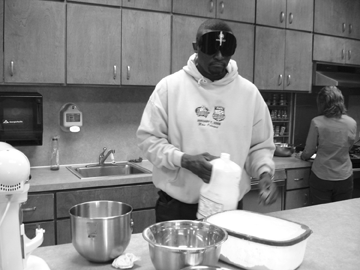
Ec and Home Management: On the center�s second floor are two kitchens
across the hall from each other. One has a dining room behind it. This area
is where some of the most spectacularly enjoyable and down-to-earth of the center�s
activities take place. One morning while we were there, in Merilynn Whittle�s
kitchen one student was learning to make pancakes under Kelly Womack�s supervision.
He had a bit of trouble at the beginning flipping the pancakes in the pan halfway
through the cooking process, but he had no trouble at all sitting down to enjoy
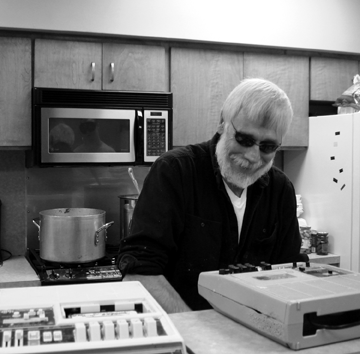
the fruits of his labors. Another student was assembling a carrot cake using
a recipe recorded on cassette tape. A third student was doing the final preparation
of his meal for eight, which he served in the dining room at noon. He had made
the dessert (grasshopper pie) the day before. This morning he was making cheese
and garlic biscuits, chicken cordon bleu, corn on the cob, and tossed salad.
Home
Ec and Home Management: On the center�s second floor are two kitchens
across the hall from each other. One has a dining room behind it. This area
is where some of the most spectacularly enjoyable and down-to-earth of the center�s
activities take place. One morning while we were there, in Merilynn Whittle�s
kitchen one student was learning to make pancakes under Kelly Womack�s supervision.
He had a bit of trouble at the beginning flipping the pancakes in the pan halfway
through the cooking process, but he had no trouble at all sitting down to enjoy
the fruits of his labors. Another student was assembling a carrot cake using
a recipe recorded on cassette tape. A third student was doing the final preparation
of his meal for eight, which he served in the dining room at noon. He had made
the dessert (grasshopper pie) the day before. This morning he was making cheese
and garlic biscuits, chicken cordon bleu, corn on the cob, and tossed salad.
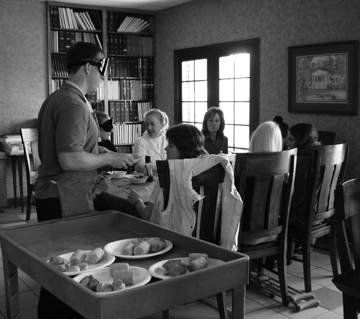 Across
the hall in Jeff Pearcy�s kitchen a student was mastering the intricacies of
bread baking, and another was preparing to make ice cream in a portable ice
cream freezer.
Across
the hall in Jeff Pearcy�s kitchen a student was mastering the intricacies of
bread baking, and another was preparing to make ice cream in a portable ice
cream freezer.
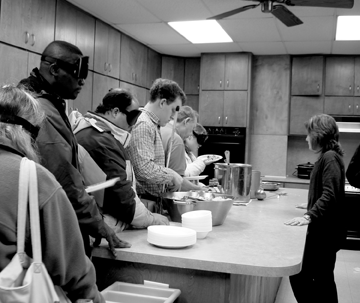
The first day of our visit we were lucky enough to be invited
to Pete�s meal for forty. This is every student�s final cooking project, and
Pete was justifiably proud of the results. He served two variations of Hungarian
goulash along with a big tossed salad, jalapeno cornbread, and brownies for
dessert. These large buffet lunches serve as training for more than the cook.
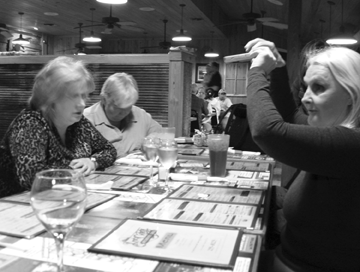
Many blind people have never been expected to serve themselves from a buffet
table. So a staff member, in this case Kelly, stationed herself on the back
side of the buffet line. She was there to identify items and provide advice
about pouring salad dressing, juggling a salad bowl and a paper plate, and transferring
a serving of anything from the pot to a plate.
 Her
advice was so appropriate and was delivered so calmly and quietly that the students
obviously found it easy to take and benefit from. Sometimes students try making
excuses to avoid the dreaded buffet line: I don�t care for that dish; I�m not
hungry. The staff never forces students to eat a meal if they don�t wish to,
but, if they themselves don�t choose to eat they must go through the line and
gather a meal for one of the staff members who is busy doing something else.
By the time we got to the buffet table, it was clear that several spilling accidents
had occurred, but no one was perturbed. Barbara asked who had the job of washing
the floor. The answer was immediate. Students who needed practice washing dishes
might be assigned to help with the cleanup of the mountain of dishes required
to prepare a delicious meal like this one, but washing the floor would be Pete�s
job.
Her
advice was so appropriate and was delivered so calmly and quietly that the students
obviously found it easy to take and benefit from. Sometimes students try making
excuses to avoid the dreaded buffet line: I don�t care for that dish; I�m not
hungry. The staff never forces students to eat a meal if they don�t wish to,
but, if they themselves don�t choose to eat they must go through the line and
gather a meal for one of the staff members who is busy doing something else.
By the time we got to the buffet table, it was clear that several spilling accidents
had occurred, but no one was perturbed. Barbara asked who had the job of washing
the floor. The answer was immediate. Students who needed practice washing dishes
might be assigned to help with the cleanup of the mountain of dishes required
to prepare a delicious meal like this one, but washing the floor would be Pete�s
job.
 Cooking
is hardly the only activity that goes on in the kitchens. One afternoon Jeff
worked with several male students on tying neckties. Another day Merilynn Whittle
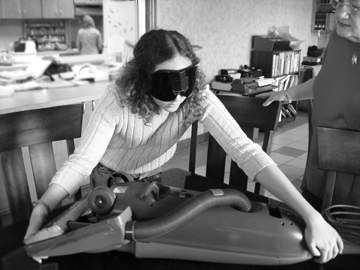
was directing a student who was learning to put a belt back on a vacuum cleaner.
At the same time she was supervising a student who was practicing handwriting
since everyone should be able to form all the print letters and write his or
her signature. Several students were working hard with computer programs drilling
them in math facts. Pam Allen laughed wryly as she explained that many rehabilitation
professionals dismiss the results of the NFB adult training centers. Their explanation
is that our centers take only the cream of the rehabilitation crop�those students
who would do well no matter how demanding or undemanding the training center
was and get on with their lives after returning home. We observed some obviously
bright LCB students who were clearly already successful, but we met and talked
with many others who are dealing with multiple disabilities and deficits. The
realities they were coping with were not about to slow them down. All the students
held high expectations for themselves and for each other. They were clearly
prepared to support and cheer each other. They were helpful and constructive
with one another but resisted the temptation to provide inappropriate assistance
or information. Everyone with whom we spoke understood that high expectations
for themselves and everyone else are the order of every day at an NFB training
center.
Cooking
is hardly the only activity that goes on in the kitchens. One afternoon Jeff
worked with several male students on tying neckties. Another day Merilynn Whittle
was directing a student who was learning to put a belt back on a vacuum cleaner.
At the same time she was supervising a student who was practicing handwriting
since everyone should be able to form all the print letters and write his or
her signature. Several students were working hard with computer programs drilling
them in math facts. Pam Allen laughed wryly as she explained that many rehabilitation
professionals dismiss the results of the NFB adult training centers. Their explanation
is that our centers take only the cream of the rehabilitation crop�those students
who would do well no matter how demanding or undemanding the training center
was and get on with their lives after returning home. We observed some obviously
bright LCB students who were clearly already successful, but we met and talked
with many others who are dealing with multiple disabilities and deficits. The
realities they were coping with were not about to slow them down. All the students
held high expectations for themselves and for each other. They were clearly
prepared to support and cheer each other. They were helpful and constructive
with one another but resisted the temptation to provide inappropriate assistance
or information. Everyone with whom we spoke understood that high expectations
for themselves and everyone else are the order of every day at an NFB training
center.
 Computer
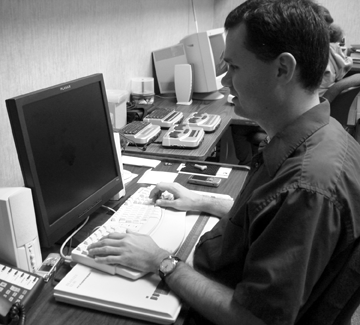
training/keyboarding: Directly beneath the kitchens�not an ideal location when
plumbing problems occur�are the computer labs. Josh Boudreaux and Jewel Ardoin
preside over activity in these rooms. With their calm advice and suggestions
students practice keyboarding skills and search for information on the Internet,
order products, do research, exchange email, create PowerPoint presentations,
and master the finer points of word processing. Just sitting there listening
provided us with some tips on formatting documents. The staff had already acquired
a knfbReader Mobile, which they were learning to use.
Computer
training/keyboarding: Directly beneath the kitchens�not an ideal location when
plumbing problems occur�are the computer labs. Josh Boudreaux and Jewel Ardoin
preside over activity in these rooms. With their calm advice and suggestions
students practice keyboarding skills and search for information on the Internet,
order products, do research, exchange email, create PowerPoint presentations,
and master the finer points of word processing. Just sitting there listening
provided us with some tips on formatting documents. The staff had already acquired
a knfbReader Mobile, which they were learning to use.
 This
brings us to cane travel, perhaps the most spectacular element of NFB center
training. Students get two hours a day of structured-discovery travel training.
Frequently, (but only after the instructor is sure the student is ready) students
receive instructions to go out on travel routes by themselves. The three travel
instructors are currently Arlene Hill, Roland Allen, and Darick Williamson,
who also teaches at Louisiana Tech. They are very careful to give a full description
of the route and to have the student repeat the directions and answer questions
about it to demonstrate their mastery of the assignment. However, often the
instructor goes out with the student. On our first day Arleen was getting ready
to walk back to the student apartments with a new student. She was preparing
him for the day soon when he will make the trip in the morning on his own. The
day we left, seven or eight students and some of the travel instructors were
headed for Monroe in a freak snow storm to work on bus travel�Ruston does not
have any city buses.
This
brings us to cane travel, perhaps the most spectacular element of NFB center
training. Students get two hours a day of structured-discovery travel training.
Frequently, (but only after the instructor is sure the student is ready) students
receive instructions to go out on travel routes by themselves. The three travel
instructors are currently Arlene Hill, Roland Allen, and Darick Williamson,
who also teaches at Louisiana Tech. They are very careful to give a full description
of the route and to have the student repeat the directions and answer questions
about it to demonstrate their mastery of the assignment. However, often the
instructor goes out with the student. On our first day Arleen was getting ready
to walk back to the student apartments with a new student. She was preparing
him for the day soon when he will make the trip in the morning on his own. The
day we left, seven or eight students and some of the travel instructors were
headed for Monroe in a freak snow storm to work on bus travel�Ruston does not
have any city buses.
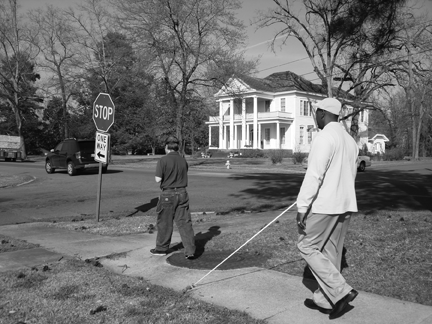 Late
Wednesday afternoon we trailed Adam on a two-mile travel route with Roland Allen.
It was anything but a stroll in the park. We of course had no idea where we
were going, so we couldn�t have cheated by helping Adam even if we had wanted
to. Roland left to run an errand for us during part of this route. Adam went
too far before making a turn. When Roland found us, he asked several pointed
questions, and when Adam had formulated a theory about where he might have gone
wrong, he led us back the way we had come to check out his theory and get back
on track. When we returned to Roland�s office, teacher and student sat down
together to have Adam analyze what had gone well and where he had let his insecurities
lead him into errors. Throughout this exercise Roland was quiet, positive, and
affirming. Adam must have left the center that afternoon feeling good about
his performance and about what he had taught Barbara and Dan about demanding
travel training.
Late
Wednesday afternoon we trailed Adam on a two-mile travel route with Roland Allen.
It was anything but a stroll in the park. We of course had no idea where we
were going, so we couldn�t have cheated by helping Adam even if we had wanted
to. Roland left to run an errand for us during part of this route. Adam went
too far before making a turn. When Roland found us, he asked several pointed
questions, and when Adam had formulated a theory about where he might have gone
wrong, he led us back the way we had come to check out his theory and get back
on track. When we returned to Roland�s office, teacher and student sat down
together to have Adam analyze what had gone well and where he had let his insecurities
lead him into errors. Throughout this exercise Roland was quiet, positive, and
affirming. Adam must have left the center that afternoon feeling good about
his performance and about what he had taught Barbara and Dan about demanding
travel training.
We have already mentioned that students show remarkable initiative
in doing their work. One student took justifiable pride in telling us the story
of a morning when he forgot something he needed during the first class. He had
reached the center before he remembered what he had done. He immediately turned
around and raced back to his apartment, grabbed the item, and trotted back the
half mile to the center. He had missed the announcements, but he was on time
for class. In our three-day visit we never heard an excuse. Instructors are
friendly and accessible, but they don�t waste time, and they structure their
classes so that students don�t have to waste their time waiting for attention.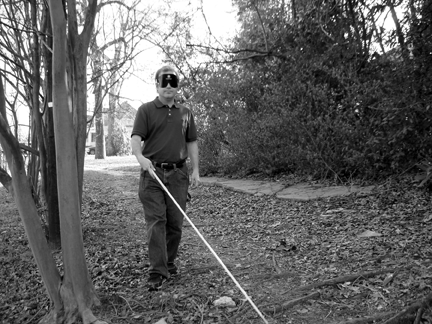
Ruston is a town of somewhat over twenty-one thousand with an
additional ten- to eleven-thousand students at Louisiana Tech University. The
townspeople are friendly and might be tempted to undermine the center�s efforts
to teach its travel students to be independent and to figure out the best course
of action when they are uncertain what to do, except that, throughout LCB�s
twenty-three years of existence, the staff has worked steadily to be a good
corporate citizen and to educate the community about what and how the students
are learning. The result is that LCB students are welcome as customers in community
businesses. Moreover, residents watch with interest and pride as they see students
hone their skills through the months of their programs. They have been known
to comment to staff members on what they have observed, and one suspects that
they now educate each other about when to intervene�when a student might be
in real danger�and when to stand back and let students gather the necessary
data to resolve their problems.
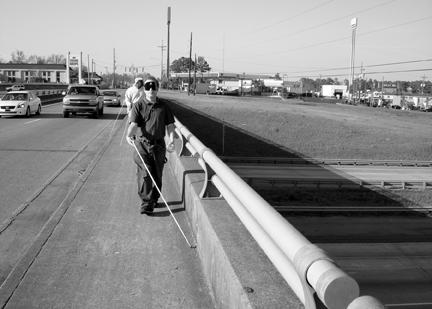 There
are clearly disadvantages in having the center located in small-town America:
no buses or rapid transit easily at hand, an absence of truly complex traffic
patterns, no mobs of shoppers or sports fans to negotiate. Yet the LCB staff
has found ways to introduce such challenges to the students. Besides many benefits
accrue from living and working in a quaint and lovely community comprised of
friendly people. In a small town thirty students constitute something of a market
force. Cashiers automatically count out change by identifying the bills. Most
things are in walking distance. Students really can become part of community
life.
There
are clearly disadvantages in having the center located in small-town America:
no buses or rapid transit easily at hand, an absence of truly complex traffic
patterns, no mobs of shoppers or sports fans to negotiate. Yet the LCB staff
has found ways to introduce such challenges to the students. Besides many benefits
accrue from living and working in a quaint and lovely community comprised of
friendly people. In a small town thirty students constitute something of a market
force. Cashiers automatically count out change by identifying the bills. Most
things are in walking distance. Students really can become part of community
life.
To spend a few days in Ruston and at the Louisiana Center for
the Blind is to want to return, perhaps in another season to appreciate the
community in another mood. While we were there, the baskets hanging from lampposts
were filled with blooming pansies. When the temperature rises in a few weeks,
what flowers will replace them? Later this spring Ruston will conduct a peach
festival. Navigating the booths, displays, and hoards of visitors will provide
new challenges for the students. The Louisiana Center has made a place for itself
in Ruston. Students and staff have mastered the art of southern hospitality.
On the day we said good-bye, students and staff members repeatedly stopped us
to invite us to return and to assure us how much they had enjoyed the seminar
we had conducted the preceding afternoon. As we tried to find the words to thank
Pam Allen for the hospitality we had received, she responded by saying that
she was only grateful that we had had an opportunity to glimpse the miracle
that they watch unfold every day. We understood exactly what she was talking
about.