_______________________________________________________________________________
Braille Monitor
Vol. 62, No. 6 June 2019
Gary Wunder, Editor
Distributed by email, in inkprint, in Braille, and on USB flash drive, by the
The National Federation of the Blind
Mark Riccobono, President
telephone: 410-659-9314
email address: [email protected]
website address: http://www.nfb.org
NFBnet.org: http://www.nfbnet.org
NFB-NEWSLINE® information: 866-504-7300
Like us on Facebook: Facebook.com/nationalfederationoftheblind
Follow us on Twitter: @NFB_Voice
Watch and share our videos: YouTube.com/NationsBlind
Letters to the President, address changes, subscription requests, and orders for NFB literature should be sent to the national office. Articles for the Monitor and letters to the editor may also be sent to the national office or may be emailed to [email protected].
Monitor subscriptions cost the Federation about forty dollars per year. Members are invited,
and nonmembers are requested, to cover the subscription cost. Donations should be
made payable to National Federation of the Blind and sent to:
National Federation of the Blind
200 East Wells Street at Jernigan Place
Baltimore, Maryland 21230-4998
THE NATIONAL FEDERATION OF THE BLIND KNOWS THAT BLINDNESS IS NOT THE CHARACTERISTIC THAT DEFINES YOU OR YOUR FUTURE. EVERY DAY WE RAISE THE EXPECTATIONS OF BLIND PEOPLE, BECAUSE LOW EXPECTATIONS CREATE OBSTACLES BETWEEN BLIND PEOPLE AND OUR DREAMS. YOU CAN LIVE THE LIFE YOU WANT; BLINDNESS IS NOT WHAT HOLDS YOU BACK. THE NATIONAL FEDERATION OF THE BLIND IS NOT AN ORGANIZATION SPEAKING FOR THE BLIND--IT IS THE BLIND SPEAKING FOR OURSELVES.
ISSN 0006-8829
Each issue is recorded on a thumb drive (also called a memory stick or USB flash drive). You can read this audio edition using a computer or a National Library Service digital player. The NLS machine has two slots--the familiar book-cartridge slot just above the retractable carrying handle and a second slot located on the right side near the headphone jack. This smaller slot is used to play thumb drives. Remove the protective rubber pad covering this slot and insert the thumb drive. It will insert only in one position. If you encounter resistance, flip the drive over and try again. (Note: If the cartridge slot is not empty when you insert the thumb drive, the digital player will ignore the thumb drive.) Once the thumb drive is inserted, the player buttons will function as usual for reading digital materials. If you remove the thumb drive to use the player for cartridges, when you insert it again, reading should resume at the point you stopped.
You can transfer the recording of each issue from the thumb drive to your computer or preserve it on the thumb drive. However, because thumb drives can be used hundreds of times, we would appreciate their return in order to stretch our funding. Please use the return envelope enclosed with the drive when you return the device.
Las Vegas Site of 2019 NFB Convention
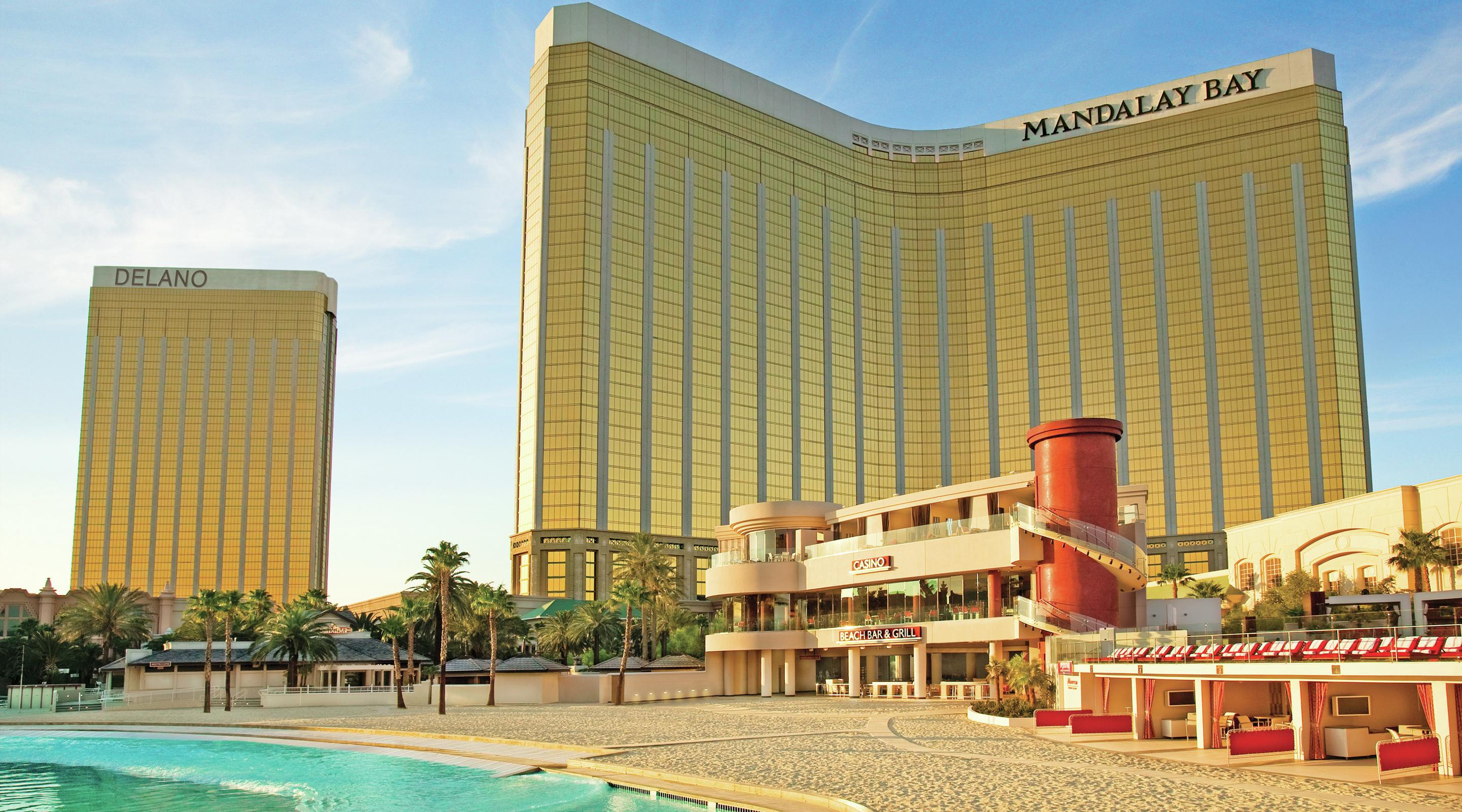 The 2019 convention of the National Federation of the Blind will take place July 7 to July 12, at the Mandalay Bay Resort and Casino, 3950 South Las Vegas Blvd, Las Vegas, Nevada 89119. Make your room reservation as soon as possible with the Mandalay Bay Resort staff only. Call 877-632-9001.
The 2019 room rate of $99 per night applies to singles and doubles as well as triples and quads. Hotel and sales taxes are 13.38 percent and 8.25 percent, respectively. The resort fee (normally $37 a night) will be waived for NFB convention attendees. However, fees for internet access, local and toll-free calls, and fitness center access may apply. The hotel will take a deposit of the first night’s room rate for each room and will require a credit card or a personal check. If you use a credit card, the deposit will be charged against your card immediately. If a reservation is cancelled before Friday, June 1, 2019, half of the deposit will be returned. Otherwise refunds will not be made.
Rooms will be available on a first-come, first-served basis. Reservations may be made before June 1, 2019, assuming that rooms are still available. After that time the hotel will not hold our room block for the convention. In other words, you should get your reservation in soon.
Among its features is an aquatic playground called Mandalay Bay Beach which has real sand, a wave pool, and a lazy river. The hotel is also home to an aquarium with more than 2,000 animals including sharks, green sea turtles, and a Komodo dragon. Plus, it offers top-notch entertainment including Michael Jackson ONE by Cirque du Soleil.
The schedule for the 2019 convention is:
Sunday, July 7 Seminar Day
Monday, July 8 Registration and Resolutions Day
Tuesday, July 9 Board Meeting and Division Day
Wednesday, July 10 Opening Session
Thursday, July 11 Business Session
Friday, July 12 Banquet Day and Adjournment
Vol. 62, No. 6 June 2019
Illustration: Paws for Celebration
Correction
Let Us Play Us: Starting Down the Road to Equality on Stage and Screen
by Julie McGinnity
How Do You Get Around? There’s No One Strategy to Get There
by Sheri Wells-Jensen
How People Who Get It Done Get It Done
by Gary Wunder
The Changing Landscape of Accessible Voting at the Polls
by Lou Ann Blake
Regarding the Colorado Center for the Blind and My Experience
by Luc Gandarias
Leave a Legacy
Social Butterflies at Convention
by the Communications Team
Blindness, Dual Disabilities, and Aira
by Eric Duffy
A Blind Man Whose Business Was Doing Business
by Peggy Chong
Can I Have an Able Account if I am Forty-Fifty-Sixty Years Old?
by Albert Elia
Botany: Growing Plants, Growing Strategies, and Growing People
by James Beck
Recipes
Monitor Miniatures
Copyright 2019 by the National Federation of the Blind
Paws for Celebration
As a blind person, learning how to travel can be one of the most empowering skills one ever gets. For some of us freedom of movement is achieved through using a guide dog. Some of us use a cane. A goodly number use both a dog and a cane and let the situation determine which they will use.
In recognition of the important role guide dogs play in the travel of many blind people, the last Wednesday in April is celebrated as International Guide Dog Day. This year it fell on April 24, and we participated in the celebration by highlighting it on that day. We continue to act as strong advocates through our legal advocacy, our rideshare testing, and our active National Association of Guide Dog Users and its many programs. Moving is essential to a movement, and we proudly recognize our brothers and sisters who travel with their loyal and dedicated guide dogs.
Correction
In the May issue of the Braille Monitor we ran an article entitled “Facts About Blindness” by Joe Orozco. In the editor’s note we credited the article to the Vigilant, but mistakenly referred to it as the newsletter of the National Federation of the Blind of West Virginia. In fact it is the newsletter of the National Federation of the Blind of Virginia. We regret the error, but we very much appreciate all of the letters from Virginia.
Let Us Play Us: Starting Down the Road to Equality on Stage and Screen
by Julie McGinnityFrom the Editor: Julie McGinnity is a program specialist who works at the Jernigan Institute. But as many of us do, she holds different jobs in the organization, and in this article she speaks primarily in her role as the president of the Performing Arts Division.
I remember the first time I was denied a role in a production because of my blindness. In fifth grade we performed a children's version of A Christmas Carol, and I longed for one of the leading roles. Now, elementary school isn't Broadway. In order to earn a leading role, a student had to read, speak, learn, and communicate well. He or she also had to be comfortable performing in front of an audience. Since some of the roles were divided among the students, there was plenty of stardom to go around. And yet, I did not receive one, despite being at the top of my class academically, being clear and perhaps even loud with my verbal communication and having been in voice lessons for the last year. I knew I could sing as well as act up to their standards, and looking back, I know my confidence at the time was not misplaced. However, the music teacher didn't give me a chance because he would not produce the script in Braille, and he believed that I could not navigate the stage independently. I remember parroting lines that were read to me, one line at a time, rather than reading lines and engaging in the dialogue on the script like my peers. One stand-alone line was given to me that I could deliver standing in a group of other students so that I wouldn't be walking by myself on the stage. I was hurt that no one would let me audition for a role I really wanted. The opportunity was denied me, and even worse, I didn't have the language to fight it and advocate for myself.
When I began thinking about the roots of the Let Us Play Us campaign, that recollection came to mind. So many of you can probably relate to my story because it is not unique. It speaks to a pattern that continues to occur in the world of the performing arts. That pattern rests on the low expectations of blind performers and is perpetuated by a lack of opportunity that persists on stage and in the film industry. Let’s dig a little deeper into the Let Us Play Us campaign and what we can do about this problem. Then I hope you will join me in working hard together to break this pattern and open up opportunities for blind performers.
We protested on April 4 in New York City outside CBS headquarters with two immediate goals in mind: We wanted the show In the Dark to be canceled until a blind actress could replace the current choice, who is not blind. We also wanted CBS to consult with us about the show and any future decisions it makes regarding its portrayal of blindness.
But that’s not why I protested. I protested because I, like many Federationists, have had enough.
My voice deserves to be heard, and my experience as a performer should grant me a spot at the table. I am tired of the current narrative surrounding blind performers, and I would like to lead the charge as we speak out. It’s time to turn performers’ dreams into reality and work together as a federation to be heard by the entertainment industry. We would like to develop relationships with those in the industry so that we can work together to create a landscape of equality for blind performers at all skill levels.
Allow me to point out one important fact: Blind people are and can be successful in the performing arts. There are accomplished, professional blind musicians, opera singers, actors, dancers, and more. Although the successful blind performers I’ve met have faced discrimination, they have also been given chances to learn and prove themselves. So, before I begin writing about what we should work to accomplish in this industry, I want you to know that it can be done. My story above was not my end as a performer. The actress, Marilee Talkington, who spoke at our 2018 national convention, did not meet the end of her career when she was discouraged either. But so many blind performers are kept off the stage and away from the film sets. We are questioned, challenged, swept aside, and denied access to learning more on a regular basis. We have received stories from a range of blind performers, from those who could never gain experience on the stage as a child, to those who perform professionally as a career. All of them have one thing in common. They experienced unequal treatment in their performing endeavors.
Blind performers seek equality, opportunity, and full integration in the entertainment industry—lofty goals, I’ve been told. The Let Us Play Us campaign, after all, is a first step. How can we expect full integration when we can’t even play blind characters on TV?
This is nonsense and does not represent the goals and aspirations of the Federation I know and love. The National Federation of the Blind believes in the capabilities of blind people. We believe in each other and live out that belief through our high expectations. We won’t accomplish everything right away. But if we only look at this as one protest, one opportunity for a blind actor to play a blind character, we are doing our blind performers a disservice.
We must consider first how we plan to change attitudes. What attitudes need correcting as we continue this process after Let Us Play Us? After all, nearly all unequal treatment stems from negative attitudes about blindness.
We must begin by rejecting the inspirational model. You’ve all seen them, those inspirational stories written about blind performers who have overcome their blindness. Inspiration may seem uplifting and harmless, but it does not promote an atmosphere of respect for the performer’s talent, education, and skill. The inspirational model defines blind performers by their blindness and does not give them credit for actual accomplishments.
In grad school, after a performance of opera scenes in which I played several solo roles, a professor told me I was inspirational. I replied that I didn’t want to be inspirational; I wanted a job. Blind performers are looking for work, and too often, we are not taken seriously. How can our talents and accomplishments be fairly evaluated and appreciated when we are praised for simply walking on the stage?
While we invest ourselves in overturning harmful attitudes about blind performers, we must also work to open up opportunities for future blind actors. Acting classes, improv groups, and university programs should know that they can come to the National Federation of the Blind when a blind student seeks to join their ranks. I have heard far too many stories about blind hopefuls being turned away from acting classes because the teachers believe it would be too difficult to accommodate a blind student. I have also heard stories, though fewer, involving the success of a blind participant in an acting or theater class. Blind people must learn gesturing and facial expressions differently from our sighted peers, but we can and do learn them. If we allow ourselves to build relationships with these institutions of learning, we can dispel the misconceptions about what it takes for a blind person to learn to act on stage or screen.
Finally, let’s use our organizational platforms to lift up those blind performers who have experienced full integration on stage or in film. Many of us have played a variety of roles that do not involve blindness. If a blind performer has the opportunity to play a blind character, and they are able to make this portrayal authentic to a true blind experience, we should celebrate this as well. I caution us not to wait for this to occur. Blind characters may be appearing more frequently lately, but they are still few and far between when we consider the sheer number of characters that should be open to us in plays and films.
Even as we have undertaken this campaign, I have received questions. Can blind people play sighted characters? Should a blind person act out a role that is specifically meant for a sighted person? Can a blind person really learn to act as though they live in a sighted body? Those are good questions. I would answer them, however, by proudly proclaiming that this has been done before, particularly on stage. I am not the only one who has played a variety of characters in stage productions. The script does not tell us that the nun, the queen, the sassy house maid, or the god of love must be sighted. These are all characters I have played with varying degrees of accommodations as a blind opera singer. On stage the blindness matters less and can be deemed unimportant as the actor fulfills his/her role in the story. It is my understanding that the film world has not gotten to this point, so I urge us to discuss how we will find our place as ordinary characters on TV and in the movies. Let’s begin by highlighting those who have had those experiences and discussing how we will make them work on film as well.
All of these goals can also be accomplished by forming relationships in Hollywood. There are agencies dedicated to diversity and increasing minority representation in film. We should reach out to them as well as to casting agencies, writers’ guilds, and organizations of producers and directors. Staying silent isn’t an option any longer. If we want representation, we must build the relationships and firmly demand that blind people are represented in stories and casts.
In order to accomplish these goals, we need your help. We need your ideas, perspectives, experiences (for those who have them in this area), and your talents. We cannot achieve the representation we seek if only a few of us are fighting for it. Although we have a good start, we are also exploring uncharted waters. We have not yet explored the limits of blind actors and performers. Let’s join together to raise our expectations and achieve the dreams of blind performers.
How Do You Get Around? There’s No One Strategy to Get There
by Sheri Wells-Jensen
From the Editor: Sheri Wells-Jensen is an associate professor at Bowling Green State University in the College of Arts and Sciences. She specializes in linguistics, where she does teaching and research. In this piece she observes that traveling as a blind person is much more than route travel. It is an ongoing exploration. Sheri shows that what we do doesn’t have to be or look perfect; the important thing is that it gets done. Here is what she says:
Like just about everybody who doesn’t drive but needs to get places, I have a lot of interactions with cab drivers. I mean … a lot. Mostly, these involve the basics: exchange of greetings, exchange of information, exchange of cash, and mission accomplished. But there are always those extra exchanges that stick with a person.
“How do you get around?” This particular driver wanted to know, asking just as I was opening the door to exit the cab.
After sitting in companionable silence all the way across town, I was startled by the question. With the door open and one foot on the curb, I didn’t have time to say much. Even by that minimal standard, though, my answer felt inadequate.
“I just … go around,” I said vaguely, distracted. “Like anybody. I take cabs, like this one … or I sometimes walk … you know.”
This piece of brilliant elocution accomplished, I finished extricating myself from his cab, closed the door on his answer, and headed on my inarticulate way across the parking lot and up to my office.
I don’t consider it my job to educate every abled person about blindness or any other disability, but when people aren’t overtly rude, I do at least try to be reasonably congenial and moderately informative most of the time. The poor fellow had probably deserved a little more of my attention, but his question, I realized, juggling phone and keys and cane and computer bag in the elevator, was hard to respond to. He’d wanted there to be a simple answer: the one magic thing that disabled people do to solve the problem. The one “right” way we all pour water, or match our clothes, or pick cat hair off a jacket—the silver bullet that “makes it all possible.” What could I have told him that both would have been true and would have fit into the approximately five seconds I’d been given?
As an experiment, I put the question to the next student who stopped by my office: “How do you get around?” I asked her, pretending this was a normal question one human being might ask another.
I was secretly pleased when her answer was about as inarticulate as mine had been. “What do you mean?” she wanted to know. “Like … on campus? I just … walk mostly, or I take the shuttle sometimes.”
“But what if you don’t really know where you’re going?” I pressed. “What if you had to go to …” I searched for a moderately obscure building I’d had to find, “… Eppler South?”
She hesitated. “That’s by the Union, isn’t it? I’d just like, go over there and look around until I found it, I guess.”
Fair enough. Neither of us was being very clear. She “goes over there” and “looks around.” And she doesn’t think about it.
Despite my inarticulate interaction that morning, I do think about it. And while as a sighted person she has just one primary, half-conscious way of finding a building she needs, I have a basket full of interconnected strategies ready to employ whenever I want to go somewhere—especially somewhere new to me.
Let’s take that example of Eppler South—a building that is, I agree, somewhere over by the Student Union. It is vaguely northwest from my office. I confess that I still don’t know where exactly it is, but the English department faculty, for some reason, had decided to hold a mid-morning meeting over there just a few weeks back.
If I were sighted, I suppose I, too, would wander in that direction and look around until I saw the sign, and then go on in and check room numbers and find the meeting, and that’d be that. You could call that Plan A if you like.
Plan A doesn’t work in the same way for me. So that morning, knowing I had to find this new building, I started with Plan B. It went something like this: About two hours before the meeting, I text a pal of mine who I know is probably going to the same meeting: “hey kimberly u going 2 the department mtg?”
I don’t ask her to go out of her way. If she’s going, I’ll meet up with her somewhere. There’s time. She’s going to use Plan A, and I could follow along.
She replies in under a minute. “mtg? nooooo! going 2 b late!”
We text back and forth for a bit, griping about faculty meetings, and I say finally: “c u there”
Plan C: I try another contact. “Hey [NAME-REDACTED] r u going 2 the mtg?”
[NAME-REDACTED] takes over ten minutes to answer, during which I become a little more alert to the passage of time.
My phone buzzes. “r u kidding? no freaking way!” He adds a few pertinent emoji, including my favorite, the “smiling pile of poo.”
I sympathize. But I do have to go.
An hour and a half later, I take my usual cab to campus, which drops me off near my own office. Things are getting tighter.
Plan D: I stop on the curb and text another pal. “hey chad? r u walking over 2 the mtg?”
Chad replies almost instantly. “already here! 26 minutes early! where r u????”
I choose a sarcastic emoji or two in response and proceed with plan E. I walk over to my building, reasoning that other colleagues will be coming out of there, and I could follow somebody over.
No luck. Either they’ve already left, or like Kimberly they are planning to be late … or maybe they’re on the [NAME-REDACTED] plan—lucky dogs.
The time comes when I can’t wait any longer or I won’t have time for plan F, which I start inventing fast!
So … Plan F: I turn around and head northwest. It’s worth mentioning at this point that it’s raining … that dreary, uncompromising, insistent kind of Midwest rain that likes to last all day just to make you miserable. I get what I figure is about halfway there and pull out my phone again.
I have several GPS apps, some of which work well on campus and some of which don’t. My favorite is Over There by Dmitrijs Prohorenkovs, which grew out of Smith-Kettlewell’s virtual talking signs project. You hold the phone flat like a remote control and point it around, and it identifies landmarks. Trying to keep the rainwater off the screen as best I can, I scan for the building. But it isn’t there. I mean, it literally isn’t there. It’s as if the rain had washed it completely off the map. Fail.
Plan G. It’s time to stop a passerby and get information the old-fashioned way. But the rain has apparently washed all the people off the map too, and I hear nobody near me.
Plan H: Are we really on plan H already? I have just under ten minutes now. Returning to Over There, I do find an entry on the map for “BGSU Something-Something Gymnastics” (I can’t hear well through the increasingly heavy rain), and I remember that the building I’m looking for was a gym once, or still is maybe? If anything near me had anything to do with gymnastics, Eppler South might be it. And it’s kind of in the right direction.
I re-adjust course, choose a sidewalk that seems to trend that way, and step up the pace, sploshing through some pretty impressive puddles I don’t have time to avoid.
The wind is picking up, and I don’t think I’m that close. Plans I through L form in my mind. I could just keep going, which will probably eventually work if I’m right about the gymnastics thing. I could go inside whatever classroom building is nearest (I hear one looming off to my left) and find somebody to ask, or I could re-text one of my pals and ask them to come out to meet me, or I could turn around—which is sounding pretty nice right about now—and take my soggy self back to my office. Maybe [NAME-REDACTED] is there, and we could commiserate.
Plan M presents itself in the form of a colleague of mine walking up behind me with an umbrella and asking if I’m going to the meeting … and if I’d like to go with him because I’m looking a little drowned. And off we go.
Now, if the meeting had been a particularly important one, I would have arranged things more securely ahead of time. Working through my possibilities, I would have come up with three or four totally different plans, each of which could have served as a backup for the others. I could have learned the route ahead of time, or made arrangements to help set up the meeting and accompany someone there, found out if a cab could go directly to Eppler South instead of to my usual drop-off place, or asked around until I found someone else who was definitely going and met up ahead of time, maybe for coffee—making it a win-win situation, especially considering the rain. I would not have been relying on chance or the casual good will of strangers.
And that’s just the thing … my ability to “get around” is much more a set of contingencies than a single, easily articulated method. It grew out of years of cane practice and persistent trial-and-error. It grew from countless times when I got lost, re-found my way, got lost again, and realized that getting lost is neither permanent nor disgraceful. And, most of all, it grew out of the realization that there is no one right way to do anything—that all success is a patchwork of tactics we employ when they are needed.
We start out, reappraise, continue, evaluate, adjust, invent alternatives, actively strategize, and make endless micro-decisions as information flows in. We are improvisational artists, juggling options like plates spinning high above our heads, deftly selecting this strategy or that as we proceed. I wouldn’t say that it’s difficult, but it can be intricate. In any case, it’s definitely too much to describe in five seconds with one foot on the curb and the other still inside a taxi, no matter how articulate you believe yourself to be.
How People Who Get It Done Get It Done
by Gary Wunder
In writing an editor's note for “There’s No One Way to Get There” by Sheri Wells-Jensen, I realized I could not put into it all the things I think must be said about how we get where we are going. The first step to getting things done is realizing that they can be done, even if doing them may be more challenging than we would wish. Most answers to questions are in the affirmative: I do this, this, and this. But in the case of blind people and challenges, what we don't do seems every bit as important. Let me see if I can make something positive out of statements about what people who get along in the world don't do:
People who get things done don't just say, "It shouldn't be this hard." They may think it, but they know that complaining about what shouldn't be is less effective than working within the system to create something closer to what should be.
People who get things done don't just say, "I deserve better than this" when confronted with stressful or anxiety-producing situations. Sure they feel it, but feeling it and letting it immobilize them are two different things. Stress is a normal part of life. So too is some level of anxiety. Some things will always be hard; other things are hard but get easier as we repeatedly do them. But the stumbling block that keeps things hard, creates anger and frustration, and keeps us feeling like victims is the idea that we deserve better. One of my friends said that he has started asking himself how his problems compare to people who live in more difficult places in the world. I have to find a building. I don't know where it is. So how does my need to problem-solve my way to a solution compare with the girl who spends three hours each day going to get water for her family? How does it compare to the unfortunate refugee whose life has been torn apart by a war he didn't start and didn't want? He reminds himself that the issue he is dealing with is smaller, and within his ability to change. It’s hard, and it’s frustrating to have to deal with, but unlike war or physical distance from potable water, he can overcome it for himself.
One message we must find a way to share with blind people so they can live the lives they want is that stress, failing, and wishing things could be easier is a part of everyone's life. I get tired of making routine corrections to text we publish, but I bet my father got tired of moving levers on the machine that dug basements, and my mother tired of sweeping floors that were clean yesterday but were dirtied by foot traffic from all of us who failed to appreciate how much work went into her keeping things clean.
We need to look at the world without thinking of ourselves as disadvantaged or permanently hobbled. We have challenges. Considered together they can seem daunting, but one at a time they are manageable. Whether they are our curses or our salvation we can decide, and helping people see that there really is a decision is part of why the National Federation of the Blind exists. We are here to eliminate barriers, but we are also here to say that we are just as capable of dealing with them as others. We are not frail; we do not consider ourselves entitled to a stress-free world. We will live as best we can, invoking the prayer that has been the salvation of so many: God, grant me the serenity to accept those things I cannot change, courage to change the things I can, and the wisdom to know the difference.
The Changing Landscape of Accessible Voting at the Polls
by Lou Ann Blake
From the Editor: Lou Ann Blake is a very busy woman. She is our go-to person for voting issues, and she is also the deputy executive director for blindness initiatives in the Jernigan Institute. Here is some history about the passage of the Help America Vote Act and what has happened since.
With the passage of the Help America Vote Act (HAVA), blind, low-vision, and other voters with print disabilities have been able to cast a private and independent ballot at the polls. However, the type of accessible voting system used and how it is implemented has changed over the past sixteen years, due in large part to a lack of federal funding once the initial HAVA funds were spent, and increased security concerns surrounding elections in the United States. This article will discuss the transition from a direct recording electronic (DRE) voting system to a paper ballot and optical scan system that the majority of state and local governments have undertaken and the impact this change in voting systems has had on voters with print disabilities. It will also discuss the secrecy of their ballots.
Voting Rights for People with Disabilities
Prior to 2002, when HAVA was signed into law, there was no legal requirement that mandated the right of blind, low-vision, and other people with print disabilities to vote independently. Consequently, before HAVA, voting systems were inaccessible and most voters who were blind or had other print disabilities had to tell their choices to a sighted person and trust that person to mark their ballot as instructed.
HAVA was enacted as a response to the problems that occurred with old mechanical-lever voting machines during the 2000 presidential election. Advocacy efforts led by the National Federation of the Blind (NFB) resulted in HAVA's requirement that at least one accessible voting machine be available in all polling places for federal elections. For the first time in our nation's history, the right of blind and other voters with disabilities to vote privately and independently was guaranteed. However, HAVA only applies to federal elections, and, as a result, there are currently some states that do not provide an accessible voting system for state and local elections. In addition, HAVA does not provide a voter with a disability a right to file a lawsuit when her right to vote privately and independently in a federal election is violated; instead, the US Department of Justice is assigned the authority to enforce HAVA.
Recent changes in US Department of Justice regulations have resulted in the successful application of the Americans with Disabilities Act (ADA) in voting discrimination cases. These regulations extend to state and local elections the rights guaranteed by HAVA to voters with disabilities during federal elections by requiring election officials to provide voters with disabilities an opportunity to exercise their right to vote privately and independently that is equal to the opportunity provided to voters without disabilities. In addition, the ADA provides people with disabilities a private right of action when they have been discriminated against. Therefore, when blind voters in California were not able to vote privately and independently at their polling places because of malfunctioning accessible voting machines, and when blind voters in Maryland were not able to vote absentee privately and independently because of an inaccessible paper ballot, federal courts found that they had been discriminated against under Title II of the ADA.
The First Generation of Accessible Voting Systems
HAVA authorized the Election Assistance Commission (EAC) to administer $3.9 billion in grants to the states so they could replace outdated lever voting machines by January 1, 2006, with either direct-recording electronic (DRE) touch screen voting machines or an optical scan system that included an accessible ballot-marking device. These first-generation accessible voting systems included the Diebold AccuVote, Election Systems & Software (ES&S) AutoMARK, and the Sequoia Edge.
The advantage of the DRE touch screen voting machine was that all voters used the same system. To make this type of system accessible to a blind voter, poll workers simply had to attach headphones and the user interface keypad. Most DRE systems do not produce a paper ballot but record an image of the voter's ballot on an external drive. Unlike the DRE voting system, an optical scan system uses paper ballots that are marked by hand or an accessible ballot marking device (BMD) and then inserted into the optical scan tabulator.
The Move to Paper Ballots and the Second Generation of Accessible Voting Systems
In 2003, shortly after many states had begun implementing voting systems based on a DRE voting machine, computer security experts at Johns Hopkins University performed a security analysis of DRE voting systems that revealed security vulnerabilities. This analysis was followed by others that also raised security concerns, and nervous state legislators started following the lead of the Nevada legislature, which passed a law in 2004 requiring a voting system that produced a voter-verifiable paper record.
The future of voting was all electronic when HAVA was passed in 2002. However, by 2019 that future has changed, with virtually all of the states requiring a paper ballot or voter verifiable paper record in response to the security concerns surrounding DREs. The security concerns and shift away from electronic ballots by election officials has resulted in the discontinuation of the development and manufacture of DRE voting systems by election technology vendors. Consequently, the second generation of accessible voting systems available to state and local election officials consists only of optical scan tabulators and accessible ballot marking devices. Xx These systems include the ExpressVote BMD from Election Systems & Software, the ImageCast Tablet BMD from Dominion Voting Solutions, the Verity Touch Writer BMD from Hart InterCivic, and the Unity Voting System.
Election technology vendors promote BMDs as universal voting systems because they include a touchscreen, as well as accessibility features that enable the majority of voters with disabilities to vote privately and independently. All BMDs include a headphone jack and a user interface keypad so that blind and other print disabled voters can navigate through an audio ballot and privately and independently mark and print their ballot. In addition, the touch screen font size and contrast can be changed to make the ballot marking process easier for voters with low vision. Devices such as sip and puff and jelly switches can also be used with BMDs to make them accessible to voters with dexterity disabilities. In addition to accessibility features, another important feature of BMDs is that they eliminate the problems of stray marks and over-voting that are frequently encountered with hand-marked ballots.
From a Universal System for all Voters to a Segregated System for the Blind
At the time that many states were abandoning a universal DRE voting system because of security concerns, there was no federal money available to purchase the replacement optical scan systems. Consequently, the replacement system that was implemented by most states and local governments relied on the majority of voters hand-marking their ballot and provided only one accessible ballot marking system per polling place. In addition, the fear that a BMD could be hacked through the computer used by election officials to design the ballot and program the software that are loaded onto the BMD has also prevented BMDs from being deployed as a universal voting system. However, these fears may not justify limiting the use of BMDs to voters with disabilities because the US Department of Homeland Security has developed many tools and services to assist state and local election officials and election technology vendors with managing risk to our election infrastructure.
Limiting the use of BMDs to voters with disabilities creates a separate, unequal system for those voters and jeopardizes the secrecy of their ballots. As shown by the blind and low-vision voter surveys conducted by the National Federation of the Blind, the likelihood that the accessible voting system would be set up and running when a blind voter arrived at her polling place has decreased from 87 percent in 2008 to 66 percent in 2016 and 2018, and the likelihood that poll workers had problems setting-up or activating the system increased from 19 percent in 2008 to 33 percent in 2016 and 2018. This forces blind and low-vision voters to wait while poll workers attempt to figure out how to set-up or activate the accessible ballot marking systems. It too often means voters with disabilities are deprived of their right to vote privately and independently and instead must vote with assistance because of poorly trained poll workers. This does not meet the ADA's mandate to provide people with disabilities an opportunity to exercise their right to vote privately and independently that is equal to the opportunity provided to voters without disabilities. If the accessible ballot marking device was used as a universal voting system for use by all voters, it would be far more likely that the BMD would be set-up and running when a voter with a disability arrived at her polling place and that the poll workers would know how to operate the system.
Finally, the secrecy of the ballots cast by voters with disabilities may be jeopardized when the use of the BMD is limited to disabled voters. The ability to cast a secret ballot is vital to our democracy since it enables a voter to vote for the candidate of her choice without fear. However, many of the BMDs currently in use do not enable a voter with a disability to cast a secret ballot because they produce a paper ballot that is different in size from the hand-marked paper ballot. In addition, many of the BMD paper ballots only list the candidates selected by the voter, as compared to the hand-marked paper ballot, which lists all of the candidates for each contest. When a contest is too close to call at the end of Election Day, the ballots are removed from the ballot box for a recount. When the ballot produced by a BMD is different in size and content from the hand-marked ballot, and its use is limited to voters with disabilities, election workers performing the recount will know that a BMD ballot was cast by a voter with a disability. This is not a secret ballot. The mandate of the ADA to provide voters with disabilities an opportunity to exercise their right to vote that is equal to the opportunity that is provided to voters without disabilities has not been met.
Legislative Efforts to Mandate a Segregated Voting System for Voters with Disabilities
The Protecting American Votes and Elections (PAVE) Act, HR 6093, was first introduced into the House of Representatives on June 13, 2018, and while the bill was never voted out of committee, efforts are currently underway to revive it in the Senate. This bill will amend HAVA to require a paper ballot. In addition, it will not allow funds provided under the PAVE Act to be used to purchase BMDs unless they are to be used by voters with disabilities. States will be provided only enough funds under the PAVE Act to purchase one accessible BMD per polling place. Any legislative effort that mandates a paper ballot and a segregated system for voters with disabilities must be vigorously opposed because it fails to provide blind and low-vision voters with an opportunity to exercise their right to vote that is equal to the opportunity provided to nondisabled voters as required by Title II of the ADA.
Surveys of the Blind and Low-Vision Voter Experience
There is no data available that quantifies the specific impact that a segregated, paper-based voting system has on the voting experience of blind and low-vision voters. Similarly, there is no data available that focuses specifically on the issues experienced by voters with disabilities on Election Day in 2018 in the twenty states that were using DREs that were more than a decade old and had outlived their useful life. However, national surveys of blind and low-vision voters conducted by the National Federation of the Blind following the elections in November 2008, 2012, 2014, 2016, and 2018 provide insight on the general experience of blind and low-vision voters during these elections. Trends revealed by the 2016 and 2018 surveys may reveal the impact that the changing landscape of accessible voting has had on voters with disabilities.
Data from the 2018 survey indicates that the percentage of blind voters who voted at the polls (85 percent) was consistent with the data from 2012 through 2016. However, the number of blind voters who voted at the polls and who requested or were offered an accessible voting machine declined significantly from 2016 (92 percent) to 2018 (81 percent) as compared to a steady increase reflected in all prior surveys (63 percent in 2008, 79 percent in 2012, and 88 percent in 2014). The percentage of blind voters surveyed who reported that they were able to cast private and independent ballots decreased from 79 percent in 2016 to 68 percent in 2018, and the percentage of voters who cast their ballots with assistance increased from 17 percent to 29 percent.
For blind voters who cast their ballots on accessible voting machines, the majority of voters surveyed indicate mixed results, especially when compared with 2008. As noted earlier in this article, only 66 percent of the blind voters surveyed in 2016 and 2018 who used an accessible voting system said that it was up and running when they arrived at their polling place, as compared to 87 percent in 2008, 63 percent in 2012, and 74 percent in 2014. The percentage of voters who used accessible voting systems and reported that poll workers had problems setting up or activating the machines remained high in 2016 and 2018, at 33 percent. This compared to 19 percent in 2008, 29 percent in 2014, and 33 percent in 2012. In 2018, 21 percent of blind voters who cast ballots on accessible machines said that poll workers did not provide them with clear instructions on how to use the machines, similar to the results from 2016 (20 percent), but a significant increase from 10 percent in 2014. However, 54 percent of respondents said they did not need such instructions in 2016 and 2018. Only 59 percent of blind voters were able to cast their ballots on accessible machines with no problems in 2018, compared to 87 percent in 2008, 62 percent in 2012, 60 percent in 2014, and 66 percent in 2016. The percentage of blind voters who were able to cast their ballots privately and independently using an accessible voting machine declined to 75 percent in 2018, compared to 86 percent in 2008, 75 percent in 2012, 83 percent in 2014, and 85 percent in 2016.
In 2018, 75 percent of blind voters surveyed indicated that they were somewhat to very satisfied with their voting experience, as compared to 89 percent in 2008, 75 percent in 2012, 78 percent in 2014, and 80 percent in 2016. The percentage of blind voters who were somewhat or very dissatisfied with their voting experience has increased from 11 percent in 2008 to 20 percent in 2018 (compared with 19 percent in 2012, 15 percent in 2014, and 17 percent in 2016). The percentage of surveyed blind voters who said their voting experience was better than their previous experience also declined. The 2018 percentage was 28 percent, compared to 35 percent in 2016 (33 percent in 2008, 27 percent in 2012, and 21 percent in 2014). However, the percentage of blind voters surveyed who said that their experience was worse than their previous experience was higher than all previous surveys at 20 percent, continuing the trend of results from 2012, 2014, and 2016 surveys (17 percent, 15 percent, and 15 percent respectively). This compares with only 7 percent in the 2008 survey results. Finally, the percentage of surveyed blind voters who said they would vote again remained high at 98.8 percent.
When asked what would improve their voting experience, only 15 percent of the blind and low-vision voters who responded to this question in 2018 said it did not need to be improved, as compared to 20 percent in 2016. Thirteen percent of the 2016 responses said that poll workers needed better training on the operation of their accessible voting machines, while 6 percent of the responses said that poll workers needed better training on how to interact properly with a blind voter. In 2018, 21 percent said that better training of poll workers on the accessible voting machine and on how to interact with blind voters would improve their voting experience. In 2016 the need to correct machine breakdowns and malfunctions was noted in 9 percent of responses, while a new machine, better machine, or a machine that worked was mentioned in 11 percent of the 2018 responses.
The data from the 2018 survey highlight several issues that should be of concern to blind and low-vision voters. The percentage of all blind voters surveyed who reported that they were able to cast private and independent ballots decreased from 79 percent in 2016 to 68 percent in 2018. In addition, the number of blind voters who were able to cast a private and independent ballot using an accessible voting machine decreased from 85 percent in 2016 to 75 percent in 2018. In both categories these numbers reverse a trend of steady improvement from 2008 to 2016. The same trend reversal is reflected in the percentage of voters who cast their ballots with assistance, which increased significantly to 29 percent in 2018 from a low of 17 percent in 2016. In 2018 the percentage of voters who were able to cast their vote using an accessible voting machine without any problems was only 59 percent. This continues the steady decline in this category from 2008, when a high of 87 percent experienced no problems when they cast their vote using an accessible voting machine. These trend reversals may reflect the unfamiliarity of poll workers--and to some extent of voters with disabilities with the new accessible BMDs that are now in use in most states. Also, the continued use in some states of DREs that are more than a decade old may also be reflected. As poll workers and voters become more familiar with BMDs, and as the remaining DREs are replaced with BMDs, it will be important to note if data from future surveys reflects a reversal of these trends. To read the entire 2018 Blind and Low-Vision Voter Experience report, visit https://nfb.org/programs-services/center-excellence-nonvisual-access/national-center-nonvisual-election-3.
Conclusion
The move by the majority of states to require a paper ballot or some form of paper record has resulted in the loss of a universal voting system, and the resulting segregated system for voters with disabilities has meant the loss of a secret ballot for many blind, low-vision, and other print disabled voters. In 1954 the United States Supreme Court found the separate but equal doctrine unconstitutional in Brown v. Board of Education. Clearly there is inequality when voters with disabilities do not have a secret ballot because their ballot is different in size and content from the hand-marked ballot. Inequality also exists when only 75 percent of blind voters who used an accessible voting system were able to mark their ballots privately and independently because one-third of poll workers do not know how to setup or operate the system or when the system malfunctions because it is old technology. Restoring a universal voting system will help to resolve these inequities because all ballots will be the same size and have the same content, and the necessity for poll workers to know how to operate the accessible voting system will be stronger because everyone will use the same machine. Finally, a universal BMD system will also prevent the over-voting and stray marks associated with the hand-marking of ballots.
It is vital that all blind and low-vision Americans join in opposition to the unequal treatment we currently experience in the exercise of our right to vote. Let your state and local election officials and state and federal legislators know that you oppose a segregated voting system because separate is not equal. As first-class citizens, we deserve nothing less!
Regarding the Colorado Center for the Blind and My Experience
by Luc Gandarias
From the Editor: Luc Gandarias made a wonderful presentation at the convention of the National Federation of the Blind of Washington, and he writes with a flavor that is seldom seen from someone who will be turning sixteen as you read this. Gary and Denise Mackenstadt were the people who were primarily responsible for recruiting him into the Federation. Luc’s writing displays a wonderful sense of humor and brings quite a lot of wisdom to his subject. I hope that this is but the first of many articles he will write for us.
He has taken his advanced placement biology test using Braille and audio, and he loves math and science. He wants to go to a good university and become an astrophysicist. Luc participates in cross country and in track. He uses a human guide, but does not compete in the disabled category. He loves to bike, and in addition to all the physical outdoor things he does, he loves computer nerdy stuff. He will soon attend the NFB EQ, a week-long engineering program, and he has been accepted to participate in the Microsoft Ninja Camp program later this Summer. Here is what he has to say about his initial reaction to attending the Colorado Center for the Blind and his subsequent reflections on the experience:
Good afternoon fellow Federationists. I am glad to return to the Washington affiliate convention after a year break due to my aunt’s wedding, which was inconveniently scheduled over convention weekend. At any rate, I am here to speak to you today about my summer at the Colorado Center for the Blind (CCB). Before I can talk about the main points, it is important that I give some background. I first learned of CCB while I was at national convention three years ago. My mother and I were returning to our hotel room after a lengthy general session to change and prepare for the banquet when she noticed the CCB table. Immediately she strode over to it with me in tow and began cheerfully firing questions at the CCB rep behind it. I listened in curiously until I heard it mentioned that it was an eight-week program all the way in Colorado, from which point I tuned out the conversation. Clearly having her voracious appetite for answers satiated, mother turned to me and said “Excellent! Guess where you’re going after freshman year.” I, for one, was vehemently opposed to this idea. I was twelve and entering seventh grade at the time. I was certainly opposed to anything that impinged upon my summer pastimes of alternately hanging out with my friends and playing Minecraft. I clearly wasn’t seeing the wisdom in going to such a program, though it would provide the skills training I needed to realize my goals in the professional workspace.
As time wore on, I grew considerably warmer about the idea of going to CCB. I talked with many of my closest Federation family members, who all thought that the Colorado Center was a perfect fit for me. They said the experience would give me a taste of what college living might be like. Another factor that contributed to my newfound desire to attend the program was the additional activities they offered, such as outdoor rock climbing, whitewater rafting, and a 5K run. These activities were all under sleepshades, which I was understandably underwhelmed about. However, what I didn’t realize is that once you’re under sleepshades for eight hours a day anyway, it isn’t a problem to put them on for recreational activities as well.
Eventually the time came for me to attend the program, so my mother and I made the journey down to Littleton to get situated in the apartments. It was then that I met my counselor, a college student in Georgia, and also the president of NABS in that state, named Justin Heard. This is also when I met a fellow student named Brett Camen. I would soon grow quite close to both of these people. After the three-day period of rest while everyone got to know one another, the program came on hard and fast. The home management segment of the program held no real difficulties for me since I have always been expected to cook and help out with the chores at home like any other kid. However, even in the first week, I saw enormous growth in other students at the program as their counselors instructed them on how to complete a basic cooking or cleaning task and then turned them loose to try it themselves. By the end of the program, several students who came to CCB scared to open an oven were making entire meals unsupervised, and that is the power of Structured Discovery.
Though the physical tasks of cooking and cleaning weren’t difficult for me, the aspect of living with three other people was. It was exceedingly hard to keep my possessions separate from those of others. There were even several instances when I went on a mad rampage around the apartment looking for one of my dress shirts that had inexplicably dematerialized from the hanger. To make matters even more convoluted, my counselor and I both wore the same size clothing and had pairs of khakis that were identical. This experience greatly improved my organizational skills, which desperately needed help anyway.
Probably the class that challenged me the most and incited the most growth in my skills was travel. I was a competent cane user before coming to the program, and I had experience using sleepshades, but my skills under them were mediocre at best. This changed quickly, however. CCB mandated that all students were to have their sleepshades on from announcements at the beginning of the day until the bell at the end. This was initially quite difficult for me, and I was caught several times peeking, but I adapted reasonably quickly. After about the second week I didn’t mind not being able to use my sight, but I did mind very much the sticky, itchy, uncomfortable nature of the sleepshades. The temperature was in the high 90s in Littleton after all. However, I slowly grew accustomed to this too.
The first few days of travel class were slow going and mainly consisted of basic cane techniques, but we quickly progressed to lessons navigating different intersections in the neighborhood surrounding the center. When I asked when we would work on traveling to specific locations, I was informed that they would start doing such lessons the following week. This was too long for me to wait, so I planned a trip with one of my friends to go to the Microsoft store in Park Meadows on Thursday of the second week of the program. This store was fifty miles from the apartments, all the way on the other side of Denver, and it involved three train transfers and two busses to get to. Michael and I actually had no real reason to go to this store, because we neither needed nor had the money to purchase anything. The trip was meant to challenge our problem-solving skills and to prove our abilities to the counselors so we could do other such expeditions in the future. This played out well for me since the travel instructors were quite willing to let me go on independent routes or to go with another student. They even permitted me to go to Wells Fargo to resolve an issue with my bank account during center hours—alone of course.
Perhaps the most beloved part of each week at CCB was the Sunday shopping spree and cleaning extravaganza. Students would loudly complain to one another about how long shopping took and how much they didn’t want to clean. I never found cleaning particularly grueling; in fact, it usually took me about a half hour to clean the apartment, which went rather quickly. However, I am in full agreement with the other students regarding the laborious task of shopping for the week. It was mind-numbing and took hours. The shopper’s assistants were slow and rarely acquired the correct items. A list of twenty-five items took nearly two hours to locate, acquire, and check out. At home, I know the layout of all the local stores and can easily find almost any item. A shopping trip like the one described above would take my family and me about twenty minutes total. In spite of this, I feel that it was beneficial to do this on a regular basis. I may have a more efficient method for shopping in my area, but the experience at the center allowed me to see what shopping will be like when I am in college or living on my own. Additionally, creating a weekly budget to provide meals for various eating styles in my apartment was a challenge and a necessary skill to develop. I learned a lot about budget and compromise. Also, I learned how expensive my favorite summer meal of Greek pasta salad is to make when not shopping at Trader Joes.
Truly the most highly anticipated and fun part of the program was the NFB national convention. All eighty-nine students from all three programs were flown to Florida to experience the magic of a national convention. Our trip was excellent. Like normal, we were required to wear our sleepshades from eight in the morning until five in the evening unless we were sitting in a meeting. This amounted to very little time actually wearing the shades since meetings comprised most of the day, but navigating around the hotel under shades was torture. The place was cavernous and echoing in one area, which was difficult to navigate, but not too bad. The lower hall was a different story altogether. It was carpeted and lined with tables that made shorelining impossible. The only way to navigate this hallway was to make an educated guess where the walls were and walk as straight as possible toward the escorts at the end of the hall. This gave me all kinds of mobility practice in a vast and unknown area. It was good experience for my fellow CCB students and me.
General sessions were long but never boring. I have had the good fortune to attend convention three times before this summer, so I knew what to expect. This was not the case for many of my peers, and they were overcome by the sheer number of blind people in one place. Something I noticed among all students during the convention was the desire for involvement in this great organization. Even those most depressed by their condition before coming to the convention were fired up by the NFB philosophy by the end. Interacting with people who share ideas, adventures, and prospects for the future was a new experience for many of us.
All that I learned at CCB can’t be contained in this speech, but one thing I would like to mention before I close is that I will never be a dishwasher. Though my plan has been all along to go to college and study to become a physicist, I am doubly convinced that this will be my path now. At the end of the program, students were assigned to an internship at various local establishments, and my job was a dishwasher at a local restaurant. On the first day, the supervisor told my friend and I that he hoped this internship made sure that we never worked in the restaurant industry, and that set the tone for the rest of the week. On the upside, we were provided free food and anything we wanted to drink the entire time we worked there. I also enjoyed the commute in the morning. It was rather long since we worked in Golden. This commute was made without supervision after the first two days, when we were deemed to have sufficient travel skills to find our own way.
Eight weeks at CCB seemed daunting at the beginning of the summer, and I thought I would lose all my vacation. In the end, I am so happy I went to CCB and came to know the amazing friends that I met. I have people I can call all across the country now. I have lifelong friends, and I got a glimpse of what skills I need beyond my regular school day. Thankfully, my NFB family and early TVI, Denise Mackenstadt, set me on a good path. I only hope that attendance at CCB will be an option for more Washington state students. This is not just a live-in program but a real-life program.
Leave a Legacy
For more than seventy-five years the National Federation of the Blind has worked to transform the dreams of hundreds of thousands of blind people into reality, and with your support we will continue to do so for decades to come. We sincerely hope you will plan to be a part of our enduring movement by adding the National Federation of the Blind as a partial beneficiary in your will. A gift to the National Federation of the Blind in your will is more than just a charitable, tax-deductible donation. It is a way to join in the work to help blind people live the lives they want that leaves a lasting imprint on the lives of thousands of blind children and adults.
With your help, the NFB will continue to:
- Give blind children the gift of literacy through Braille;
- Promote the independent travel of the blind by providing free, long white canes to blind people in need;
- Develop dynamic educational projects and programs that show blind youth that science and math are within their reach;
- Deliver hundreds of accessible newspapers and magazines to provide blind people the essential information necessary to be actively involved in their communities;
- Offer aids and appliances that help seniors losing vision maintain their independence; and
- Fund scholarship programs so that blind people can achieve their dreams.
Plan to Leave a Legacy
Creating a will gives you the final say in what happens to your possessions and is the only way to be sure that your remaining assets are distributed according to your passions and beliefs. Many people fear creating a will or believe it’s not necessary until they are much older. Others think that it’s expensive and confusing. However, it is one of the most important things you will do, and with new online legal programs it is easier and cheaper than ever before. If you do decide to create or revise your will, consider the National Federation of the Blind as a partial beneficiary. Visit www.nfb.org/planned-giving or call 410-659-9314, extension 2422, for more information. Together with love, hope, determination, and your support, we will continue to transform dreams into reality.
Invest in Opportunity
The National Federation of the Blind knows that blindness is not the characteristic that defines you or your future. You can live the life you want; blindness is not what holds you back. A donation to the National Federation of the Blind allows you to invest in a movement that removes the fear from blindness. Your investment is your vote of confidence in the value and capacity of blind people and reflects the high expectations we have for all blind Americans, combating the low expectations that create obstacles between blind people and our dreams.
In 2018 the NFB:
- Distributed over seven thousand canes to blind people across the United States, empowering them to travel safely and independently throughout their communities.
- Hosted forty-eight NFB BELL Academy programs, which served more than three-hundred-and-fifty blind students throughout the United States.
- Provided over one hundred thousand dollars in scholarships to blind students, making a post-secondary education affordable and attainable.
- Delivered audio newspaper and magazine services to 118,900 subscribers, providing free access to over four hundred local, national, and international publications.
- In the third year of the program, over three hundred fifty Braille-writing slates and styluses were given free of charge to blind users.
Just imagine what we’ll do next year, and, with your help, what can be accomplished for years to come. Below are just a few of the many diverse, tax-deductible ways you can lend your support to the National Federation of the Blind.
Vehicle Donation Program
The NFB now accepts donated vehicles, including cars, trucks, boats, motorcycles, or recreational vehicles. Just call 855-659-9314 toll-free, and a representative can make arrangements to pick up your donation—it doesn’t have to be working. We can also answer any questions you have.
General Donation
General donations help support the ongoing programs of the NFB and the work to help blind people live the lives they want. Donate online with a credit card or through the mail with check or money order. Visit www.nfb.org/make-gift for more information.
Bequests
Even if you can’t afford a gift right now, including the National Federation of the Blind in your will enables you to contribute by expressing your commitment to the organization and promises support for future generations of blind people across the country. Visit www.nfb.org/planned-giving or call 410-659-9314, extension 2422, for more information.
Pre-Authorized Contribution
Through the Pre-Authorized Contribution (PAC) program, supporters sustain the efforts of the National Federation of the Blind by making recurring monthly donations by direct withdraw of funds from a checking account or a charge to a credit card. To enroll, visit www.nfb.org/make-gift, and complete the Pre-Authorized Contribution form, and return it to the address listed on the form.
Social Butterflies at National Convention
by the Communications Team
From the Editor: The Communications Team is headed by Stephanie Cascone, and serving with her on that team are our web guru, Alyssa Vetro; our director of public relations, Chris Danielsen; and our director of social media, Karen Anderson. I have the pleasure of getting to sit in on and contribute to the deliberations of the committee, which I value as a way to know more about what's going on and a way to get good ideas for the Braille Monitor. Here is what the team has to say about participating on social media during our 2019 National Convention:
Whether or not you consider yourself to be a social butterfly, national convention is one of the best opportunities for in-person engagement and connection with your Federation family. However, there is another way to also amplify the experience. If you’re attending national convention or unable to attend this year, connect with members, other attendees, and the session topics online through social media. Let’s leave the cocoon and explore the many blossoming platforms that you can land on to engage with us during convention.
Social media allows for our voices to be heard on digital public forums, although most can be also set to private, and it’s a way to have conversations with each other anywhere from a smartphone or desktop computer. Similar to butterflies, we can glide back and forth from different platforms as much or as little as we would like. Here is some general information about the various social media platforms:
The idea behind Twitter is to say what you are thinking or doing very concisely, in 280 characters or less. When you sign up for Twitter, you’ll create a username or handle. This is what people will associate with you along with the name you list. For example, our National Federation of the Blind username is NFB_Voice. In your profile, you’ll be able to edit a little more information about yourself such as a brief bio, your picture, and your location. When you create a tweet, which is what posts are called on Twitter, it will be listed under your profile. By placing the @ symbol in front of a username, you can tag, or mention, another user in your tweet.
- A follower is someone who follows you on Twitter and sees your updates on their home feed, and you can follow people back to see their tweets in your home feed.
- Your home timeline displays a stream of tweets from accounts you have chosen to follow on Twitter.
- Retweet (RT) is a way for someone to share a tweet from another user’s account.
- Hashtag is the act of using the # symbol in front of any word or phrase to tag your tweets. When someone clicks that hashtag, they see your tweet along with everyone else’s tweets using that same exact term.
- Alt-text for images—be sure to turn on the feature to compose image descriptions that can be found in settings. If you create a post with an image, a field will then populate to include the description.
- If you are using Twitter on your iPhone or Android, the Twitter app is fairly accessible. On iOS, Twitterrific is another popular app that has taken accessibility very seriously. On your desktop computer, you can use Twitter by going to the website twitter.com. You can also choose to download a client such as OpenTween or Chicken Nugget. Because of Twitter’s decisions about what to allow outside apps to access, these clients are not always up to date with your direct messages, but they do provide an ad-free and easy-to-access way of reading and writing tweets.
It is worth noting that we will be live-tweeting much of the 2019 National Convention, so make sure to follow us.
Facebook is arguably the most popular social media platform. On it you can “friend” people you know and keep up with what they are doing, join groups related to things you are interested in, and follow the “pages” of companies and organizations you are interested in. For example, you can find us on Facebook by searching for “National Federation of the Blind.”
If you are using an iOS or Android device to interact with Facebook, you should download the Facebook app. If you are using your desktop or laptop computer for Facebook, you use the website facebook.com. Alternatively, you can use m.facebook.com for a “lighter” experience. By lighter we mean fewer options as the downside but easier screens and more obvious options on the upside.
During the convention, there may be various times in which we Facebook Live. This is a video that is streaming on the platform that allows you to watch and comment. We’ll be sure to post the expected times prior to, so those at home or work can be ready.
Facebook has recently added the ability to add alt text to photos using the mobile app. To do this, create the post and share it. Once you have done that, find the post in your newsfeed and double tap on it. Double tap on the picture, and then double tap on “more.” In that menu you should find the option to edit alt text.
Instagram and LinkedIn
The newest flowers that we in the NFB are pollinating are Instagram (IG) and LinkedIn.
Instagram is a primarily picture-based social media platform. While this doesn’t sound like something that will interest many blind people, the ability to add alt text to pictures was recently added, and this makes IG a much more enjoyable experience. There are also Instagram videos which can be enjoyable, so make sure to follow us @NFB_Voice.
LinkedIn is a great social media tool if you are looking for a job or if you are an employer looking to hire someone. The goal of LinkedIn is to connect people and to show off your resumé and experience.
You can currently add alt text on LinkedIn only by using the desktop site. Once you have uploaded your image, click on “add description” to add alt text.
You can find us on LinkedIn by searching for National Federation of the Blind.
Flying Away
In conclusion, it would be great to connect on social media. If you’re new to it, it’s ok to give it a taste and see what you enjoy. Whether you choose one platform or all of them, social media can add value to your convention experience and might even help you meet people you had not met before. We look forward to strengthening connections and creating new ones through these various platforms.
Blindness, Dual Disabilities, the Federation, and Aira
by Eric Duffy
From the Editor: Eric Duffy lives in Ohio, and he is well-known in the Federation for his service as the president of the Ohio affiliate, his work at the Jernigan Institute as the director of technology, and the kindness and enthusiasm he brings to everything he does. This first appeared in the spring issue of the Buckeye Bulletin and has been updated as a result of recent discussions ongoing at Aira. Here is what he has to say about functioning with dual disabilities.
Neither of my parents graduated from high school, but they both had more than a healthy dose of common sense. I was born at least two months early in 1963. I was quickly placed in an incubator, which of course saved my life, but it also left me blind. I don’t know how old I was when my mom took me to the doctor and said to him, “This baby is blind.”
The doctor said, “Lady, there is nothing wrong with this baby.”
My mom said, “He doesn’t look around, and he doesn’t turn his head until he hears a sound.” She said, “I’ve had enough children to know what I’m talking about.”
After a little more convincing by my mom, the doctor performed some tests and told her she was right. He said, “Your son is blind, and the best you can do is to take him home, keep him clean, and take good care of him. Someone will have to care for him for the rest of his life.” That is the story my mom told me more than once many years later.
Of course my parents were devastated. They knew nothing about blindness. They had just been told that their youngest son was going to have to be cared for for the rest of his life. But their troubles weren’t over yet.
My mom soon noticed that I wasn’t reaching some of the appropriate milestones for movement, such as sitting up, crawling, and walking. The doctors eventually told her that I had cerebral palsy. They wanted her to put braces on my legs at night and get me into physical therapy.
I remember the braces and the physical therapy all too well. The braces were heavy, they felt tight on my legs, and if they thought it was hard for me to walk before, what were they thinking the braces were going to do? So naturally I fought the braces and the therapy.
When I was still very young, I remember having two surgeries on my legs to lengthen muscles. For some little time I walked on my tiptoes. I remember being in casts for months. And of course there was more physical therapy.
When most kids my age were starting kindergarten and first grade, I was dealing with leg surgeries and their aftermath. I wasn’t thinking about school, and neither were my parents. I had to walk better before I could go to school, so I started school at a later age than most kids.
I have a younger sister, and of course she was walking, running, jumping, and doing a lot of physical activities long before I was. So at some point in my life I learned that I was different from everyone else in my family. I was told that I was blind. I was told that I couldn’t walk like everyone else. I don’t know when I heard the term “cerebral palsy” for the first time, but I do remember being told that I couldn’t do certain things until I learned to walk better.
I was also told that I was going to go to the school for the blind and that I was going to have to stay there during the week and come home on the weekends. I wanted no part of that. When the day came for me to go to the school for testing, I told my mom that I wasn’t going to do it. She could take me there, but I wasn’t going to talk to them.
Well, I did what I said I wasn’t going to do, and they got the testing done. I don’t remember how that happened. But they told my mom that I wasn’t going to be able to read and write Braille. They said that my hands weren’t strong enough. I heard my mom telling other people this. By that time, I wanted to learn to read and write Braille. I was placed in the classroom of first grade teacher Mary Butler. She started teaching me to read and write Braille. I started school in April, and by June I could read and write Braille as well as anyone in my class. In fact, one evening, when my dad came to pick me up, they called him into the office and asked him who was teaching me Braille at home. He said that no one was. No one in my family knew Braille. They told him they couldn’t believe how fast I was learning to read and write.
Their concerns about my physical strength were put to rest also. I played on the playground, took physical education, and did the same things that the rest of the kids did. To their credit, that is exactly what the teachers and staff at the school encouraged me to do. I soon figured out that I couldn’t run, jump, and do some of the things that the others in my class could do. I also didn’t take long to figure out that, if I could use my upper body to compensate in any way for the leg strength that I didn’t have, I would have a great equalizer. I started to do things to build my upper body strength. While everyone else was running around, I was hanging on the monkey bars and the jungle gym. I knew that I could build my hand and arm strength and that doing so was going to be to my advantage. I don’t remember anyone telling me to do this. It just made sense.
As most boys do, my friends and I liked to wrestle, and yes, occasionally we got into fights. Word soon had it that whatever you do you can’t let Duffy get his hands on you. If he gets his hands on you, it’s all over. You’re done.
I wrestled in elementary school and made the high school varsity team. Balance and leg strength just weren’t a big issue anymore. I completed all of my physical education requirements, from which I could have gotten an exemption. At some point I got smart enough to realize the long-term value of physical therapy, and I actually volunteered for it. So it went throughout my time at the school for the blind until it came to orientation and mobility.
I was given basic cane travel instruction. In fact, I had permission to leave the campus alone and travel to nearby locations. As I continued to work with instructors, however, they became concerned with the fact that I fell occasionally. For me it was not a big deal. I fell, got up, and kept going. But the school decided that they were no longer going to give me orientation and mobility instruction. When I asked what I was supposed to do when I started college, I was told, “You’re smart enough to figure it out.”
Figure it out I did. I taught myself to use the bus system in Columbus. I was soon traveling wherever I wanted to go. I then began to question why so many people were nervous about traveling in new places alone. Why did we have to have these highly educated professionals teaching travel? It just didn’t seem to be a big deal.
As I began spending time around other Federationists, I learned that there were others who didn’t spend a lot of time thinking about how to get from one point to another. Like me, they thought traveling as a blind person just wasn’t something to spend a whole lot of time thinking and worrying about. I got a lot of good tips from Barbara Pierce and Bob Eschbach.
There came a time when I was elected to the board of directors of the National Federation of the Blind of Ohio. This meant that I was also traveling on behalf of the organization. Sometimes during that travel I would fall. No one made a big deal of those falls. One time, as I was walking through a gas station with a glass Coke bottle in my hand, my foot hit a pump island. I went down. The bottle broke, and my hand was cut. The cut seemed bad, so I went to a nearby fire station and from there to an urgent care center. I went from the urgent care center to an emergency room, where they told me I needed stitches. I won’t take up space here describing everything I said to try to convince the doctors that I didn’t need stitches. Let’s just say that they weren’t amused when I started talking about what I had learned about stitches in medical school.
Long before that point I had come to understand that society tends to judge all blind people on interactions with just one or two blind people. I was proud of the work that the Federation was doing and that I was beginning to be a part of the leadership in Ohio. But I also knew I had balance problems. I did not want people to judge our work and our organization based on my falls. I called Barbara Pierce and told her what had happened. I also told her that, if she thought I should, I was prepared to resign from the board.
She said she wouldn’t hear of it. She said, “You didn’t fall because you’re blind.” After that point I had no more questions. It was a refreshing change to go from a school where I was told that I wasn’t good enough for its orientation and mobility program to an organization that embraced me.
I have often heard people criticize the Federation by saying that we are not accepting of people with multiple disabilities. When it is pointed out that I have a disability other than blindness and that I am a leader in the Ohio affiliate, the critics don’t know how to respond. I was once walking with Jim Gashel and other Federationists at a rather fast pace while Jim was still employed as the director of strategic initiatives for the Federation. We were walking on some narrow and rather uneven sidewalks. Jim asked if I would like to take his arm. I did, and I began to explain about the cerebral palsy. Jim simply said, “I know,” and we didn’t discuss it any further.
John Paré has always been good about pointing out ramps and asking whether or not I need assistance when steps were the best way to go. President Riccobono has done the same thing when we have walked together. All of this is part of the reason I say the Federation is an accepting family that I’m proud to be a part of.
In 2016 I began to use what was then a new service called Aira. When signing up for the service, I created an online profile. I was asked if there were health issues or medical concerns that I wanted Aira to know about. I did not mention the cerebral palsy. I said nothing about balance concerns.
While taking my first walk using the Aira glasses, I hit my foot on the bottom of a construction fence. The Aira agent had told me the fence was there, and I touched it with my cane. Nevertheless, as I walked along the fence, my foot hit one of the supports that were sticking out, and I went down. I popped up quickly and went on walking. Of course the agent asked me if I was ok, and I said I was fine. I continued my walk to the Walgreen’s store. When I reached into my pocket to get my wallet, I noticed there was a problem with the little finger on my left hand. Actually, I thought I had broken it. That night I spent several hours in the emergency room only to find out that it was a sprain. I never told anyone at Aira until about eighteen months later when I had lunch with the agent with whom I had been working when the fall happened.
In late July of 2017 I was walking to a barbershop in Baltimore. The Aira agent told me I was approaching construction ahead. She suggested that I turn around, walk back to the corner, cross the street, get past the construction, and cross the street again. I said no, that sounded way too time-consuming. I said I would step out into the street and get around the construction that way. Wouldn’t you know it, my foot hit a traffic cone, and I went down. A very concerned Aira agent asked if I was ok, and I told her that I was. I could hear the concern in her voice, and I tried to reassure her. I continued my walk to the barbershop, got my haircut, and walked back to the Jernigan Institute.
Later that evening I received a call from an Aira team lead. He and I had developed a good rapport. He said he was calling out of personal concern and because the Aira agent had reported my fall and that she was very concerned. I assured him that I was fine and that there was no further need for worry.
I knew then, however, that something had to change. I then called my friend Amy who is still a vice president at Aira. I explained what had happened, and of course she was already aware of my fall. I told her about the cerebral palsy. I told her that it is something I have dealt with all of my life. I explained that I know how to fall without getting hurt. I also said that, if I needed medical assistance after a fall while I was working with an Aira agent, I would let the agent know. I told Amy that I understand that the agents will be concerned when I fall and that in fact I appreciate the concern. But I said that I am always going to fall. Sometimes I will fall while working with an Aira agent. But somehow, you have to help me deliver the message to the agents that, if I fall and tell them that I’m ok, I am ok. We should go on as normal. I can’t have agents panic every time I fall.
Much to Amy’s credit and to that of Aira, the message has gotten through. New agents get it as well. My falling is not a big deal to me, to the Federation, or to Aira, and that is how it should be.
I believe Aira has saved me from many falls. They can spot uneven terrain ahead and warn me of it in advance. They point out rough or cracked sidewalks. As I get older, falling takes a bigger toll on my arms and shoulders, so I appreciate it when an Aira agent or anyone else for that matter helps me avoid a fall.
Aira has a policy that requires agents to remain silent while an explorer is crossing the street. At first glance this policy makes sense. However, many people want to know when they are veering into the parallel traffic. This kind of information can be extremely helpful to those with hearing loss. I would like to know when I am veering, and I would also like to be directed to the curb cut. An agent giving direction while I am crossing can help me avoid a fall. I am one of Aira’s biggest champions, and I have been since the first time I used it on that walk to Walgreen’s when I sprained my finger. I will continue to champion Aira, but I am making a simple request. Let me check a box, sign a waiver, or do something to indicate that I understand the company’s street-crossing policy, but I am waiving liability in order to get the information I need.
Many of us have been in ongoing discussions with Aira about this policy for more than a year. They tell us they are listening. They hear our concerns. I believe them, and I believe they will be responsive. I know many of the people in the administration of Aira. They are good people, and I believe they want to provide the best service possible while protecting the best interests of the company.
I do not know how the revised policy Aira is working on will turn out, but I am an optimist, and I believe the change will be acceptable to all concerned. Whether or not it turns out to my liking, I will continue to use Aira just as much as I always have. I will continue to champion the service as much as I always have. But I am intelligent enough to ask for the information I need and use it in a responsible and appropriate way, and I trust Aira to know this and to act accordingly.
A Blind Man Whose Business Was Doing Business
by Peggy Chong
From the Editor: Peggy Chong is an exceedingly active member of the National Federation of the Blind, and she makes frequent valuable contributions to the Braille Monitor. In addition, each month she sends out an email to her growing list of subscribers, with the topic of the month from The Blind History Lady. Below is her April email. If you would like to subscribe to The Blind History Lady’s email, send a note to [email protected].
Happy Spring to my Blind History Lady fans. This time of year cures my cabin fever. I like to get out and find new places to go. My story this month is about a man who got out and tried varied careers and modes of transportation in the late 1800s. If not for a few newspaper articles, William would go unnoticed to the world. He thought of himself as just an average guy working at whatever he could to support his family. I am sure he loved spring as well.
He had little education and many hard breaks in life. In some ways, his hard breaks are what made him a relatively successful businessman, father, and husband. May I introduce to you William Branch.
William Nicols Branch was born in July of 1852 to William H. and Mary Branch in Hamilton County, Ohio. Soon after his birth, his parents moved to the Ramsey County area of Minnesota. Father William and an older brother also named William H. were carpenters and bricklayers, a good profession for the new state and its growing communities. The Branch family had six children in total, William being the third.
It is believed that William became blind at a young age. In about 1865, the school for the blind in Faribault knew of him but had not been able to convince his family to enroll him as a student at that time. The institution was new. The first class did not begin until 1866, and many parents labored under the false impression that the school was also an asylum—a place where one might put a family member away who was feeble-minded; a place where people went in but did not come out; a place to get sick or stay for the rest of one's life. They certainly did not think it was a school.
In 1867 at the age of 15, William was finally enrolled by his parents at the school for the blind. At that time the school for the blind and the school for the deaf were housed in the same buildings. There were far more deaf students than blind students, and there was only one instructor for blind children for the first few years of the program.
While at school William learned to play music for a trade. He played the piano, organ, violin, base, and flute in the school presentations, musical reviews, and annual concerts. During his time at the school, there was not a class in piano tuning. Indeed, the only occupational training that was available for blind students was that of a cooper (barrel builder).
After leaving the school in 1873, he moved back to the St. Paul area near family. He is not listed as a graduate, most likely because he was an older student who was focusing on employment. William's father had died on New Year's Eve of 1872. Because there was little support for a widow, William could not rely on his mother or family to support a blind child; he had to make it on his own.
For a time he tried being a milkman, delivering milk door-to-door on a horse for the rural neighborhood. His horse worked something like a guide dog. William listened for fences, groves of trees, or other landmarks to indicate a drive. William tugged the reigns to tell the horse what direction to turn. The job was short lived.
You may wonder how he even thought about riding a horse by himself. When he was a young boy, William showed off his horse-riding skills at the Dan Rice Circus one night. It was late after dark—a disadvantage to many of the boys and young men who wished to ride the trick mule pony of the circus. There was little lamplight for the sighted boys, but being blind and having little usable vision, the lack of light did not bother young William. He accepted the challenge of trying to stay on the bucking mule. He did stay on and won the five-dollar prize that night for his accomplishments. When he got home later that night and told his family that he won the money, he got a "licking" from his father for trying such a stunt.
Next, he took a job in a piano factory in St. Paul where pianos were built, repaired, and tuned. He worked in the tuning room with other blind and sighted piano tuners. Here is where he learned the profession most thought of as possible for the blind. According to William, the blind employees were the best at the shop because they paid attention to the little details. He befriended the blind men and eagerly learned their craft.
Music helped him to earn money. William played the piano, violin, cornet, flute, and clarinet. All of these he played with better-than-average skill. Knowing how to play several instruments meant that he could also get jobs playing music for many occasions. He could sit in for another musician in another band at short notice. He would travel by streetcar or walk to most of his engagements just as he did in getting to the piano factory.
In 1876 William married Nellie, a woman five years his junior, who immigrated from Sweden in 1869. The couple had four children. Sadly, their two boys died at very young ages. James was born in 1877 and George in 1879. Neither boy made it to his fifth birthday. The couple later had daughter Sara, born in 1888, and Lillian, born in 1898.
In 1890 William worked out of his home that he purchased that year at 981 Margaret Street in St. Paul. Few blind people could afford to purchase a home, so even though one of his businesses did not succeed, the combination of all his efforts provided for his family. Besides piano tuning he also advertised as an acupuncturist out of their home. This particular business was not very successful, and after a few years he no longer advertised the service. No records show where he received training for this profession.
Some tuners hired children to lead them around or had their own children do so. In William’s case, there is no indication that he used a sighted guide at all. His sons died before being able to do so. His daughters were born much later. There is no mention of William’s wife in news articles, leading me to believe that she did not act as his guide either.
To get to his various piano-tuning jobs, William rode a bicycle through St. Paul for many years. A blind man riding a bike? Yes, it was not as unusual as you would think in the Twin Cities. Once one piano tuner tried it and succeeded, others did the same. The ruts in the road from the wagons left a deep trail to follow and helped keep the wheels of the bike inside of the wagon rut. By listening and noting the changes in ruts, he recognized intersections and large alleys or driveways. He noted the change in the air. A sudden breeze could mean an alley or a taller building.
William rode a horse through town if he could rent one. Of course, it was important for him to know where he was going when riding. A horse does not want to injure itself and avoids obstacles that the blind rider might not notice; this made it even more difficult for William to know where he was and where he intended to go.
Walking alone on the streets of St. Paul, William often was offered help. Sometimes he needed the assistance; most times he did not. Sometimes he would ask for assistance or directions. Once in a while he would walk with a fellow citizen to his next destination or to a street he was looking for. This proved to be a great opportunity to educate the public about blindness and also allowed him to drum up a little business as a piano tuner and musician.
William passed away on May 26, 1907, in St. Paul. He was fifty-five and left his widow with one young child. In 1910 Nellie still lived in the house and had enough funds to support her young daughter without working. Daughter Sara, “Sadie” lived with her mother and was a piano teacher, a skill she had learned from her father. William left enough behind to keep his wife until her death decades later.
You can read my books at www.theblindhistorylady.com.
Can I Have an ABLE Account if I am Forty-Fifty-Sixty Years Old?
by Albert Elia
From the Editor: This informative article was taken from the Spring 2019 issue of the Braille Spectator, the newsletter of the National Federation of the Blind of Maryland. Here is the way it was introduced:
Editor’s Note: Recently, Congress enacted legislation that permitted the blind, and others with disabilities, to establish ABLE savings accounts that will largely not affect their eligibility for Supplemental Security Income (SSI), Medicaid, and other public benefits. Albert Elia, an ABLE expert, an attorney with TRE Legal, and a member of the National Federation of the Blind, gave the following presentation at the 2018 Annual Convention of the National Federation of the Blind of Maryland.
An ABLE account is kind of like a 529 college savings plan, only it’s for people who have disabilities. If you’re familiar with a ROTH IRA, an ABLE account works very much like that. You can invest money in an ABLE account and do not pay taxes on any growth that you get in the account; thus you can put money into it and use it like a savings account. The interest is tax-free, or there are investment options just like a typical retirement account and those, too, grow tax-free.
Now, it’s important to know whether you qualify to get an ABLE account. It is only for people with disabilities, and you must have had a qualifying disability—blindness is a qualifying disability—before the age of twenty-six. So if you are currently blind and are under the age of twenty-six, you need to have an ABLE account. For example: you win an NFB scholarship, and you have all this money that you got from the NFB, and you deposit it into your bank account. Then all of a sudden your Supplemental Security Income (SSI) benefit goes away because you have too much money in your bank account. That won’t happen with ABLE.
One of the main purposes of ABLE is to ensure that all of the means-tested government benefits, like Medicaid and SSI, are not affected if you have money saved in an ABLE account. As in the earlier example, say you are a student; you have scholarship money, all the money you get from your relatives to go to college and to pay for expenses, and anything that you earn from a college job. You put all of that in the ABLE account, and it does not impact your SSI.
Second, you can use it for any disability-related quality-of-life expense. This can basically mean anything that is legal. So no buying drugs, but otherwise you can pretty much use ABLE for anything that you want. You can use it to buy the self-driving car or to pay for an Uber. You can use it to pay for health care, or housing, or tuition. You can use it to pay for pretty much anything, as long as it is a thing that increases your quality of life.
Now, for everyone here who is not currently under the age of twenty-six, if you were disabled prior to the age of twenty-six you can still open an ABLE account. For instance, I am currently forty-four years old, and I became legally blind at the age of seventeen. Last year I was allowed to open an ABLE account because I was legally blind, I was disabled, and this disability occurred prior to the age of twenty-six. So if you were disabled—you were legally blind or had another qualifying disability—prior to the age of twenty-six, then no matter what your current age is, you can open an ABLE account that will, basically, allow you to save money tax-free for disability-related expenses or for retirement. However, you can use that money before retirement if necessary; it is basically like free money that can’t be taxed. And let’s face it, we need more free money that can’t be taxed so that we can support NFB, and then give NFB some of the money, right?
For those of you who don’t have an ABLE account, I want to give you two websites. One is www.ablenrc.org, and the second one, since we are here in Maryland, is www.marylandable.org. You can use either of these to sign up for an ABLE account.
In addition to a tax benefit for not having to pay taxes on the growth of funds, if you live in Maryland, you are a Maryland taxpayer, and you open a Maryland ABLE account through that marylandable.org website, then you actually qualify for a deduction on your state income taxes—up to $2,500 per year for the money that you put into your own or another person’s ABLE account. So, again you are going to save $2,500 on your taxes; save the money, donate money to the NFB, or keep more of your money for yourself.
It does not matter what age you are, if you had a qualifying disability, like blindness, prior to the age of twenty-six, you qualify to open an ABLE account, and you should all do so. I opened one. I am using it as an alternative to a retirement account because I work for a small employer, and we don’t have a retirement plan. But if you want to use it to simply save up money for that self-driving car when it comes out, or so you can pay for the Aira service, put the money in ABLE.
You can put up to $15,000 per year in an ABLE account. Or if you are working and contributing some of your earned income, you can contribute your earned income up to an additional $12,000. So basically, if you are working, you can contribute up to about $27,000 per year. I would love to be able to contribute $27,000 per year; that would be a great problem to have to hit that limit. In the meantime, even without the extra earned income, the $15,000 is still three times what you can contribute to an IRA. It is a really, really valuable financial tool for people like us who have disabilities. I urge you all to do it, and, like I said, especially you students out there. You really need one because the last thing you want is to have to deal with SSI, having your benefits terminated, and having to go through the reapplication process. Just put it in an ABLE account, and you don’t have to worry about it.
There is not a means test for ABLE. The goal of ABLE is to avoid a means test for benefits like SSI and Medicaid, which require means testing generally. This creates a way to avoid the means test without being penalized. However, ABLE does not reduce your income for purposes of income testing under the Social Security Disability Insurance (SSDI) Program and other income-tested programs. This is because ABLE accounts are exempted from means testing but not income testing.
Botany: Growing Plants, Growing Strategies, and Growing People
by James Beck
From the Editor: These remarks were presented to the National Federation of the Blind of Kansas annual meeting on November 3, 2018. Dr. James Beck teaches in the department of biology at Wichita State University. It is always encouraging to find a teacher willing to go above and beyond in helping his or her blind students achieve. It is even more encouraging when one is listening to Dr. Beck, who is not only a teacher willing to but actually eager and enthusiastic about the time and effort involved to blaze a trail and create the best ways to teach advanced botany concepts to a blind student. Whether this has been done before we do not know, but when he and his student couldn’t find others who had done it, they worked to invent techniques and to share them. Here is what he has to say:
I’d like to thank Emily Schlenker and all of you for the invitation to speak here today. This is a new experience for me, not just because I’ve never spoken to a mainly blind audience before, but also because I’m not accustomed to speaking about my teaching. I’ve given many presentations about my research, which is in the field of plant systematics. Systematics is simply the discipline of biology, where we attempt to document how many species there are on earth and how they are related to one another evolutionarily. In other words, my job is to help figure out plant biodiversity and plant evolution. I’ve been at Wichita State since 2013, and I have an active research lab in which both master’s and undergraduate students participate.
My teaching at WSU includes courses in ecology, evolution, botany, and general biology. My first experience with a student who is blind was with Emily when she took my general biology course last Spring. I team-taught that course with another professor—Mary Liz Jameson, and since Mary Liz had the first half of the semester, she really got the ball rolling, establishing one-on-one study sessions with Emily and working with the Disability Services office to produce tactile diagrams and Brailled lectures. There were delays at times with getting Emily’s Brailled/tactile materials, but as long as these were in place, that class went smoothly. Looking back I think we had already identified the four key ingredients for a successful class:
1. Materials prepared in advance: Brailled lectures, screen readable versions of the textbook, and tactile versions of key diagrams are fundamental. It’s critical that these are available to the student well before the material is presented in lecture, and this requires a lot of communication between the professor and the media resources folks that prepare these specialized documents. If these are in place, it gives the student time to read ahead a bit and (perhaps most importantly) helps minimize that feeling of the unknown that all good students have. Good students worry that really difficult material is just around the corner, even if they have the entire text at their disposal. I would assume that this anxious feeling is even more pronounced for a blind student, particularly if he/she has minimal opportunity to read materials ahead of lecture.
2. One-on-one instruction: In my experience Emily does two things during class: makes use of the tactile diagrams when we get to them, and listens. In particular, she seems to prioritize listening to and understanding what I’m saying, and for this and practical reasons she can’t make detailed notes, specifically drawings. There are also limits to what can be conveyed in a tactile figure, and there are many figures that simply can’t be made tactile. Some images, especially photos of complex structures, are simply too busy to be comprehended in tactile form. For that reason we decided from the start to have standing meeting times for one-on-one instruction. These typically lasted one to two hours, in which we’d go over any topics from the most recent lectures that were confusing, paying particular attention to topics conveyed in tactile diagrams. Having a standing meeting is good for both student and professor. The student can count on that extra instruction each week which reduces anxiety, and it allows the professor to reliably set aside that time and keep other blocks of time free for research and other activities.
3. Creativity: There are of course limits to what can be presented simultaneously to both sighted and blind students and limits to the ways a blind student’s knowledge can be tested on an exam. In these instances the instructor needs to come up with alternative but equally rigorous ways to present material and test a student who is blind. In general biology there were really very few of these limits because the exams were multiple-choice-based, but in my next course creativity was a daily task.
4. Student attitude: There’s no getting around the fact that these three key ingredients I’ve just mentioned require a major time investment on the part of the instructor. However, in my experience this is totally worth it if the student is eager to learn and adapt when things don't work out perfectly. But this would be a nightmare scenario for a professor if all this work went toward a student who was not willing to put in the time, was hostile, entitled, or even if they were simply the kind of passive personality so common in many of my students. It’s hard to overstate the importance of student attitude—teaching someone who wants to learn can be a genuine joy even if it is a ton of work.
Late in the Spring semester Emily told me that she was going to take two upper-division biology courses in the fall, one of which being my Vascular Plants course (Biolog 502). The idea of a botany course may conjure up images of students happily gazing at flowers, but this is a dense, technical course where we discuss the evolution and diversity of all green plants—that’s everything from green algae to redwood trees. To do this we cover a wide variety of topics, including how to reconstruct evolutionary history from DNA sequence data, basic descriptive morphological terms for plants, major evolutionary transitions along the green plant phylogeny, and detailed discussions of numerous plant families. Students find this course difficult; in fact the last time I taught it in 2016, 47 percent of students either dropped the course or failed it. So this is considerably more difficult relative to general biology.
We're also adding many activities that require creative solutions. For instance, how does one relate the key information from a very busy image under a microscope? How does one describe plant structure that is too small to be tactile? And how does one test a blind student over this material? Luckily we already had a game plan. As with the previous course, we knew it would take a lot of advance preparation of materials, devoted one-on-one study time, creativity, and a positive student attitude. And I think this approach is working.
First the materials. A real eye-opener for me was the almost complete lack of Brailled and tactile materials for botany, a fact that I strongly believe extends to most upper division science coursework. One of the first things I did was put the word out on professional listservs and social media: does anyone have experience teaching botany to a student who is blind, and/or do you know of any relevant materials? Absolute radio silence. The only responses came from people who wanted me to contact them if I came across anything. This was alarming but also pretty exhilarating—it became clear that we were among the first people to attempt this kind of instruction, and it’s exciting to do something new. So we knew that we’d have to develop our own materials, and my saving grace were the folks at the WSU’s Media Resources Center, specifically Jay Castor in the Academic Accessibility and Accommodations unit. These folks have been able to make essentially any tactile/Brailled materials I need, but they also pushed me to prepare as much in advance as I could. This was critical, particularly since each of my PowerPoint lectures needed to be modified to make it accessible. This involved adding alt text to all images, making sure all slide text was in text boxes, adding titles to all slides, and choosing slides to convert to tactile diagrams. This takes several hours per lecture, and the MRC folks got me trained and going with this early in the Summer. If they hadn’t been proactive, this semester would have been a train wreck.
They also identified an elegant, versatile solution for making tactile materials—the “Pictures in a Flash” (PIAF) system. PIAF allows most anything that can be photocopied to be made tactile. The MRC folks could adapt figures from my botany textbook, print them on the special PIAF paper, and then run them through a heater which causes the printed portion to swell and become tactile. They’ve made many such figures for my class in this way. The same system also made it possible for me to draw figures and make them tactile. Again, all I had to do was make an original image, copy it onto the PIAF paper, and heat it to make it tactile. This is how I relate complex images and plant structure to Emily, by making my own drawn versions of these images tactile. Emily and I then review these images, and she adds titles to them with Brailled adhesive labels. PIAF was a lifesaver and has been easily the most important technical approach we’ve taken.
Emily and I also established and stuck to a schedule for one-on-one instruction. The botany course meets on Tuesday and Thursday evenings, so we have a study session on Wednesday and Friday mornings. This gives me enough time to prepare a few custom-drawn tactile materials that fill gaps in the previous evening’s lecture, which Emily and I discuss along with any other topics she found confusing. This typically takes around an hour per session.
I mentioned creativity before, and this course has required a number of creative solutions. One came from my colleague Melanie Link-Perez (Oregon State), who suggested that when we discuss flower structure I could have all students make flowers that matched various technical specifications or were representative of a particular plant family. The key here is that the sighted students learn by doing, and the flowers they make become instant tactile teaching material for Emily. I’ve already mentioned the use of PIAF to reproduce figures from the text and also make custom ones. These have been useful on exams because I can ask the sighted students to identify portions of an image of a slide, and then make a tactile version of that same image and ask Emily to identify the same things. Some exam questions also require dissections, and when these are needed we do an interactive dissection. Emily tells me exactly what/how to dissect and what to look for; then based on my feedback, she answers questions about the given structure.
I think the most creative (and maybe the most fun) solution for an exam question involved a phylogeny (evolutionary tree). The question listed eighteen items—these were either “tips” on a phylogenetic tree or names for internal branches, and the students had to draw a tree connecting and including all these items. Sighted students typically find this question quite difficult but are not physically limited; they can simply draw the phylogeny. For Emily I decided to provide a set of cut poster board strips of various sizes along with Brailled versions of the items. Using these materials Emily had to construct a tactile version of the same phylogeny on a large table. That worked quite well.
That exam question and countless other moments in this course have required the positive student attitude I mentioned before. Emily is genuinely interested in the material, views learning as a reward unto itself, and takes both praise and criticism seriously. That attitude has made it not only possible, but also enjoyable for me and the folks at the MRC to provide this instruction.
Recipes
Recipes this month were provided by the National Federation of the Blind of Nebraska.
Artichoke Spinach Dip
by Audra Kramer
Audra has been the treasurer of the Lincoln chapter for twenty years now. She is employed by the Nebraska Department of Labor as a statistical clerk. She lives in Lincoln.
Ingredients:
1 14-ounce can artichoke hearts, drained and finely chopped
1 10-ounce package frozen chopped spinach, thawed and drained
1-1/2 cups of parmesan cheese
1-1/2 cups shredded monterey jack cheese, divided
4 ounces cream cheese, softened
2/3 cup sour cream
1/3 cup mayonnaise
2 garlic cloves, finely minced
Paprika, to taste (optional)
Method: Preheat the oven to 350 degrees. Press the excess moisture from the spinach. Combine the artichokes, spinach, 1-1/4 cups of parmesan cheese, 1-1/4 cups of monterey jack cheese, cream cheese, sour cream, mayonnaise, and garlic in a bowl and mix well. Spoon the artichoke mixture into a 1-1/2 quart baking dish. Sprinkle the remaining monterey jack and parmesan cheeses on top, and then sprinkle with paprika, if desired. Bake for thirty minutes. Serve warm with tortilla or pita chips, crackers, or vegetables.
Napa Salad
by Christine Boone
Christine has been a long-time active leader in the Federation. She currently serves as the NFB of Nebraska legislative chair.
Ingredients:
1 head napa cabbage (I have used regular cabbage in a pinch, but napa is a lovely green color and much fluffier than ordinary cabbage, so it’s great if you can get it.)
1 bunch green onions
1/4 cup butter
1/2 cup sliced almonds
1 package ramen noodles without the sauce packet
3 tablespoons sesame seeds
1/2 cup sugar
1/4 cup tarragon vinegar (you can substitute 1/4 cup apple cider vinegar plus 1/2 teaspoon tarragon leaves)
3/4 cup olive oil
2 to 3 tablespoons soy sauce
Method: You will need a very large bowl, a small bowl, a small saucepan and a nine-by-thirteen-inch glass pan or similarly sized dish. You will begin by making the topping and then the dressing, as both will need to cool before use.
In a small bowl combine the sliced almonds, ramen noodles crunched very fine, and the sesame seeds. Melt the butter in a heavy saucepan, being sure not to let it get too brown. Add the nut and noodle mixture and brown in butter for about five minutes. You will want to stir constantly, and it will smell wonderfully toasty when brown. Return the toasted mixture to the bowl and set aside to cool.
In the same saucepan combine sugar, vinegar, tarragon, oil, and soy sauce. Stir to dissolve the sugar and heat to boiling. Let boil for about two minutes, remove from heat and set aside to cool.
Shred the cabbage by hand or chop with a good knife and place in a large bowl. Slice the green onions, being sure to remove any limp ends, and combine with the cabbage. Mix these greens well. Coat the greens with cooled sauce and place in the nine-by-thirteen pan. Then stir in about half the nut and noodle mixture. Refrigerate for two hours before serving. You can retain the rest of the nut and noodle mixture to use on your next salad, or if your family is like mine, you will want to add it as a topping immediately before serving this salad.
Red Hots Applesauce Salad
by Nancy Oltman
Nancy Oltman has been a long-time Federation leader in Nebraska. She has served on the board of directors in years past and currently is a member of the board of directors for our senior division. She has won numerous ribbons and awards for her cooking throughout the state and can always be counted on to bring delicious items that bring us lots of money during our auction held at our annual convention. She says about this recipe: “My family has been making this recipe since I was a little girl, many, many years ago, and it is still a favorite of mine.”
Ingredients:
1 large package of cherry Jell-O
2 cups boiling water
1 package Red Hots Cinnamon Candies
1 24-ounce jar of applesauce
Topping:
1 8-ounce package cream cheese
1/2 cup mayonnaise
1/2 cup sour cream
3/4 cup coarsely chopped celery
3/4 cup coarsely chopped nuts (generally I use pecans, but other nuts work)
Method: In a large kettle, bring water to a boil. Add the boiling water to Red Hots and over low to medium heat continue stirring until candy has dissolved. Turn off heat, add Jell-O, and stir until Jell-O is dissolved. Add the applesauce. Pour into a nine-by-thirteen-inch glass pan. Place in refrigerator to let the mixture set up totally. Note: The applesauce takes the place of the usually added cold water. Beat cream cheese until smooth; then beat in mayonnaise and add sour cream. Stir in celery and nuts. Spread mixture over Jell-O mixture and refrigerate until ready to serve.
Italian Sausage Soup
by Christine Boone
Christine says, “I love this recipe because it is so easy and makes a wonderful, big potful. It tastes like you worked all day.”
Ingredients:
2 pounds sweet or mild Italian sausage
3 carrots, peeled and chopped
1 small onion, peeled and chopped
3 cloves garlic, peeled and chopped
2 quarts chicken stock
2 14.5-ounce cans diced tomatoes with Italian seasoning
2 14.5-ounce cannellini beans (white kidney beans)
1-1/2 tablespoons basil
1 cup small shell pasta
Method: Brown the sausage in a frying pan, drain, and place in a large soup pot. Add carrot, onion, garlic, tomatoes, beans, and broth and bring to a boil. Add the basil and simmer for about thirty minutes. Add small shell pasta and continue boiling gently until the pasta is tender, about fifteen minutes. Serve with crusty Italian bread and salad for an elegant meal.
Bierock (Runza) Casserole
by Deb and Jeff Altman
Jeff serves as the first vice president of the Nebraska affiliate. He teaches travel at the Nebraska Center for the Blind and serves on the National Blindness Professional Certification Board. He lives with his wife Deb in Lincoln.
Ingredients
1 pound hamburger
2 cups shredded cabbage
1/4 cup chopped onion
1 can cream of celery soup
2 tubes Pillsbury Dough Sheets
3/4 cup shredded cheddar cheese
3/4 cup shredded mozzarella cheese
Method: Brown hamburger; drain. Add cabbage and onions. Simmer for ten minutes to cook cabbage down. Add cream of celery soup; mix well. Place one dough sheet in the bottom of a nine-by-thirteen-inch pan to form bottom crust. Spread the hamburger mixture on top of the dough sheet. Sprinkle the cheese over the hamburger mixture. Place the second dough sheet on top of the hamburger and cheese mixture to form top crust. Bake at 350 degrees for fifteen to twenty minutes or until crust is brown.
Note: You can also make this with colby-jack, swiss, or any other cheese you prefer. Crescent rolls may be used for the crust instead of the dough sheets. Just unroll the crescents, but do not separate them.
Taco Soup (Fritos Pies)
by Mike Hansen
Mike is the second vice president of the Nebraska affiliate and also serves as our webmaster. He is employed by the University of Nebraska in the telecommunications department. He lives with his wife and daughter in Lincoln. This soup is a family favorite.
Ingredients:
2 pounds hamburger
2 cans RO-TEL
2 cans stewed tomatoes
2 cans pinto beans
2 cans chili without beans
1 large block Velveeta cheese
2 bags Fritos corn chips
Method: Brown hamburger and drain. Drain RO-TEL, tomatoes, and beans. In a crock pot combine hamburger, RO-TEL, tomatoes, beans, and chili. Cut cheese into small chunks for easier melting, add into crock pot. Cook on high stirring occasionally until cheese is completely melted. To serve, put a handful of Fritos in a bowl and ladle some taco soup on top.
Pork Wellington
by Bryan Baldwin
Bryan served as the president of the Nebraska Association of Blind Students and NFB-NEWSLINE® coordinator until he was recently hired to work as an orientation and mobility instructor with the Colorado Center for the Blind. He and his wife Steph (a leader in our movement in her own right) are making the move from Lincoln to Denver.
Ingredients:
1 egg
1 tablespoon water
1 pork tenderloin
1 pack of prosciutto
1 ounce dried apples
1/4 teaspoon salt
1/4 teaspoon pepper
1 teaspoon fresh thyme
1 teaspoon all-purpose flour
1 tablespoon mustard seed
1 sheet of fully thawed puff pastry
Method: Put oven rack in upper third of oven and preheat oven to 400 degrees. Whisk one egg and one tablespoon water and set aside. Cut pork tenderloin longways down the center and flip one the opposite way so the thickness of the ends match. Lay out the prosciutto on top of parchment paper, overlapping each piece until they are the length of the pork tenderloin. Make sure to overlap the long sides of the prosciutto. Sprinkle the salt, pepper, and thyme over the prosciutto. Place pork tenderloin pieces together in the center of the prosciutto. Put the dried apples in a food processer and blend until they are medium diced. Then place in between the tenderloin slices and push them together. Using the parchment paper to help, roll the prosciutto and tenderloin into a meat roll of sorts. Sprinkle flour on a flat surface and roll out the thawed puff pastry to twelve-by-fourteen inches. Sprinkle mustard seed across the center of the puff pastry and place the meat roll on top of that in the center. Fold over the puff pastry and roll. Pinch the ends and tuck them. Brush the whole pastry with the egg wash. Place on parchment-paper-lined baking sheet and bake for twenty-five to thirty minutes. Let cool for ten minutes after.
Cowboy Dinner
by Bridgit Kuenning-Pollpeter
Bridgit is the president of the Omaha Chapter and also serves on the board of directors for the state affiliate. She and her husband live in Omaha with their two energetic young boys. Her recipe makes six to eight servings, and while it is a vegan recipe, you can substitute animal-based products instead where desired.
Ingredients
Beef Mixture:
2 pounds Gardein meatless crumble
1 medium yellow onion, diced
1 teaspoon salt
1/2 teaspoon black pepper
1 cup frozen corn kernels
8 ounces plant-based sour cream
1-1/2 cups salsa (jarred or homemade)
1 can (15-ounce) black beans, rinsed and drained
1 cup Daiya non-dairy cheddar cheese, shredded
Cornbread Topping:
1/2 cup cornmeal
1-1/2 cups flour
1/3 cup sugar
1 tablespoon baking powder
1/2 teaspoon salt
1/3 cup coconut or avocado oil
2 tablespoons chia seeds, mixed in 6 tablespoons water
1-1/4 cups almond milk or plant-based milk of choice
Method: Preheat the oven to 375. Lightly grease a nine-by-thirteen-inch pan and set aside. In a large twelve-inch skillet, cook the onion, adding the salt and pepper, over medium-high heat for about two minutes. Add the ground crumble and cook an additional three to four minutes. Remove from heat. Stir in the corn, salsa, and beans. Pour the mixture into the prepared nine-by-thirteen-inch baking pan and set aside.
For the cornbread, combine the cornmeal, flour, sugar, baking powder, and salt in a medium bowl. Make a well in the center and add the oil, combined chia seeds and water and milk. Whisk together until just moistened and no dry spots remain. Sprinkle the cheese over the crumble mixture and pour the cornbread batter over the cheese and crumble mixture. Gently spread the cornbread to the edges of the pan, evening it out over the top of the casserole. Bake for forty to forty-five minutes until the edges are bubbly and a toothpick inserted into the center of the cornbread comes out clean or with a few moist crumbs. Let the casserole stand for ten minutes before serving.
Spinach and Mushroom Lasagna with Creamy Butter Garlic Sauce
by Kimberly Scherbarth
Kimberly currently serves as the president of the At-Large Chapter and a member of the affiliate board of directors. In addition, she is an active participant in the Nebraska Career Mentoring Program and the new Nebraska NFB-NEWSLINE® coordinator. She says that this recipe has become a Christmas tradition for her family.
Ingredients:
1/2 cup butter
2 to 3 tablespoons minced garlic
1-1/2 cups half & half
1 cup shredded, fresh parmesan cheese
Salt and white pepper to taste
1 teaspoon Italian seasoning
12 ounces part skim ricotta cheese
10 ounces spinach (if frozen, thaw and drain completely)
2 cups chopped mushrooms
One medium onion, finely chopped
2-1/2 cups cooked and shredded chicken
2 cups shredded mozzarella cheese
16 ounces uncooked lasagna noodles
Method: Preheat oven to 350 degrees. In a medium saucepan melt butter on medium low heat. Add garlic and simmer one to two minutes. Whisk in half & half and parmesan cheese. Heat to a simmer, about three to five minutes on medium low heat, until bubbly and smooth. Whisk in oregano, salt, and pepper. Remove from heat; stir in ricotta.
In a greased lasagna pan spread a thin layer of sauce. Set aside. Add spinach, mushrooms, onion, and shredded chicken to remaining sauce in saucepan. Stir well. Spread a layer of chicken, vegetables, and sauce mixture over lasagna noodles. Sprinkle one-third of the mozzarella cheese over this layer. Add another layer of uncooked noodles, sauce mixture, and mozzarella. Repeat for the third layer.
Cover lasagna with aluminum foil, being careful to keep the foil from touching the top of the lasagna. I make a foil tent, so that the cheese does not stick to the foil. Bake covered for forty-five minutes.
Remove from the oven and increase oven temperature to 375 degrees. Remove foil and return to oven for fifteen to twenty minutes, or until cheese is toasted and browned. Remove from oven, and let it rest for ten minutes before cutting the lasagna.
Peanut Butter Dessert
by Amy Buresh
Amy is a member of the national board of directors and the president of the Nebraska affiliate. She lives in Lincoln with her husband Shane, (a Federation leader in his own right) and their children Noah and Sarah.
First Layer:
1-1/2 cups graham cracker crumbs
1/2 cup brown sugar
1/2 cup crunchy peanut butter
1/4 cup melted butter
Mix all ingredients together and press into a thirteen-by-nine-inch pan. Chill.
Second Layer:
1 8-ounce package cream cheese
1 cup powdered sugar
1/2 cup crunchy peanut butter
1 cup Cool Whip
Mix cream cheese, sugar, and peanut butter together. Mix in the Cool Whip. Pour this over the mixture in the bottom of the pan. Chill.
Third Layer:
2 3-ounce packages instant chocolate pudding
1 teaspoon vanilla
3 cups milk
Mix all ingredients together and pour over the second layer. Chill.
Fourth Layer:
3 cups Cool Whip
1/2 cup salted peanuts.
Top with the Cool Whip. Sprinkle nuts over all. Chill.
Revel Bars
by Nancy Oltman
Nancy says about this recipe, “It is a bit more complicated than some recipes; but in my opinion it is worth the effort for the delicious fudgy center. The filling on its own also makes the best hot fudge ice cream topping ever.”
Ingredients:
1 cup butter or margarine, softened
2 cups brown sugar, packed
2 eggs
2 teaspoons vanilla
2-1/2 cups all-purpose flour
1 teaspoon baking soda
1 teaspoon salt
3 cups quick-cooking oatmeal
Filling:
1 15-ounce can sweetened condensed milk
1 12-ounce package (2 cups) semisweet chocolate pieces
2 tablespoons butter or margarine
1/2 teaspoon salt
2 teaspoons vanilla
1 cup chopped walnuts
Note: Things have changed a bit for this recipe. Sweetened condensed milk is now a 14.5-ounce can, and most chocolate chips come in an 11-ounce package. The canned sweetened condensed milk still works fine, but make sure you use two cups of chocolate chips.
Method: In large mixing bowl, cream together butter or margarine and brown sugar. Beat in eggs and vanilla. Mix together flour, soda, and salt in a large bowl. Stir in oats. Mix dry ingredients into creamed mixture until blended. Pat two-thirds of mixture into a greased ten-by-fifteen-inch jelly roll pan. Set aside remaining dough.
In heavy saucepan over low heat, melt together sweetened condensed milk, chocolate pieces, butter or margarine, and salt, stirring until smooth. Stir in vanilla and nuts. Note: you can melt milk and chocolate pieces together in microwave if you would prefer.
Spread chocolate mixture over dough. Dot with remaining oat mixture. Remaining dough will not totally cover the chocolate mixture. As stated, dot dough over chocolate and use fingers to spread it out a bit, but it still will not totally cover chocolate, which is okay. Bake twenty-five to thirty minutes at 350 degrees. Cool, then cut into two-inch-by-one-inch bars. Yields about seventy-five bars.
Monitor Miniatures
News from the Federation Family
Krafter’s Division Craft Sale:
The Krafter's Division is offering an opportunity for crafters to sell their products during the 2019 NFB Convention. If interested, go to https://www.krafterskorner.org/convention/. There is a link here where you can use PayPal to pay the $50 registration fee for a table.
Note: The Krafter's Division is not responsible for your products or manning your table. We just provide the opportunity for you to sell at the convention.
If you have further questions, please contact Tammy Freitag, Krafter’s Division president at [email protected]
Elected:
The South Dakota affiliate held elections at our annual convention with the following results: president, Kenneth Rollman; first vice president, James Konechne; second vice president, Mike Klimisch; secretary, Beth Albury Konechne; one-year board position, Cheri Knispel; and two-year board position, Pam Fisher.
Governor Northam Vetoes Legislation to Change Virginians with Disabilities Act:
On May 3, 2019, Governor Northam vetoed House Bill 2296, which would change the Virginians with Disabilities Act (VDA) by requiring a claimant to provide at least 120 days of notification to financial entities prior to the commencement of a lawsuit regarding web accessibility. The Governor’s full veto statement is below.
May 3, 2019
Pursuant to Article V, Section 6, of the Constitution of Virginia, I veto House Bill 2296. This legislation changes the Virginians with Disabilities Act (VDA) by requiring a claimant to notify financial entities including banks, trusts, savings institutions, and credit unions, at least 120 days prior to commencement of a lawsuit regarding web accessibility.
This legislation recognizes that as more banking services move online, it is essential that websites are accessible for all Virginians, especially individuals with disabilities. The legislation takes a positive step in ensuring accessibility by establishing web content accessibility guidelines. However, the legislation also creates arbitrary delays in the administration of justice for individuals with disabilities. It creates onerous preconditions for the initiation of a lawsuit and shifts the burden of identifying VDA violations from covered entities to people with disabilities. Additionally, the bill will make it more difficult for people with disabilities to obtain legal representation to aid them in protecting their rights under the VDA. Finally, House Bill 2296 does not address the issue that it seeks to remedy. While the bill makes changes to the VDA, it does not and cannot override the federal Americans with Disabilities Act. With this in mind, I encourage stakeholders to work together to find a solution.
Accordingly, I veto this bill.
Sincerely,
Ralph S. Northam
In Brief
Notices and information in this section may be of interest to Monitor readers. We are not responsible for the accuracy of the information; we have edited only for space and clarity.
Announcements from Seedlings:
For teachers:
To celebrate our thirty-fifth anniversary in 2019, Seedlings Braille Books for Children is offering all certified US teachers of the visually impaired four one-volume books of their choosing for FREE this year!
- Order online at http://www.seedlings.org/order.php and use the code TVIP19 as your Purchase Order number so you won't be asked to pay.
- In the Check Out Information, include your school name and address. You may enter a different address in the 'Send to' information if you wish.
- Understand that by ordering these free books, you are agreeing to be on our email list for our quarterly newsletters and other updates.
- Please be patient. We will produce and pack free book orders when we are not busy with paid orders.
- Teachers are eligible to sign up for this program one time only during 2019.
- For more information about this and Seedlings' other free book programs, go to http://www.seedlings.org/special.php
For kids:
Children ages zero to twenty-one in the US and Canada who are blind or visually impaired are eligible to receive three FREE Braille books a year from Seedlings through our Book Angel Program. But they must be re-registered every calendar year. Sign up is easy!
- Go to http://www.seedlings.org/bkangel2009.php
- List four books from our online catalog http://www.seedlings.org/order.php and we will send three of them (as time and materials allow).
- If you have questions or if you would like us to mail you a printed catalog, please call Seedlings at 734-427-8552 or 800-777-8552 or email us at [email protected]. These offers are good throughout 2019, but why delay? Order/Register today!
The Hunger Games, Book One added to Seedlings' list of 475 UEB titles:
The Hunger Games, Book One is now available in Unified English Braille from Seedlings Braille Books for Children. The Hunger Games is one of ten books recently added to Seedlings' UEB collection for independent readers, bringing the total to 165!
The other nine are Boxcar Children #47: Mystery of the Hot Air Balloon; Magic Tree House #3: Mummies in the Morning; Percy Jackson & the Olympians, Book One: The Lightning Thief; Sharks: The Perfect Predators; Ramona and Her Mother; Rosa Parks: My Story; Hana's Suitcase; A Little House Chapter Book: School Days; and Who Was Steve Jobs?
This brings to 165 the number of books Seedlings offers in contracted UEB for older children! Order today at goo.gl/oHp4X9 Check back often as we are regularly adding titles.
All of Seedlings' 310 print-and-Braille books for younger readers are already in UEB. See our entire catalog at http://www.seedlings.org/order.php
Get Stevie Wonder, Mary Poppins, and 480 more titles in UEB from Seedlings:
Seedlings Braille Books for Children just added five more books to its Unified English Braille collection for independent readers! One is a brand-new title, Who is Stevie Wonder? The others were converted from the old Braille code: Mary Poppins; Catching Fire, Book 2 of The Hunger Games; My Father's Dragon, a Newbery Honor Book; and Boxcar Children #3: The Yellow House Mystery. This brings to 170 the number of books Seedlings offers in contracted UEB for older children! Order today at goo.gl/oHp4X9
Check back often as we are regularly adding titles. All of Seedlings' 310 print-and-Braille books for younger readers are already in UEB. See our entire catalog at http://www.seedlings.org/order.php #braille4kids
National Inventors Hall of Fame Announces 2019 Inductees at CES:
On January 8, 2019, nineteen innovation pioneers were announced today as the 2019 Class of the National Inventors Hall of Fame® (NIHF) on the main stage at CES®.
These innovators, whose inventions range from the UNIX operating system to fluoride toothpaste, will be celebrated as the newest Class of Inductees during the NIHF Induction Ceremony. In partnership with the United States Patent and Trademark Office (USPTO), NIHF will honor these Inductees in Washington, DC, on May 1-2 at one of the innovation industry’s most highly anticipated events—“The Greatest Celebration of American Innovation.”
“I am honored to be inducted into the National Inventors Hall of Fame," said 2019 Inductee Bill Warner, pioneer of digital nonlinear editing for video. “I love how inventions can change the world for the better, and I am thrilled to join this year’s Class.”
Of the nineteen inductees, Monitor readers may be most interested in Chieko Asakawa, who was inducted for her web browser for the blind and visually impaired. Asakawa invented the Home Page Reader (HPR), the first practical voice browser to provide effective internet access for blind and visually impaired computer users. Designed to enable users to surf the internet and navigate web pages through a computer’s numeric keypad instead of a mouse, HPR debuted in 1997; by 2003, it was widely used around the world. For full biographies of each Inductee, visit http://www.invent.org/honor/inductees/.
The Class of 2019 will be honored at “The Greatest Celebration of American Innovation,” a two-day event held in our nation's capital. Danica McKellar—star of the TV show The Wonder Years, Hallmark Channel regular, mathematician, and author—will serve as master of ceremonies.
The Illumination Ceremony at the National Inventors Hall of Fame Museum at the USPTO Headquarters in Alexandria, Virginia, where new Inductees will place illuminated hexagons displaying their names in the Gallery of Icons™ will take place on May 1, 2019. On May 2, the Forty-Seventh Annual National Inventors Hall of Fame Induction Ceremony will be held at the National Building Museum in Washington, DC, where the new Inductee class will be honored for their contributions to society during an evening including a black-tie dinner, ceremony, and after-party. To learn more about the event, visit http://www.invent.org/honor/inductees/induction-ceremony/.
“The National Inventors Hall of Fame honors the innovation game-changers who have transformed our world,” said NIHF CEO Michael Oister. “Through inventions as diverse as life-saving medicines and web browsers for the visually impaired, these superhero innovators have made significant advances in our daily lives and well-being.”
About the National Inventors Hall of Fame
The National Inventors Hall of Fame (NIHF) is the premier nonprofit organization in America dedicated to recognizing inventors and invention, promoting creativity, and advancing the spirit of innovation and entrepreneurship. Founded in 1973 in partnership with the United States Patent and Trademark Office, NIHF is committed to not only honoring the individuals whose inventions have made the world a better place, but to ensuring American ingenuity continues to thrive in the hands of coming generations through its national, hands-on educational programming and collegiate competitions focused on the exploration of science, technology, engineering, and mathematics. The National Inventors Hall of Fame Museum is a Smithsonian Affiliate. For more information, visit http://www.invent.org. To nominate an inventor for Induction, visit http://www.invent.org/nominate.
Xavier Society for the Blind Goes Digital:
Xavier Society for the Blind is pleased to announce that our conversion to digital talking book format is now complete, and we have added some popular titles on cartridge to our library! These books can be played on the talking book machines provided by the National Library Service. With an existing catalog of over 1,500 Braille and audio titles, Xavier Society for the Blind provides inspirational, spiritual, and religious reading materials in Braille and audio to the blind and visually impaired community of the faithful free of charge. One of our primary objectives is to choose new titles which will appeal to a larger audience, and we hope that the combination of more appealing titles and the digital talking book format will allow us to reach many more people. Adding titles in Spanish is a key objective as well. For more information, including how to register for our materials, please visit our website http://www.xaviersocietyfortheblind.org or call us at 800-637-9193. We look forward to serving many more patrons in new and innovative ways!
State Resource Handbooks Available for Purchase:
I have created forty-four screen-reader-friendly resource handbooks containing resources pertaining to the blind and visually impaired for use by consumers and professionals. This handbook is for the residents of specific states and includes the many organizations for the blind and visually impaired covering areas such as employment, housing, transportation, and more. The handbooks include contact information on the local, regional, and national level.
Currently the handbooks are for Alabama, Alaska, Arizona, Arkansas, California, Colorado, Connecticut, Delaware, Florida, Georgia, Hawaii, Illinois, Indiana, Idaho, Kansas, Kentucky, Louisiana, Maine, Maryland, Michigan, Mississippi, Missouri, Massachusetts, New Jersey, New York, Texas, Oregon, Ohio, Nevada, Pennsylvania, South Dakota, North Dakota, North Carolina, South Carolina, Utah, Wisconsin, Minnesota, Tennessee New Hampshire, Nebraska, Vermont, Wyoming, Montana, Washington, and Iowa.
The Resource Handbooks are available in the following electronic formats: Microsoft Word, PDF, HTML Microsoft Word, and Rich Text. Since these are electronic formats it will be sent to you by email with an attachment.
If a large-print hard copy is desired, please contact me at [email protected].
When contacting me regarding large print hard copy, please let me know what state resource handbook you desire so I can give you the correct pricing information.
For more information on pricing and formats please contact Insightful Publications by email at [email protected] or by phone at 808-747-1006.
NFB Pledge
I pledge to participate actively in the efforts of the National Federation of the Blind to achieve equality, opportunity, and security for the blind; to support the policies and programs of the Federation; and to abide by its constitution.
(contents)