A Giant in Federation History is Now at Rest
by Daniel Frye, Parnell Diggs, and Mark Riccobono
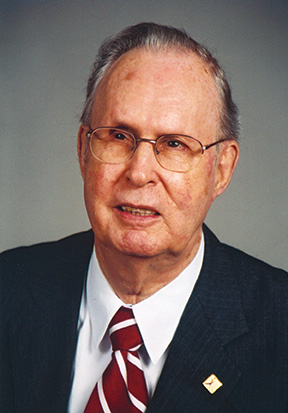 From the Editor: I suspect one would have to be fairly new to the Federation if he or she didn’t know the name Donald Capps or that Southern gentleman’s voice. Until I saw his name in the pages of the Braille Monitor in the early 1970s, I had no idea that a blind person could be a vice president at a major insurance company. Dr. Capps was living a life I dreamed of living, not so much insurance, but excelling at something. I hadn’t yet committed myself to going beyond the dream, really embracing it as a possibility, and staking my honor on the fact that it would happen. His success made it clear to me that blind people could do something outside the blindness field, rising to significant leadership and responsibility. I might not have his talent, but it was clear to me that I had some of my own, and his example suggested to me that there might be a career out there for me if I would only believe and try.
One of the things I most admired about our longtime national first vice president and president of the South Carolina affiliate was that he didn’t decide he was too busy to help his blind brothers and sisters. He assumed leadership, but he took much more than a ceremonial title. He took responsibility for growing his affiliate so that it now stands as one of the largest in the country and has more chapters than any other state in the nation. He did not say, “South Carolina is my kingdom. Let the national body do the best it can for itself.” He realized that the Federation must be strong at the chapter and affiliate levels, and he knew that to exert nationwide influence, we must be strong nationally as well. For this reason he headed our national membership committee and traveled extensively throughout the country to build the Federation.
Dan Frye hails from South Carolina, and like so many others from the state, he gives tremendous credit to Dr. Capps for shaping his character and helping when he was most in need. Dan attended the funeral for Dr. Capps at the request of President Riccobono. Parnell Diggs wrote remarks for an issue of Positive Note 1736, a weekly memo generated by the president of the National Federation of the Blind of South Carolina. President Riccobono, of course, wrote his own moving tribute. All three are printed here together in loving memory of this most extraordinary man:
Dan Frye’s Remarks
Donald Capps cared. He cared for me. He cared for the blindness community: from the members of his local chapter, to the development of a framework of services and opportunities for the blind of South Carolina, for the championship of civil rights for the blind of America and for the concerns of the blind across the world. He cared and served with an old-world dignity that reflected a love and loyalty for the South, which was his home. Donald Capps was powerful, pioneering, and progressive when called to public service, but soft-spoken and charming when engaging with individuals. Donald Capps lived through dramatically changing times, and he demonstrated an extraordinary ability to evolve, remain current, and be effective.
I want today, however, to publicly acknowledge and show gratitude to Donald Capps, the man and leader, who took a personal interest in me—an interest, I think, which demonstrates the best of humanity. I came to South Carolina upon the death of my parents and lived with my paternal grandparents on a small tobacco farm in Horry County. My grandparents loved me but had no real sense of what I could become as a blind person. Somehow, Donald Capps found me, introduced me to the National Federation of the Blind, and helped extricate me from an environment that would have limited my opportunities. Dr. Capps knew that I came from the poorest of roots; he saw that I never had to experience the disadvantages of poverty while attending school as a student at the South Carolina School for the Deaf and Blind. He quietly kept tabs on my academic progress, my social development, and my ambition. When the time was right, he reached out to me, inviting me to assume a young leadership role in the Federation. And by granting me that opportunity he taught me humility, how to see things in shades of gray instead of in the black and white of youthful exuberance, to understand the value of public service, to undertake commitment through the lens of compassion and principle, and to aspire to make a difference.
I was, on occasion, a tremendous disappointment to Dr. Capps, but he was patient and unrelenting in his effort to guide me. He coached, cajoled, mentored, and molded me. He helped me to become a well-rounded, fairly polished, self-confident human being. Dr. Capps and his wife Betty regularly had me to their home to teach me the skills of growing up to be a decent person. You wouldn’t necessarily think that our mutual membership in the Federation would have imposed such an obligation on him, but it is often said that we in the NFB are a family, and Dr. Capps exhibited this truth for me in ways that will forever influence who I am, what I’ll do, and who I may become.
In the absence of a family able to help me flourish, this influential man—both gently and roughly—stepped in and played a vital role in my maturation. If he did this for me, I suspect that he did it for thousands. To Dr. Capps’s son and extended family, on behalf of the blindness community and the members of the National Federation of the Blind, thank you for sharing Dr. Capps with us.
Parnell Diggs’ Remarks from Positive Note 1736
This week’s spotlight falls on perhaps the most distinguished Federation leader South Carolina has ever produced, Dr. Donald C. Capps. But this is not to tell the story of his long life of ninety-one years in sequence of events from start to finish. Instead, I will use this opportunity to convey a few thoughts about Dr. Capps, the man in retrospect in 2019.
Our dear friend absolutely, dearly loved the National Federation of the Blind. It was so connected with his life that it could not be separated from his being. He first came to the Federation in the mid-1950s when he was in his twenties. He attended his first chapter meeting at about the age of twenty-five and his first national convention at the age of twenty-seven.
He attended his last meeting in October of 2019. In recent years it had been increasingly difficult for Dr. Capps to attend Federation meetings due to a number of health issues. For him to get out of the house and get to the Federation Center required tremendous exertion and effort on his part. We now know that the October meeting was to be his last, as he passed away some twenty-seven days later.
It was not always physically difficult for Dr. Capps to attend meetings. At the age of twenty-seven, he and Mrs. Capps traveled cross-country by car to attend the San Francisco convention in 1956. There he met Dr. tenBroek (then president and founder of the NFB) and Kenneth Jernigan, who would become one of Dr. Capps’ best friends until Dr. Jernigan’s death in 1998. Within ten years of attending his first national convention, Dr. Capps had begun working on initiatives that many of us now take for granted. For example, the Federation Center was dedicated in 1961, when Dr. Capps was thirty-three years old. He saw the need to improve programs for the blind in South Carolina. The person who was running the Division for the Blind, which was in the South Carolina Department of Public Welfare, said “That young Don Capps had better watch his step.” But our most treasured advocate was not to be deterred. Along with his brother-in-law Gene Rogers, Dr. Capps wrote the legislation creating the South Carolina Commission for the Blind, which was established in May of 1966. At that time our leader was thirty-seven years old. Over the next five decades he continued to work tirelessly on initiatives that would improve the quality of life for blind people across the nation and around the world. You do not have to be a longtime member of the Federation to know of the dozens of bills enacted in South Carolina in which he played an essential part.
Dr. Capps was about fifty years of age when we established what was then Rocky Bottom Camp of the Blind (later Rocky Bottom Retreat and Conference Center of the Blind). He was about fifty-five when, in his wisdom, he was responsible for hiring a young aspiring professional, David Houck, and these two gentlemen worked closely together for the next thirty-six years.
I could easily work this into a book, but there will be other opportunities to talk about the life of this most special of men, so I will end my remarks by telling you one more thing that you should know about him. He believed in young people and the importance of bringing youth into the Federation. At the funeral, Dan Frye articulately shared memories of his own childhood, having met Dr. Capps when Dan was about thirteen. While attending a Columbia Chapter membership banquet in April of 1989, Dr. Capps was the first person to approach me, shake my hand, and welcome me to the Federation Center on that fateful evening. I was a twenty-year-old student at the University of South Carolina, and this man (at the age of sixty) had already enjoyed a successful career of nearly four decades at Colonial Life and Accident Insurance Company. He had retired from Colonial Life just a few years before. He was involved in the work of the Federation on a full-time basis, spending many hours each day working to improve the quality of life of his blind brothers and sisters. He never missed an opportunity to lead a blind person to the Federation, but this was especially true when it came to young blind people. There are Federation leaders in South Carolina and across the nation who came to be part of the Federation after being recruited by Dr. Capps. He will be remembered as one of the greatest chapter organizers and membership recruiters that the Federation has ever known.
From the age of twenty-five to the age of ninety-one, Dr. Capps gave every ounce of energy he could muster to the work of the National Federation of the Blind. I hope that others will follow the example set by Donald Capps on giving of our time, energy, and talent to this big program of work with the blind. But the bar set by Dr. Capps is very high, since sixty-six years of dedicated service is a long time to spend in the furtherance of any cause. But from what I have learned from this beloved Federationist in my thirty years of working with him, I think it would be safe to make the following estimation. Dr. Capps would be pleased with those who commit to work with the National Federation of the Blind if they would simply do their fair share and then some.
Remarks from President Mark Riccobono
The National Federation of the Blind would like to express its deepest appreciation and warmest sympathies to the friends and family of Dr. Donald Capps. Dr. Capps touched the lives of so many, and his lifelong contribution can never be adequately recounted for the blindness civil rights movement of the United States. Dr. Capps provided stability, foundational principles, and continuity for the rest of the world. He generously shared his understanding and experience in order to spark the development of movements organized by the blind in other nations. He served with honor and distinction in so many ways, but he always did so with a sense of purpose and humility. He is the only individual that served and supported the first seven presidents of the National Federation of the Blind.
I, as our eighth and current president, was mentored by Dr. Capps at a critical time in my leadership development. This likely means that almost all of the first hundred years of the National Federation of the Blind will have been influenced directly by the Capps personality and spirit. With certainty, his indirect influence will echo into the next century of the organized blind movement. That demonstrates the power of life and commitment, the same qualities he shared with his wife and family, setting an example that service and family go together.
Dr. Capps always made sure that he had a watch that was in good working order. I had the opportunity to help get him one when he needed it. Upon reflection, it is clear why it was so important to him. He knew that every minute counted, and he did more with his time than probably anyone else I have ever known. As we go forward with the memories of both Don and Betty in our hearts, I urge us to value and use those minutes as effectively as they did to share life around the world. If we do that even half as well as they did, our time will have been well spent. The blind of America and the world salute this great man, who gave his time and his heart to raising expectations for the blind. Our future achievements will be built upon the strength, value, and spirit that he gave in service to us.
Be well, my friend. And thank you.
Media Share
