I am a Federationist
by Jessica Reed
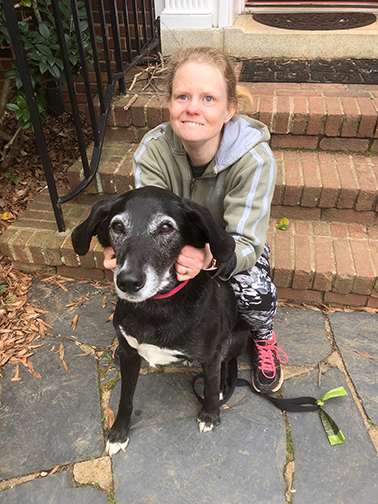 From the Editor: I think this article is a pearl, and the truth is that I almost lost it. It got stored in a pending folder, and evidently I pended the desire to look at it. It came six months ago, but thank goodness, it is as timely now as it was when submitted.
Jessica Reed is the mother of two children ages five and two. She is the vice president of the Fredericksburg Chapter of the National Federation of the Blind of Virginia. An active Federationist since 2004, she enjoys reading, physical fitness, the outdoors, and history.
In this article Jessica speaks eloquently to the value of sight, the sadness in losing it, the reluctance to believe other blind people might have answers, and the life-changing realization that those of us in the Federation have some. Here is what she says:
I cry over my blindness, and all too often fall into the trap of "Why me!" I have never felt that my blindness was “just a characteristic.” I would take my vision back in a nanosecond. As a student at the Louisiana Center for the Blind, I took two weeks to make a lemon meringue pie, dropping more than one egg yolk on my classmate’s foot.
I am many things, but I would never call myself super blind. If we are totally honest, for the first ten years of my blindness I would have flinched and may have smacked anyone who called me blind. All this and I am a Federationist.
I lost my vision at the age of nine as a result of medical malpractice. To say that my family and I were devastated would be an understatement. I was close to needing to repeat the third and fourth grades because, when I did make it to school, I was more often than not missing and later found hysterical in the girl's bathroom.
When it first happened, doctors assured my family that my vision loss was only temporary. I woke every morning expecting to see. Not until years later was I told point-blank by a prominent neurosurgeon, “There isn't a snowball’s chance in hell.” My family was never the same after this doctor visit.
Today I am a stay-at-home mother to two beautiful thriving children. I have a sighted husband and live in the historic town of Fredericksburg, like I always dreamed. I have traveled, jumped out of a plane, ran a marathon, graduated from college, and have worked. I am a Federationist.
When I ventured off to the Louisiana Center for the Blind at the age of eighteen, I went with the conviction that I would try out its training (which I wasn’t convinced I needed), but they could keep their NFB hard-nosed, militant philosophy to themselves. I loved guide dogs and was not the political type. I had many sighted friends so therefore did not need any blindness social club. While in Louisiana, I questioned and argued with almost everything they taught. The word blind was a slap in the face. It was a scarlet letter I had to attempt to hide and mask at every turn, and I was baffled at how the staff and students could have no shame in it. These were educated, well-put-together, attractive people. There were people with children, some with advanced degrees, some who were wealthy, and some who lived paycheck to paycheck. I slowly began to fall off my pedestal. There were also those who struggled immensely with cane travel, cooking, computers, or knew no Braille at all. There were those that knew nothing other than blindness and those like me trying to navigate a jagged road of anger, frustration, and immeasurable grief.
The National Federation of the Blind philosophy is not the delusion I was once convinced it was. Yes, I would love to know exactly what my children look like and see another sunrise, but what stabs through my heart most of the time is not that. It is the frustration of not being able to drive. It is the sadness that I will never be able to teach my son to drive. It is the anger that rears up when I hear of another blind Lyft or Uber customer being stranded by a driver because they have a guide dog. It is the anger that claws up at me when I hear of another blind parent having their child removed by CPS [Children’s Protective Services] solely due to their blindness. It is the sadness I feel when I meet a highly educated blind person who cannot find even a minimum-wage job. These people are all me, so I am a Federationist.
As a little girl, I had a little wooden cross I would hold nightly during prayers. I would trace the metal figure of Jesus nailed to that cross. The number of tears I cried while clutching that cross and wondering what I did wrong and the number of times I kissed his little feet cannot be counted. The word “inconvenience" was jarring even when put into context with “the proper training and opportunity.” The phrase was jarring because I didn’t fully understand its meaning ...until now. I could not see that the NFB was simply saying that it did not have to be the debilitating death of my hopes and dreams that much of society tries to impose. The NFB philosophy that I can live the life I want is not incongruous with the grief at suddenly and unexpectedly going blind; instead it compliments it. I know what it is to beg, bargain, and plead for a so-called cure. I woke up every day for years expecting to see. I had no blind role models who successfully lived the lives they wanted. I could not picture being a blind high schooler, then a blind college student, and finally a blind adult. I felt like I was waiting for my real life to begin—and let me tell you that is agonizing and exhausting!
Today the NFB is the beacon of hope that I craved. The NFB fights to protect the interest of blind parents so that their children are not needlessly removed from loving homes just because a well-meaning social worker cannot understand how we safely provide for our children. The NFB fights for the equal opportunity of guide dog users to use ride-sharing companies such as Uber and Lyft without fear of being stranded. The NFB legislates for continued accessibility on the internet and everyday home appliances. The NFB has been fighting for my dreams long before I knew there would be a fight.
Would I like to have my vision back? Yes! Though he was so cruel in his delivery all those years ago, the prominent neurosurgeon was correct. There is little in optic nerve research, so the potential for any vision restoration is nil. My love and contributions to this world are not. The National Federation of the Blind is the vehicle to my contributions, hopes, and dreams. I have learned that what cripples me most is not always my blindness but an inaccessible world that does not always understand me. This is a measurable variable that can be improved, and that is what the NFB strives to do. I am a Federationist.
Today, I am a Federationist because my Federation family understands my sadness, anger, and frustrations of being blind. They listen to and challenge in the way that only they can. I am a Federationist.
Just as no two sighted people are the same, no two blind people are the same. I have learned that there are many who have never viewed blindness as a tragedy. While I do understand where they are coming from, I think we are falling short as a Federation family if we do not acknowledge that there are also those like me who have come from a place of tragedy. The NFB philosophy was never meant to imply that blindness is not traumatizing for some, but, instead, it does not have to be our end. I am a Federationist.
Media Share
