Across Three Continents and Generations, A Candle of Hope is Ignited
by Syed Rizvi
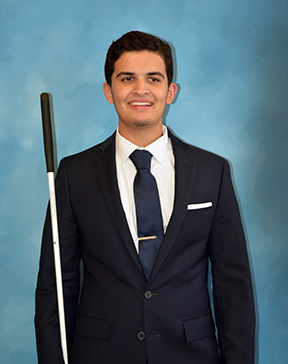 From the Editor: This presentation was made at the mid-winter meeting of the National Association of Blind Students on February 10, 2020. Syed is the first vice president of the division, and here are the moving remarks he made:
Good morning, everyone.
I would like to tell you all a story today about a woman named Seema. It’s World War II. The British Empire is stretched thin due to the war that would supposedly end all wars. The empire has lost control of Southeast Asia. India, once a great country, fractures into three separate countries. Mohammad, living in India, flees to East Pakistan. While in East Pakistan he attends medical school and becomes a doctor. East Pakistan falls and becomes Bangladesh, so he flees again to West Pakistan, which is modern day Pakistan.
As the country rebuilds, it needs doctors. He settles in a small village called Phulerwan, appointed to live there by the government as a rural doctor. While there, he builds his family. He gets married and has four beautiful children: Asad, Huma, Seema, and Karar. But today we are going to talk about Seema and Asad.
Seema was a bright child from birth. As she grew up, anything she put her mind to and tried, she did well and excelled. As a rural doctor, Mohammad would have to go to farmhouses and all over the countryside visiting patients. Out of his four children, he would always bring Seema as she always would bring light into the room. She was smart, intelligent, and actually knew the backcountry roads better than he did, even as a little girl. She excelled in academia but once she came to middle school, she could no longer read the small text or see the blackboard.
Mohammad didn’t understand what was going on. As a family practitioner, Mohammad knew basic medicine, but he knew something was going on. He took her to the capital city to meet with the best doctors. She was diagnosed with Stargardt’s disease. Living in the countryside in a Third World country, she didn’t have access to a lot of great resources. Eventually, she had to leave school, and her bright light began to dwindle. Due to disability-phobic attitudes, she faced abuse and discrimination.
Meanwhile, in Pakistan, in-fighting began, and groups like the Taliban and Al-Qaeda started spreading violence amongst the people. Seema’s eldest brother, Asad, wanted the best for his family, so while his wife worked as a doctor in the main city of Karachi, she paid for him to be able to go to Europe as the western world promised a more peaceful and equal life. While in Western Europe, he studied to become an orthopedic surgeon. He brought over his family, one by one, wife and his two children. While in Europe, he realized, that as a foreign-born doctor, he could never become a full-fledged attending doctor in the Irish hospitals since he wasn’t an Irish citizen. He wanted to live in a country where there was complete equality no matter his origin or the color of skin. So, he looked toward America, the promised land. The streets—he had heard they were paved with gold. He moved to Connecticut. Once they moved to America, they had their third child. Each of his three children all excelled. His eldest son was a football player, an all-American kind of kid, was on the swim team, and went to UMass Amherst and Johns Hopkins University. His daughter went to Mount Holyoke, went to Tufts, and became a dentist. His third child—well the signs started to pop up. But Asad ignored them because he couldn’t accept that they were there. His son would go to school and complain that he couldn’t see the board. He would complain that he wasn’t able to see the sheets or his work. Asad, being a doctor, knew how genetics work, and he knew that since his sister had Stargardt’s, it was possible that his son could have it as well. But, again, that would be something too hard to face. Finally, at some point, the reality had to be met. He took his son to an ophthalmologist and specialist in Stargardt’s, and he was diagnosed with the disease.
Asad thought about his father’s story: Mohammed, having to leave India, going to Bangladesh, going to Pakistan. Then he thought about his own story: having to escape from the Taliban and Al-Qaeda, going to Europe and bouncing around from Ireland to Scotland, and finally to the United States. He thought, “I’m forty-eight now. Why do I have to face something like this? I have bounced all around the world and was promised the American dream—that the streets would be paved with gold. How could this happen here?”
As his son moved forward, they tried to help his problem by using CCTV, using magnifiers, but nothing really helped. In high school he didn’t do as great as he could have, and he fell behind his older siblings. He became depressed; older siblings were becoming doctors and dentists and playing sports and he, he was barred from full access. For Asad, it was like watching his little sister’s life story play in front of his eyes all over again. It was as if it was a nightmare that could never end.
But once his son began college, an organization reached out to him when he applied for a state scholarship. That organization was called the National Federation of the Blind. That small light that had dwindled away was again ignited. His new Federation friends told him he could be anything he wanted and that his blindness would not determine his future. He started getting straight A’s in college. He went from failing high school to the Dean’s List and then the President’s List. His blind mentors and even university staff told him, “Why don’t you go transfer to a better university? But first—we have a training center run by an entire blind staff, where they train you within six to nine months to make it so that your blindness can be reduced to a mere nuisance.”
Like Mohammed and his father Asad, his journey began. Starting in Massachusetts, he moved to Louisiana for nine months and got the training he needed. From Louisiana he moved to Texas and attended a great university. Whereas, before, he was barred from accessing every aspect of life, now he was able to excel academically, socially, spiritually, and religiously. In May, he’s graduating. For four years he’s been competing for the number one men’s powerlifting team in the United States. In May he’ll graduate with high honors. In June he’s getting married. In the fall he’ll be heading to law school and will be living the life that Seema never could. But, since we began with a tragic story, like all great stories, there’s always a happy ending. He still talks to Seema regularly on the phone, and Seema says, "You know what? Everything that I had to go through—it's fine. You are living the life I’ve always wanted, and that makes it okay for me. I am happy through you.” Ladies and gentlemen, Seema is my aunt.
Media Share
