Microaggression and Syntax Overload
by Mary Ellen Gabias
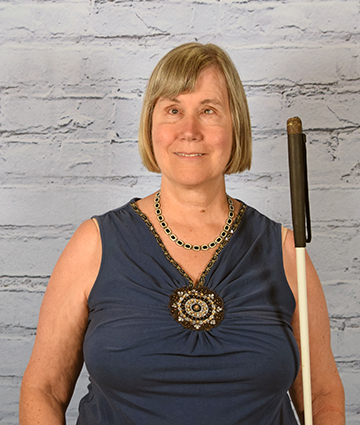 From the Editor: It wouldn’t be accurate to say that Mary Ellen Gabias is a frequent contributor in these pages, but every time she does make a contribution, she brings tremendous perspective, thought, and insight to the topic she addresses. Her note is written in response to an article we carried recently about microaggression. I am grateful for it because it both furthers the dialogue on an important topic and shows that this publication is a forum for discussion so that we may evolve in our own understanding and policy positions. Here is what she says:
Eighty-one years and five generations has allowed the NFB enough time to create valuable tradition. We have handed down statements, beliefs, legends, customs, and information from generation to generation.
We have largely avoided nostalgia, a wistful desire and sentimental yearning to return to the remembered happiness of a former time. Partly this is because the times we remember weren't all that great. Partly we have avoided nostalgia because we understand that it mimics tradition but is its enemy, because nostalgia is mostly empty illusion.
Those of us who have been part of this movement for more than a generation are most responsible for distinguishing between our rich and valuable tradition and dangerous nostalgia. Just because we’ve always done things a certain way or talked about them with certain words doesn’t mean those habits are immutable. Just because language is trendy doesn’t mean we should automatically embrace it.
No one doubts the clarity of thought or the profound philosophical insights of Jacobus tenBroek or Kenneth Jernigan, but even those of us with the deepest attachment to their words recognize changes in linguistic usage that could make their speeches—written decades ago—grate on today’s audiences. It would be odd indeed if the language had remained static. We are wise to modernize the way we speak to ensure that our language avoids being alienating, but the words we substitute must also remain true enough to the original meaning to avoid inadvertently losing the nuanced understanding that has made our philosophy so powerful.
We have set ourselves a delicate task under normal circumstances. The current political and cultural climate complicates the job immensely.
Syntax overload is the phenomenon of words and phrases that convey a multitude of meanings, sometimes different meanings to different audiences. The phrase "Black Lives Matter" is an absolutely undeniable statement of truth as a moral principle. It incorporates the sad truth that the lives of human beings with black or brown skins have far too often not been treated with proper respect by authorities and by our culture. But the phrase also refers to a controversial political organization that is not universally held in high regard. It is perfectly possible to staunchly uphold the dignity of Black people while simultaneously disapproving of some of the policies of the organization bearing the "Black Lives Matter" name. Syntax overload.
For decades the NFB logo was a triangle with the letters NFB in its center and the words Security, Equality, Opportunity circling it. The logo was deeply meaningful to our members, particularly those old enough to remember the battle to remove some of the more draconian restrictions from the Aid to the Blind welfare system that had kept too many of us extremely insecure. But as logos go, it was visually boring and static. We wanted a logo that conveyed more vibrant activity. Whozit was born. Then Whozit was changed to incorporate symbolism stressing collective action.
We used a variety of symbols and phrases to describe ourselves, but none was elevated to a tag line. The aspirational message, said in many different ways, could be articulated as "strive to be your best and work with others so we can achieve our dreams." True, but a bit lengthy. So now we say, "Live the life you want." The message incorporates freedom of choice and possibilities. It's pithy, easy to remember and repeat. Syntax overload could cause us difficulty if the person reading “Live the life you want” understood “want” as selfishness. Wanting doesn’t mean acting out of selfishness, but generational syntax overload sometimes complicates understanding.
In February the Monitor published an article called “An Introduction to the Concept of Microaggressions.” I was intrigued, partly because it was written by my daughter, but primarily because it was a sincere effort to describe all too common experiences of blind people in current terms.
Federation literature has always incorporated stories of blind people facing public misunderstanding, sometimes extreme cases of ignorance. “Of Visions and Vultures” and “That’s How it Is at the Top of the Stairs” both include lengthy poignant stories of harm caused by public misconceptions.
NFB training centers have always taught that understanding public attitudes and learning to deal with them without becoming emotionally upset or damaged is one of the core tasks of learning to live successfully as a blind person. Does the word “microaggressions” accurately encapsulate all the nuances conveyed in our traditional teaching about how best to understand and deal with public misconceptions? If not, what’s missing? If the word accurately conveys the concept, does using it increase understanding of the problem or alienate potential supporters because of syntax overload?
The concept of microaggression certainly includes a sense of inaccurate, unfair, and unwelcome interactions. If such interactions are thrust upon us, are we victims? Does our approach to such encounters have any influence on the degree of our victimhood? Ultimately, where does the power lie?
Who among us has not engaged in lively conversations on this topic? “You wouldn’t believe what happened to me when I was running errands yesterday!” Often we laugh; sometimes we share anger and frustration. “If only I’d thought of that snappy comeback at the time instead of half an hour later.”
Sometimes our response is both graceful and gracious. Sometimes our response is less than we would wish it had been. Whatever happens, and however we respond, we can talk about it with one another, decide what it means, how we feel, and what we can learn for the next time. We know there will always be a next time, perhaps under different circumstances, but a next time nevertheless.
What does it mean to avoid becoming upset or damaged by misconceptions about blindness? If the ignorant individual is someone walking past on the street, probably the damage is minimal and fleeting. If the ignorant person is a potential employer or a potential love interest, the damage is deeper. The first can be brushed aside; the second requires introspection at the least and possibly confrontational advocacy. The first may be a paper cut; the second a knife slash.
The concept of microaggression does not include remedies, other than confronting and attempting to eliminate microaggressions. The ultimate solution lies in changing the behavior of the micro aggressor.
Traditional Federation discussion of this problem overtly shifts power to the blind person. We begin with the clear understanding that we are knowledgeable; the person making the unwelcome comment knows less than we do. Our role changes in a subtle but very powerful way. It is now our choice whether to go on our way and politely ignore the comment or to impart what we know through education. Either way, we’re in charge. We can decide to insist that the overly helpful and invasive airport employee leave us in peace, or we can calculate that the confrontation isn’t worth it. But, even if we choose to go along to get along, we have chosen, and we have done so consciously, understanding that we’re still the most knowledgeable person involved in the interaction.
Is misunderstanding an offense? If so, every one of us takes a turn at being offensive to others, because we all have areas of incomplete or inaccurate understanding. One question we must all ask ourselves is whether we want our areas of ignorance laid bare for exploration. If so, how do we want it done? Do we admit what we don’t know in a straightforward manner and request the education we know we need? If we lack the confidence to admit the holes in our understanding, is our best bet to try to bluff our way through, acting as if we know more than we do? Or do we try to avoid any situation where these issues may arise? Difficult questions that tend to increase empathy for those whose attitudes about blindness fall short. If those we meet become so afraid of being offensive or committing microaggressions, might they avoid saying anything they fear might be offensive, thereby remaining ignorant? Worse still, might they avoid us altogether?
How does our approach to microaggressions (or we might call them incorrect public attitudes) affect us? Humans tend to find more of whatever they focus attention on. If we expect ignorance and microaggressions, they will be everywhere. I was returning home from a Federation event in which the topic of blind airline passengers being forced to ride in wheelchairs they neither requested nor needed was discussed at length. Sitting on the airplane, I heard the flight attendant asking if the wheelchair had been ordered to be at the aircraft door at our destination. I was fuming! I rang my call bell and explained that I did not need a wheelchair. “The woman two rows ahead of you who cannot walk needs one,” the flight attendant said calmly. I had just defended myself against a microaggression that didn’t exist. At other times, when I wasn’t even thinking about it, I’ve been approached with an unwelcome wheelchair at an airport. It was easy to shake off the unwanted chair with an “Oh, you must have me confused with somebody else” because I was relaxed and not at all defensive. Due to our history, dealing with airlines is challenging. Airports are hard places for me to maintain equanimity. In current language, they trigger me. My task of remaining assertively friendly and clear about my needs and lack of needs becomes much more difficult because I walk in the door determined to fend off problems. Trips are much more exhausting due to my negative expectations. Living my entire life burdened in that way is not a joyous prospect. Living my life believing that I am a powerful educator capable of dealing graciously and mostly effectively with members of the public who don’t understand my blindness is empowering.
The concept of microaggression, at least the way I understand it, fails the test of accurately conveying the full nuance and power of the old concept of “dealing with public misconceptions.” The term tends to increase our feeling of victimhood and to keep the power in the hands of the micro aggressor, since our hope of redress lies primarily in changing them, something over which we have little control.
Syntax overload also comes into play. My very conservative brother saw the title of the article and immediately commented that he didn’t want to read an article designed to make him feel guilty and ashamed. He and I have discussed misunderstanding and ignorance about blindness many times, and he has always been fully supportive. I teased him about being triggered by the term microaggression, and he did not laugh as I intended that he would. Instead, he talked about how uneasy he felt about accidentally demonstrating a flawed understanding. He was afraid of being mocked and condemned. Syntax overload.
The National Federation of the Blind is neither liberal nor conservative. It is liberal and conservative. We recognize both the power of individual initiative and the need for strong community action and support. Societal polarization makes the line we walk and the balance we maintain much more difficult. It is easy for me, as a more traditional person, to become unhappy when we use words closely tied to what is disparagingly referred to as “woke” culture. I am less aware of ways in which my colleagues who regard themselves as more socially and politically liberal might be uncomfortable with terms I prefer. As a general principle, I believe we do best when we avoid syntax overloaded language. The Federation is uniquely positioned to live out the respect that can bridge our very dangerous cultural chasms. Doing so will require courage to be clear about differences between our traditional thinking and nostalgia. There may be circumstances where we come to believe that our traditional thoughts on a topic no longer serve us. That has happened before. In 1949, the NFB passed a resolution asking for two-for-one airfare for blind travellers. In the mid-1960s the debate was held again, and a two-for-one airfare resolution lost, barely. Today it would be difficult for such a resolution to find a sponsor.
Core Federation principles have kept me involved for a half century. I love this organization because it affirms my ability to decide and actively create the life I believe is best. The Federation understands the fallacy of blind people “making it on their own” and is committed to the value of collective action and mutual support. We face discrimination and misconceptions with strength, but we also work to avoid bitterness and to deal compassionately and hopefully toward members of the public. I love that we fight when we need to, negotiate when we can, and strive to help one another become stronger, kinder, and more resilient.
My hope is that, as we think about new ways to say what we have always believed, we continue to take the time to check with one another so that our language conveys the fullest and most nuanced understanding of our beliefs that we can possibly express and that we are mindful of the dangers of hanging on to old language out of nostalgia or adopting new ways of speaking that damage us through syntax overload.