The Father Who Showed No Ignorance
by Shawn Calloway
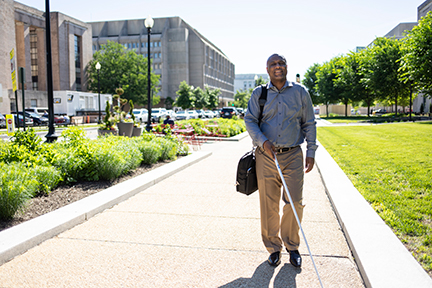 From the Editor: Most readers know that Shawn is a member of the National Federation of the Blind Board of Directors, the president of the District of Columbia affiliate, and the co-chairperson of our Diversity and Inclusion Committee. He and his wife have a daughter six years old. He works for the United States Department of Health and Human Services as a program specialist and has done so for ten years. His hobbies are traveling and being a sports fanatic. This is evidenced by his being a season ticket holder for the Washington football team and the Washington Wizards, and he loves to play fantasy football. With all of this on his plate, we who read the Braille Monitor are grateful that he has taken the time to reflect on and share his experience in forming romantic relationships as a person who is blind. Here is his story:
After losing my vision at nineteen years old, I believed that I would never be in a meaningful relationship with a woman. Having countless conversations with family members and friends about how to improve myself to enter a meaningful relationship, I concluded that I had to be successful in certain phases of my life. First, I had to accept that I was blind. Second, I had to establish goals that would lead to social and financial independence. Lastly, I had to work toward being self-confident and self-assured. This last phase was extremely important because I had to prepare myself for rejection from women not wanting to date me due to my blindness.
After I met the criteria to complete my three phases, I began dating, and I was met with the surprise of my life. Most of the roadblocks I encountered to a meaningful relationship were not created by the women I pursued. No, it was the parents of the women I courted that created a road block to a meaningful relationship with their daughters.
There were three instances in which I encountered parental ignorance. The following examples were not the singular factor to having a relationship, but the attitudes displayed by the parents were clear misconceptions of the capabilities of blind people. First, as a student at the University of Maryland, I began a friendship with a young lady who was the sister of my cousin’s friend. We had good daily conversations leading to our first date, which was to her place of worship. A few days after our date, she contacted me with some bad news. She informed me that her mother was not happy that she went out on a date with me. The young lady said that her mother said, “Your going out with a blind man is ridiculous; what can he do for you?” I was shocked and disappointed to hear that her mother felt that I was not worthy to date her daughter.
However, the bad news did not stop there. The young lady informed me that she no longer wanted to date me and that we could be friends. I asked the young lady, “If you knew that you no longer wanted to date me, why did you waste your time telling me what your mother said to you about going out with me?” She replied, “I do not know. I guess it was something you needed to know.”
My second encounter with parental ignorance occurred while I was pursuing my graduate degree. I began dating a young lady who was the friend of a high school classmate’s girlfriend. We talked daily and had wonderful conversations. We had fun on our social outings together as well. I felt good about our relationship until I received a disturbing phone call. When I answered the phone, the young lady was crying. I asked her what was wrong. She said, “My mother and aunt called me on a three-way call, and they were laughing and making fun of me.” When I asked her why they were laughing at her, she said, “They said, ‘What can a blind man do for you? You will be taking care of him. He cannot take care of you.’” Once again, I was disappointed to know that a parent and an aunt would have these feelings toward me. When I asked the young lady how she was feeling, she said, “I do not know how I am feeling.”
I asked, “Are we going to continue to date?” She responded by candidly saying that she did not know. Once I heard the answer “I do not know,” I decided to end the relationship. I made this decision because I felt that the young lady was influenced by her mother’s and aunt’s comments. Therefore, I quickly determined that she did not have a mind of her own.
The last collision with parental ignorance occurred at a friend’s cookout. I was approached by a young lady at the event, and we began a brief conversation. After we completed our discussion, we exchanged phone numbers, and we promised to keep in touch. Once the young lady departed the cookout, I was approached by a man who seemed to be intoxicated. The man asked me, “Do you know the young lady you were talking with?” I said, “Yes, and she seemed to be a nice young lady.”
He said, “I know she is nice because she is my daughter.” The man proceeded to ask me more questions. He asked, “Do you work?”
I said, “Yes, I am a social worker.”
He said, “Do you live alone?”
“In a few weeks I will be living alone because I just purchased a home,” I said.
Finally, the parent made the statement that he wanted to make before speaking with me. He said, “You seem like a good dude, but please do not make plans to talk with my daughter again.” He continued, “I raised her to have the best in life, and I do not need her taking care of a grown man.”
My anger intensified as a result of his comments because his daughter and I were discussing resources for her boyfriend’s father who was losing his vision. I had no plans of attempting to date his daughter. As I departed the cookout, I heard the father yell, “Do not forget what I told you.” A force of nature lifted my right arm and extended my middle finger, and I stated, “Tell this.”
I do not want to create the impression that every encounter that I had with a parent was negative. There were some parents who accepted me, and my blindness was not an issue. However, my last encounter with a parent became my best encounter with a parent.
In the fall of 2003, I began dating Ms. Latonya Rollins, the woman who would eventually become my wife. During my courtship, I was confident that a marriage would occur, but the feelings of confidence often disappeared because I had not met Latonya’s father. She was from Cleveland, Ohio, and with me living in Washington, DC, it would be six months before this encounter with her father would occur. In June of 2004, the opportunity to meet Latonya’s father had finally materialized. This meeting occurred in Ohio at the home of my future uncle and aunt, Michael and Mary Coles. The event was a family cookout, and all of Latonya’s family members were present. When I walked through the door, I began introducing myself to all who were in attendance. Latonya grabbed me and escorted me to where her father was sitting. She said, “Dad, this is Shawn, and Shawn, this is my father, Ed Rollins.” We exchanged handshakes, asked the other how he was doing, and then he continued a conversation with a relative.
Due to our first encounter being brief, I felt as if Mr. Rollins was disinterested in me dating his daughter. As the festivities continued, I found myself sitting alone on the back patio. Suddenly someone approached me saying, “How are you doing?” I said fine, and I realized it was Mr. Rollins. He said, “It is nice to finally meet you, and I have one question for you.”
I said, “Go right ahead.”
He asked, “What are your intentions with my daughter?”
I said, “Well Mr. Rollins, hopefully one day I will marry your daughter, and I feel I can make her happy.”
Mr. Rollins said, “Well, I think you will be fine; just respect my daughter, and I think she will marry you.”
After that I felt like a ton of bricks had been taken from my shoulders, and we began discussing topics ranging from politics to sports. I felt thankful that Mr. Rollins did not have the ignorant parent syndrome. What made the day much more special was that Latonya’s entire family, led by her aunt Mary, accepted me, and I felt as if I was a family member.
When I made the decision to propose to Latonya, I made arrangements to meet with Mr. Rollins to ask for his blessing. As we walked around Lake Erie in Ohio, I told him that I wanted to marry his daughter, and I would like to have his blessing. Mr. Rollins stated, “You have my blessing, and I want to ask you something.” He said, “I hope you do not think that your blindness was ever a concern for me.”
I said, “No, I never felt that way, but was my blindness a concern for you?”
He said, “Not at all. I just want to be sure that you treat my daughter right and you respect her. As far as I am concerned, a blind man is no different from a sighted man, and I know of some sighted men who have treated their wives pretty bad. So I am judging you on your character and not your blindness. By the way, stop calling me Mr. Rollins, and call me Dad.”
After Latonya and I were married in 2005, my father-in-law and I continued to converse about topics ranging from religion to current affairs in society. When I visited Cleveland, sometimes my father-in-law and I would go to a restaurant and continue our intense and thought-provoking conversations. I never felt that he was dismissive of my thoughts or ideas, and he would often call me to gain my prospective on breaking news regarding sports or politics. My father-in-law was extremely happy that I became a member of the National Federation of the Blind (NFB), which is an organization that advocates for the civil rights of blind people. Often he would ask me the same question which was, “What is your organization fighting for now?” This question would lead to lengthy discussions because he wanted to know about the details of each legislative priority of the organization. My father-in-law was so intrigued by the work of the NFB that he attended a national convention in Orlando, Florida, and he traveled with me to Sumter, South Carolina, to support me as I delivered a keynote speech at an event conducted by the Sumter chapter of the NFB of South Carolina. A few days after the event, he told me that he enjoyed my speech, and he was glad that I married his daughter. This comment was bitter sweet for me because it reinforced my belief that he believed that I could be a good husband to his daughter. However, the comment was painful because my wife and I began to notice that my father-in-law was potentially in the beginning stages of dementia.
After his diagnosis of dementia, my father-in-law began residing in long-term care facilities to assist him living with his condition. It was inevitable that our conversations would no longer be lengthy, and I was blessed just to hear him utter a few words to me. In July of 2020, my father-in-law succumbed to his dementia. After his death, I prayed that all blind people who are seeking a lifelong partner would be fortunate to have an in-law like Mr. Rollins. After fifteen years of marriage to Latonya, as I conduct daily chores such as taking out the trash, balancing the household budget, preparing a meal for my daughter, or cleaning the bathroom, I would be telling an untruth if I stated that sometimes I do not think of the parents who did not think I was good enough for their daughters. My belief is that these parents were not horrible people; they just lacked awareness about the capabilities of blind people. If they would have taken the time to get to know me, I believe their attitudes toward me dating their daughters would have been different. However, these thoughts are immediately erased from my memory and overtaken by remembering Mr. Edward Rollins, the father who showed no ignorance.