Inspiration, Aspiration, Advocacy, and Travel
by Juliette Walker
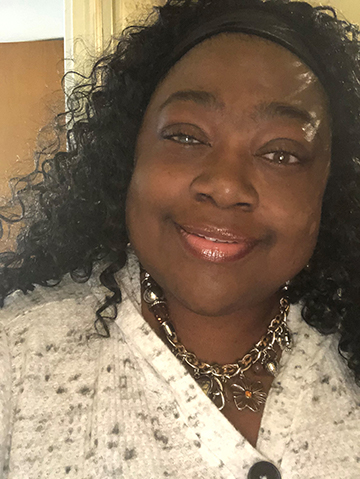 From the Editor: This article is based on a presentation Juliette Walker delivered at the 2020 convention of the National Federation of the Blind of Illinois and is taken from the Illinois Independent, the newsletter of the Illinois affiliate. Juliette worked for a public school for twenty-one years, seventeen of them as a kindergarten teacher. Her loss of vision was abrupt, and she had never thought of the possibility she might be blind. Juliette was the person her family depended on, and blindness made her unsure how she could find her way down the stairs, walk to the corner, and how she could continue to work. The accommodations she had offered to her students never came to mind as being helpful for her. She currently serves on the scholarship committee for the affiliate and plans to take on more activities once employment is again secured. Here is what she says:
I am so happy to be here with you this morning! I'm here to tell you how the National Federation of the Blind changes people's lives—in particular, how it has changed my life. I'd like to start by giving you a little history about me.
I was born and raised here in the city of Chicago. I am the eldest girl in a family of five children. I am a product of the Chicago Public School system. I graduated from Chicago State University with a bachelor's degree in elementary education, and I received a master's degree in curriculum and instruction from Loyola University. I worked for the Chicago Public School system for twenty-one years, until one day I woke up and saw that my world had changed. On that morning it seemed as though I was viewing the world through a glass marble.
I had to be rushed to my doctor, and from there I was rushed to an ophthalmologist. She looked into my eyes and saw that something was definitely wrong. She wasn't quite sure what it was, and she needed a second opinion. I was sent to a retina specialist where I waited for two hours. They conducted various tests and ultrasounds. Two hours later, I received the news that I had become a member of the blind community.
Of course I was devastated when I heard this revelation. The doctor told me there were three things I could do. Trying to find some semblance of hope, I asked, "What are they?"
I hoped she would tell me she might be able to bring my vision back, but she said, “No, it's gone; there's nothing we can do about that. What I want you to do is, number one, I hope you didn't drive here."
I said, "No! I couldn't see to drive."
She said, "You know what? You can't drive anymore. That's number one. Number two, you need to fill out disability paperwork. At this point I don't see you working anymore. And number three, you need to call a Chicago-based organization that can provide you with rehabilitation."
I just went to work the day before! Yesterday I drove! Now she was telling me all of those things had changed!
I felt horrible about what had happened to me. I cried in her office, and I went home and cried some more. I cried so much that my younger sister told me, "Maybe if you stop crying you might be able to see after all!"
I felt I was living through a nightmare—but when you have a nightmare you wake up. I'd open my eyes, and I still couldn't see. The nightmare wouldn't end.
I did everything the doctor told me to do. I stopped driving. I called the Chicago-based rehabilitation agency, but they told me they couldn't help me. I didn't have the paperwork they needed. It would take a while before they would be able to do anything.
I went into a deep, dark depression over all of this. I went to see another primary-care physician. She asked me a list of questions, and when I answered them honestly she said, "You are in a state of depression." I said, "Well, duh! My life as I knew it has changed. It's over."
She said, "I think you need to speak to someone. We have a young lady who has just joined us. She's a therapist. Maybe you'll like her."
I said, "I have nothing to lose. Why not?" So I went to her, and we talked. She said, "You know what, Miss Walker? We're going to get you started. We need to figure out how to make things right."
I said, "I don't know if you can make things right. I just want to make something better."
She said, "Let me talk to my professor. He's blind, and he's one of the best professors I ever had."
At that point my expectations of what I could do had gone totally down the drain. I said, "A blind professor? I didn't know blind people could be professors!"
The only blind people I knew of were Ray Charles and Stevie Wonder and the gentleman on the corner who shook his cup and asked for change. I knew I couldn't sing like Ray, but maybe I could work something out with the gentleman on the corner. We could shake our cups together or something. But first I had to figure out how to make it to the corner!
The therapist called her professor, and he said, "Miss Walker, I want you to go to an organization that I think can help you. They have a support group on Wednesdays for people who have RP (retinitis pigmentosa)."
I said, "I don't have RP."
He said, "It doesn't matter. They'll give you support. It's a group of people who can't see, and you need to be there with them."
I went to the support group, and I met a wonderful bunch of people there. I had a chance to discuss what was going on with me, and I felt much better knowing I wasn't the only one. While I was there I met a young lady who told me, "We can help you with your independent living skills. We can help you learn to move around. We can help you get your job back."
I said, "Please, help me!" I had nothing to lose.
She did help me. While I was there I met a bunch of other people who were seeking the same things. I also met some people who had been blind for most of their lives, and they were taking classes. There was a group of students taking a computer class. One day over lunch they mentioned a meeting they'd attended with the National Federation of the Blind. They were excited about an upcoming convention, and they were excited about President Riccobono's speech. I said, "What are you talking about?"
They said, "We're talking about the National Federation of the Blind. Our chapter meets the second Saturday of the month at Exchequer Restaurant and Pub in downtown Chicago. You can get a good meal and a whole lot of new information."
I said, "Can anyone go?" They said, "Yes!"
So I went to my first NFB chapter meeting. From the moment I stepped through the door, I saw blind people moving around independently. I heard people talking about their new business ventures. I heard them talking about cases they needed to go home and work on. I thought, there are a lot of people here who are doing things I used to want to do myself! I heard about authors and lawyers and business owners. These were professional people—professionals like I used to be myself.
I got inspired. From that moment on, my life changed.
Every time I go to a meeting of the National Federation of the Blind, I get four things. First, I get inspiration. I move into aspiration. I find new ways to advocate for myself, and I do some traveling.
I get inspired by going to these meetings. At one time I didn't think there was anything I could do. I found out I'm still the person I was before I lost my sight. I just have to figure out a different way to do what I did before.
Then comes the aspiration part. I thought, I might want to go back and do what I did before, but maybe I want to do something even greater. I changed lives before, but I think I can change many more lives. I can be the best me that I can be. I can live the life I want.
The third thing is advocacy. Advocacy has been empowering and enlightening for me. You all are very supportive around the things we go through as blind and low-vision people. If things are not working out the way we want them to, if we see that an injustice has been done to us, we can tackle that injustice together. If you found out that dealing with the injustice done to you can benefit other people, you can write something called a resolution. You put in your whereases and therefores and all your specialized language, and we can submit the resolution at the local level. Maybe it can be submitted at the national level, too. Maybe we can even turn it into a law!
Finally, traveling. When I first lost my sight, I was afraid to go anywhere. Now I take trains, buses, and planes. I had the opportunity to attend the National Convention of the NFB in Las Vegas in 2019, and I got there independently. I went through the convention independently, and I got home independently. I was so proud to walk among all those white canes and guide dogs, to hear those canes tapping across the floor! Moving from place to place and going to those sessions I learned so much! I was so proud to make it there and get back home by myself! I went to Las Vegas thirteen years ago, when I was fully sighted. Now here I was, a blind person, and I was able to get there and back independently.
The National Federation of the Blind has helped me redefine who I am. It has helped me realize I still can live the life I want. I'm still the same person. I didn't lose my mind; I only lost my sight.