A Bias View on Anti-Bias Training Programs
by Maurice Peret
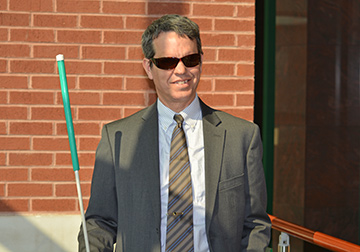 From the Editor: Maurice is a fellow who likes to think and to share what he’s thinking. Often he takes a broader view of issues, suggesting that they are not as simple as we think they are but are in fact tied to a number of other things going on in society. In this article he applauds the Federation’s embracing the evolution of society to be more inclusive and understanding. At the same time he cautions against being so attached to our differences that we fail to see our similarities and the causes on which we must unite as blind people. Here is what he has to say:
There has been a resurgence of racial sensitivity and anti-bias training programs implemented in public, corporate, and nonprofit sectors in response to the brutal police slaying of George Floyd, Breonna Taylor, and too many other unarmed Black citizens to name in the summer of 2020. This led to mass demonstrations worldwide of millions of people from all backgrounds. Well before this pinnacle moment, the leadership of the National Federation of the Blind had been engaged in updating our programs and procedures to reflect our commitment to civil and human rights for all. Ongoing revisions continue to be made to our code of conduct and training programs designed to embrace the rich diversity of our membership have been launched. In its fullest sense, this is intended to create an environment of inclusivity. We continue to innovate educational training opportunities for our members, including raising awareness and assuming responsibility for creating environments that do not tolerate harassment of any sort, including among the most harmful and long lasting of these, sexual abuse. The NFB is also providing anti-bias training for broad layers of our membership to address any existing inequities, whether in form or in attitude. As a microcosm of society, a mass membership organization like ours is simply not immune to the often poisonous and divisive attitudes and practices that are unfortunately present in the world we live in.
Before I offer an alternative perspective from an admittedly biased viewpoint, I wish to make clear that my opinions on the question of sensitivity or anti-bias training programs are general and not to be misconstrued as in any way opposed to the programs and procedures under development by multilayered leadership bodies in the Federation. I would also place in context my comments as coming from a position of strong and long-standing aversion to discriminatory practices of all forms, whether based on race, national origin, religious belief or non-belief, disability, sexual orientation, gender identity, or what too often gets left out—adherence to dissenting political views, whether within or without the traditional two-party American political paradigm.
As a student of history, I am particularly interested in the chronicled mass movements in our country which affected fundamental change of truly historic proportions. These included, but are not limited to:
- The Civil War that defeated the Southern Slavocracy in the United States, (the second American Revolution)
- Establishment of local governments throughout the south during the period known as Radical Reconstruction in the war’s aftermath that included land reform
- Ascendence of an unparalleled number of Black business leaders and elected officials throughout the South
- Armed Black defense organizations to confront white supremist bands such as the Klu Klux Klan and White Citizens Councils
- Farmers’ struggles in the 1920s Jazz Era amidst a mass migration of African Americans from southern states to the industrial north
- Integration of Black workers into industries during the rise of the powerful movement for industrial unions
- Mass movement of multinational and multiracial working-class people who decisively crushed Jim Crow legal segregation in the United States
- Supreme Court Brown versus The Board of Education decision in 1954 that eliminated legally sanctioned school segregation
- The Montgomery bus boycott in Alabama that halted apartheid-style separate status for Black passengers less than a year later
- Women’s suffrage and subsequent waves of women’s liberation movements
- Farm workers’ struggles
- And the Black, Chicano, and Native American rights and anti-Vietnam War movements of the 1960s and 1970s.
It was these movements of ordinary people like you and me that pushed back social divisions among Americans who increasingly found themselves working shoulder to shoulder and interacting with people from all backgrounds and traditions. This is no less true today. In fact, in our overwhelming majority, we are more diverse and inclusive than at any time in history.
The fact that systemic racism and other forms of hideous prejudices exist is unquestionable. My assertion is that the focus should be on the “system” or systems that perpetuate these irrational and harmful divisions in the interest of a specific and identifiable class. Although I have framed much of my description of bias in terms of anti-racism, it is not intended to ignore the fact that biases are broader than just racial and can be deeply imbedded. Although having cultivated certain sensitivities in this area as an activist, I assume no responsibility for these artificial social divisions but consciously choose to be a fighter against them.
At the center of all negative biases in our class-divided society, meaning attitudes that would belittle or diminish in status members of minority groups on usually superficial grounds, is a power dynamic. Power manifests in a great many ways, but in terms of structural society, power is recognizable in its most controlling fashion in the form of the state apparatus which holds in its grip law enforcement, the so called “military industrial complex,” the prison infrastructure which grossly and disproportionately disenfranchises men and women of color, as well as the political machinery that is inseparable from its big-money sponsors. I use the term “disproportionate” since power, by the limited definition of capital and blunt militaristic force, is in the hands of a relative few as compared to most of us who can claim none of the above power tools. It is the antithesis of a truly “representative democratic” process. Ibram X. Kendi, author and founding director of the Anti-Racist Research and Policy Center at American University, says “…the origins of racism cannot be separated from the origins of capitalism… the life of capitalism cannot be separated from the life of racism.
The trouble in my view with many programs that purport to address bias, either explicit or implicit, is that they target the wrong audience. They set up a dynamic whereby a group, presumedly of “woke” experts, sets, and defines parameters of what is to be considered “appropriate” discourse and behavior by the rest of us who need to be enlightened or corrected. In 2019, for example, New York City rolled out a new $23 million “implicit bias” training program for all Department of Education workers. “Anybody that feels that somehow that process is not beneficial,” said Richard Carranza, New York Schools chancellor, “they are the ones that need to reflect even harder upon what they believe.” The New York Times 1619 Project, which has been widely adopted in classrooms across the country, is another example. Programs such as these are steeped in historic revisionism as they tend to ignore examples of unified people’s movements in our nation that drew together workers and farmers of all backgrounds. This misreading of history disingenuously minimizes the importance of the proud historic record of resistance that has effectively pushed back, not reinforced racial and other forms of structural oppression. Instead, its author, Nikole Hannah-Jones, says, “Anti-Black racism runs in the very DNA of this country.” True enough as it goes, but the question remains: who benefits the most from racism and other forms of social disparity? Furthermore, this type of identity politics frames non-Caucasian people nearly always as victims rather than as architects and movers of change and progress. When the late Malcolm X was asked by a reporter if his intention was to raise the consciousness of African Americans to their oppression, his response was, “No, to awaken them to their humanity.” Many of these programs fall under a philosophical ideology coined as critical race theory (CRT) which is a framework in academia and jurisprudence that examines society and culture as they relate to categorizations of race, law, and power in the United States of America. It began as a movement in American law schools in the mid-to-late 1980s as a reworking of critical legal theory on race issues. Unfortunately, theories such as these tend to perpetuate rather than solve the problems of systemic inequalities by reducing them to purely visible characteristics such as skin color or appearance. They also tend to be steeped in a politically polarized framework of what has become known as “cancel culture.” It has been widely reported in mass media outlets and social network platforms that numerous journalists and other public figures have lost their livelihoods because of this tacit form of social censorship under the all too familiar rubric of political correctness. It stifles not encourages the free exchange of ideas.
I would assert that the mass injustices against our brothers and sisters are largely a factor of class privilege which focuses upon a power structure that benefits from divisions among us, diverting attention from them and instead encouraging tribalistic infighting among us. The fact is that the greater “us” suffer the most from these divisions, whether African American, Caucasian, Muslim, Jewish, Latino, Native American, Asian Pacific, female, LGBTQ plus, or whatever classification. So, whenever the issue of “white privilege” is brought up in a fashion that demands that we “search internally for our hidden or implicit biases,” I say, let us instead examine class privilege which has widened the gap of inequality dramatically over the past several decades and exacerbated social divisions in society. To illustrate the point, the income gap between Caucasian and African American workers over the past several decades has actually narrowed—not because lower paid workers of color rose nearer to those of White workers, but because the steady decline of real earning power has lessened for all workers across the board. This assertion does not ignore the glaring truth that people are treated differently in our society based upon superficial visible characteristics such as skin color, no indeed. I do not buy into any utopian illusions of a “colorless” nor of a “classless” society and do not, therefore, condescend to suggest that we are all treated the same. I have always valued the privilege of working and collaborating with a wide and diverse community of people from all sorts of backgrounds and identities. I appreciate and respect the initiatives that our elected leaders in the National Federation of the Blind are engaged in to remedy all remnants of inequities in our organization. I was moved by the presentation at the 2020 virtual convention of our Black Federation leaders speaking frankly and boldly about their experiences both as blind people and as Black Federationists in a society that ever burdens under a legacy of brutal division and strife. My point in all of this is to encourage us to recognize in one another our common struggles while celebrating and learning about our differences. Those, like our blindness, do not define us or our future.