Smart Cities Summit
by Karl Belanger
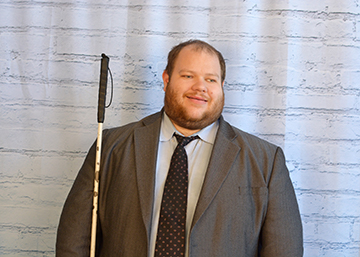 From the Editor: Karl is one of the most knowledgeable people I know when it comes to technology, and I am grateful he is willing to help some of his less fortunate friends when they/I encounter problems. The really wonderful thing about Karl is that his knowledge extends well beyond assistive technology (AT) where he fields most of the questions he gets. To show how far beyond AT he goes, enjoy what follows:
I have a love for technology and a passion for improving accessibility in all areas of life. The nonvisual technology that can be used to independently navigate through various environments is both beneficial and fascinating. As cities around the country begin to implement new technologies for wayfinding and information gathering, it is vital that they are accessible to those with blind and low vision. Our Smart Cities conference highlighted how access technology can be used effectively by blind and low-vision individuals to access various environments’ services including public transportation, voting, public kiosks, indoor navigation, and autonomous vehicles. Each session brought together stakeholders from both industry and government to present new technologies and strategies for improving access in the relevant area. The conference also discussed the National Federation of the Blind’s Blind Driver Challenge from 2011 as well as current and future collaboration regarding autonomous vehicles.
With the support of the Maryland Department on Disability (MDOD) through a Nonvisual Accessibility Initiative (NVAI) grant from the state of Maryland, the NFB investigates and evaluates the various tools being used for wayfinding and the strategies for creating accessible public spaces throughout the year. Our Smart Cities Summit was held on January 28, 2021, and allowed us to highlight the work being done to create accessible means of making public and private spaces and services more accessible. Representatives from various academic, public, and private organizations had an opportunity to share best practices and network.
We kicked off the summit with a welcome from President Riccobono, highlighting the work we did with our Blind Driver Challenge in 2011 and the influence it has had in establishing the National Federation of the Blind as viable partners to researchers and manufactures in the design and development of accessible autonomous vehicles. Afterward, Henry Claypool, disability policy consultant, set the tone for the summit with a keynote presentation on “The State of Access to Smart Cities.” He highlighted the strides made toward the implementation and use of technology to create more accessible cities and the challenge we face in our efforts to ensure accessibility moving forward. The rest of the summit consisted of plenary and concurrent sessions hosted via the Zoom platform. The following is a brief description of the topics covered:
Ensuring Access through Technology Procurement
Sharon Maneki, the director of legislation and advocacy, NFB of Maryland, shared her comments on “The Stakeholder Difference.” Sharon stressed the importance of stakeholder involvement in advocating for accessibility, emphasizing the importance of the need for blind people to be actively engaged in the entire process. She described the tactics that the members of the NFB of Maryland successfully used to enact legislation in 1998 and 2000 that incorporated nonvisual access requirements into the procurement process. This legislation was enhanced in 2018 by establishing penalties for noncompliance by vendors and by updating the 2000 law to reflect changes in current technology. She explained the nature of the give and take when negotiating the passage of public policy, referring to it as the “art of the possible.” Of course, passing the legislation is insufficient if there is no real plan on how to implement the appropriate practices required to request, evaluate, and procure accessible technology.
Stephen Polacek, an information technology accessibility evaluator with the Maryland Department of Disabilities, gave a presentation on “Accessibility Procurement Planning.”
Improving Public Transit through Collaboration
The NFB CENA (Center of Excellence in Nonvisual Access) has a very productive working relationship with the Maryland Transit Administration (MTA), and collaborates to enhance the accessibility of Maryland’s public transit system. Jaime McKay, a transportation planner for MTA, described the projects that NFB and MTA have partnered on over the past year. These projects included the evaluation and production of accessible bus schedules using a print-Braille flipbook, evaluation of various wayfinding technologies at local light rail and subway stations, and the accessibility evaluation of various mobile apps that provide public transportation schedule and service information. MTA demonstrated a commitment to hearing from representatives of the disability community by expanding its interaction with other disability-focused organizations.
Hindley Williams, an independent living specialist with the IMAGE Center of Maryland, described how MTA contracted with the IMAGE Center to conduct outreach during a variety of meetings and conferences of people with disabilities, including the state convention of the NFB of Maryland. We closed this session with a demonstration of CharmPass, Baltimore’s accessible bus ticketing and information app.
Nonvisual Access to Digital Public Services: Ensuring Accessible Public Information through Training and Policy
Public kiosks have been around for a while, but there appears to be growth in their utilization as a tool to provide self-service options, public information, and wayfinding assistance. The NFB is committed to fostering the partnerships with developers of next generation kiosk technology to ensure the accessibility of these tools as they are deployed throughout the country. Gina Winkler, director of product and Kara Tuckerman, lead product designer for IKE Smart City at Orange Barrel Media, presented along with Drew Nicholson, president/chief operating officer of Intellectual Technology, Inc, describing the accessibility features of their kiosk technology. IKE Smart City has developed a mobile interface to its informational kiosks deployed in several cities across the country. It also worked with the NFB BUILD, (Blind Users Innovating and Leading Design) program to gain valuable user feedback. ITI discussed their fully accessible kiosk designed to provide full access to self-service features at its local DMV.
Accessible Elections, Lessons Learned for Successful Execution
With lockdowns and social distancing becoming commonplace in 2020, many states turned to mail-in voting. With this change came an increased focus for the National Federation of the Blind on ensuring that the implemented solutions were accessible to blind and low-vision voters. Lou Ann Blake, director of research programs at the National Federation of the Blind, discussed recent developments in accessible voting systems and the guidelines for developers to make their devices and software accessible. Lou Ann then interviewed Jared Dearing, director of elections for the state of Kentucky, and Heidi Schissler, legal director for Disability Rights Kentucky. The discussion covered the challenges faced when working to introduce accessible voting technologies, and each of them highlighted the steps they are taking to ensure the right to a private, secure, accessible vote for each blind and low-vision Kentucky citizen. Following this, Karl Belanger demonstrated the Democracy Live online ballot marking system, which allows blind voters to independently mark and print out their ballot.
Accessible Pedestrian Spaces
It is possible to create accessible public spaces using features and technologies that are functional and esthetically pleasing. Peggy Martinez, principal of Creative Inclusion, LLC, gave a presentation on a variety of strategies that can be used to improve accessibility for people with disabilities in the areas of technology, wayfinding, transit, recreation, travel, and entertainment.
Scanning, Mapping, COVID-19 Automated Contact Tracing and Navigating Indoor Spaces
The blind have had access to wayfinding technology, like Sendero, that provides information that assists us to navigate throughout outdoor spaces for years. However, the technology that provides access to information about indoor environments in a manner that allows for independent navigation indoors continues to present a challenge. Mike May, chief evangelist of GoodMaps, the innovator of Sendero, co-presented with Ruben Kazantsev, co-founder/CEO of IndoorAccess®. They discussed the evolving technologies and the various ways they can be used.
Enhancing Mobility through Autonomous Vehicles
We were honored to have Dr. Anne Marie Lewis, senior director of technology, innovation, and mobility policy with the Alliance for Automotive Innovation to offer a keynote for the beginning of our presentations on autonomous vehicles. The National Federation of the Blind is proud to have such a productive relationship with the Alliance for Automotive Innovation. They have been tremendous partners in helping us enact legislation, like the Pedestrian Safety Enhancement Act, which makes the world safer for all pedestrians. We look forward to our continued work together to implement the legislation and policies that will make autonomous vehicles a reality.
Researching Accessible Autonomous Vehicles
Dr. Julian Brinkley spoke to summit participants on his research toward the design of accessible autonomous vehicle technology. The NFB worked with Julian while he was a student seeking his doctoral degree. Accessible autonomous vehicles was his focus then, and we are pleased that he has continued his work as assistant professor of human-centered computing at Clemson University. The relationships we establish with researchers is key to ensuring that our voices are heard in the design and development process.
Partnering with Stakeholders in the Design/Development of Technology and Policy
Our partnership with autonomous vehicle manufactures is essential if we are to ensure that our voices are heard and our recommendations are incorporated into the design, development, and implementation of autonomous vehicle technology. We have established collaborative partnerships with several automobile manufacturing companies, offering feedback and participating in the evaluation of various accessibility strategies. Ellie Casson, head of local public policy, Waymo, and Kenny Montilla, public affairs manager, Cruise, co-presented during this session to give updates on their progress. They emphasized the importance of stakeholder involvement in the design and development of autonomous vehicle technology.
At the end of the summit, we were able to once again highlight our NFB Blind Driver Challenge and offered a teaser about how we would be accelerating accessibility in 2021.
Moving Forward
The event was a success, with many participants enjoying the day. Some participants commented they would like to see more discussed about options in rural areas, discussion of accessibility in large spaces like malls, as well as information on activities outside the United States. As cities continue to evolve and autonomous vehicles come ever closer to reality, the National Federation of the Blind Center of Excellence in Nonvisual Access will continue to work toward the goal of blind people living the lives they want in a fully accessible city.