Longtime CFB President Mary Ellen Gabias Retires
by Doris Belusic
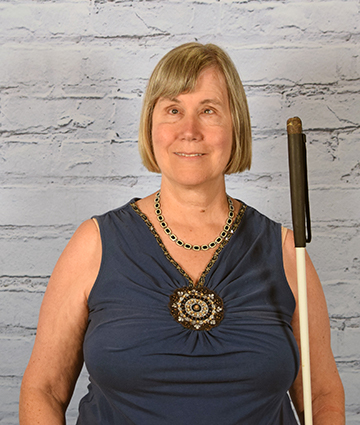 From the Editor: This article was originally printed in The Blind Canadian, Volume 20, December 2021, a publication of the Canadian Federation of the Blind (CFB). Readers of the Braille Monitor know about the stellar work of Mary Ellen Gabias, her work as a former member of our national staff, her marriage to Paul, their move to Canada, and their starting of an organization similar to the Federation in its philosophy and being run by the blind. Here, in substantial part, is the article:
It is with mixed emotions that we in the Canadian Federation of the Blind see the retirement of our longtime president, Mary Ellen Gabias. Of course, it is hard to let go of a president like her!
The position of president is demanding, and Mary Ellen served in this capacity from May 2012 until this past September of 2021. Before that she served many years as our first vice president. She fulfilled her roles with dedication, dignity, diplomacy, wisdom, and spirit. This she did while giving generously of her time, knowledge, experience, energy and friendship. Mary Ellen was mentor extraordinaire.
Mary Ellen, along with her husband, Dr. Paul Gabias, founded Federationism in Canada in 1992 and founded the CFB in 1999. Paul, a psychology professor at the University of British Columbia Okanagan, received an honorary doctorate from the University of Victoria in 2000 for his work in bringing Federationism to Canada. Due to their vast early involvement in the National Federation of the Blind in the United States, Mary Ellen and Paul knew the importance and value of such an historic, grassroots, membership-driven, advocacy and mentoring organization—by the blind and for the blind—and knew what such an organization can offer to the blind. They wanted to bring this successful blindness movement model to Canada. Until then, Canada knew no such thing, and for many blind Canadians, Federationism was something foreign and new, an eye-opener, no pun intended. It was what blind Canadians needed—this knowledge that one can learn to be more independent, confident, successful, and live the lives we want if given appropriate blindness skills training, information, and opportunities. We learned about not bending to societal low expectations or to the stigmas and stereotypes of blindness. We learned about being advocates for the greater good and being advocates for ourselves in our own daily lives. We learned about the importance of having a positive can-do attitude toward our blindness. We learned about the NFB-style long, white cane—better for mobility—and to view our canes with pride instead of shame, to see them as tools of ability, not inability, of independence, not dependence. And we learned about powerful Federation philosophy:
- We are an organization of blind people speaking for ourselves.
- We believe blindness is a characteristic and not a handicap, that blindness is not what defines us or holds us back.
- We believe with proper training and opportunity blind people can compete on terms of equality with sighted peers. Blind people can do almost anything sighted people do; sometimes we just use alternative techniques.
- We believe the real problem of blindness is not the lack of eyesight. It is inequality in society, low expectations, an old charity model, and the lack of positive information about blindness and the abilities and achievements of blind people.
- We believe it is respectable to be blind and that the white cane is an empowering tool for independence and a symbol of freedom and pride.
Through Paul and Mary Ellen, we gained knowledge about the three world-renowned United States NFB intensive blindness skills training centres and about NFB annual national conventions—the largest gatherings of blind people in the world, at about 3,000 attendees each year! We’ve met many Federation leaders and members and have listened to and talked with many successful role models: blind lawyers, blind educators, blind business people, blind writers, and blind parents.
This takes me back to the early Federation days in Canada, when in 1997 Paul and Mary Ellen, at major expense, sponsored over ninety of us Canadian newbies to attend and experience our first-ever NFB convention, held that year in New Orleans. That was some week! Talk about educational, inspirational, and life-changing experiences for many of us who had never known that such events, that such learning grounds, existed. This was mentorship at its best!
Yes, it was Paul and Mary Ellen’s mission to expose blind Canadians to the benefits of Federation conventions, to bring together blind people, to learn from each other. They felt it was critically important that we in Canada know the value of attending these NFB conventions, but also to hold our own Canadian Federation gatherings—hence, our CFB conventions! The value of these conventions should not be underestimated.
Mary Ellen was instrumental in our CFB conventions, including writing and presenting many informative and entertaining speeches and banquet addresses, which are preserved for all to read on CFB’s website, and published within issues of our own CFB magazine, The Blind Canadian, which she also helped establish.
Mary Ellen was very instrumental in areas of blindness advocacy, including many government-related issues, such as equitable library service. She must have written hundreds of letters over the years. She gave media interviews, attended important meetings, ran our monthly national CFB meetings, and helped plan and attended our rallies/ protests, as CFB advocated for positive change. Among these were several human rights cases and issues such as the need for better blindness rehabilitation services in Canada. Mary Ellen was also a strong advocate opposing Canada’s old, pervasive charity model, which in many ways has held the blind back, especially the working-age blind. The list of her advocacy work goes on and on.
When I mentioned that Mary Ellen was mentor extraordinaire, it wasn’t an exaggeration. She was knowledgeable on so many aspects concerning blindness and has helped many people on their own blindness journeys. And since she is the mother of four grown children, she has been able to offer a lot of experiential guidance to those who asked about blind parenting.
Because of the Gabias family, our thinking in Canada has shifted about blindness, about ourselves, and about possibilities. All this and more is what Federationism is about. We, the blind in Canada, were given this gift of knowledge—an awakening. Today, Federationism is growing and expanding across this country. We owe a great deal of gratitude to Mary Ellen and Paul for all of their hard work and a HUGE THANK YOU to Mary Ellen as she retires from the president’s chair. May your retirement be joyful! But luckily for us, we still get to keep you, one chair over – as our Immediate Past President!