Chapter Chatter: Listen, Speak, Repeat
by Christine Faltz Grassman
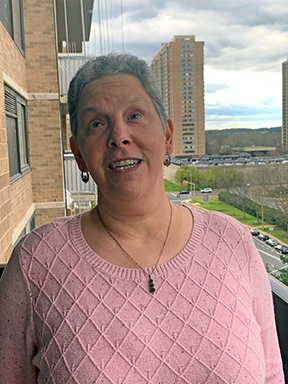
From the Editor: Christine Faltz Grassman is a native New Yorker who moved to Virginia three years ago to take a job as a conflict resolution specialist in the federal government. She has been active in the Federation for thirty-five years and is the president of the Potomac Chapter of the NFB of Virginia and a Project RISE mentor. A 1987 scholarship recipient, Christine is an attorney and teacher, a member of her community’s Emergency Response team, and is a secular celebrant certified by the Center for Inquiry. She lives with her spouse, Gary Grassman, and their ruler, a Norwegian forest cat named Pixie. Here is the first in what I hope will be many such articles:
"One of the hardest things in life is having words in your heart that you can't utter."
—James Earl Jones
 As individuals and as members of the NFB community, a significant focus over the past few years has been ensuring safety for ourselves and our diverse community. One of the elements of this effort is bystander intervention: learning ways that you can intervene when you witness a problem in which an individual or several individuals are harassed, bullied, or otherwise placed in physical or other jeopardy.
It is difficult to be the person who decides to step in. It could get messy. What if the person turns on you? What if you are misunderstanding the situation? What if you make it worse? How can one stand up for another if one cannot stand up for one’s self?
Before you can become an effective advocate, ally, or intervener, you must be one for yourself. When you are comfortable (or comfortable enough) in your own skin and with your own voice, it is much easier to step in and be there for others.
Of course, you may be an extremely introverted person who just is not someone who speaks up, even when something bothers you or if you think something else might be done more efficiently or effectively. You might feel, for the most part, quite happy with who you are and how you handle things, and if this is so, that is fine; those who care about you and know you well will realize that.
I want those of you who feel silenced, unheard, or uncomfortable to consider what is lost when you do not speak up, when you speak up or react confrontationally, or when you decide you do not want to bother any longer, and we lose your voice, your perspective, your strength and skills.
You are at a chapter meeting. Someone says something about how much more difficult it is for a blind woman than for a blind man to receive assistance in a store when shopping. You are a blind woman, and you think this is ridiculous. Just because this person has trouble doesn’t mean it is because she is a blind woman. You do not have trouble receiving assistance when you go out. You are sick of the whining, the statements you deem to be overblown victimhood. You want to yell out something like “Stop it already. Enough!”
While I do not recommend that strategy, healthy, respectful, and fruitful debate of such issues makes communication and collaboration stronger while fostering a spirit of honesty and bringing all to a place where they can get past hindrances and find common ground. It is excellent practice to expose others to differing points of view and to have them do the same for you. As long as the discussions are thoughtful and honest, and if you talk to the person the way you wish to be talked to, this is a wonderful mechanism for clarifying priorities and strengthening relationships in a group that must marshal its resources toward common goals that help all of us.
How might you direct this discussion to something fruitful? “Excuse me,” you might say, “I have not really witnessed a difference in the treatment of blind women or blind men when I am out shopping. It is true that salespeople might have to be sought out rather than their coming to us, but I think this is true for any blind person. People just do not know how to approach us sometimes.”
“No, no,” you are informed, “It happens all the time. I hear of it often. It’s definitely worse for women.”
How might you steer this forward?
“How can we actually know that?” you might ask. “Has anyone actually compiled statistics, any sort of data on this, even informally? Are there studies or surveys? Have people been interviewed?”
One of you is definitively stating something as a fact, as something obvious, as something with which she believes there is no quarrel and no other perspective. You, on the other hand, are requesting data; you want proof for this assertion. You are not making it personal.
This does not, of course, prevent her from taking it personally or from feeling attacked. That is not your problem, since you did not belittle her, cast aspersions, or tell her to be quiet and stop making a fuss about something so trivial.
It is often the way we deliver our opposition to an idea—or our challenges to what another might state as obvious to all—which often creates problems. If you sound impatient or angry, or if you and the individual often clash on issues, you or she may be tempted to take this all personally, which helps neither of you and sets the chapter back.
Past relationships, past arguments, or various alliances might lead to factionalization and an “us” and “them” situation, which can be fatal to groups large and small.
If you are angry, upset, or if you feel yourself cringing or otherwise physiologically aggravated, take a deep breath before you decide to say anything. Think about the most neutral way to frame your question or addition to the discussion. If someone responded to you the way you are about to respond, how would you feel? Would you become defensive? Would others perceive your response as reasonable? Where do you want to take this discussion? Do you want to “win” points or humiliate someone you deem an “opponent,” or are you more interested in hashing things out in a level-headed and meaningful way? If you and this individual are typically at odds, are you doing this simply to get under her skin? If there are new or potential members at the meeting, will the manner in which the discussion progresses frighten them away and leave them with a poor impression of the chapter, affiliate, or the entire organization?
You must be clear about your motivations, whether you have something constructive to say, and how it will be perceived both in the short and the long term. You do not want to alienate; you want to generate.
No one does any of this perfectly, but everyone can improve their communication skills, especially when it comes to thorny topics and situations. Speak up, and allow others to speak up. Listen to each other, really listen. Answer what is actually put out there for discussion; do not bring in tangential topics or try to derail the discussion because you do not like where it is going. Remain respectful. If you become too upset or angry, state that you would like to have time to consider the subject further, but you feel a break would be beneficial. Keep in mind that, if you do this often, it will appear to be a stalling mechanism and will manifest as not wanting to communicate better.
The larger a group gets, the more complicated relationships and communication become. It is vital, however, that there is ample opportunity for practice of such skills. In my next post, I will discuss how others can assist when things go awry during a chapter meeting discussion.