A Tribute that Can Only Begin to Capture My Friend, My Brother, and the Most Important Member of My Federation Family
by David De Notaris
 From the Editor: David is well known for his work in state government, having served in several leadership roles in New Jersey and Pennsylvania including as director of Blindness and Visual Services (BBVS) and eventually as executive director of the Pennsylvania Office of Vocational Rehabilitation (OVR) in Pennsylvania. After seventeen years, he decided it was time for him to do what he had long wanted to do, that being to start a training company. He and his wife Mariann are the founders/owners of Sky's the Limit Communications LLC. In his work he deals with everything from education at the school district level to employment, his work includes companies such as Verizon, Comcast, Fidelity, NASA, United States Army, and players in the healthcare industry, and even the technical giant, Microsoft. His company concentrates on providing instruction in advocacy, employability, resiliency training, iOS productivity, and accessible financial literacy training for state agencies nationally. For his business, his company does diversity, leadership, and resiliency training, meaning he knows people from human resources to top executives. In covering everything from education to rehabilitation to employment, his company has the ability to build relationships that get blind folks what they need.
In addition to all of this, David is an active member of the National Federation of the Blind, and it is in this capacity that he writes to honor a cherished friend, brother, and treasured family member:
Seldom do I feel apprehensive, but trying to capture the life of Joe Ruffalo is no small undertaking. I’ve known Joe for most of my life, and he has not only been a larger-than-life character, but he has been at the center of so many things I have wanted to do and have eventually done.
Not only do I want to tell Joe’s story as I have experienced it, but I’ve tried to incorporate the experiences of so many he has touched. Of course I am not so naive as to believe I can come close to capturing all that he was and will continue to be for people, so let us not think of this as the first or the last article about Joe. What I do hope is that this one can demonstrate his generosity, humor, and enthusiasm for many generations to come.
I met Joe on a day I will forever remember; it was December 29, 1983, and the location was the Essex Racket Club and Fitness Center in West Orange, NJ. It was an event sponsored by the Association of Blind Athletes of NJ (ABANJ). We were brought together by Rich Ruffalo, Joe’s younger brother. Rich was my high school biology teacher and a coach who talked me into going out for weight lifting. Like Joe and me, Rich was in the process of going blind due to retinitis pigmentosa, more normally abbreviated as “RP.” I was a young teen trying to find a way to distinguish myself and find something that would get me noticed for something positive and in which I could take pride.
I was encouraged by Joe to always set goals and work toward achieving them. One of them had to do with weight lifting. He taught me through demonstrating in his own life that the way to succeed in reaching a goal was to write it down, go after it with lots of enthusiasm, track my progress, and eventually achieve it. He said that one of the advantages to writing down and tracking a goal came at the end. “Just think how good you are going to feel when you write the words ‘Goal Achieved’ on your list.”
On that cold December day not only did I start learning about setting goals but also about the value of making friends I could look up to for guidance and as role models. Joe and Rich encouraged me to become involved in the Association of Blind Athletes in New Jersey. Joe’s heart came through to me when I realized that he celebrated my milestones with every bit as much enthusiasm as he did his own. He still holds a world record in the Paralympic weight lifting competition, but it isn’t surprising that you heard that from someone other than Joe. As he so often said, “It’s not about me, me, me. It’s about we, we, we!”
This fantastic man was more than a role model and a friend. Joe was exactly the soldier you wanted by your side, and as Rick Fox remarked at Joe’s memorial service, Joe was both a general and a lieutenant. As a general, he could see the big picture, could think strategically, and predict with remarkable success what was likely to happen in the future as a result of actions taken today. As a lieutenant, he was marching with his men and was in tune with the needs of each and every one of them.
Our friend came to the Federation in 1988. Joe’s Federation sister, Jerilyn Higgins, has observed through much thought, study, and experience that the best way to get someone to do something you want them to do is to nag. It took her six months, but eventually she got Joe to attend his first meeting. Joe’s wife Judy, knowing him better than anyone, told him “I know you’re going to go off and join another organization. Isn’t it enough that you are already a part of the Lions Club, the Knights of Columbus, the Boy Scouts, and the special education board? You are going to join; I know it.” This he vehemently denied and made Judy a promise that if he joined, he would take her out to dinner. When he got home, Judy took one look at him and said, “I told you so. You joined, didn’t you?” Joe just smiled and asked Judy where she wanted to go out for dinner.
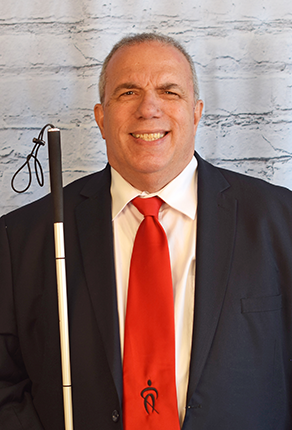 Joe has often told the story of his first meeting and what convinced him to be a part of this organization he had previously thought to be radical, militant, and unreasonable. He shared the story that when he arrived at the meeting, Florence Bloom, then the president of the National Federation of the Blind of New Jersey, asked if he would like a cup of coffee. He replied in the affirmative, believing that in the meeting of the blind, a coffee would be delivered. Florence informed him that the coffee was at the back of the room and that the decaf was on the left and the regular on the right. He found this both interesting and motivating. He liked the idea of blind people doing for themselves but was worried enough about his ability to carry that he poured himself less than half a cup of coffee, reasoning he would not spill any.
As the meeting progressed, the discussion turned to fundraising, and Joe observed that the Federation could easily make dollars instead of pennies on each sale if only it upped its marketing game. Florence was not defensive; it didn’t bother her that he was a new person on the block proposing significant change. She said that she could see his point and asked that he be in charge of the project. That quickly led to his being in charge of all of the affiliate’s fundraising.
This was the first of many projects to which Joe lent his name, his talent, and his energy. Just how he would be called on to serve he couldn’t know, but one morning he got a call, and on the other end of the phone line was President Maurer. “Good morning, Mr. President,” Dr. Maurer began.
“I’m sorry sir, you’ve got the wrong number. This is Joe, and I’m the vice president.”
“No, I don’t have the wrong number. Congratulations, President Ruffalo.” It seems that the previous president gave up her job, and Joe’s assumption to the presidency was first communicated by a man he was so honored to serve under for decades.
So by 1993 Joe was the president of the National Federation of the Blind of New Jersey, and he held that position until 2020. State convention attendance was from fifteen to twenty when he joined, and now convention planners routinely count on three hundred or more to fill convention sessions. An affiliate that had two chapters when he joined had seven chapters and seven special interest divisions when he left the office some twenty-seven years later.
I attended my first national convention in 1992, and if memory serves, it was the first national convention for Joe as well. I remember seeing him at the New Jersey affiliate table, and although I don't remember what we were selling, I remember vividly how excited he was about it: lots of folks take their turn selling, but Joe did not regard it as a burdensome task. I will never forget observing him standing there, rubbing his hands together, and shouting out with enthusiasm that was infectious. As the crowd would come and make their purchases, you could hear Joe saying “Isn't this great! Isn't this great!”
One of the things I remember about Joe is that every time he approached me with a request, the way he introduced it was to say “Dave, I would like to ask you for a small favor.” A small favor seemed so little, and with Joe it was never a big favor, not even when he asked me to be the coordinator for the job opportunities for the blind program. Just having gotten a job myself, I argued how very busy I was. Joe was sympathetic. He said, “Well, how about this? Let’s say you try it for a couple months, and if it doesn’t work out, get back with me, and we’ll find someone else.” Well that two-month temporary appointment turned into most of a decade of service, but I got as well as I gave, learning from people like Lorraine Rovig and others how to organize activities, advertise them, and generate excitement about them. Here, too, Joe was a tremendous help, always reminding me that the best way to get someone enthused was to capture in a lead phrase or a sentence (a hook) exactly what you intended to do. He understood the importance of establishing momentum from the beginning and then maintaining it throughout the life of a project. His constant refrain was, “nothing ever happens without enthusiasm,” so it is not surprising that enthusiasm was something he brought in large measure to everything he did.
In talking with Carol Castellano, I learned that Joe was a master of the small ask. “He would call me and always start out by saying, ‘Two minutes, three minutes, that’s all I need.’ This might happen five or six times a day, and almost always those two or three-minute conversations went half an hour. I knew it would, but I loved being a part of whatever Joe was a part of, and I knew I was honored to be on such a team.”
Of course, Joe was about much more than selling, competition, growing, and achievement. He was about kindness, manners, being a gentleman, and living the Golden Rule. He often observed that the important thing was not the growth that took place in the affiliate but the difference we were able to make in the lives of people who interned, then decided to become a part of the organization. He deeply believed that if you did what was right for people, organizational growth would take care of itself. Joe would always say, “People don’t care how much you know unless they know how much you care.”
When Joe learned about somebody who was going blind, whether it was talking to them in person or to one of their relatives, the time he was willing to spend on the phone with them knew no bounds. He knew it was all about forging relationships and through them giving the hope that would determine whether blindness was a tragedy or simply a nuisance and an inconvenience. It was not uncommon to find Joe on the telephone late in the evening and sometimes during the very early morning. This is what all of the organizational stuff was about. Bringing hope, creating opportunity, and seeing change were all results of Joe’s positive attitude and at the same time the very reason for it.
After college there were times when I wanted to participate in some particular activity of the Federation and simply didn't have the money. When Joe found out, he would pull me aside, slip me some money, or let me know that this or that would be taken care of: “Your room is covered.” “We have your registration and banquet already, so don’t worry about them.” I listened closely during chapter and affiliate treasurer reports, but never did I hear about a fund that made me a grant. I asked Joe about this once, my theory being that perhaps the costs were rolled into convention revenue or maybe there was a scholarship covered by other attendees’ registration. His response: "No, Dave, I just take care of it out of my pocket. You know, if people don’t have it, they can't come, and letting them show up and hearing something positive just may change their life, and that makes all the difference."
I used to tease him and wonder why he so frequently won in the 50-50 drawing. Of course, the greater number of tickets you have, the greater chance you have of winning, but I think there was also something else involved. Joe would tell me repeatedly, “Dave, don't worry about being a go-getter; concern yourself with being a go-giver." I think that kind of attitude was reflected back to him in the form of what we called luck but may have been a bit of the Divine intervening to see that Joe could continue his good work.
The one thing I treasured most about Joe was his ability to laugh not only at situations but also about himself. One story I love to share is a bunch of us at a United States Association of Blind Athletes’ event went out to dinner at a busy restaurant. They directed/controlled its customer lines using poles connected together by velvet ropes often found at banks/restaurants/registration areas. We found ourselves in a long line, and Joe’s brother Rich decided to play a prank. He did this by gently unfastening one of the long velvet ropes and attaching it onto Joe’s backpack. Once Rich knew the rope was secured, he yelled to Joe “Come on Joe, get moving, you’re holding up the line.” Of course, Joe set off with real determination, and the ropes and polls that made-up the crowd-control system of the restaurant made a joyous crash, boom, bash noise as it collapsed. The only noise louder than those clanking poles was the laughter of Joe Ruffalo, the man who, no matter the circumstance, never got ruffled.
Joe used to tell me "I don't have a college degree, but I will work harder than anyone else." What a great lesson that was to me: a lesson about taking what some would consider an adversity or a detriment and turning it around to be a major source of motivation. But it was more than work; it was about attitude. "It is not about me, me, me; no, it is about we, we, we."
Joe was hardworking, determined, and driven; when he got an idea he would run with it! Some close friends would playfully call him “Joe Rockhead” a reference to Fred Flintstone’s good friend from the Water Buffalo lodge.
Joe was not only a great soldier for the National Federation of the Blind but also for the Knights of Columbus and the Lions Club, the latter giving him the highest award they could offer. There was no question that Joe was loyal through and through, the finest in what you would want in a good soldier. If there were things that bothered him or questions he couldn't answer, his standard refrain, in which he believed totally was, "They are in a better position to know than I am. I'm sure they know more than I do and have already considered this."
One of the things that most endeared me to Joe was his concern about me and about my family; his questions were not general but specific: how is Marianne, young David, MaryKate, and Emily.
I used to love it when Joe would show up at the NFBNJ Christmas Party at the Gateway Hilton Hotel in Newark, and the kids would go crazy because they observed that Santa Claus was carrying a white cane. A blind man who was happy, a blind man who was a major part of a celebration; a blind man who was always leading in holiday festivities! What an example of a role model and what better way to let young children know that blind people can be givers too.
Joe was very involved with the programs of the New Jersey Commission for the Blind. Much of his work was as a volunteer, but he did have at least two paid positions with funds from the Commission. One of them was working in the Leadership Education Advocacy and Determination Program serving children from thirteen to twenty-one. I interviewed one person who remembered one meeting that was held at Joe’s house, and the activity was cooking. He helped a young man make a pie, and at the end of the session the young man pleaded with Joe to adopt him.
I played a small role in helping Joe gain a paid position working with seniors. I was asked to review a proposal to fund a program through the Commission. It was called the Senior Community Independent Living Skills Program. As I read, I could see Joe written all over the success this program could have, but, near the end of it, I came upon a stumbling block. I noted with regret that the manager must have a college degree. That was too limiting, so I inserted a part of a sentence that said "or equivalent life experience." When I turned the proposal back to the director and told him about my addition, he agreed that it was something that should have been included in the document from the beginning.
As soon as I completed that call, I called Joe Ruffalo and suggested he apply. At first he was skeptical, noting his lack of formal qualifications. I told him about the substitution of life experience. Then he was concerned because he had no resumé, but with a three-way call between Joe, Carol Castellano, and myself, Joe was able to submit an application the very next day, and he served for more than a decade helping seniors. He loved the work, it showed, and just as he had with his transition-aged students, he and others could see that his work was making a positive difference in the lives of blind folks. What I learned that day was that even the most positive among us occasionally need encouraging. Joe had some doubts about Joe, but his friends did not. One of his often quoted remarks came to serve Joe as well as the many men and women he helped: "People need encouragement like flowers need rain."
Although this article is about Joe’s life, it would be incomplete if we did not say that Joe is being buried at Arlington Cemetery, an honor reserved for those with distinguished service. Among his medals is a bronze star, representing heroic achievement, heroic service, meritorious achievement, or meritorious service. His service came at a cost, Joe returning with occasional eruption of PTSD. One day when he threw himself and his sister Jane to the ground and she asked what he was doing, is a subdued and apologetic voice he apologized: “I thought I was saving us; for a moment we were both in Saigon.”
As flattered as I am to try to chronicle the life of my friend, one of the hard things about writing this is that I have known him the majority of my life, and he is so much more than a friend: he was my advisor, my older brother, and my mentor. Interestingly, he would at times argue otherwise, many times identifying me as his mentor and then quickly letting people know that one did not need to be more advanced in age in order to mentor. One simply had to have experiences from which another could benefit, and he credited me generously with that, using as but one example the observation that I encouraged and helped teach him to use the screen-reading program JAWS.
The only reason I can write this is that I know that no single article can capture the larger-than-life character that was Joe Ruffalo, and I trust others will fill in the blanks and tell all of the other stories that must be told. In writing remembrances, we sometimes ask ourselves what we should leave out—those things less flattering, less admirable, more revelatory of one’s darker side. This has not been my issue, for there was little of this in Joe. My problem is simply that there isn’t enough space in this article or creativity in me to say the kind of thank you that Joe deserves. I trust that he knows the enormity of the task we are all trying to undertake in honoring him, and he would encourage us to be kind to ourselves, give one another the time and love he can no longer give, and to understand that this really was never about him but about us.
One day I recall Joe calling me and sharing, “David, do you know what NFB stands for?”
“Yes Joe, of course, National Federation of the Blind.”
“Yes, correct, but it also stands for Never Felt Better!” Joe was blessed to find the NFB, and then he found himself.
I end this with tears in my eyes, love and respect in my heart, and gratitude in my soul for having the opportunity to know, learn from, and, like so many, be encouraged by our good friend, brother, and mentor, Joe Ruffalo! Joe would so often end what he wrote with: We care, we share, we grow.” And yes, Joe, we promise to keep doing all of this and more. Thank you Joe—you were and still are a difference maker!