She Had an Anteater
by Peggy Chong
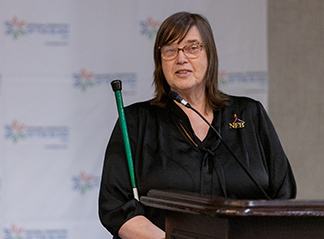 From the Editor: Peggy Chong is often featured in these pages because of what she reveals about blind people who have played such a part in building what we now enjoy but would otherwise get little credit were it not for her efforts. For me what she writes is therapeutic. So many times in my life, I have thought I was a pioneer, but the reality is that I was traveling a road that some blind person had helped to build. I sometimes have felt like I was carrying the weight of the world on my shoulders, but the reality is that people who had far less to work with carried the burden every bit as well as I have and in many cases have done it far better. Here is a splendid example of a woman who enjoyed her life, focusing not on her adversities but on how she could live the life she wanted. Here is Peggy’s article:
Hello Blind History Lady Fans:
One of my more interesting ancestors this past year is Emily Raspberry. There was so little written about her and yet so much to tell. Following is a glimpse into what I have learned of this incredibly strong woman.
Born December 12, 1915, in Alabama, Emily came down with the flu at age four. When she recovered from the flu, she was totally blind. Her little sister died from the flu on December 20, 1918.
Emily's mother sent her to public school with her older brother. No accommodations for a blind Black child were possible, so Emily listened and participated in class orally, not learning to read or write. Finally, Emily was enrolled at the Alabama School for the Negro Deaf and Blind in the fall of 1926.
Emily was homesick, but there was so much to learn. In only two weeks, she mastered the Braille Code and read all 130 books the school owned. A new world opened to her. She had a glimpse of the sighted world, and she wanted to be a part of it. Her teachers were impressed with Emily's quick acquisition of the Braille Code and placed her in the upper class. She studied hard to cram in several years of learning into her first year.
Emily returned home for the first time on May 22, 1927, to find her mother gravely ill. Emily was home only a few hours before her mother died. Instead of returning home as she intended, immersed in the joy of showing how well she was able to learn as a blind child, she was faced with the shock that came from the death of her mother and the heart-wrenching separation from her family that would follow.
A funeral was planned in days. After the funeral, Emily was told she would live with her half-sister in West Virginia. She was enrolled in the West Virginia School for the Colored Blind almost immediately. She found they had twice the Braille books in their library and magazines in Braille. Emily threw herself into her studies. She found the classes harder than in Alabama.
Unlike other schools, West Virginia held unsegregated classes that included both the deaf and the blind students. The boys had one dorm and the girls the other. There were no separate dorms for the blind and deaf students. Rooms were crowded; sometimes three or four boys shared one that would have been considered small for two.
There is no record of when Emily graduated, but it is believed to be either 1932 or 1933. She enrolled at the West Virginia State College for Negro's in Dunbar. At the end of her first year of college in 1935, she knew she wanted to be a teacher in a school for the blind. Her hope was to share her love of reading and literature to the blind and colored students she taught, her hope being they would come to experience many of the possibilities offered by the outside world.
Emily graduated in 1938 and continued classes through the West Virginia State College, enabling her to become a certified teacher of the blind. She received her master's degree from Hampton University.
Emily started as an academic teacher in the primary grades at the West Virginia School for the Colored Blind in 1940 in Institute, West Virginia, a town located near Charleston. She taught reading and writing for the blind and deaf children in her classes.
On her desk she had a toy anteater. Over the years, the anteater showed its wear. Emily decided the toy needed to be disposed of. Knowing her students loved the anteater, frequently saying hello or goodbye to it, she set up a funeral for the anteater. The class went out and dug a shallow grave for the toy, placed it in the grave, and held a short service.
When the school for the white in Romney and the school for the colored combined in 1955, Emily was one of only three teachers from the colored school that made the transfer. Not all the colored students from the Institute transitioned to Romney.
The staff at Romney were friendly, but Emily did not mix socially. For at least the first year, she took a room in the student dorms, as did the other single teachers. As a single woman, and the only Black faculty in the blind department, she may have felt out of place.
In reading classes when she recognized a spark, she assigned a poetry lesson for spelling class to bring out the creativity of the students. The children were encouraged to write a poem, including all of the spelling words for the week. In her Braille classes, she taught the students to work with a slate and stylus, while other teachers used the Perkins Braillewriter.
She incorporated listening to the radio into her classes to ensure her student's interest. They were assigned lessons to write about what they heard. The eighth-grade class in 1956 wrote a quiz show based on the show, "The Big Surprise."
Emily supervised school trips to watch plays or listen to concerts. For years, she had season tickets to the Cumberland Classical Musical Series. Each year Emily paid for four student season passes for those with an interest in music. She took the students by riding the bus or hiring a driver.
When a movie of interest—mostly historical films such as Man of All Seasons came to town, she asked students to accompany her to the movie theater in Romney. She paid for their tickets and treated them to their own box of popcorn.
A memorable year was 1967 when she was chosen to supervise a student teacher. Emily was honored and proud as the student teacher was a former blind student.
In 1969, Emily taught health. This was most likely not her favorite subject, but she entered the class with the same enthusiasm as her English classes, even though textbooks were more than twenty years old. One assignment was to make up word puzzles relating to their health lessons. When the project was over, the best questions were put into an article for the school newspaper, The Tablet, to show how much her students learned that semester.
Later she took an apartment above a restaurant. Rickety wooden stairs led to her door. The apartment overlooked Main Street. The entire space may have been no more than nine hundred square feet.
Emily frequently took the Greyhound bus to Washington, DC. When a student of hers also rode the bus, she talked to them about their schoolwork or family. In class, Emily mentioned her travels to DC, commenting on the friendliness of the staff to her and sadness that maids in the hotels were paid so little.
Other blind teachers from the school asked to have their meat cut or their tea poured from the pot on the table, but not Emily. She insisted she would cut her own meat, pour her own tea, and serve herself.
Summer vacations were never wasted. She took classes at Harvard. In 1961 she worked as a proofreader for Perkins Braille Press. Vacations meant spending time in exhibits at the planetarium, museums, concerts, exhibits on history and more. Usually these were attended in Boston. There were also trips to attend conventions of the AAWB [American Association of Workers for the Blind], of which she was a member.
At one concert, she spoke briefly to Senator Edward Kennedy, also attending. Their meeting was exciting for Emily, and she took the news back to her students about this encounter with a man who would make history.
Emily retired at the end of the 1977 school term and moved to Boston. She kept in touch with some of the Romney residents. They wrote to her in print, and she answered them in print. She died September 12, 1988, in Vermont.