Distinguished Educator of Blind Students Award
For a presentation on the Distinguished Educator of Blind Students, Carla McQuillan!
CARLA MCQUILLAN: Good morning, fellow Federationists. It is great to be here in person. I'd like to begin by thanking the members of the committee who selected this year's recipient of the Distinguished Educator of Blind Students Award. We had Emily Gibbs from Texas, Michelle Chacon from New Mexico, Paul Howard from California, and Conchita Hernandez, who is, even as we speak, giving dance lessons to our kids in NFB Camp. Thank you very much, committee.
I'm going to start by saying that when we met to discuss the several applications that we received for this award, I kept my thoughts to myself, because our recipient is someone I have known for many years. He, without a doubt, stood head and shoulders above the other nominations we received. Back in the late 1990s, early 2000s, we had a totally blind student at our Montessori school. I later found that in this person's early years of his teaching career, he worked with this student and on through his high school. So I met him when he drew the short straw and had to present for the Department of Education at our state convention, and he was warned by his colleagues how ruthless and horrible we would be to him. He confessed later that he found just the opposite to be true, and we developed a wonderful, collaborative relationship, focusing on the importance of education for our blind students.
He also chaired a fund that we had in Oregon, established after the closure of our Oregon School for the Blind, and we received $5,000 for our first BELL Academy in 2014. I served with this individual on the Oregon Commission for the Blind, and when he applied to be the superintendent of the Washington State School for the Blind, I was contacted for my recommendation. I give two types of references: One is glowing to the extent that one believes no human being is capable of such accomplishments. The other is "My attorney has advised I say nothing to you on this person." [laughter] You might guess which I gave for this individual.
His state president, Marci Carpenter, said that at the school for the blind, they had a contest to see how many digits of pi the students could recite. The winner got to throw a pie in the superintendent's face! [laughter] I wish I'd have been there for that.
Marci says, "I have pictures!" [laughter] We'll post them.
The other thing that I find particularly great about this individual is that he attends the state conventions entirely, through the end of the business sessions on Sunday. I know, because I've been there.
Oregon is going to claim part of this guy, because he lives in Oregon, he works in Washington, so "Go Northwest," right? [cheering]
The National Federation of the Blind honors Scott McCallum, Distinguished Educator of Blind Students [applause] for your skills in teaching Braille—oh, I have a plaque—I should show the plaque, huh? Sorry, Suzanne.
It reads:
THE NATIONAL FEDERATION OF THE BLIND
Honors
Scott McCallum
DISTINGUISHED EDUCATOR OF BLIND STUDENTS
For your skills in teaching Braille and other alternative techniques of blindness,
For graciously dedicating extra time to meet the needs of your students, and for empowering your students to perform beyond their expectations.
You champion our movement.
You strengthen our hopes.
You share our dreams.
July 7, 2022
I also have a check for $1,000, and Scott will be presenting at the meeting of the Parents of Blind Children this afternoon. So now, Scott, a few words. [applause]
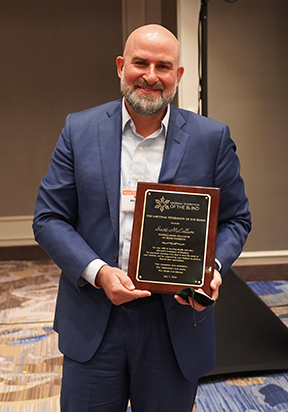 SCOTT MCCALLUM: Thank you, Carla—I wasn't going to cry [voice breaking]—and you started it. [laughter] Okay, I'll get through this. Thank you, Carla, President Riccobono, and members of the National Federation of the Blind for such incredible recognition and award. It's really hard to read my notes through my tears here—[laughter].
As was stated during the introduction, my name is Scott McCallum. I'm currently living—I actually moved, Carla—and working in Washington State, serving in my seventh year as the superintendent of the Washington State School for the Blind. Before I say much more, I'd also like to recognize and thank my good friend Marci Carpenter. [applause] Yeah, give her a round. [applause] Many of you may know Marci as a devoted and very engaged member of the NFB and president of the NFB of Washington. Marci serves on my ex officio board of trustees representing the National Federation of the Blind. Marci, thank you for nominating me for this very distinguished award. [sniffling, voice breaking]
I'm so incredibly grateful and honored to be selected as this year's Distinguished Educator of Blind Students. While there are a number of awards in education spaces that recognize effective and positively impactful teachers and administrators, being recognized with such distinction by the oldest and largest organization led by blind people is incredibly significant to me. I work hard to center the voices of the children we serve, as well as blind adults in the work we do at WSSB. So, this recognition, coming from all of you, is not taken lightly. Thank you from the bottom of my heart. [cheering and applause]
Oops, I still have more to say! [laughter] I've spent nearly twenty-five years in the field of education of blind children. The honest truth is that I've loved every step of the way, from teacher to program coordinator to school and agency superintendent. With every step I've benefited by having great support and influences that helped me learn, grow, change, and improve my craft. Thank you to everyone who has supported me along the way. I especially offer my heartfelt appreciation to all my former and current students [voice breaking] who have taught me every bit as much about life as I have taught them. Thank you to all the families who have trusted me to work with their most precious resource—their children. Thank you to my colleagues and friends who have constantly supported, challenged, and inspired me. And finally, while they aren't here with me today, I'd also like to thank my mother and my wonderful wife, Jennifer. Thanks. [applause] Thank you. Both my mother and my wife have been there to provide support at critical times behind the scenes that have allowed me to flourish and thrive in my professional roles.
After finishing my undergrad in elementary education and my graduate training in education of blind children at the University of North Dakota, I started my career in the late 1990s working as an itinerant teacher of blind students in school districts across Lane County, Oregon. During those early teaching years, I immediately saw the need for and pursued additional training, eventually earning my master’s degree in orientation and mobility in early 2000s. I loved serving as a teacher and an O&M specialist.
Here it may also be fitting to recognize and thank Carla McQuillan. Carla happens to own and operate a few Montessori programs in the area where I started teaching, and one of my first students of Braille started his education at one of Carla's schools. I remember meeting with Carla in the early days of my teaching career. Carla was a strong advocate for my student and a fantastic example of a blind adult living their best life for everyone else involved. Later on in my career I had the opportunity, as Carla mentioned, to serve on the board of directors for the Oregon Commission for the Blind. Carla, you've been such an excellent role model for me and so many others. Thank you. [applause]
I served as a teacher and an O&M specialist until 2010, when I made the transition to administration. I was hired to coordinate one of Oregon's eight regional blind and low-vision education programs and managed the implementation of legislation that had resulted in the closing of the Oregon School for the Blind. As a new administrator, one of the efforts that I’m most proud of resulted in helping Oregon design and implement the nation’s first online adaptive state assessment accessible to Braille readers.
Those efforts led to the purchase, related training, and distribution of a Braille embosser capable of producing tactile graphics, a forty-cell refreshable Braille display, an updated version of the JAWS screen reader, and Braille transcription software for every single student reading Braille in Oregon's public schools. [applause]
I've spent the last six years serving as the superintendent of the Washington State School for the Blind. Serving at WSSB has allowed me to have a statewide and national impact on improving services and supports for blind children. At WSSB, we are able to provide the full continuum of services and supports, all in the name of accomplishing our mission of empowering blind individuals to reach their full potential. We offer a wide range of short and long-term service options which include but are not limited to residential, day, short courses, online as well as itinerant, direct and indirect options to meet the needs of the students we serve. We also partner with others to provide a range of transition options as well as a materials production and distribution center that reaches well beyond the borders of Washington.
Today, while I serve as superintendent of WSSB, I also continue to learn as I work towards a doctorate in educational leadership. This fall, I hope to begin the formal dissertation stage of my program as I aim to complete a qualitative study about the educational experiences of blind children of color in the Pacific Northwest. My proposed study will seek to center the voices of these young adults so that we can learn more about their complexities associated with their intersectional identities and lived experiences. [applause]
I'm almost done, I promise! [laughter] It's been quite a run for me so far, and I look forward to the future. I've been fortunate to have the opportunity to serve and positively impact blind children throughout the entirety of my career. I've loved and appreciated every opportunity I have had, and I couldn't have done it without the support and guidance from others, such as all of you, the NFB, as well as my fellow teachers and administrators, and the many regional and national partners that exist in this space.
Oh, and a little update about that student who attended one of Carla's Montessori schools: He's in college pursuing his dreams and passions connected to his interests in biochemistry and becoming a doctor some day. [applause] He recently coauthored an article published in the scholarly journal called Free Radical Biology in Medicine. His article is titled "Strategies to Protect Against Age-related Mitochondrial Decay: Do Natural Products and their Derivatives Help?" I have no idea what that all really means, but what I do know is that he's doing pretty well, and I'm honored to continue to be a mentor and friend long after the days when I served as his teacher and O&M specialist.
In closing, thank you for choosing me as the 2022 Distinguished Educator of Blind Students. It's an incredible honor just to be nominated, let alone chosen to receive this award. I can't thank you enough and will cherish this award and this moment as affirmation that I'm headed in the right direction. Thank you! [applause and cheering]
MARK RICCOBONO: Thank you, Scott, thank you, Carla, to the committee. Everything you said was worth it, so don't worry about that! [laughter]
SCOTT MCCALLUM: I have one more thing. [laughter]
The $1,000 check, which I'm grateful to receive as a gift, I'll be donating that back to the Washington State chapter of the National Federation of the Blind.
MARK RICCOBONO: Very nice, thank you! [applause]
I'm sure Marci will take it! [laughter]