A Report from the Advocacy and Policy Team
by John Paré, Jeff Kaloc, and Justin Young
 From the Editor: One of the highlights of our national convention has always been the report about our legislative efforts, our progress, and the work we have left to do. This report was first given by Mr. Gashel, and, agendas being what they often are, he got a little less time than he anticipated but always managed to pull it off well. Now the work of the advocacy and policy team is a bit more diverse, but it still offers the same excitement to me. Here is what John Paré, Jeff Kaloc, and Justin Young said to our 2022 National Convention:
John Paré: F. Scott Fitzgerald once said: “Never confuse a single defeat with a final defeat.” Mr. Fitzgerald’s first book This Side of Paradise was rejected by publishers 122 times before Charles Scribner’s Sons Media recognized its potential.
Fitzgerald then went on to write a few more books including The Great Gatsby, considered by many to be one of the greatest novels ever written. While Fitzgerald initially faced rejection after rejection, he did not let these initial setbacks deter him from pursuing his goal.
Political advocacy, much like publishing, requires that we have the patience, clarity of mind, and determination to recognize that a single defeat or setback does not mean we are finished. There have been many times in the past where the outlook for our legislative priorities has been grim. There have been difficult and tense negotiations, flat out refusals, and much lively discussion. Things have not always gone our way, but we have kept fighting because perseverance, determination, and tenacity, are three characteristics that encapsulate the National Federation of the Blind.
Times are tough, but we are far from finished. Because of that persistence, our legislation now has more momentum than ever before.
On January 3, 2021, the first day of the 117th Congress, we had no sponsored legislation. On January 21, 2021, Representatives Thompson and Kelly introduced the Access Technology Affordability Act in the House. We now have 158 cosponsors.
On February 3, 2021, Senators Cardin and Boozman introduced the Access Technology Affordability Act in the Senate. We now have thirty-seven cosponsors.
On April 5, 2021, Representatives Scott and McMorris Rodgers introduced the Transformation to Competitive Integrated Employment Act in the House. We now have fifty-four cosponsors.
On November 18, 2021, Senators Casey and Daines introduced the Transformation to Competitive Integrated Employment Act in the Senate. Given that it has been five years since we have had a companion bill in the Senate, this is an important accomplishment.
On July 29, 2021, Representative Schakowsky introduced the Medical Device Nonvisual Accessibility Act in the House. We now have fifty-eight cosponsors.
We have been working on the Website and Application Accessibility Act, and we expect it to be introduced in both the House and the Senate soon.
Along with the National Federation of the Blind, nineteen other disability groups support this legislation.
In addition, our affiliates continue to rack up successes at the state level. Regarding voting, twenty-eight states allow electronic ballot delivery for blind voters, and eight states allow electronic ballot delivery and return.
In the spring of 2020, the NFB of Illinois began working on this issue. They attempted to contact the governor and the state legislature because a bill designed to provide absentee voting for the 2020 election only provided the ballot in Braille or large print for blind and low vision voters. Missing was the right to cast a ballot privately and independently using access technology. Initial efforts to work with the governor and the legislature were unsuccessful. But the NFB of Illinois would not give up and built a coalition of interested organizations including Equip for Equality (the state’s Protection & Advocacy agency), and the Illinois Council of the Blind.
Their efforts resulted in electronic ballot delivery but only for the 2020 general election. The coalition then began working on a permanent solution.
In 2021 bills were introduced in both chambers of the Illinois General Assembly but did not pass. The legislature referred the matter back to the State Board of Election for further study and hearings. So, the coalition redoubled their efforts by continuing to work through the summer and fall of 2021 to urge the board of elections to conduct the hearings mandated by the legislature.
In early 2022, bills were once again introduced in both chambers of the Illinois General Assembly. When the passage of these bills seemed to be in doubt, the NFB of Illinois took assertive action. On March 9, the affiliate led an information protest in front of the State of Illinois building in Chicago. The story was picked up by the local CBS Radio affiliate, WBBM News radio. I am happy to report that on May 13 Governor J.B. Pritzker signed SB 829 into law.
Sixteen states have phased out or limited the payment of subminimum wages for people with disabilities. Fifteen states have passed legislation protecting the rights of blind parents. All of this success would not be possible without the perseverance, determination, and tenacity of the members of the National Federation of the Blind. Whether at the federal level, the state level, or the local level, NFB members make it happen.
Twenty years ago this month, I registered for NFB-NEWSLINE®. Since then I have used NFB-NEWSLINE almost every day, initially over the telephone and more recently via the iOS app.
I listen to national news, local news, magazines, and the weather. NFB-NEWSLINE is what first alerted me to the National Federation of the Blind. I would have never attended my first chapter meeting—Tampa, my first affiliate convention—Florida, and my first national convention—Georgia, if I had not learned about the National Federation of the Blind by using NFB-NEWSLINE.
It was created twenty-seven years ago and has provided essential news to tens of thousands of blind Americans. It is available via the telephone, the web, the Victor Reader Stream, the NLS digital talking book player, the Amazon Echo, and the iOS app.
There are 542 publications and some portion of NFB-NEWSLINE is accessed every 1.86 seconds on average. Recent additions include J-14, Forbes, the Tuscaloosa News, the Illinois Pantagraph, the New Mexico Deming Headlight, and the Nepal Kathmandu Post.
There are also TV listings for every cable and satellite provider, seven-day weather forecasts, emergency alerts, and job listings. If you do not already use NFB-NEWSLINE, I urge you to sign up.
Sean Seward is our new manager of the Independence Market. He was once a Randolph-Sheppard vendor, so he brings an exciting entrepreneurial spirit to the Market.
You can browse our catalog on our website and order items by calling our main number. We have over four hundred items in our catalog including white canes, Braille and audio watches, kitchen aids, measuring tools, and games.
The Independence Market also helps with our free white cane and slate and stylus programs. Over the past year the National Federation of the Blind has distributed 5,763 white canes and 705 slate and styluses. We also have NFB logoed shirts and jackets. I regularly wear our logoed attire because I am proud to demonstrate my commitment to the NFB, and I am proud to think about the successes of the many Federationists who came before us, demonstrating their commitment by relentlessly advocating for the rights of the blind. Those Federation members understood that no matter the circumstances they had to press on. They demonstrated the perseverance, determination, and tenacity that describes Federationists then the same way it does now.
To paraphrase a line from Fitzgerald’s seminal work, so we labored on, boats against the current because we understand the difference between a single defeat and a final defeat. There have been times when societal inertia, industry opposition, and political forces seemed too powerful for us to overcome. There have been times when we have been told to accept inadequate Braille instruction, lack of employment opportunities, and accessibility barriers as a fact of life. But we, the organized blind, have labored on. Sometimes our proposals, our ideas, and our plans have been rejected, but we are not deterred.
We will work together to improve educational opportunities, to expand employment opportunities, and to protect the civil rights of blind Americans. We have had many successes in the past, both at the state and federal level, and we will have even more in the future. We will build upon the foundation constructed by the Federationists who came before us.
We will work to get our voting rights bill passed in every state. We will work to get our 14C bill passed in every state. We will work to get our parental rights bill passed in every state. We will work to get the Access Technology Affordability Act, the Medical Device Nonvisual Accessibility Act, the Website and Application Accessibility Act, and the Transformation to Competitive Integrated Employment Act to the President’s desk. This will not be easy, but we are up to the task.
We will work together with love, hope, and determination. We will transform our dreams into reality. And we will live the lives we want.
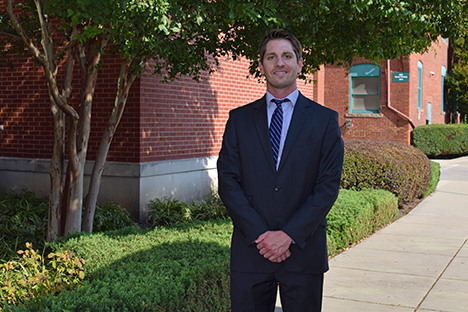 Jeff Kaloc: As we gather at this year’s convention, we focus on our objectives and prioritize our goals for the coming year. While preparing for the future is important, it is also important to reflect on the past and to take into account the accomplishments over the years and review our current standing. The foothold we have built did not come easily or quickly. It required time and patience, hard work, and sacrifice. We stood on the shoulders of giants as these leaders guided us to greater heights and helped us pursue a path towards a better tomorrow.
During the Federation’s last convention in New Orleans, in 1997, Dr. Jernigan in his banquet speech said, “Equal responsibility as well as equal rights is the very essence of theNFB’s philosophy. It is what we set out to get in 1940; it is what we have fought for every step of the way; it is what we are now close to achieving; and it is what we are absolutely determined to have. Equal responsibility – equal rights.”
Dr. Jernigan’s words from the 1997 Convention were as true then as they are now. It is the very reason we are advocating for our legislative agenda. All of the bills we advocate for promote independence and accessibility. But by asking for those concepts there is an understanding that responsibility is part of the agreement. An agreement that solidifies an investment, an investment that we at the National Federation of the Blind know will benefit all parties involved.
The Access Technology Affordability Act will put more access technology in the hands of blind people. The bill does this by providing a $2,000 refundable tax credit over the course of three years for qualified access technology such as Braille notetakers, screen-reading software, or Braille embossers. It provides the freedom and flexibility for individuals to choose which accessible technologies fit their own needs. Some may need a refreshable Braille display while others need an embosser. This legislation equips blind Americans with the tools needed to independently seek employment and excel at their job. Additionally, we expect this legislation to increase the federal government’s revenue in the form of taxes and reduced dependence on Social Security Disability Insurance, Supplemental Security Income, Medicare, and Medicaid programs. Federal, state, and payroll taxes will grow as more blind Americans enter the workforce. Social Security Disability Insurance, Supplemental Security Income and other programs will be better funded as the use of these programs decreases. For all these reasons, this legislation has gained bipartisan support in both chambers of Congress. It presents itself as a win-win in many respects and we must continue to push for its passage.
Advocating for legislation cannot and will not be possible without expressing our voices and casting our ballots. Again, it is the responsibility of the individual to exercise their civic duty to vote. Therefore we must seize every opportunity and focus our efforts to ensure that every ballot is nonvisually accessible and provides the blind voter the same privacy, independence, and ease of use as other voters. It is imperative that we engage with all of our elected officials on this important matter if we seek the changes necessary to overcome discrimination. That is why when we engage with our policy makers, we must express to them the significance behind casting a ballot both privately and independently. Mind you, this isn’t an unattainable notion that we cannot achieve. Various states as a result of our advocacy efforts have enacted into law legislation ensuring these concepts are put into place. Because of these efforts, several states have accessible remote voting that allows voters privacy and independence, everything from registering to vote, requesting a ballot, casting a ballot, and verifying your ballots. We cannot and will not stand silent while we know this opportunity awaits. That is why we must take action to mobilize and educate our lawmakers so that accessible voting isn’t only available in a handful of states but every state.
Now, twenty-five years after Dr. Jernigan’s speech, we reflect on the words that he spoke. If equal rights are to be given, then we must accept the responsibility. Well, we do accept that responsibility and continue to do so each moment we educate lawmakers, grow our membership, and come together as an organization, because, when we mobilize and flex our strength, there is nothing we cannot accomplish together.
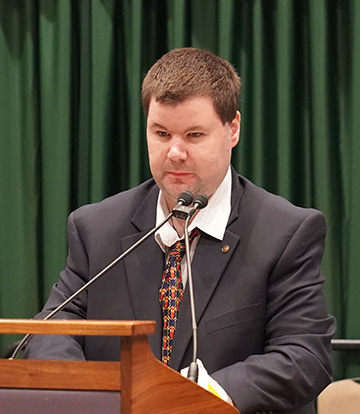 Justin Young: In his 1967 banquet address, Dr. Jacobus tenBroek said, “The blind have a right to live in the world. That right is as deep as human nature; as pervasive as the need for social existence; as ubiquitous as the human race; as invincible as the human spirit.” To live in the world independently, we must have the right to access medical devices and be given the opportunity to earn a fair wage for the work we perform.
At last year’s convention, we passed Resolution 2021-01 which urged “The United States Congress swiftly to consider and pass the Medical Device Nonvisual Accessibility Act, thereby ensuring and protecting the independence, safety, and health of blind Americans.” On July 29, 2021, Representative Jan Schakowsky from Illinois introduced H.R. 4853, the Medical Device Nonvisual Accessibility Act. This bill would amend the Food Drug and Cosmetic Act related to Class II and III medical devices with a digital display. Some medical devices that apply to these categories would include: continuous glucose monitor, blood pressure devices, chemotherapy, in-home dialysis machines, and many more. After amending the Food Drug and Cosmetic Act, it would require the Food and Drug Administration to begin a three-year rule-making process. After this rule-making process, the manufacturers must make these devices accessible. Without accessibility, we will not be able to independently and safely use these critical health maintenance and monitoring products. It’s time we be allowed to use the medical device we want, not the only one that might be somewhat accessible!
We have made great efforts on our legislation to end the payment of subminimum wages. There has been a two-pronged approach on this initiative over the past several years. We have worked on both federal legislation like the Transformation to Competitive Integrated Employment Act, and there has also been a push at the state level. In total, sixteen states have begun the elimination or have limited the use of Section 14C certificates. Three of them happened this year! On April 14, the Governor of Tennessee signed a law that would make it illegal after July 1 for businesses to pay subminimum wages. On May 23, South Carolina’s Governor signed a joint resolution phasing out subminimum wages by August 1, 2024. On June 15, the Governor of Rhode Island signed a law immediately repealing sections of the State’s labor law related to authorizing the payment of subminimum wages. The thirteen other states are Alaska, California, Colorado, Delaware, Hawaii, Illinois, Maine, Maryland, New Hampshire, Oregon, Texas, Vermont, and Washington. We have made great progress, but the fight is not over until Section 14C is once and for all gone!
To echo Dr. tenBroek all those years ago, we will continue to advocate for our rights to live in the world, and we will not stop until our work is done!