Owning Your Creative Content: Cryptocurrency, Accessibility, and the Organized Blind Movement
by Suman Kanuganti
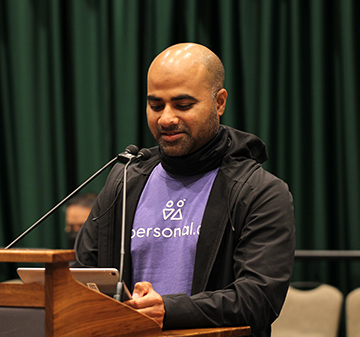 From the Editor: Suman has attended many of our conventions, and his message is always on the cutting edge. This year he comes to us in his capacity as CEO of the company Personal.ai based in San Diego, California. Here is a presentation he made at our 2022 National Convention on Saturday, July 9:
Good morning National Federation of the Blind!
My name is Suman Kanuganti, the co-founder and CEO of Personal.ai. For many years I spoke to you as the founder of Aira. I cannot begin to speak without asking you all if you are an Aira Explorer, please make some noise.
I want to thank President Riccobono for having me today to discuss the trends in technology that are critical for the blind community.
After arriving at the convention yesterday morning, I ran into a good friend of mine, Paul Schroder. In our conversation, he said, "You are here for life now, Suman."
I smiled and said, “Of course I am. Why shouldn't I?” This is my eighth consecutive year at the convention. I started my journey with NFB in 2015.
You, this community, have shown me a path when I most needed it, have embraced me when I was most vulnerable, and guided me through building and developing experiences that were most novel, unique, and with a sense of connection. So of course I am committed for life.
Today, I want to talk about you, each of you, and each of your roles in the next generation of internet evolution. If you use the internet on a day-to-day basis, say “I.” If you want the entire internet to be accessible, say “I.”
Ok... (Pause) Is it entirely accessible?
Well, internet is about to celebrate its 40th birthday on Jan 1, 2023, and like humans, it continues to evolve its phases.
The first era of the internet was possible on huge mainframes, mostly available to government and institutions. There were just a few who put content and information on the websites. For the rest of humanity, this version of the internet, often referred to as Web1, was simply to read. Web1 is about accessibility.
Although the Web1 era started in 1993, the Section 508 amendment for digital content accessibility didn't happen until 1998, and WCAG 2.0 standards did not start until 2008—friends, that’s fifteen years later. Web1 was supposed to be accessible to everyone, and still it’s a work in progress after thirty years.
OK. If Web1 was read-only by most, Web2 for consumers was not just readable but also writeable. This was the dot com era in the early 21st century. Over time, many of us started writing and uploading to the internet in the form of applications and social media or podcasts.
I remember the days when I would sit with friends at a dining table and say, “I think it will be cool to have someone read aloud my book anytime.”
Another friend said, “Oh, there is an app for that.” These apps increased the “usability.”
The internet created tons of utility for all consumers. But yesterday John Paré, our John, said the Application Accessibility Act on Usability is happening this year. That's almost fifteen years later after the beginnings of Web2.
And here is another example: the accessibility team at Facebook started in 2012, eight years after its inception. During this time almost everyone who has access to the internet and used it has become a contributor to Web2. If you are a creator, thought leader, writer, author, podcaster, entrepreneur, small business owner, or freelancer, say “I.” Congratulations. You have been making the big tech very successful with your creations. Ha ha.
There is probably nothing wrong with it since it created tons of utility, but now people are more aware of how valuable our data is and how algorithms can be insensitive about privacy and how they can hurt society with misinformation and how biased and discriminating these algorithms can get. Now, something else was happening during this time. These apps were so good in exchanging information and promoting our thoughts that we didn’t care about who is the owner of this data that every one of us creates. That’s the evolution of big tech companies that we all experience today.
Now the question is do you want to own the data on the Internet that you create? ... Yes!! ... Welcome to Web3, my dear friends.
To recap, Web1 is readable, and it’s all about accessibility, yet we are still working on this after thirty years; Web2 is writable and it’s all about usability, it looks like we are finally making progress after fifteen years; Web3 is own-able and it’s all about own-ability which is still in its infancy stages and we should be making progress on it "NOW."
In fact, the term Web3 gained popularity and meaning only in the last two years. Before Web3 became a term, the industry was shaping in the forms of blockchain, cryptocurrency, and NFTs. No, they are all not the same. Similar to the Web2 dot com bubble, Web3 is in a bubble.
A few of the NFB members already recognized that. They are at the forefront of it. To name a few—Reese, William, Andrey, and Aaron—they all showed up at the session and they are passionate about updating the basic protocols. The good news is that you, the community, can define the rules in crypto. For example, why is alt text limited to a number of characters by the platform or why is there not an alternate voice for describing art or image on the web in the words and voice of the creator?
Before we dig deep, if you care about privacy and ownership of your data, say “I.” That's blockchain. If you care about that data making money for you and economic opportunities for you, say “I.” That's cryptocurrency. If you care about making that data useful to your community, say “I.” That's NFTs. It's that simple.
How does blockchain help with privacy? Think about it as every piece of data that we add to the internet, like a social media post, a podcast, or an article has associated ownership and ledger to keep track of. That's the new internet.
How does cryptocurrency make money for you? Think about it as every piece of data that you add to the internet carries an associated monetary value, normally referred to as tokens. When a group of people believe in a currency, it can be used to trade goods or digital assets. Traditionally the currencies are backed by the government. In the case of cryptocurrency, it's backed by people, the community, and it's a movement from people around the globe.
Now you may ask, what are NFTs? Think about NFTs as goods that you exchange with cryptocurrency that is built on blockchain.
So what is all this to do with the blind community?
Remember it took many years of work and advocacy from the blind community for Web1 accessibility and Web2 usability.
The next wave, Web3 own-ability, is happening now and I believe it's important for this community to have a seat at the table in the places that matter to be at the forefront of this change so it doesn't become another movement, but it’s fundamentally designed with each and every one of you in mind.
Web3 enables the future of consumer internet experiences such as metaverse, owning your own creative content, and participating in the economy upfront. Web3 is about privacy, security, independence, and ease of use. We have to be ahead in the game of this technology wave.
I am building personal AI, where every person gets to create his or her own digital mind. The digital mind we create is an AI algorithm that is trained on all the data you create digitally. So far we have been giving that away to big tech to benefit them, and I am motivated to give that control of the data, utility of the AI, and monetary value created from that data back to people. So if you are already an author, writer, podcaster, or thought leader, you should create your own personal AI and create a community in which the economic benefit comes back to you.
A few people at NFB are creating a discord community called "blind in crypto." If you want to be a part of the movement and if you want to be at the forefront of the crypto movement, specifically in the context of the blind, join this group by entering your email at https://personal.ai/blind.