Engineering a New Response: Transforming At-Home Testing through Partnership with the Blind
by Jill Heemskerk
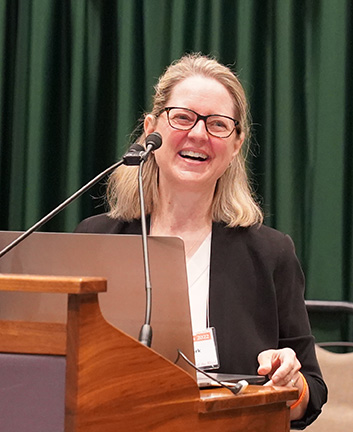 From the Editor: Dr. Jill Heemskerk is the deputy director of the National Institute of Biomedical Imaging and Bioengineering at the National Institutes of Health. Here are the words President Riccobono used to introduce her talk about our partnership to make possible at-home testing:
We've discussed extensively at this convention our disappointment with the initial government announcement about the at-home COVID testing program. But from January 3 forward—from the beginning—we have been very clear with the administration that of all the tools that we have to compel the government to get it right: We want to be a partner. We want to help get this right for all at-home testing in the future. And when we did get the attention of the government, our experience has been, especially with the leadership at the National Institutes of Health, they've said, you know what? We did this quickly. We didn't get it right on accessibility. But we are gonna nail this going forward [applause]. And here's what I want to say about that. You may not realize that at-home COVID testing is changing the nature of at-home testing forever. In the month of February alone, more Americans took at-home COVID tests in that month than took at-home pregnancy tests in all of 2021! That means there's a big opportunity to innovate, and I think we should be focused on the fact that the government, and especially the leadership at NIH, has rallied to our call for equal access. Not only that, they have called on us, the National Federation of the Blind, to be a trusted expert in helping them get it right [cheering and applause]. So I'm really excited to have with us at this convention the deputy director of the National Institutes of Health National Institute of Biomedical Imaging and Bioengineering. I've talked about it extensively in our presidential report. Please welcome Dr. Jill Heemskerk!
[Intro music: Hit me with your best shot, why don't you hit me with your best shot! Hit me with your best shot... fire away!]
JILL HEEMSKERK: [chuckling] I'm really wondering what to make of that intro music [laughter]! You guys are a hoot.
Yes, so, thank you for that nice introduction, and good afternoon, everybody [applause]. I am Jill Heemskerk, deputy director of, we'll say, NIBIB. You heard the full name and it's a mouthful, but really what we are is the engineering institute at the National Institutes of Health.
The NIH is one of the largest, is actually the largest funder of biomedical research in the world, and funds most of the research done at universities, small businesses, and research institutions in this country. It's actually made up of twenty-seven different institutes and centers, and you know at least one, because Dr. Tony Fauci runs the National Institute of Allergy and Infectious Disease [cheering and applause]. That's one of the biggest NIH institutes. Engineering is a small one, but we're mighty. And when the pandemic started, Congress gave the NIH a lot of money to develop new vaccines, new treatments, and new tests for COVID.
The engineering institute, our institute, NIBIB, was charged with developing COVID tests, which is a perfect role for the engineering community. You'll remember at the beginning of the pandemic how very hard it was to get a COVID test, and then once you got your test, how long it took to get the results back. Yeah, that's right, you couldn't even get them.
So, I'm going to tell you today about a program we started called RADx, and that stands for Rapid Acceleration of Diagnostics. We've been successful at delivering about half the diagnostics available in the country now, not only in laboratories, but also at point of care in doctors' offices, clinics, as well as the at-home tests that we're so grateful to have. But really the big story today is our partnership with NFB to make home tests more accessible for people with blindness and low vision [applause]. So, as we just heard, when the government started distributing free tests to people in the country early this year, NFB and other advocacy groups quickly did some very important and very effective outreach to the government. They pointed out that, while it's great to have tests in the country, the tests that we have are not accessible to people with blindness and low vision and other disabilities.
We completely agree and recognize that everybody needs tests that can be taken easily, independently, and confidentially.
And so I'm going to tell you about our RADx efforts to make accessible tests a reality.
I'm going to first describe the RADx program, because it's unique and it's quite a powerful process for accelerating research and development. NIBIB had received funding for development, because we already had a program in place since 2007 developing point-of-care and at-home tests for lots of different diseases and conditions. We quickly expanded that network in April of 2020 to focus on COVID test development.
We had four academic centers at the time and a coordinating center at Mass General Hospital. We established new core resources to validate tests, conduct clinical studies that the FDA needs for authorization, and we set up one resource that is truly unique at NIH called the Deployment Core at CIMIT, which has all of the expertise in house to get tests from the ideas stage all the way out to the market.
What we did is provide much more than funding to these manufacturers. We provided this wrap-around support to the companies developing tests that managed issues around supply chain, manufacturing, and FDA authorization. We helped them solve every problem in getting an entirely new kind of test to the marketplace.
The experts in the Deployment Core spent the last two years working with over nine hundred experts from multiple sectors to create an entirely new ecosystem of at-home and point-of-care tests in the US.
We started with a broad call for technology solutions as soon as we got the money in April, and this really galvanized the engineering community. We were amazed that we attracted 824 separate proposals for tests from companies and academic institutions. To deal with this onslaught of proposals, we set up a pipeline to evaluate the tests and figure out which ones were the most important to support. We developed a unique process for NIH that almost resembles a venture capital approach. We started off with a viability assessment, and then proposals that looked promising entered what we were calling the "Shark Tank" phase, where a team of experts worked closely with the companies over one or two weeks to look at all their data and their capabilities, and we examined all the aspects of the technology: the technical, the clinical, the regulatory, and the plans for manufacturing.
So, we had a very good sense of which of these test proposals were the most promising. We moved those into phase one, which was sort of a de-risking phase—trying to make the test, trying to validate the test—we helped with all of that. And those that were successful moved to phase two, where there was a very large-scale investment to get the clinical studies done for the FDA and to scale up the tests for the marketplace. This novel, hands-on process has proved to be tremendously successful, and we actually reduced what is typically a several-year test development timeline down to as little as six months.
What have we accomplished so far? We have delivered 2.6 billion tests and products to the United States—that's billion with a b [applause].
For comparison, last year in the US, there were eight million pregnancy tests taken; so that's just a completely different scale.
These tests include not only laboratory but point-of-care and home tests, and they represent about half of the tests that are available in the US now.
We have supported tests all the way to FDA emergency use authorization. We have forty-four FDA authorizations under our belt, including ten for at-home tests, and we've got more on the way [applause]. In this process, we've worked with more than one hundred manufacturers, and we're relying on our relationships with these companies to help in our effort now to develop more accessible tests for people with blindness and disabilities.
We are still actively working and developing new tests and continuing with this successful pipeline. Central to this, of course, is developing tests that can be used independently by people with blindness and low vision. But we plan now and going forward that accessibility will be built into all of our development efforts, [cheering and applause] including efforts to develop at-home tests that are as reliable as lab tests. We also would like to broaden our efforts to other diseases. For example, respiratory infections like flu and RSV. We'd like to spur innovation in the cost drivers to get tests to the market that are not only accessible but cost as little as $5 per test [applause]. Thank you.
It's funny to look back at the start of this project. I thought that if we could just have a COVID test that was like a pregnancy test, that would be great. We'd be done. And then we get to that point, and we realize, oh, they're not accessible, they're not affordable. They're not very sensitive. So there's still a lot to be done.
That is where the partnership with NFB comes in. Once the NFB and other groups reached out to the government about the importance of accessible tests, the first thing we did in RADx was to organize a listening session. Actually, that was the second thing we did. The first thing was regret that we had not had accessibility built in at the outset.
We set up a listening session so that we could talk to the users and understand the challenges in the accessibility of at-home tests. We invited advocates from the disability community, the aging community, and the blind and low-vision communities.
Beyond just listening, the important goal here was to set up relationships so that we could integrate these users into what we knew was going to be an ongoing process to develop tests. We didn't want to have a single engagement and then go from there. We wanted to have active partners. And I have to say that NFB has been incredibly generous with their time and education and resources [applause].
We also invited the six federal agencies that have accessibility as part of their mission, including multiple institutes from NIH, the CDC, FDA, the Administration for Community Living, the National Council on Disability, and the US Access Board. We had at this meeting three breakout sessions: one blind and low-vision, one fine motor impairment, and one for older adults. It was incredibly revealing for us to hear about things that we had not even considered, incredibly valuable feedback. One thing that we did notice was that these groups, in their separate breakout groups, often came up with the same challenges, regardless of what the challenge was. And they were actually challenges that we all have with these tests. The instructions were a big one: small print, complicated, few language options, no Braille at all. And often no simple, step by step instructions. The boxes were difficult to understand because there's no scannable identifier, so you have a box and you don't know what's in it; you don't know what instructions to look for.
The test procedure itself is challenging too, truly for almost everybody. There are too many steps in these processes: the need to count drops of fluid and aim into a tiny hole on the device, multiple small little parts in the box, and instructions that say things like "put the drops in the top hole." Well, if you don't know which end of the device is up, you don't know what's the top hole and what's the bottom hole.
I think especially vexing for people with blindness is that repeated instruction not to touch this part and not to touch that part [applause]—that is just not helpful at all [applause].
Also key for people with blindness is that the result appears often as a little faint line on a strip. There's no simple interpretation that says "your test is positive" or "your test is negative." Although some of the tests work with smartphones, they're not accessible to many people. We learned that as many as 40 percent of these communities don't have access to cell phones.
So, we are taking a two-pronged approach here. One prong is the fastest approach, which is to modify existing tests. The other prong is the best approach, which is a longer-term plan to design accessible tests with accessibility built into the design from the very beginning, which clearly is the preferred approach [cheering and applause]. We'll be announcing a solicitation for proposals in a matter of just a few weeks. But I'm going to tell you a little bit about our process for test modification, which we're very engaged and excited about.
Ellume is a good example of a reasonably accessible test, and that was noted by the NFB in their own accessibility evaluation. And the government—I want to make sure I tell you—the government on covidtest.gov, is making Ellume COVID tests available free to people with blindness and low vision [applause]. But even Ellume, if you've taken it, has room for improvement. And those improvements are what we want to bring to bear. So our process is a multistep pipeline, where we start with the accessibility evaluation and then, based on the challenges observed for the particular test, design a prototype. On the advice of NFB, some of our designers are people with blindness and people with low vision [applause]. Getting advice from experts is always the best idea.
Once we have the prototype designed, we'll move into the user feedback phase. Again, we want to put these in the hands of people with blindness and low vision for them to tell us if we got it right, and what we need to do next. This is a very high-touch process with lots of user involvement. We're going to go through that process twice. Tests that have gone through the user feedback stage already, and we've heard, no, that's not quite what we want. So what we're thinking is that we're going to start with a sort of early prototype, go back to the design stage with the feedback, and then produce a more mature prototype and get feedback again. We'll do that as many times as we need to get something that is acceptable to the community [cheering and applause]. Once we have an agreed-upon product, we'll support the companies to start producing those.
We identified twenty-four different tests for this initial evaluation, and twelve look very amenable to modification, and have moved on into this prototype design phase.
Our goal is to have more accessible tests being produced as early as this fall [applause].
We've had a lot of good news in this process already. The first piece of good news we got was that, as we reach out to the companies making these tests and tell them what we're doing, they've been saying, "That's great. Do this as quickly as possible. We're developing tests for other things. We want to know how to make them accessible." [applause] So they're very eager for the feedback. And very, very eager to start producing more accessible tests. They see a huge benefit in this. We even had a company start making modifications before we got all the user feedback in, and we had to tell them to slow down, they were so eager!
The other very gratifying news is that we have always collaborated closely with the FDA on our RADx program, and they are also very excited about this and prepared to advise and accelerate the process. Any changes we make to the tests are going to have to go through FDA review, and they're going to need data that tells them that the changes made don't do anything to make the test unsuccessful. So even something as simple as changing the instructions is going to take probably three months before there's a new product on the shelves.
There are two other elements of the accessibility initiative that I wanted to mention. One is really focused on the instructions, because two-thirds of our recommendations from the accessibility review have been about the instructions. So we've set up a separate fast-track process that can benefit all of the marketed tests. We'd like to develop a general format that all companies can use that is simplified, has larger type, has a new layout, and we will make this available so that any company, whether they're working with us or not as they're developing their instructions, can use this template [applause].
For web-accessible instructions, we are addressing packaging for rapid access to the relevant instructions, such as QR codes. I was really interested to hear what Kellogg has—that you can do that from four feet away is brilliant. The FDA is poised to help, as I said, and they will review the new instructions after all the users have agreed that the instructions are now actually helpful.
The other effort that we're doing is a best practices effort, because what we'd like is for the work that we're doing to benefit all test manufacturing. Now home tests are commonplace because of COVID, and there are going to be other tests for other disorders: glucose tests, flu test, pregnancy tests. We want accessibility guidelines to be available to manufacturers so they can design with accessibility in mind from the outset [applause].
So in conclusion, everybody at RADx is really excited about this initiative. We recognize that accessibility improvements will benefit everybody, and we're very grateful to the NFB for their role in not only stimulating this work, but for their ongoing support and advice as we work together to create accessible COVID tests. Thank you very much [cheering and applause].