Who Are the Blind Who Lead the Blind: Those Elected in 2022
Periodically we run the article “Who Are the Blind Who Lead the Blind,” but for this issue we have chosen to highlight the newest members elected at our most recent convention in July of 2022. Enjoy becoming acquainted with these talented and dedicated people who give so much to serve us:
Donald Porterfield: Husband, Uncle, Brother, Son, Prosecutor, and a Member of the National Federation of the Blind
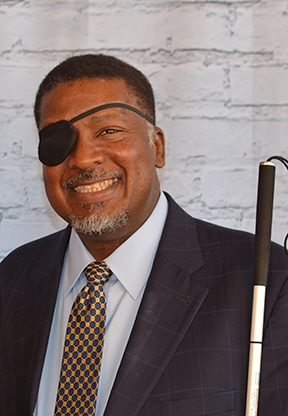 Donald Porterfield was elected to the National Federation of the Blind’s Board of Directors in July of 2022. He is also the president of the NFB of Arizona. Born in 1959 to James and Doris Porterfield, he has three siblings: an older sister, an older brother, and his twin. His blindness is caused by diabetes and did not manifest itself until he was forty-eight years old.
Donald says that he was a medium to good student, but his school experience was significantly enhanced by his participation as an athlete. “I was lucky to be good at sports, and that brought me some friends, but given that I am an introvert, the thing that I feel most fortunate about is that I am a twin and was born with my best childhood friend.”
The onset of Donald’s blindness occurred in the same year his father died, so he and his family had two crises to deal with in the same year. For some, their adjustment to Donald’s blindness was a slow process, while some adjusted quicker. Some saw that it was their responsibility to take care of Donald, but that sense of obligation they felt didn’t last long when it became clear that Donald was doing his own cooking, laundry, and had no trouble with his personal hygiene. This he could boast even before any training in the skills of blindness.
From as early as he can remember, Donald wanted to be a prosecutor, but it took him some time to get to a place where he could go to law school. He spent the first twenty-three years of his working career in the golf resort and hospitality industry. For much of that time he was an executive, and many years of his tenure with the company saw him as vice president of food and beverage operations. This was not an easy job for him because unquestionably he is an introvert and had to learn how to be gregarious and outgoing. He laughs that his twin brother can walk into a supermarket and walk out knowing one hundred people, but this was not how Donald experienced life. Learning to be outgoing has been a challenge. “My former manager and mentor was somewhat bombastic and always put me into a position where I had to improve my stage presence. At times he certainly made me uncomfortable, but this paid off not only in my career as a manager but would reveal itself as beneficial in the other twists and turns that would come to make up my life.”
It was in the second week of his second year in law school that Donald, at age forty-eight, began experiencing real vision problems. He had noticed a slight decrease in vision over time, and this he attributed to age. But on that fatal day, he found that he simply could not focus on any of the work before him. Figuring that he was fatigued, he went to take a nap. After the nap his vision seemed normal again, but when he went back to school on the following Monday, the focus problems returned, so off to an ophthalmologist he went. The diagnosis was retinopathy, a result of his diabetes, and much of the next two years found him going to doctors once a week and trying different surgeries, all while managing his studies in law school. “When I found that my reading speed dropped from four hundred words a minute to sixty words a minute, I was afraid, but I soon realized that either I had to pack it in and leave or figure it out and keep moving toward my dream. I chose the latter and along the journey found out I was an auditory learner. Ultimately, I graduated with my law degree. After graduation we had to try one more surgery. The surgeon thought he could restore most of my vision if he peeled off the scar tissue that had accumulated, but he tried and he was wrong. The result is that now I can still see light and certain shapes, but I can no longer perceive the difference between most colors.”
Donald graduated from law school at age fifty and moved back to Arizona. “I knew that if I was going to be a competent lawyer and blind man, I needed blindness training.” He first learned about the National Federation of the Blind while in training at SAAVI Services for the Blind from the person who would become his wife and is now the primary partner in everything he does. He did his homework and concluded that he liked the grassroots civil rights organization that he found in the National Federation of the Blind. “I grew up as a black kid in the 60s, so I understood discrimination and was experiencing the same things as a blind person. Not only did I get disparate treatment, but I was also being patronized and in not very subtle ways told that I was incapable. I realized I had the spirit of a Federationist without being a member, and in the Federation was where I wanted to be.” So off he went to a chapter meeting and later on that year to a national convention where he took his first ride with a blind driver as President Riccobono chauffeured him around the hotel parking lot. He was hooked.
After gaining the skills, tools, and competency through training, Donald fulfilled his lifelong professional dream by becoming a deputy county attorney, serving as a prosecutor for Pima County, Arizona. When he was going through law school, many of his colleagues mistakenly believed that he wanted to be a defense attorney, but he believes the role of a prosecutor is that of a “minister of justice.” Being a prosecutor is more than just prosecuting people who commit crimes; it is about making sure everyone connected to the criminal justice system is treated fairly and receives justice.
Donald’s first significant job in the Federation was serving as the legislative director for the Arizona affiliate. His tenure has witnessed the passage of the statute that protects the rights of blind parents, and he is equally happy about the pieces of legislation that he and his affiliate members have kept from becoming law. Many of these attempts have involved increasing regulations on guide dogs and their users, and all of these have been successfully turned back.
When asked what asset he thought to be the most significant of those he brings to the Federation, he said, “I can easily talk to policymakers about blind equality, and I love doing it. We have many members who don’t have that comfort level, and, because I am an introvert, I understand their unwillingness and perhaps inability to speak out. Given my background, I’ve learned to work around my innate inability, and I think this makes me a stronger advocate. … Hamilton is one of my favorite plays. In Hamilton they ask the question ‘Who will tell your story?’ That same question has been asked of us. Only we can tell our story because we are the only ones living an authentic life as a blind person.”
“I used to have to work at getting into the character of being an advocate, a describer of life as I and others live it, but I now realize I am not playing another character; I am simply being me. I like educating the public about the positive truths about blind people. I was faced with so many misconceptions when I was ready to take the bar examination and was searching for a job that any chance to minimize these for others is one I enthusiastically embrace.”
Given that a major goal of his life is to live one that is full, balanced, and enjoyable, his activities go well beyond his professional work and organizational commitment. He and Amy love to travel and to embrace the new experiences it offers. He loves jazz and they spend a lot of time listening to this art form and going to concerts. He also loves to read and often he and Amy find themselves sharing a book and the pleasant conversations that accompany the reading.
“I love my wife Amy, and everything I do, I do with her. We are passionate about civil rights for the blind, and we often say our family is in the civil rights business. I love how fortunate we are that we can travel this path together.”
Shelia Wright: Rehabilitation Professional, Entrepreneur, Leader of Blind People
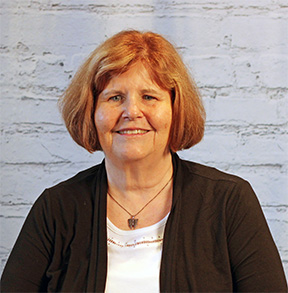 Shelia Wright was elected to the National Federation of the Blind Board of Directors in July of 2022. Her service in the National Federation of the Blind began in South Carolina, was evidenced in Nebraska, and for more than three decades the state of Missouri has been the beneficiary of her initiative, hard work, and follow-through.
When Shelia was born, her vision problem was known almost immediately, but the extent to which she could not see was often downplayed and the word blindness was never used. She needed glasses by the time she started school, but not much was provided in the way of accommodation except letting her sit closer to the front of the class. By the time she got to the end of elementary school, she was sitting about four feet from the blackboard near the teacher's desk.
Shelia went to elementary school in Hartsville, South Carolina, and she got there by walking or riding her bicycle. When in junior high the school was too far away, she got herself to the elementary school in the same way and then caught a bus.
By her senior year in high school, it was determined she needed large print books; she often ran into the problem of getting ones that were out-of-date. To her great frustration, she could study all she should but still end up writing down the wrong answers because her books were not the newest edition being used by her teacher and classmates. Soon she got to the place where she started leaving books in the locker and relying as much as she could on what she heard in class. Because she brought no alternative techniques to the game, her grades in junior high and high school were less than stellar.
Shelia remembers first being diagnosed as "blind" when she was sixteen. Before, she was always dismissed after examinations, and her doctors met with her parents who were told that there was nothing they could do for her, and they were referred back to the optometrist, who they said was doing an excellent job fitting her with glasses. Shelia believes that the inaccurate diagnosis and hesitancy by the ophthalmologist to talk with patient and family did not provide them with the information needed to seek out and support appropriate specialized educational services. This is the reason Shelia has been so adamant about young blind children getting diagnosed quickly and ensuring that students begin learning Braille at an early age. "It certainly should have been before age sixteen that I heard I had a progressive eye condition that was so significant that I was already legally blind. The doctor told me I should learn Braille because it would be easier to learn at sixteen than at thirty when there would be no other options."
When Shelia started to plug in to vocational rehabilitation services, she immediately had to undergo psychological testing, a custom of the agency at that time. The prediction of the psychologist and her rehabilitation counselor was that she would not make it beyond one semester in college. "The only reason you want to go to college is to get your MRS degree," she was dismissively told.
"None of my cousins went to college, but when I was told I could not, that was very motivating for me. Being told I can’t often is the prescription for I can, and I will."
Her motivation, hard work, and innate ability meant that Shelia graduated with a Bachelor of Arts in psychology. She chose this path to reduce the number of classes in mathematics and science. She then entered a master's program in education, specializing in vocational rehabilitation counseling, and after successfully securing that degree, she has managed to work in three states.
Shelia worked for several months at the Iowa Commission for the Blind as a rehabilitation associate. This was an opportunity for her to see vocational rehabilitation for the blind at its best, and this job gave her invaluable experience. When she returned to South Carolina, she marketed her skills to a nursing home that had several blind residents. She was hired to work with blind and visually impaired residents on how to travel safely around the facility. She also assisted them in participating in social and recreational activities. Additionally, she taught staff to help blind residents be more independent. She found this job exciting for about six months and worked until a fulltime job in the field of vocational rehabilitation became a reality.
In the state of South Carolina, the general rehabilitation agency discriminated against blind people, saying that if a blind person wanted a job in the field, they should go to the agency for the blind because the general agency needed its counselors to travel. The reality was that rehabilitation counselors at the Commission for the Blind traveled more than their counterparts in the general agency.
When Shelia took a job at the South Carolina Commission for the Blind, she did so with some reluctance. She really wanted to work in some other field and then come back to rehabilitation for a career, but that is not the way things worked out. "I was really afraid that I would end up being pigeonholed into a job that I didn't want, and I wanted rehab to be something that I actively chose to do with my heart and my soul." She worked at the Commission for about three years, but periodically she would be solicited by Dr. James Nyman, the director of the Nebraska agency. At first she was cavalier about the interviews, at one point telling him that the only job she would be interested in was the one he held. After more calls and some negotiation, she eventually took a job as the director of the orientation and adjustment center. Taking that job was a gutsy thing for her to attempt given that she had never been to an orientation center, had never had any cane travel, and what Braille she knew came from her own learning. She relied on friends when she needed help and advice in any of these areas, and though it certainly was not the easiest or most traditional way to begin managing a program, she embraced and overcame the challenge. Those friends also helped her solidify her understanding and internalization of the philosophy of the National Federation of the Blind, a view she was familiar with but was never sure she thoroughly understood or had worked at integrating into her being.
After working in this position for three years she decided it was time to move along. Though Shelia would return to the agency for some temporary work to help them in solving a staffing problem, eventually she came to Missouri. The job search she conducted saw her sending out thirty to forty job applications a week for about six months, and, strangely, on the day when she received a job offer from Missouri, there were two of them: one was with the state agency and the other with a private agency in St. Louis called ABLE. She took the counseling job with the state agency and moved to Kansas City. She was challenged because at that time there were no blind counselors working for the agency. "If you were blind, you worked as a rehabilitation teacher who is paired with a sighted assistant. As a counselor they did not even give me as much as a Braille writer." Her work for the agency started in July of 1984 and continued until August of 1988. She then went to work for Blind FOCUS, a private agency, where she worked until 1995. She is particularly proud of the program she helped to build that was for students transitioning from high school to college to work.
Believing that she had spent too much of her life working in the field of blindness and wanting to move into event planning, Shelia left Blind FOCUS in 1995. Though she did not pursue the career she thought she would, she has held a number of jobs that have resulted in new programs and good programming for the blind. She helped in shaping the Technology Access Program for Internet, an innovative program in Missouri that provides screen-reading software and other assistive technology to allow blind people to gain access to the resources found on the internet. She has worked as a consumer support provider for that program since its inception and continues to do so, providing direct teaching and product evaluation. She contracted with Missouri Rehabilitation Services for the Blind to conduct the Code Master Project which focused on blind adults needing intensive training in Braille, and she has contracted to do program evaluations in other states.
Nationally one of the efforts that Shelia is most proud of is participating in the creation of the National Association of Blind Rehabilitation Professionals. "Before this group, many of us felt like Lone Rangers out in our agencies, and I saw this group as being really important to give us inspiration as we tried through our daily work to bring about the hopes and dreams that are embodied in the Federation."
Of course, her work with the National Federation of the Blind has kept her extremely busy. She has been an active member in all the states in which she has lived, joining the Missouri Board in 1993, becoming second vice president in 2001, moving to first vice president in 2003, and assuming her current job as affiliate president in 2017. Since Gary Wunder was the state president for much of the time before she assumed that title, he can tell you that one of the things that elevates people to office and keeps them there is the willingness to follow through on commitments. He says, "Never did Shelia leave us hanging out on a limb. If she promised to make a call, it was made, write a letter and it was written, chair a committee and it met, organize a legislative event and it was organized, and, wow, could she keep a list. She has always been an active supporter of anything we put our name on, but her support has not always been without criticism. When I sent out an annual list of affiliate committees and asked my ranking officer Shelia what she thought of the appointments I had made, she said, 'I often wonder whether you are drunk when you make these lists.' You can bet I worked harder at seeking her advice when drawing up future lists."
Like the rest of us, Shelia has a life beyond work and Federation activities. She married Harvey Fisher in 1985, he being a rehabilitation teacher for the state agency. Unfortunately, Harvey died as a result of cancer in 1991. In 1996 she married Jeff Wright, an able and loving helpmate. Jeff shares her love of the Federation and in addition to helping her do many behind-the-scenes tasks, he has also served as a chapter officer for many years. Together they work hard in their church and strive to live the values in which they deeply believe.
Shelia’s hobbies include tandem biking, swimming, playing the guitar, and reading. She also enjoys sports, and those who know her are well aware they should not call when either the Kansas City Chiefs or the South Carolina Gamecocks are playing.
Shelia says that she believes one of the greatest assets she brings to the Federation is developing projects and programs and then overseeing many of them until they are well-established. "I like being a change agent and the new endeavors we create. I am proud of the fact that we established a program for young students called Mission Believe, another program called Mission BEAM, and an active group that is now known as the Cane Drivers. I am not always the person who does most of the work, but one of my strengths is in building teams and in helping them get things done."
"I have enjoyed watching things change, such as seeing kids who come to the convention with canes learning to use them and getting around by themselves. I was glad that Nebraska was a part of this and that at the time I was a part of the Nebraska agency and the affiliate. When I look back on advancements we have made, I am proud of all of them; whether they bear my handprint is less important than the fact that I have actively participated in the Federation and therefore have something to do with everything that gives blind people an opportunity to live a better life."
Grace Pires: Caregiver, Mother, Wife, Role Model, Affiliate Leader
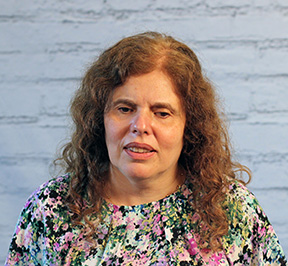 Grace Pires was elected to the National Federation of the Blind Board of Directors in July of 2022 and also serves as the president of the National Federation of the Blind of Rhode Island. She was born in Portugal in 1970. Within three months Grace’s mother Virginia realized that something was wrong with Grace’s vision. She was not actively trying to look at things, nor did she track in the way that her mother had witnessed in other children. The first visit to a local pediatrician resulted in her mother’s concerns being dismissed, but when other doctors were consulted, they agreed that there definitely was a problem, though to this day no one has been able to accurately diagnose the reason for Grace’s blindness. Some doctors have offered the opinion that she is blind because of retinitis pigmentosa, while others argued that it is most likely Leber’s disease given that she has never had any vision and the condition is genetic. Her parents did what genetic testing was available and were told there was a 25 percent chance that any future offspring would be blind. Her younger brother is blind, but the upside is that there are some important things they share together.
Grace did not start school until she was ten. The Portuguese island on which she was born had no school for the blind, and both she and her parents were very upset by the residential experience at the school on a neighboring island. After this experience, the family made a real effort to come to the United States, and it was at this point that Grace really began her formal education. “Coming to the United States was in some respects the end of my childhood. I didn’t really know what to ask for, but all of a sudden I had to be an advocate for myself and, because they didn’t speak English, for my parents as well. She was placed in the fourth grade to be near children her own age, but she certainly was in no position to do the work. She first had to learn English, then Braille, and it wasn’t until the sixth grade that she really began to hit her stride. Before that time she would rely on her cousin, a second grader who could read print, who would help her with learning to spell. She was elated when, in the seventh grade, she realized that she was independently doing work that let her study for and pass tests. “I was quite excited when I was able to take home and do my homework. I know many students who said that they couldn’t stand it, but for me the feeling was tremendous.”
Grace began receiving cane travel when she was twelve years old, and at first she had mixed feelings about the experience. “I was afraid that people were going to see by my cane that I was blind, and I laugh now at my reluctance because it is clear to me that everyone already knew I was. Even as I felt this reluctance, I loved the independence I was getting. I was happy to be an independent traveler who could walk around the school by myself and could actually go to the lady’s room without another student assisting me. I was really excited when my parents and other adults let me walk alone once they realized I could travel safely with my cane.”
“Making friends was very easy when I was a novelty, but as the novelty wore off, I began to find it more difficult when some of my friends dropped away. Luckily I had a core group that I built during middle school, and although class changes in high school meant that we were not always together, some of those friendships survived, one of them even into college.”
Unfortunately for Grace, she grew up having few role models, and the idea that a person might go to a rehabilitation center was never raised as a possibility, not to mention a wonderful opportunity. Failing to see blind people she wanted to be like, she had what she categorizes as a meltdown at age thirteen and angrily asked her teacher of the visually impaired what in the world a blind person was supposed to grow up to do and be. Her dream was to get an education, have a job, get married, and have a family. Her teacher was resourceful and took Grace to visit a lecture on health that was being given by a blind woman. “The lecture was impressive and the blind woman giving it was educated and well spoken. She gave me hope. She let me know that I could do what she was doing, that I was smart, and that I could do anything I wanted to do. This was a major turning point in my life. This woman named Monica became a mentor throughout school and in my career. We still maintain some meaningful contact today.”
Grace remembers that the first time she learned that a piece of equipment could be modified for her use was when her family got a microwave oven. She couldn’t use it, and this same teacher suggested that they mark it with dots. “When I got those dots and we put them on, I felt like it was Christmas.”
Grace attended Rhode Island College, a four-year institution near where she lived. There she took a bachelor’s degree in social work, and when she couldn’t find a job, she went back to school and earned a master’s degree in the same field. When she looked at the employment market after her bachelor’s, she was surprised to find that so much of the work involved travel and that so little in the way of transportation existed for her. By the time she had gotten her master’s degree, not only was she more qualified, but by then she enjoyed the benefits of an active paratransit system that allowed her to go to and from the homes of clients. Her first job was working part-time at an independent living center, a job that not only required significant travel but one that also gave her the opportunity to do some of her work from an office. That part-time job eventually resulted in full-time employment, and it was there that Grace worked until 2003.
She then took a job with the state of Rhode Island as a rehabilitation teacher. She did that job for six years, and what she found so amusing was that this person who had never gotten the benefit of any formal rehabilitation teaching was herself being asked to teach. She knew the techniques that needed teaching; what she didn’t know was much about the art of teaching. She is thankful for the textbooks that taught her how to pass along knowledge that she learned from her mother to others who needed to learn how to make a bed, do laundry, and safely operate a hot stove.
While working she earned another master’s degree, this one in rehabilitation counseling, and it qualified her for another job that she holds today. She works as a vocational rehabilitation counselor and has since 2009.
As soon as Grace got a job, she felt free to expand what she was doing and begin giving back. When she said that she wanted to join the National Federation of the Blind in 2000, the person she was talking with said, “Are you sure? You don’t have to!”
“My response was that I now have a job and I want to do something to give back. I most certainly want to join the NFB. What I didn’t realize at the time was that I would gain so much more from being part of this movement. From the first meeting I attended, I was treated like an old friend.” Grace says that she was pretty shy, but she felt comfortable offering to help with tasks. “Richard and Cathy Gaffney and other members were so welcoming that I brought my boyfriend and my brother. They both accompanied me to the state convention and joined on the spot.”
What Grace finds so sad is that in all of her contact with the rehabilitation system prior to employment, never did she find a role model or anyone willing to discuss with her their own blindness. Never did the people she worked with talk with her about blindness or put themselves front and center as people she might want to be like. From what she observed, those helping her, while well-intentioned, had problems dealing with their own blindness and embracing alternative techniques that would let them be comfortable with themselves and efficient in the things they did.
The lesson Grace has taken from this is that it is necessary not only for her to teach attitudes and techniques but to instill in her clients a sense that they can talk with her about blindness. She also hopes that the way she lives her life and the mastery she has gained in living life as a blind person will translate into her being a role model for those she serves.
A second piece of legislation in which Grace takes pride allows for mail-in election ballots. Having a good relationship with the secretary of state means she has been a part of evaluating the ballot-marking machines that were eventually purchased.
Knowing what a barrier transportation was for her, she serves on a public advisory committee which seeks to improve transportation services to Rhode Island residents. She is working on legislation to expand transportation to all disabled Rhode Islanders. She is quick to note that she is not the primary person working on this legislation and that another member of the Federation is actually spearheading the effort.
Like most busy people, there are times when Grace finds it difficult to juggle all of the responsibilities she has. Of course there are the school meetings to attend, and since her parents still do not speak English, she accompanies them whenever they go to doctor appointments and acts as a translator. “I am so lucky to have a job with some flexibility and with sick time I can use when needed. When my mother worked in a factory, she did not have this flexibility. I could only call her if there was a dire emergency. They just wouldn’t have known how to reach her. I am glad that I can now get an occasional call or text when my son needs something.”
When not otherwise engaged, Grace likes to read, knit, and take long walks outside. “I love the peace that comes in being outside with nature—it is me being me on my time.” She also admits to being somewhat addicted to Netflix, a pleasure that she and her husband share together. She enjoys playing Uno with her nieces and again finds herself tremendously grateful for the contributions of Louis Braille in her life.
“I think my most important role in the Federation is to be a good listener, accept people where they are, and offer myself as a role model for those looking to be happy, to be productive, and to feel good about themselves. Sometimes life has meant hard work, but people need to see that often that is what it takes, and the rewards are well worth the effort.”
Barbara Manuel: Blind Entrepreneur, Proud Mother and Grandmother, and Activist
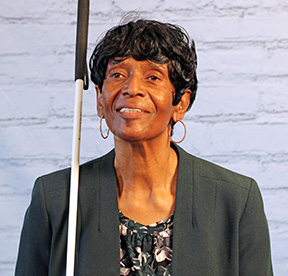 Barbara Manuel was raised in the small Alabama town of Citronelle, about thirty miles north of Mobile. She has retinitis pigmentosa but did not know or encounter any blind people growing up, so she simply coped with her vision loss the best she could throughout her education in the local public schools. Her coping mechanisms included copying questions and assignments from close friends rather than trying to read the blackboard. Despite some struggles, she remembers being an average student.
In her early twenties, Barbara took advantage of job training at the E.H. Gentry facility operated by the Alabama Institute for the Deaf and Blind in Talladega to learn medical clerical work. When work in that field was no longer available, she took her first job in the Randolph-Sheppard vending program, working for another vendor that she met through an RP support group. After six years, a snack-bar location at the Mobile City Garage became available. Ten years later, an opportunity to run a full cafeteria at the University of South Alabama Nursing School arose. Barbara and her employees served breakfast and lunch daily, and she also took advantage of catering opportunities, which she enjoyed immensely. Finally, Barbara obtained her current location at the United States Coast Guard Aviation Center in Mobile. She now manages seventeen employees and runs an operation that serves breakfast, lunch, and dinner 365 days a year, as well as maintaining the facility’s seventy-two sleeping quarters. She is proud that she often receives compliments about the food and facilities.
Barbara first learned about the National Federation of the Blind through a contact from her days at E.H. Gentry. That friend convinced her to attend an affiliate convention in Mobile sometime in the mid-1980s, which she says, “Changed everything.” She became the chapter president in Mobile in around 1989 and served in that capacity for eleven years, while also rotating on and off the affiliate board of directors. After stepping down as Mobile chapter president, Barbara remained active and rose to affiliate vice president, which was the position she held when the late Joy Harris stepped down for health reasons in 2017.
Under Barbara’s leadership, the affiliate was successful in getting parental rights legislation enacted in 2019. “I was so proud when we went to the governor’s signing of that initiative,” she says. “When we can pull together, the sky’s the limit.”
Barbara is proud of what she has been able to accomplish with a relatively small but growing team. “Everyone can do something, even if it’s just make a phone call,” she says. At the same time, “I always tell my members that we need each of them, and we need every blind person in Alabama to join and be an active part of our movement.” The affiliate is currently engaged in a long-running battle with the state over accessible absentee voting, which has been a struggle because the secretary of state did an about-face on supporting it, even though military and overseas voters can submit absentee ballots electronically. Because of her work in this area, Barbara has also become a member of The League of Women Voters. She is grateful to Lou Ann Blake and the late Scott LaBarre for their assistance and is determined to keep up the fight.
Barbara also serves on the board of the National Association of Blind Merchants, and in 2022 she was elected to the National Board of Directors. When she is not engaged in Federation activities, she enjoys spending time with her son and daughter-in-law, granddaughter, and two great-granddaughters. She also enjoys traveling with her best friend, whom she has known since they were in the first grade.
Reflecting on the character of our movement, Barbara recently said: “The National Federation of the Blind strives to embrace one common thread that is tightly woven throughout our movement: ‘blindness.’ We are a close-knit family, and it’s our goal to create a place for every blind individual, from every walk of life.”