The Significance of the Washington Seminar 2023
by Mark Riccobono
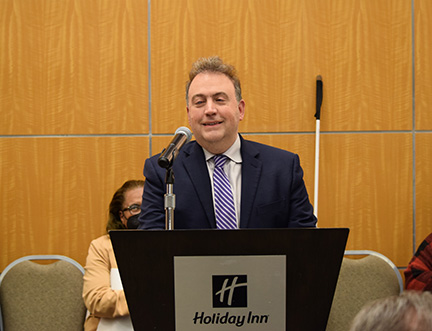 From the Editor: This was the keynote address given to begin our 2023 Great Gathering-In at 5 p.m. eastern time to one crowded ballroom and one overflow room connected using closed circuit television. Here are the remarks given by our President:
In November of 1940, the National Federation of the Blind was founded to provide the blind with a vehicle for collective action on a nationwide basis. In his call to action for the new organization, Jacobus tenBroek, the first President of the National Federation of the Blind and an emerging thought leader on the United States Constitution, declared: “Individually, we are scattered, ineffective, and inarticulate, subject alike to the oppression of the social worker and the arrogance of the governmental administrator. Collectively, we are the masters of our own future and the successful guardian of our own common interests.”
Since that time, we have continually worked to have the voice of the nation’s blind respected and our desire for full participation understood in the halls of power in Washington, DC. In the fall of 1973, we held the first of our annual large scale March on Washington events, and we have come back every year: everyday blind people bringing their daily lived experience, their future aspirations, and their commitment to participating fully in strengthening the country we are proud to share; a nation where blindness is not the characteristic that defines us or our future; a nation where we are not held back by the low expectations and artificial barriers that today stand in our way. Year after year we have carried our own agenda to Washington, and we have positively changed America.
We have shown up in the most difficult of circumstances, knowing that our equal protections under the law and our equality of opportunity are too important to wait for an uncertain future. Action is required today.
In 2021 the occupants of the halls of power were not gathered in Washington. Social distancing protocols and advice from the so-called experts told us to wait until another time. But we have been told to wait before: told to wait for someone else to do it for us; told to wait until things work for others, then they will make them accessible to us; told that we should be grateful for what little we have, rather than dreaming of a bigger tomorrow. Since 1940 we have refused to wait, choosing instead to find ways to make our voice heard. In response to the suggestion that we wait, we innovated a large-scale Zoom on Washington—hundreds of meetings skillfully coordinated, hosted, and followed through by the blind of America. While we did not gather in person in 2021 or 2022, our voice was heard by the lawmakers of our nation.
Now our nation welcomes the new 118th Congress to Washington, and a familiar voice rises again to say, "We're back!” The organized blind is united, back together in-person, and equipped to continue building our future and protecting our common interests.
We arrive in Washington standing on a foundation of achievement built by those who came before us. Since we were last in-person at this gathering, we have lost some of the most significant blind leaders of the past fifty years. We stand here tonight because they showed up time after time after time and would not wait. With deepest gratitude, we hold the bond of faith they shared with us and continue our march. Their spirit calls us forward. Their love fills us with determination. Their legacy is our action this week.
We come to build a future where websites and mobile applications are built for all of us fully to participate in education, public information, and commerce. We come to guard against being denied the opportunity to manage our own care and that of our loved ones because of medical devices that are incorrectly built to require vision to be effectively used. We come to dismantle the outdated rules of the Social Security Disability Insurance program which place blind people at risk of economic hardship as we seek advancement in our careers. These are only three of our most pressing priorities; there is more we intend to build. Furthermore, while we are focused on educating the United States Congress this week, we intend to use all of the tools of advancement available to us.
We have organized in every state, in Puerto Rico, and in the District of Columbia to have a nationwide network of blind people creating opportunities for ourselves. We will be in the local city halls and state legislatures to eliminate the barriers and educate the public about our capacities. We will be in every community, demonstrating the techniques we use to successfully live the lives we want as blind people. We will be bringing educational efforts to blind youth in partnership with our teachers of tomorrow so that the next generation of blind innovators can share that bond with us and reach even higher than we have ever imagined. We will assist blind job seekers when they encounter inaccessible job application processes and discriminatory and arbitrary criteria that declare vision is a requirement for success. We will raise the quality of life enjoyed by blind seniors by teaching them that their changing vision does not change the fullness of their participation in the world. And, to secure all of this, we will advance the right of blind people to have an accessible, private, and independently fillable ballot in elections—whether we choose to vote in-person or in our homes. Let this be heard by any elected official who stands between blind people and our dreams—a vote against our future opportunities secures our votes for other leaders who believe in the blind of America.
Our work this week is concentrated in Washington, DC, but our building happens in every community across this nation every week of the year. While it feels like so many people in our society are divided, the blind are unified in our agenda and committed to the future we want for ourselves. We come back to our in-person Washington Seminar knowing more deeply than ever before that we are stronger together.
This is our march for opportunity. This is our dedication to smashing the artificial barriers. This is our salute to the blind who made it possible for us to be where we are today. This is our bond of hope for a future full of opportunities. This is the significance of the Washington Seminar.