Remarks by Marc Maurer
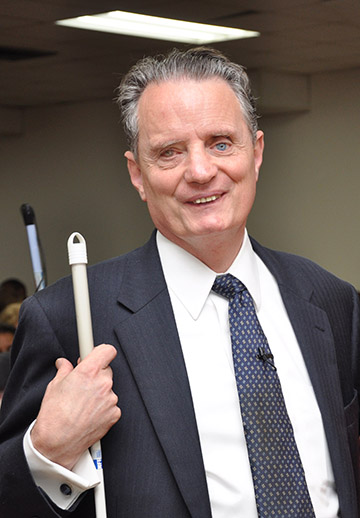 Scott LaBarre was first—and always—a friend. He had many talents. He was physically fit. He could pick up barbells weighing more than sixty pounds in each hand and do with them whatever he wanted. He loved music, and he explored many different genres. He traveled throughout the United States to inspire others and to represent his clients, and he visited many other parts of the world for the same reasons. His memory was prodigious, and he had an excellent grasp of the law. He had a commanding voice and a talent for oratory. He was a joyful human being and a fierce negotiator. His grasp of politics was thorough, and he used his comprehension of the topic to influence policy in Colorado, in the United States, and beyond our borders. Along with all of these talents he had a warm and generous spirit. He was a friend. He wanted to help. He gave of himself to do exactly that, and on those rare occasions when he could not achieve his objectives, he felt personal and profound pain.
The majority of human beings think of blindness as a medical matter, and certainly when the process of losing vision is underway, it is important to seek medical attention to prevent the loss of vision. However, when blindness has come to a human being, and no medical attention will change this, blindness is no longer medical but entirely something else. Those who become blind have talent, but often this is not recognized. Consequently, blind people are routinely prevented from full participation in the activities that other people take for granted. Scott LaBarre got the challenging assignment to change the comprehension of the legal community with respect to blindness and disability. People with disabilities have a right to full participation in society, but the judges rarely know this. Many lawyers do not know about the talents of people who have disabilities—the topic has never been considered seriously in their lives. This is not astonishing because the notion that blind people are without ability is fairly well entrenched in the thought processes of American culture.
Judges rarely encounter people with disabilities. Scott was assigned the task to change this. He served as part of the American Bar Association (at least in part) to bring the reality of disability to lawyers—to help lawyers comprehend that people with disabilities have talent and the right to use that talent. He represented clients in court who possessed disabilities. If judges haven't met competent people with disabilities, how can they escape the prejudice? Furthermore, how can judges know if the lawyers don't? Teach the lawyers, and the judges will know.
In the case of employment, the law says that an employee may not be denied employment if that employee possesses the bona fide occupational qualifications to do the work. Even if the person does possess these qualifications, an employer may deny employment if it can demonstrate a safety threat. The assertion of danger alone is not enough. There must be evidence showing that something really is dangerous, not just a claim that somebody is worried that it could be. Well over 90 percent of employment cases brought on behalf of disabled workers are lost. Consequently, any lawyer who brings an employment case faces an enormous challenge.
In 2011 the National Federation of the Blind sponsored a case of discrimination on behalf of a blind employee, Frank Hohn, who had been fired by his employer, Burlington Northern Santa Fe Railways, because they said he was blind, and his blindness created a danger in the workplace. Scott LaBarre did the legal work. After a trial that lasted seven days, the case was lost. In the court of appeals, the case was lost once again.
The evidence in the case showed that Frank Hohn had been working for Burlington Northern doing machinist repairs on locomotives for seven years. He had an excellent safety record on the job. He did his work well and in a timely manner. When the company discovered that he was blind, they fired him.
No evidence came out at trial that his safety record was poor, that he had been injured on the job, that anybody else had been injured on the job because of him, or that his performance had created the likelihood of injury on the job. However, three doctors who had never observed this employee doing his work testified that it is unsafe for a blind person to do it, and the jury believed the doctors. When it came to the court of appeals, the judge who wrote the opinion said, “A reasonable jury could find that Hohn’s vision impairments precluded him not only from performing the essential functions safely, but from performing them at all.” Blindness alone can be cited, according to this court, as a valid challenge to employment—at least employment working to repair locomotives.
It is fair to presume that the judges who heard this case know relatively little about repairing locomotives, less about blindness, and nothing at all about how blind people repair locomotives. The same is undoubtedly true of the jury. The members of the jury know about doctors, and much of the time they trust them. However, although the doctors know something about diseases of the eye, they know nothing about blindness and the talents of blind people. This is not their area of knowledge and expertise. The conclusion is inescapable—the decision in the trial court rested not on evidence but on prejudice. Scott LaBarre managed this case, and he felt the loss deeply. He knew that the decision was not based on evidence. He knew that the medical model did not apply but that the judge had made him participate in a case which was based upon the wrong standard. However, he also knew that the enormous challenge to eliminate prejudice from the minds of the witnesses, the judge, and the jury must be accepted. A case involving a blind employee is, for many judges, a once-in-a-lifetime experience. If we refuse to increase this number for the judges, they will never come to have the depth of experience that gives them adequate background to make decisions fairly based upon the evidence presented.
Scott LaBarre also had his joyful cases. Aaron Cannon is a blind person who was accepted for matriculation at the Palmer College of Chiropractic in Davenport, Iowa. After Aaron Cannon had paid his money, had participated in classes, and had succeeded in meeting school requirements, the Palmer College officials told him he wasn't really qualified. They said he did not have "sufficient sense of vision," and they threw him out. After negotiations failed, we brought an administrative complaint, which proceeded through many layers of decision-making, but in 2010, we won. Palmer appealed to court, and a judge decided that no blind person can become a chiropractor. The evidence presented, that blind people all over the nation are doing this job, made no difference to the judge. We proceeded to the Iowa Supreme Court. The decision of the Supreme Court fills more than forty pages. Some of the language of the decision is on point. It contains a review of state and federal law regarding discrimination involving disability. However, the dissenting opinions exhibit some of the most obtuse, obnoxious, and prejudicial comments ever written about blindness. Scott LaBarre served as our champion. Five of the seven judges on the court declared that discrimination against the blind in colleges in the state of Iowa will not be tolerated—Aaron Cannon can go to school. Furthermore, he was awarded damages for the injuries he suffered. The reports of the case tell us that Scott LaBarre's performance was stellar.
Then, there was the Marrakesh Treaty. Blind people have been battling to get access to books for as long as anybody can remember. The World Blind Union, which includes blind people from the United States, suggested that a treaty be created to permit sharing of accessible reading matter for the blind across country borders, but organizations representing copyright holders objected. Senior officials in the Obama administration told members of the National Federation of the Blind that a treaty could not be adopted. Treaties, they said, take forever. Even if they are adopted by some kind of diplomatic conference, it is virtually impossible to get them through the Senate. They wanted us to accept what they called a "soft law" approach. But we decided to seek full recognition under international law. Scott LaBarre was our negotiator.
The diplomatic conference to address the question of creating a treaty to permit written materials to be shared across country borders occurred in Marrakesh, Morocco, in 2013. The plan was that the meeting would take place in June. I was then serving as President of the National Federation of the Blind, and the convention of the organization was to take place in early July. Scott LaBarre told me to hold a place on the convention agenda to discuss the treaty. I asked him if he was sure there would be one, to which he responded, "Certainly." When he arrived in Marrakesh there were thirty-seven unsolved problems facing adoption of the treaty. In less than two weeks Scott and his colleagues had persuaded the delegates to accept language solving all thirty-seven.
Within a few years the treaty came before the Foreign Relations Committee of the Senate. At the hearing that occurred, the chairman of the committee said that in a most unusual occurrence in Washington there was unanimity among the committee members regarding the adoption of the treaty, and it was sent forward to the Senate floor for ratification. Scott LaBarre served on the Accessible Books Consortium, which has made 730,000 books available to the blind to date which would not have been without his magnificent work.
Scott LaBarre's work to improve lives for human beings was enormous. All that he did could not have been accomplished without his robust personality. He was a friend; he wanted to give to others; he cared profoundly, deeply. I enjoyed the interplay of his thoughts, the intricacy of his mind, his insatiable curiosity. But I loved his heart and his indominable spirit. I am joyful that he was my friend.