Transformation in Employment: Smart Partnership to Build the Future Together
by Regina Kline
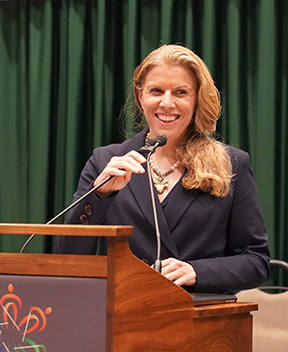 From the Editor: We are constantly bombarded by messages that suggest that if we don’t want to work for someone else, the answer is to be an entrepreneur. If we don’t want to face the discrimination that comes from employers not believing we can do a job, the answer is to become an entrepreneur. In this address, a woman who has worked as our legal counsel and has long been an advocate for entrepreneurism talks about how we who are blind can become entrepreneurs and the way all of us in the Federation can support programs to make this easier. Here is what she says:
Thank you, Mr. President! Hello and good afternoon, members of the Federation! What a privilege it is to come back here today after being gone and apart for a couple of years. This has a lot of significance to me personally, and I know it has to you. This convention is so much a homecoming and a homecoming this year during such challenging times that we all have been through.
But it does reflect a critical moment to celebrate community and to celebrate the energy that's created by this community in particular. There's potent power in this room! There are ideas and actions in this room that will lift up those that are here and those that are not, and it will do this for the rest of the year and for years to come.
Well, I was introduced just now by the President in my role as founder of EnAble Ventures and SmartJob, both companies aimed to close the disability wealth gap and grow an entrepreneurial system throughout the blind community, as I will mention. But, as was said in my introduction, I first entered this work as a lawyer. I was honored to work as senior counsel in the United States Department of Justice under the Obama administration, where I fought on matters that the NFB has always led on—and that is to advance the interests of workers with disabilities, to achieve competitive employment. That means avoiding unnecessary, unjustified segregation. It means being able to leave sub-minimum wage work when you can and want to work for competitive wages. As you well know, NFB has always been on the cutting edge of civil rights for workers in the organized blind movement, to work in employment in a range of jobs, to advance the highest expectations of people who are blind, and for the full inclusion of the organized blind in work and the economy. I look out today, and I see some of my great friends—Eve Hill, I worked with her back at DOJ. She's one of the great lawyers in the United States advancing the ADA. Anne Raish, still at the DOJ advancing civil rights. But this was back in the DOJ when we were pushing to apply the case law of Olmstead to cover places where people with disabilities worked. Now we know that people with disabilities can thrive in the job market with a range of opportunities and that there is a recognized right in the United States for people with disabilities to receive the services and supports they need to work in the community.
Later in my career, I went on and worked with Eve Hill and Dan Goldstein, who is in the audience, and other lawyers here from Brown, Goldstein & Levy—oh, yeah, let's hear it for Brown, Goldstein & Levy! [Applause]—a law firm truly with singularity that has worked hand-in-glove with the NFB to advance the rights of people with disabilities and people in this community for decades.
We worked on matters across the United States with the NFB, advancing the rights of blind workers to avoid unlawful, unnecessary segregation, to be treated equally on the job, to access ladders of opportunity, and that is work that is still carrying on today with the NFB and with these lawyers that have dedicated so much of their lives to making sure that people with disabilities have equal rights.
It was just around the start of 2020, however, that my work took me in a very interesting and very different place. I began to assess the sum of these experiences, and I was assessing what it meant that I had worked with some of the most talented people I've ever met in this community, in this room, and rooms like this around the country. And I began to realize that there were two different realities at play. First, thirty years after the ADA, it remained the case that two-thirds of working-age adults with disabilities are in fact not employed. Second, and this is really important, there is an abundance of raw innovation, invention, and ingenuity throughout the blind community. [Applause] It's everywhere! Talent is lying everywhere! And it's in this convention hall today. This sparks the question in all of us, which is how can we harness that talent to access more than just the right to be free from discrimination? What additional tools can we use to allow talented people with disabilities to achieve a freedom that works hand-in-glove with equality that is economic justice? In the movement for disability rights, how do we build on the equality already achieved and the battles yet to be fought, while leveling up to the word that is "equity"?—that which gives people economic opportunities, employment, and greater access to wealth. I turned to entrepreneurship to address these questions.
Now, ask me what entrepreneurship is. To me, it's a prayer to the kind of world you want to live in in the future. It's a prayer that through consistent and dedicated folks, you will into the world. Through the power of a single idea, you will it into reality. Even despite the odds—yes, even despite the odds that it might not succeed.
The history of successful entrepreneurs is replete with examples of people who have succeeded in spite of the odds, in spite of great barriers. They've been excluded from traditional avenues of employment. As the founder of LinkedIn, Reed Hoffman, wrote in a 2013 op-ed about the subject of immigration: Immigration is pure entrepreneurship. You see, you leave behind everything familiar to start somewhere new. To succeed, you develop alliances. You must acquire skills. You will have to improvise on occasion. That's a bold proposition, he said.
Well, like the experience of immigration, so many of the entrepreneurs with disabilities that I meet every day are fantastically situated for the experience of entrepreneurship. Each day they battle and bust through barriers in a world that was not written with them in mind. Each day, they see opportunities they don’t have, not because of their merit but because of the biases of the world. They seek new paths with new additional skills. Their lives are ones of inventing work-arounds, hacks, and better ways. And they are uncompromising in their belief that they can and will live in a world where the experience of disability is equated with problem-solving, innovation, and a better way. [Cheering and applause].
I founded SmartJob in 2020, and this year in 2022 partnered with Jim Sorensen, a world-renowned impact investor of the Sorensen Impact Platform, to create EnAble Ventures, a market-rate venture firm. Our job is to find the most talented entrepreneurs with disabilities in the world who are leveraging the disability experience as an asset. In their businesses, they are creating inclusively designed products and services. And they're launching startups that will increase the employment of people with disabilities. We connect these entrepreneurs with funding to allow their companies and enterprises to grow, to scale, to be sustainable.
These entrepreneurs and companies are bringing new products to the market that will improve the lives of themselves, others, and the lives of people with disabilities. In our estimation, by backing and supporting these innovators and entrepreneurs, we are working, and we need you to help us. We are working on building smarter jobs. We don't need to build any smart people. We've got them here; we've got them everywhere! [Cheering and applause]. We don't need to get more talent. We have talent here! We have talent everywhere!
What we need to do is change the way we design work. There is a rising class of entrepreneurs with disabilities around the world who will do that, will reimagine work for everyone.
My friend Tracy over there gives me a hard time in NFB—let's hear it for Tracy Soforenko from NFB of Virginia. [Laughter]
He says, Gina, you're too much Wall Street, not enough Main Street. You're too Harvard, not enough rock and roll. [Laughter]
Okay, Tracy, here's some regular language about what we do. We're providing our support to entrepreneurs and early-stage companies that are inventing new wayfinding solutions, next generation Braille displays, digital training and hiring platforms designed to screen in, not screen out. You heard Anne from the US DOJ. They're worried about technologies coming along that are AI driven that screens workers out. We're looking for technologies that intend and are designed to screen workers IN. [Cheering and applause]. We're backing entrepreneurs with disabilities with powerful ideas who are seeking funding, in order to grow and scale the kind of companies that will hire other people with disabilities, that will promote accessibility in their supply chains that will be designed with the community in mind from the beginning. [Applause]
It means that SmartJob is finding and supporting a global community of disability tech accelerators, small business incubators, and entrepreneurship programs that provide entrepreneurs with those critical skills—the critical skills, support, and information they need to be successful on their entrepreneurial journeys. You know, some of the fastest-growing jobs in our economy today are in the technology sector. That's an industry where people with disabilities, including people who are blind, are absolutely underrepresented. It is estimated that hundreds of thousands of jobs that exist today will be gone by 2030 because of the lightning speed of innovation, automation, and because of this increasing digital divide. People who have unequal access to technology will be the hardest hit with these labor force trends. And as you know, here we are in 2022, and the internet remains so often inaccessible to blind people thirty-two years after the enactment of the ADA.
To solve for these problems—in addition to the good work, the profound work of the NFB in its crusade for civil rights with so many talented lawyers—to solve for this problem, SmartJob is building relationships. And we're building a lot of them. We're building relationships with coding, digital accessibility, and other technology training boot camps. We're trying to connect workers with new inroads into that tech industry. We're working to pave alternative and accessible learning and training paths right into the technology sector to drive inclusion into the heart of tech by making it easier for tech to meet our talented workforce: the members of the National Federation of the Blind and people across the disability community who can and want to work in tech and can bring their talents to bear on the next generation of technology.
So, I've got to tell you since 2020 I've met with hundreds of entrepreneurs with disabilities from around the world. We're talking about inventors and dreamers and founders and makers. They're leveraging the experience of disability as an asset to business and as an asset to the world. They're expanding the disability market and the general market (the general consumer market, as they're doing it).
If you’re not an entrepreneur today, you might ask yourself why you should care about this. Again, why should you care about this? What does it have to do with your life?
Today, entrepreneurs throughout the world are working on solutions. They're working on solutions that you'll buy at the store. They're working—and many of them are blind—working on solutions to remove barriers from people with disabilities' lives. That's true. But the right solutions need funding to scale; in order to be sustainable, to reach you, they need funding in order to get off the ground, to hit a wider distribution, to have a lower price point, to make it. To make the sustainability of those products, they need sustained funding. They need a magic ingredient, which we in investing call product market feed. They need feedback like the relationship we've formed under President Riccobono with the National Federation of the Blind to know: what is the user experience? What do blind people think about this product? What does the community need to be built? Who in the community wants to build it?
So we are working on all these issues together. As we are looking to support and grow companies, we're also looking to support and grow the interests of consumers as to what they need. You know what you need, and you know what you'd like to see on the shelf in the future.
When entrepreneurs with disabilities and those co-designing with them have more funding, when they have more support, when they have more guidance, consumers do have a wider array of choices in their lives, and that levels the playing field. On this journey, as I mentioned—and I really want to underscore this—the NFB has been an indispensable partner. This should be of little surprise, as the NFB has been at the forefront of not only, as we mentioned, advancing employment for much of its eighty-plus-year history. But NFB has been at the edge, the cutting edge, of advancing innovation for all of its history. Certainly, blind innovation since the very beginning has very directly influenced the history of innovation at large in the world. You can draw a straight line from the invention of the typewriter to text to voice to audio books. Many of the component features of your iPhone in your pocket—that started in the organized blind community. That started with blind innovators! That started here! [Cheering and applause] That started in the community. Those innovations changed the world. They changed the world.
I know that your president knows that. NFB knows that. And looking out into the future, they know that there are innovators and inventors in the audience here today—all across this country—who will create the next generation of solutions in the next fifty years.
We are very excited by this partnership, and the ability to announce two special opportunities that are coming online right now in this partnership between SmartJob and the NFB. We have supported and brought to the community Synergies Works—it's a small microbusiness incubator. This is Tracy again: “What does incubator mean, Gina?” It's a place where entrepreneurs can get end-to-end support on their ideas, mentorship, the opportunity to meet with coaches about their ideas, the opportunity to receive support in accounting and marketing, understanding how to reach consumers and test products, and the opportunity to learn how to make a business plan.
We're bringing this online, and the opportunity is currently open to members of the National Federation of the Blind! [Cheering and applause]
The other thing we have to tell you is that we're bringing online, thanks to the folks at Include, LLC, a "How to Raise Venture Capital" course, how to get funding from angel investors and venture capitalists for great business ideas here in the NFB community. That course is opening right now as well. We've got lots of opportunities, and we hope that we'll see many of you participating in these as we move forward.
Thank you very much!