Creativity Is More Accessible Than Meets the Eye
by Rishika Kartik
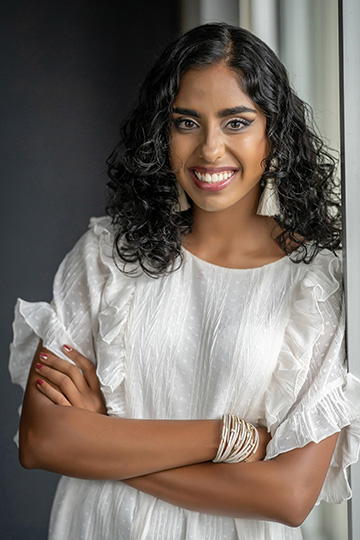 From the Editor: I’m not sure I’ve ever heard a bad TED talk, but what I do know is that I’ve never heard one better than this. Rishika, following in her father’s footsteps, volunteered for and learned from the Colorado Center for the Blind, and as with most bright, motivated, and giving students, she is now amplifying and giving back. Here is her talk, which you can also find in a link at the end of this article:
Don't Touch the Art. Heard this before? Perhaps in a museum or a gallery?
"Don't Touch the Art."
It's four simple words, and yet, it disproportionately impacts over 253 million blind or visually impaired people worldwide.
Art prides itself on pushing boundaries, yet we still view creativity two dimensionally, literally—pencil portraits, Instagram posts, sculptures we must stay ten feet from at all times—the kind of art you can look at, but cannot fully experience.
It is precisely this view that is stopping us from a more inclusive, innovative future. Making creative outlets accessible isn't just "nice to have"; it's essential.
According to a global CEOs study at IBM, creativity is the most crucial factor for future success. Yet, a study by Adobe revealed that 75 percent of people surveyed do not feel they are living up to their creative potential.
What if I told you that there's a way for almost everyone, including you, to unlock your creativity and experience the world in a way you've never experienced it before? It's easy, and it starts with viewing accessibility as an opportunity for creativity.
Now, I know what you're thinking. I'm a sighted seventeen-year-old. This talk is about accessibility, creativity, and blindness. That's like a dolphin giving a keynote about open heart surgery. It's true. I'm not blind, and I'm not a professional artist.
Funny enough, for the longest time I was convinced that I was uncreative. A creative person was a cool, elusive Edge Lord, holed up in a dim room with brilliant ideas and black coffee. I was a loud, awkward nerd with regrettable fashion sense and a caffeine intolerance.
However, four years ago I discovered that creativity is significantly more accessible than most of us believe. I was volunteering at a center for blind students. And you know what I noticed most? I noticed that there, when a student is struggling, it's viewed as an opportunity. The teacher has to creatively find a solution that works for the student. The emphasis wasn’t about helping students fit the mold, as I was used to. It's about changing the mold.
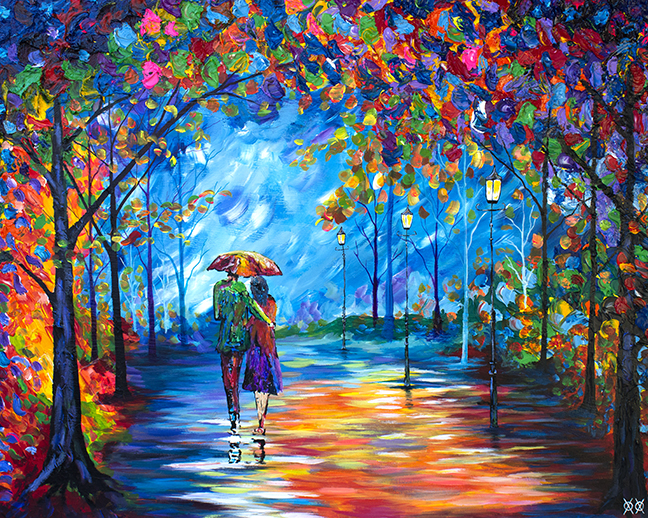
One evening, one of my friends from the center, Sarah, showed me a painting I’ll never forget. And I’m going to show it to you. But, before I do, close your eyes, take a moment, let me describe it first.
Twinkling streetlights and trees with crisp fall foliage line the path for a couple in love. Colorful fractals dance on a rainy floor beneath their peaceful silhouette.
Can you picture that? My guess is that if I asked each of you to create a version of this painting for yourself, you would each come up with a vastly different interpretation.
Okay, keep the image of your version in your mind. Now, here is what the painting actually looks like.
It turns out that the artist, John Bramblitt, lost his vision due to complications with seizures and epilepsy. When I found out, I felt terrible. My heart went out to him. But then Sarah showed me a quote from Bramblitt himself. He said: "My world is a more colorful place than ever before." She explained that, while disability is challenging, it gives people like herself and Bramblitt an opportunity to view the world differently.
John Bramblitt once aspired to be a creative writing teacher. Believe it or not he did not start painting seriously until after vision loss. So let me ask you: if he hadn't lost his vision, would he have become a world-renowned artist? His blindness was what allowed him to innovate in his field, using unique color combinations to convey emotion and textures to bring the scene alive. He created work that could not only be aesthetically admired, but touched and intimately experienced.
Just like each of you imagined a different painting based on my description, artists who are blind can imagine different worlds of possibility. Creativity is not bound to visual definitions. Creativity should include everyone.
So why doesn't it? The medical model of disability. This way of thinking views blindness as a physical limitation that must be cured in order to help people live “normal” lives. The medical model comes from a compassionate place. But when we talk about needing to cure blindness without actually listening to blind people, we walk a tightrope between empathy and pity. Instead, I learned to embrace the theory of complex embodiment. Complex embodiment views disability as a unique personal experience, much like race or sexuality. Some view their disability physically; others view their disability as a cultural identity. Some people don’t want to be defined by their condition. Others view blindness as a central part of who they are.
So if you want to learn more about blindness, ask people who are blind. You’ll be surprised at how diverse individual experiences can be.
Everyone, including nondisabled people like me, benefits from inclusion. Did you know that typewriters were created to help blind people send letters? Voice control technology we use every day like Siri was created to help blind people navigate technology.
Disability should never be mistaken for inability. Just ask John Bramblitt. He’s the recipient of three Presidential Service Awards, and his art has been sold in over one hundred and twenty countries. Traditional narratives on blindness would have painted his story as a tragedy and then told him, "Don’t touch the art."
Bramblitt's work gave me a new perspective and an interest in tactile art. This interest would lead me to flour-caked hands, clay-stained tables, and cinnamon scented paints. I joined tactile art classes. Eventually, I got to teach tactile art classes. I even got to meet John Bramblitt in real life.
I went from thinking I was fundamentally uncreative to finding a passion for the arts. Because I wasn't uncreative; our idea of creativity is just wrong. In the words of Sir Ken Robinson, an international advisor on education in the arts, "If you're not prepared to be wrong, you'll never come up with anything original.”
Creativity is not an elusive trait reserved only for the 1 percent of artists and geniuses. In fact, creativity does not require inherent intelligence at all. Creativity requires courage.
When the COVID-19 pandemic hit, I was daunted by taking my hands-on teaching style online. My first virtual tactile art workshop was a clay pottery class, and our clay substitute—flour and water—refused to mold into a traditional form. I worried that my blind students would be discouraged by such a messy experience.
Yet while I grappled with executing a pre-planned project, my students continued to create with delight. While I could only think of clay as pottery, they transformed clay into textured paint, silly putty, and papier-mâché paste. They reminded me that art doesn’t play by the rules. Sometimes, the best work happens when we stop planning and start improvising. That’s what makes these students artists.
Most people are terrified of improvising when it comes to creation. We are comfortable with a well-planned strategy, and when a project veers from that strategy, we fear we might be ridiculed, judged, or shamed. When we allow this fear to take over, more often than not, we stop generating ideas. We simply do not pursue creativity at all.
The way to overcome this fear is to dismantle ableism. Current approaches to disability inclusion send one message: "conform." We’re afraid of disability because it deviates from what we consider to be normal.
There was a nationwide poll published in the ophthalmology journal of the American Medical Association. Researchers asked people, “What is one of the worst possible health outcomes that could happen to you?” Nearly half of respondents said losing vision. Where does this fear come from? It’s because we see no other way to live than visually. We wrongly equate the "right way" of doing things with the "sighted way" of doing things. By reinforcing what we think of as normality, we are killing our creativity.
Accessibility is currently an afterthought; we design products, art pieces, buildings, and school systems assuming everyone is nondisabled and then create separate spaces for those who don’t fit this mold. If this separationist mentality continues, every one of us will be affected by it.
According to the CDC, one in four have a disability. This means it's likely that you have one, will develop one, or will be close to someone with one.
So, what can you do? First, prioritize disability inclusion from the beginning. Post alt-text descriptions on social media. Offer project-based, 3D learning opportunities in schools. Build architecture intended for every person to enter.
Next, collaborate with people with disabilities and learn from them. You literally cannot do something if you don't know it exists. So learn about how you can bring accessibility to your school, workplace, and community, and spread your knowledge to others.
Finally, reject the sighted savior mentality. Embrace complex embodiment and celebrate unique perspectives. Imagine a world where everyone could express themselves and belong; a school system or museum where students could read a textbook, touch a sculpture, listen to music; a world where everyone feels called to innovate.
In the words of John Bramblitt, "Everyone has an artist somewhere in them; sometimes they just need a little help letting it out."
To build a more creative world, we must radically redefine the way we view disability. There is no "right way" to be creative. When we explore the unconventional, we develop new modes of problem-solving, learning, and connecting. Accessibility IS an opportunity for creativity.
So smell the art. Hear the art. Feel the art. And yes, please, touch the art.
TEDx Talk YouTube Link - https://youtu.be/0jiTWP0lCls.