Cane I Stick Out Anymore?!
by Auna Mayes Namkung
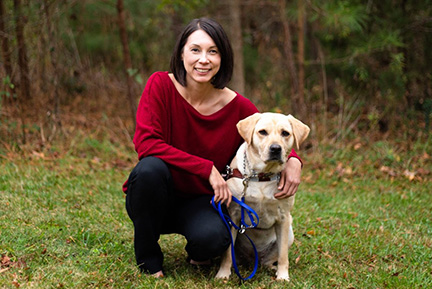 From the Editor: Auna Namkung is a licensed psychotherapist who specializes in helping individuals who are blind. She is particularly passionate about helping children in the area of social skills, helping people who are blind navigate a world that is not designed for them, and supporting individuals and their families through the process of vision loss. Auna utilizes evidence-based therapeutic models including Positive Psychology, Cognitive Behavioral Therapy (CBT), and Dialectical Behavioral Therapy (DBT). She runs a successful private practice in North Carolina and is the mother of two boys. She received her master’s in social work from the University of North Carolina at Chapel Hill and her master’s in visual disabilities from Florida State University. Auna worked as a teacher of students with visual impairments before deciding to serve the blind community in a different way. Auna has also earned a 4th degree black belt in Tae Kwon Do and has won gold medals on the state and international levels before becoming blind. Now she enjoys practicing Brazilian Jujitsu and loves to ballroom dance.
All of us have a story about how we came to know the white cane. Sometimes it was with joy, but more often than not, it was dread that later came to be joy. In the telling of our stories, we sometimes skip quickly to the conclusion, perhaps because we forget how hard it was to accept what my family referred to as “that damned stick.” “Why do you need that when you have us?”
This article gets to the joy of using a cane but encourages us to remember that how we sell a skill or the philosophy that motivates its creation and use can be of tremendous importance. Sell it wrong, and people may never have the independence it offers. Here is the wisdom Auna Mayes Namkung offers:
When a veteran becomes disabled, someone who is elderly needs hearing aids, or someone becomes blind, they often need adaptive aids which become a symbol of an identity they do not yet want to accept, but often need, in order to be more independent. Many people experience the grief process which involves five stages: denial, anger, bargaining, depression, and acceptance. People may experience all or some of these emotions and vacillate between these emotions. Often well-meaning professionals, family members, etc., go directly to the solution phase which involves acceptance; however, they unknowingly can undermine the individual’s autonomy and their need to process these emotions. My hope for this article is to highlight some of the difficult interpersonal interactions and helpful solutions between someone who uses a cane and the people in their lives.
Please allow me to provide some background information, and perhaps you may have some personal experience with this yourself. I have been visually impaired for as long as I can remember. I was obviously different from the rest of the students in my class. I looked to the right when talking to someone because of my scotoma (blind spot), and I used a magnifier and read with my nose to the paper. I had a premier spot at the front of the classroom with volumes of stinky, brown, large print textbooks, a bright lamp, and a big slant board.
The last thing a typical child wants is to be different. The same is true for a child or adult with a visual impairment. Although I did not use a cane then, I can imagine the horror I would have felt if a well-meaning authoritative figure had said that I had to use a long reflective stick attached to the front of my body that would make me stick out even more, pun intended. Like many other experiences in our lives, it can be hard for a sighted person to understand our world. It can be difficult for someone who is sighted and who also has our best interest at heart to understand why we can feel reluctant about using a cane. Although the hope is to feel confident using a cane, it is an emotional process we must experience before achieving this confidence.
This is a case when I believe understanding the five stages of grief developed by Elizabeth Kubler-Ross and the five stages of change; precontemplation, contemplation, determination, action, and maintenance; developed by James Prochaska and Carlo DiClemente are helpful. I think as parents or professionals, our first priority is safety, and we are often faced with the dilemma of not knowing how to best facilitate the use of a cane. Being able to recognize where your student/family member is on the continuum of change can assist the professional/family member in developing a more comprehensive view of the psychosocial effects of vision loss/blindness. People with a visual impairment often feel reluctant to use a cane for several reasons. We do not want to be ostracized, we want to be accepted, we want to have a say in life-changing decisions like using a cane, and we might not be ready to accept that we are losing or have lost our sight.
Let us explore some ideas about the challenges of working with a person who does not want to use a cane. I would like to first point out that in order to have the courage to be different and be proud to be different, one must first accept themselves. There are two issues here: the first is the acceptance of oneself as a person outside of a visual impairment; the second issue is the acceptance of a visual impairment as part of one’s self. In order to most effectively help your family member, student, or client, we have to "work with them" in all areas of their life, i.e., a holistic approach and not "against" their resistance to using a cane. We can start doing this by acknowledging their hesitancy when using a cane. It does not matter if their viewpoint is aligned with yours. These are your student's /family member’s feelings, and no matter what, their feelings are real and a fact within themselves. Validating these feelings is the first step in building rapport and helping them in the grief process. I believe this will also increase the likelihood of them listening to your perspective.
An unproductive versus productive conversation might sound like this:
"I don't want to use a cane. It will make me stick out."
You say or think in your head, “Well, you fumbling around makes you stick out even more.”
A better response is: “You’re right—it does set you apart. I understand why you don't want to use it. Nobody wants to stick out for weird reasons. Let's work together to help you fit in better."
In the latter situation, you are respecting the person’s autonomy, which is critical for developing self-advocacy and other emotions and skills. This is also the perfect opportunity to help your child or student with their other behaviors that need to be modified, such as posture, rocking, eye contact, etc. Then, later, you can have a conversation about the differences between what a competent and a non-competent cane user looks like. This can also lead into a discussion about how people react to each scenario. Will others be put off or intrigued?
Like many people who are blind, I enjoy various hobbies, one of which is ballroom dancing. When I walk onto the dance floor with my head held high and a genuine bright smile, people are fascinated and want to learn more about this blind ballroom dancer. In contrast, before my acceptance of my use of a cane, I would struggle to overcome the social and logistical barriers of life without using a cane. People would often wave from across the room and wonder how I could be so rude as to ignore them.
My point here is not to brag about myself, but that one must build and integrate their personal character and confidence as an individual and as a person who is blind so that we may better handle the unique challenges of being blind.
As a professional, parent, or friend, helping a person develop their confidence is a unique process, and there are many moving parts. One very important interaction that we must pay close attention to is respecting the individual’s autonomy and how their autonomy is tied to learned helplessness, confidence, and their development as a person. When one is forced to use a cane, they experience learned helplessness because they learn they do not have reasonable control over their life.
"I don't need a cane."
"Yes, you do. You could get hit by a car when you cross the street."
"Then I can sue them and be rich."
"Well, you won't be able to enjoy that money if you are dead."
I think many people with a visual impairment who need a cane know deep down that they need one. What they have trouble articulating is "I need a cane, but I am not sure how to deal with the social dynamics of being a cane user. Can you help me?"
As professionals, part of our job is to help them navigate this uncharted territory. I had the great fortune of having the cane introduced to me in the proper way and under the right circumstances. The cane was introduced to me as something that made me uniquely cool, something that I could use to my advantage, and something that "I" could choose to use “if I wanted to.” The person who introduced me to an ID cane was someone who I wanted to be more like, or a better and more current word might be role model, which according to the American Psychiatric Association’s Brochure on Resilience, is one of the ten factors of resilience. Kimberly Hudson cared for me, first and foremost, as a person. She cared for me by talking with me and helping me with issues in my life outside my visual impairment. Basically, she had an incredible rapport with me. I cannot remember the exact sequence of events, but in addition to focusing on my personal strengths, like pointing out my inquisitive nature, she started by making being visually impaired something that I could use to work for me, and not against. We started by getting a state ID card together that said “Visually Impaired” on the back. I thought, "Ok, this is sort of cool. I don't have a driver’s license, but I do have an ID card.” Some time had passed, and I asked Kim to attend a Tim McGraw concert with me. When we got there, what I thought were great seats ended up being nosebleed seats. Kim planted a seed. She said, "Auna, why don't you show them your ID card that says ‘Visually Impaired’ on the back and ask them if they can help you get closer to the stage." So I did. To get straight to the point, we ended up getting front row seats.
Side note, people with a visual impairment can get into all national parks with four other people for free. Given the difficulty in being included in society and the barriers to employment, this pass is a helpful way to contribute back to our social group.
To tie things together, there are various factors that are involved in the emotional evolution of the acceptance of a cane. People have to weigh the cost and benefit of using a cane. Will this ostracize me? Will it help me avoid a dangerous situation? Can this even improve my life somehow? Like dealing with the loss of a loved one, these emotions take time to process, and it is my opinion that respecting another’s autonomy and treating people who are blind as intelligent people who can make decisions for themselves is tied to other skills like self-advocacy.
Today, when someone offers to help me cross the street because they notice I am blind, I accept their help. I don't accept it because I need it. I accept it because this brief social interaction, that would have never occurred if I did not use a cane, could be the start of a lifetime relationship. This also gives them the opportunity to make a contribution and to be more aware of people with visual impairments. In short, besides safety, the benefits to using a cane are numerous, including the opportunity for unique social engagements, a socially accepted and quick explanation of a person's visual impairment, and the opportunity to help society to learn how to relate and work with people who are different from them, and it can serve as a micro-lesson in overcoming adversity. Let me close this segment by saying that I am having more fun as a cane user than I ever did as a non-cane user. I can say this with conviction because I accept myself first as a person and also a person who is blind. I once heard a joke that went something like this: "Finding a mate is like finding parking spaces; the good ones are taken, and the rest are handicapped.” Well, I say the BEST parking spaces are the handicapped ones.
I would love to hear your challenges and success stories. You can email me at [email protected].