Reflecting on the Ten-Year Anniversary of the Marrakesh Treaty
by Marc Maurer
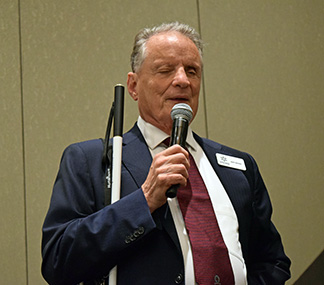 Editor’s Note: On the afternoon of Monday, July 3, the National Association of Blind Lawyers convened for its annual meeting. One of the first items on the agenda was this presentation from Dr. Marc Maurer, the Immediate Past President of the National Federation of the Blind. Here is what he said to the gathering:
The Marrakesh Treaty, officially entitled Marrakesh Treaty to Facilitate Access to Published Works for Persons Who are Blind, Visually Impaired, or Otherwise Print Disabled, is a document created in a meeting that took place in Marrakesh, Morocco, in June of 2013. The meeting was a diplomatic conference attended by representatives from dozens of countries, known by the cognoscenti as a dipcon. I was then serving as President of the National Federation of the Blind, but I could not attend the meeting because I was working to get ready for our 2013 National Convention. I sent Scott LaBarre to be our representative, and a very fortunate choice that it was for us.
The World Blind Union had proposed that such a treaty be created in 2008, and the National Federation of the Blind strongly supported the treaty. Long before we reached the gathering in Morocco, officials in the Obama administration had tried to talk us out of the treaty. They said they would support a non-legal international understanding (a “soft law” approach they called it) that would facilitate lending accessible books for the blind across country borders. They said that this would have the same effect as a treaty. Getting a treaty adopted would be next to impossible, they told us. Even if we could get it adopted, the Senate would never ratify it.
Within a few months, we hosted an executive committee meeting of the World Blind Union in Baltimore. Maryanne Diamond, who has served as president of the World Blind Union, asked, “Why are you giving up without a fight? Don’t you believe that we should share materials for the blind throughout the world?” This changed the approach of the National Federation of the Blind. We informed the Obama administration that we wanted a treaty, that we would do our best to get it, and that we would not settle for inferior substitutes that do not have the force of law.
In Marrakesh, Scott LaBarre had the tricky assignment of finding ways to negotiate the proper language for the treaty. He was required to be sufficiently demanding to get the language in the treaty that we wanted and sufficiently charming to get people to want the language to be there. Everybody seemed to want to water down the treaty. Libraries could (some people said) share books with each other, but they would have to keep records of who borrowed the books and produce those records on demand along with proof that the people borrowing them met the definition of print disability. The librarians had a fit. They said that they could not violate the privacy rights of all their patrons and that the workload of keeping such records would be intolerable. The publishers said that lending books in Braille would be fine but that lending electronic books couldn’t be in the treaty. Blind organizations from around the world said that the treaty would have to include electronic books because the entire publishing industry was headed that way. Some publishers said that recorded books could not be lent across borders because a print book has its copyright, and as soon as you make a recorded book, it’s a different book with a different copyright. The new book has its own protection, and even if there’s a copyright exception to the print book, it doesn’t apply to recorded material.
The arguments seemed endless. When Scott LaBarre got to Marrakesh, thirty-seven distinct differences in language remained for discussion in the proposed draft of the treaty. As negotiations continued, additional differences in language and arguments about what the treaty should say were presented by the representatives of the countries involved in the diplomatic conference.
The proposed treaty was regarded with alarm by rights holders of intellectual property from many, many different disciplines. Copyright law in the United States is intended to protect the rights of those who own the copyright. Most treaties dealing with copyright are written to give added emphasis to the protections required for the holders. This treaty was directed toward creating exceptions to copyright protections, and the rights holders were worried that it might be the forerunner of other efforts to loosen copyright protection. Not only the Motion Picture Association of America but also Exxon Mobile, GE, Caterpillar, Adobe, IBM, Association of American Publishers, International Publishers Association, and many, many others opposed the treaty. Our job was to change their minds or silence the criticism. Many of our opponents came to recognize the value of the treaty and joined us in supporting it before the end of negotiations. On June 25, 2013, the language was complete. The final version was adopted on the 28th.
In October 2013, the United States signed the treaty. Then began another negotiation to get the treaty through the executive branch and onto the Senate floor. Once again, the arguments seemed endless. The State Department creates a packet of material to be presented to the Senate so that the treaty can be considered. The treaty cannot come into force, however, unless conforming legislation is adopted by Congress to bring American law into line with the provisions of the treaty itself. When the Senate considers a treaty, it can reject it or accept it. If the Senate determines to accept a treaty, it can do so with exceptions, known in the trade as RUDs—reservations, understandings, and declarations. If the Senate loads a treaty with enough of these exceptions, the force of that treaty is diminished. Scott LaBarre’s job was to get a clean packet of material out of the State Department so that the treaty could come to the Senate floor with as few exceptions as possible.
In the meantime, the World Intellectual Property Organization (WIPO), the segment of the United Nations that deals with copyright around the world, formed in the spring of 2014 the Accessible Book Consortium to manage accessible titles that could be transported across borders to libraries for the blind. Scott LaBarre served as one of the founding board members of this international organization.
The State Department finally completed the package of materials for the Senate in the spring of 2016. In the spring of 2018, the Foreign Relations Committee of the Senate received testimony from the State Department, the National Federation of the Blind, and others before unanimously recommending the treaty for passage to the Senate. The chairman of the committee noted that in a most unusual occurrence in Washington, there was bipartisan, enthusiastic support for the treaty. The Senate ratified the treaty by unanimous consent in June 2018 and adopted implementing legislation to conform US law to the treaty language. The House of Representatives adopted the same conforming bill in September. The president signed that bill into law on October 9, 2018. In February 2019, an emissary from the United States carried a ratification document to Geneva to indicate that the treaty was in effect in the United States. The United States was the fiftieth country to ratify the treaty. The title of the treaty, the Marrakesh Treaty to Facilitate Access to Published Works for Persons Who are Blind, Visually Impaired, or Otherwise Print Disabled, is significant. In Marrakesh, arguments occurred repeatedly that this title was too long, too cumbersome, too verbose. Scott LaBarre said we have done all this work, we have negotiated with so many for so long in good faith, we are not leaving blind out of the title. It must show that this treaty is to serve blind people. His argument to maintain the descriptive title was successful.
Now, nonprofit organizations or governmental entities that have a primary part of their business to serve as libraries for the blind can share books across country borders for the use of the blind. The books can be recorded, electronic, Braille, or large print. More than 130,000 books from the blindness collection in the National Library Service for the Blind and Print Disabled of the Library of Congress have been shared with the World Intellectual Property Organization. Almost 5,000 titles from the World Intellectual Property Organization have been added to the Library of Congress collection of books for the blind. WIPO has books in eighty different languages, and since the adoption of the Marrakesh Treaty, books in thirteen new languages have been added to the Library of Congress books for the blind collection. According to the latest information from WIPO, there are more than three quarters of a million books in its collection.
The Accessible Books Consortium came into being only nine years ago. Its collection of books being distributed for the World Intellectual Property Organization will undoubtedly be one of the world’s greatest libraries for the use of the blind. This happened because of the work of the National Federation of the Blind, but especially because of the contributions of Scott LaBarre.