Aiming Big to Achieve Our Objectives
by Jeff Kaloc
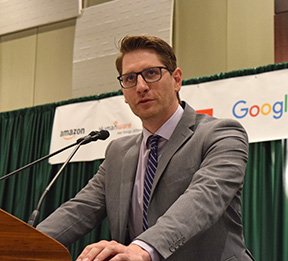 From the Editor: As John Paré pointed out when introducing him to the convention, Jeff Kaloc has experience as a staffer on Capitol Hill. Now he brings that expertise to the other side of the table in helping us to craft our legislative efforts. Here is what Jeff said to the convention:
It is good to be with everyone here in Houston! The fact that you are here at this convention, the largest gathering of blind people, speaks volumes about what becoming a member of the National Federation of the Blind means by expressing our voices, contributing to the organized blind movement, and making progress each and every day!
Houston is known for many things. The same can be said about the entire state of Texas. The saying goes that everything is bigger in Texas. Now that I’ve been here a few days, I’d have to agree. Let’s keep that sentiment in line with our goals, to aim big with our policy objectives.
The Access Technology Affordability Act’s support has grown enormously since it was introduced several Congresses ago. With politics becoming more partisan, it is refreshing to forward a bill that is bipartisan because accessibility isn’t solely a Republican or Democratic policy, it is an American ideal. The bipartisan support is evident in its reflection of cosponsors. In the 117th Congress, the bill had 165 House cosponsors and forty cosponsors in the Senate. In the current Congress, the 118th Congress, the bill has been introduced by Representative Mike Kelly, a House Republican, with Representative Mike Thompson, a Democrat, as the lead cosponsor. In the Senate, the bill is sponsored by Democratic Senator Ben Cardin and Senator John Boozman, a Republican, as the lead cosponsor. The support for this bill has grown in other ways, too. It is legislation known by committee staff and recognized by Congressional leadership.
None of this progress would have been possible without our hard work and dedication to advocate for this legislation. Whether it be attending Washington Seminar, calling and writing your members of Congress, attending at town halls, and being active on social media, we made sure our voice was heard and this bill has gotten the attention it deserved. We understand the importance of addressing the high cost of access technology that places far too many blind people at a disadvantage. Affordable access technology is often the determining factor to passing a class or applying for a job opening. It allows blind people to interact in the digital world that has now become a necessity for everyday life. That is why we must stay vigilant in our efforts by continuing to advocate until this legislation is passed and signed into law!
None of our advocacy would be possible without the ability to cast a ballot. How can we feel that our ballots matter if it cannot be cast both privately and independently? That is why we at the National Federation of the Blind have been relentless in our efforts to ensure that whether you choose to go to the polls or remain at home, voting can and must be accessible for all blind Americans. We need to continue to advocate for enhanced training at polling places. Poll workers need to be properly trained and equipped to operate ballot-marking devices. We need to ensure that ballot-marking devices are set up and fully operational from the beginning of Election Day. In addition, we also urge that more blind people become poll workers, thereby becoming involved in the election process.
Since the pandemic, remote voting has increased significantly. Countless states have allowed voters without disabilities to cast their ballots from the safety and convenience of their homes. The same principle must be allowed for blind voters. Thirteen states permit accessible remote voting for the blind and print-disabled by allowing blind voters to cast ballots through electronic ballot delivery and return. These states have worked with security experts to ensure that this process is both accessible and secure. Over thirty states have allowed for blind voters to request a ballot to be delivered electronically. While this helps in requesting and marking the ballot, the entire process is not accessible, as it requires us to still print, sign, and return a ballot by mail. We know there is a better way to provide security and accessibility because, as mentioned previously, thirteen states allow electronic ballot delivery and return.
These policies are more important now than ever. We now face new challenges that impede our path to accessible remote voting. Relentless attempts from organizations entrenched with ill-advised policies have provided state legislatures and governors’ offices with misguided and nonfactual information about election security concerns regarding electronic ballot return—attempts cloaked in fear rather than expertise. The baseless attempts have caused havoc, thereby stalling our efforts to provide electronic ballot return in numerous states.
But the National Federation of the Blind has never been known to back down from a fight! That is why we cannot stop our advocacy now. That is why we are continuing our efforts to educate our lawmakers and state officials about the practice that can be put into place to ensure election security and enhance accessibility. Everything that we have worked for is on the ballot in 2024, and we will continue to advocate until every blind voter in the United States can vote with the same ease of use as voters without disabilities!