Fighting the War on ‘Image Poverty’
by Claire Rojstaczer
Reprinted with permission from NLS News.
 Editor’s Note: The National Library Service for the Blind and Print Disabled, a part of the Library of Congress, administers the Braille and talking-book program, a free library service available to US residents and American citizens living abroad whose low vision, blindness, or other disability makes reading regular printed material difficult. Through its national network of libraries, NLS provides books and magazines in talking-book and Braille formats and playback equipment directly to patrons at no cost. Materials are also available online for download and are accessible on smart devices through the BARD mobile app. Music instructional materials are available in large-print, eBraille, Braille, and recorded formats. For more information, call 1-888-NLS-READ (1-888-657-7323).
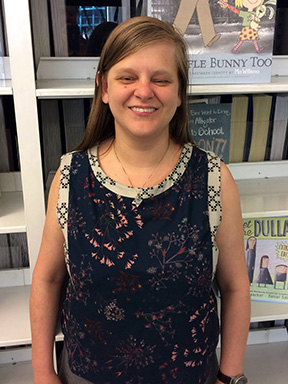
Chancey Fleet can’t remember when she started receiving books from NLS as a child, but she does know the first time she visited the Andrew Heiskell Braille and Talking Book Library in New York City, where she now works.
“I was ten years old, and I was blown away by the ability to just walk around and browse the Braille stacks,” she says—an experience not offered by the NLS network library in Virginia where she received service. “Somehow, the librarians even worked out a way for me to check out a book and return it after I went home to Virginia.”
That moment of wonder—of meaningful access to something previously kept hidden—is something Fleet strives to create for her own patrons as Assistive Technology Coordinator at the Andrew Heiskell Library.
Fleet began volunteering for the Andrew Heiskell Library while an adaptive technology instructor at the Jewish Guild for the Blind, launching a weekend adaptive technology clinic in 2010. “We were told the library was underutilized, that young people weren’t coming to the library,” she says. “I wanted to change that.”
At first, Fleet recalls, it was just her and her friends hanging out together, but patrons began to trickle in with questions about their iPhones, about using Skype and Facebook and about the free NVDA screen reader. BARD, the NLS Braille and Audio Reading Download service, was also a frequent source of patron help requests.
By 2014, demand had built enough that the Andrew Heiskell Library was able to create a new position and hire Fleet full-time. “Now we have three full-time tech experts supported by over a dozen dedicated volunteers,” she says.
“In the next ten years, we’ll see AI capable of rendering visual graphics into tactile graphics—replacing text with Braille abbreviations, assigning colors to textures, removing background clutter, improving contrast, scaling up. As many misgivings as I have about AI in other domains, I’m excited about the tactile graphics potential. We will always need talented tactile designers, but AI can help speed up routine work.” —Chancey Fleet
As the assistive technology program at the Andrew Heiskell Library expands, Fleet keeps exploring new services to bring to patrons. Since 2016, one of her areas of focus has been tactile graphics.
“A patron who had just moved to the area called and asked for a map of the five boroughs, and I realized I couldn’t just create one,” Fleet says. She wrote up a proposal for a way to solve that—and was awarded the New York Public Library’s 2017 Innovation Grant. That brought the Andrew Heiskell Library $12,000 to purchase equipment, including a 3-D printer and a graphics embosser, and train staff. Within a year from the initial idea, the Dimensions Lab was ready to launch.
As with the adaptive technology clinic, it took a while for the Dimensions Lab to draw patrons. “At first, almost nobody came,” Fleet admits. “I would go up to patrons and tell them, ‘You can make anything!’ and they would say ‘What am I going to make?’ I had to take a step back and realize that when we’ve been denied access to images, we don’t know what we want or how to begin.”
That lack of access creates what Fleet calls “image poverty,” a term she coined about five years ago. “I sometimes get pushback about the term,” she says. “I’ve been told, ‘That’s too dire.’ But a whole lot of us are missing out on this immense swath of information. It starts when we’re kids, when we’re given ‘alternate activities’ while the rest of the class learns to draw. It is dire."
But “every patron has an image that will be a catalyst or a gateway” to understanding the appeal of tactile graphics, Fleet says. And once they find that image, “the unexpectedness and richness of the ideas people bring to the lab is a challenge and a privilege.”
The Dimensions Lab now regularly hosts large group events, as well as drawing in a steady stream of individuals who want assistance making everything from maps to holiday cards to tactile finger- and footprints for a forensics class. This summer, it hosted a group from Cooper Hewitt, the Smithsonian Design Museum, who were making tactile symbols for a new exhibit. And Fleet is proud to have helped a recent Juilliard graduate receive a diploma not only written in Braille but adorned with a tactile version of the school’s seal.
Regular workshops on embroidery, accessible drawing and origami—the last taught by Fleet herself—are also popular offerings.
Going forward, she’s excited by the development of refreshable displays designed for displaying tactile graphics, not just single lines of text. One currently on the market sells for around $15,000. “We’ve got a ways to go,” Fleet says, “but it’s reasonable to think that within ten years this kind of display will be as available as refreshable Braille displays were before the NLS Braille eReader—still expensive, not as accessible as I’d like, but there.”
That NLS Braille eReader, which is loaned to patrons free of charge, is finally making electronic Braille text accessible to all, and Fleet is enthusiastic.
“This could be the year we move the needle on Braille literacy,” she says. “The economic disincentive goes away with the wide release of the eReader.”
She hopes that with accessible technology at their fingertips—and with the introduction of more tactile maps and graphics from NLS, such as the recently released Game of Thrones map—more patrons can be convinced that they can be Braille and audio readers. “Braille,” she says, “is beautiful.”
Chancey Fleet
Age: 41
Education: B.A. in Sociology and Psychology, College of William & Mary; M.A. in Disability Studies, CUNY
Current position: Assistive Technology Coordinator, Andrew Heiskell Braille and Talking Book Library
Quote: “Coming from a more traditional blindness organization allowed me to be excited about the innovation and openness of working in libraries, where we’re truly here to serve the individual. At the library, every goal is valid, even goals outside of work and educational life.”