Interview with Mark Riccobono, President of the National Federation of the Blind
Taken from Autonomous Vehicle Industry Association, State of AV 2024
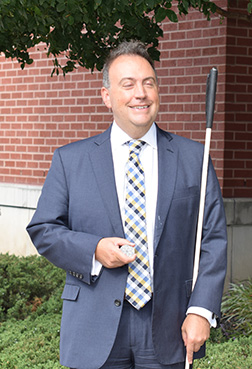 In an interview with AVIA, National Federation of the Blind President Mark Riccobono explained why his organization and blind individuals are excited about AVs’ opportunities.
Tell us about the National Federation of the Blind.
The National Federation of the Blind advances the lives of its members and all blind people in the United States. Established in 1940, the Federation is America’s membership organization “of” blind people. We have an affiliate in each of the fifty states, the District of Columbia, and Puerto Rico. As a leader in the World Blind Union, the Federation is the model for self-organization by blind people around the world. We know that blindness is not the characteristic that defines us or our future.
Every day we raise the expectations of blind people, because low expectations create obstacles between blind people and our dreams. Our collective power, determination, and diversity achieve the aspirations of all blind people.
Why are autonomous vehicles important to your organization and its members?
The National Federation of the Blind is comprised of members from diverse backgrounds across the United States. Some have been blind from birth, while others have lost their sight over time.
In the United States, driving is considered a valued privilege. The vast majority of Americans cherish the freedom of movement and flexibility that comes with operating a motor vehicle. However, in the early 21st century, we reversed the conventional belief that only sighted individuals could drive. At the Daytona International Speedway in January 2011, I shattered the misconception that vision is required in driving and demonstrated the power of accessible technology in the hands of capable humans by navigating a car independently as a blind person. Since that pivotal moment, we have redirected our resources toward autonomous vehicles.
Why? First, we recognized that an industry of new transportation was about to emerge and knew that by asserting the right of disabled people to participate from the beginning, we could enculturate the belief that the technology was for everyone. Second, we know that when the blind and others with disabilities are involved in design, the end product is better for everyone.
Whether you're sighted or blind, autonomous vehicles empower individuals to travel independently to their chosen destinations.
The technology also provides other benefits to society—fewer accidents, better use of drive times, and greater control by those who do not drive currently.
For the blind community, this represents a historic milestone—the first time we can enjoy equal access to motor vehicle transportation, just like the rest of society.
You testified before the House Energy & Commerce Committee on autonomous vehicles. What is your message for policymakers on AVs?
During my testimony before the House Committee on Energy & Commerce, I emphasized the transformative potential of autonomous vehicles for more than seven million blind Americans.
Our community faces a staggering 67 percent underemployment and unemployment rate, and one of the key contributing factors is the lack of affordable, reliable transportation—especially in rural areas across the United States.
Autonomous vehicle technology holds the promise of enhancing access to employment, recreation, and family life. However, this promise can only be fulfilled if the technology is nonvisually accessible to blind individuals. We are pleased to collaborate with Congress and our partners in the autonomous vehicle industry to ensure that blind people can operate this technology with the same equity as the broader population.
What is the Autonomous Vehicle Accessibility Act, and why is it important?
The proposed bill aims to safeguard the civil rights of blind or disabled individuals who operate autonomous vehicles. Currently, there is no explicit protection for these individuals if they are pulled over by the police while riding in an autonomous vehicle. In such cases, a blind person could potentially be charged with driving without a license.
By passing this legislation, blind Americans would have equal rights to travel in autonomous vehicles, eliminating the need for a driver’s license and ensuring their freedom of mobility.
The legislation also contains a $5 million appropriation to study the convergence of urban infrastructure, autonomous vehicle use, and disability. This is an affirmation that disabled Americans have value and an example of how we design our future with accessibility as a core value fulfilling the commitments codified by our nation in the Americans with Disabilities Act.