Building the Movement: Achieving Our Dreams through Strategic Investments
by Denise Avant, Trisha Kulkarni, Lisamaria Martinez, Sanho Steele-Louchart, and Denise Brown
From the Editor: After having published our Strategic Plan last July, it seems wise to publish what folks said about it at last year’s convention. We are finishing up articles from the 2023 Convention just in time for a new batch from our 2024 event. Enjoy the read. Here is the way President Riccobono introduced this panel:
As mentioned in the Presidential Report, our Board of Directors felt that it was very important coming out of the pandemic period to reassess and recommit to strategically investing in where we need to build the organization. This convention is the primary vehicle for steering the organization, but between conventions, our board wants to have a framework for where we commit our resources and direct the organization. Our last strategic plan was developed late in 2018. We released it in January 2019, and it's a good example that a strategic plan is a framework, not an absolute. You may remember that in March 2020 we started doing a lot of things we had not strategically planned for, such as a virtual convention. The strategic plan is meant to be a guide for the board and for where we put our energy. Certainly we could not have imagined much of our work in the last three years from the perspective of late 2018. So we put together a steering committee which was a cross section of members to advise and guide the process to develop a plan that ultimately the board would have to accept and adopt the plan and recommendations, but that was guided by a number of members from across the organization who worked with our consultant over the last year, including activities at this convention last year, to really gather data from a broad cross section of the organization. I think they've done a great job in doing that.
I hope that you will have an opportunity to review the plan in the July issue of the Braille Monitor and get familiar with it.
The steering committee was made up of members and staff from all levels of the organization. There were a few board members who participated in the steering committee, and we have one of those to guide the panel that's going to present to you the outline of the strategic plan. And I want to introduce to you in her final moments here as a board member of the National Federation of the Blind—she'll be closing out her term when we adjourn this convention—from Illinois, here is Denise Avant. [applause]
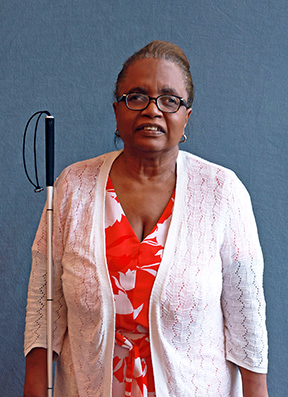 DENISE AVANT: Thank you, President Riccobono and fellow Federationists. I'm going to try not to repeat much of what President Riccobono has already told you, but there are some points that I just want to reiterate.
The steering committee has been working for the past year to construct a strategic plan that will guide the growth of our organization.
Up here on the podium with me is Trisha Kulkarni, the outgoing president of the National Association of Blind Students. By the way, Trisha is all the way at the end on my left. Sanho Steele-Louchart is the next person. He is the president of the NFB of Oklahoma. He is an attorney, and he is also our legal affairs coordinator. Next to him is Lisamaria Martinez of California. She is chair of the blind parents group. Finally is Denise Brown, who is president of the Greater Philadelphia Chapter of the NFB of Pennsylvania.
You can see that these people represent a broad cross section of our organization. As President Riccobono told you, you can find the strategic plan in the Braille Monitor. I would urge you to review it, sit with it. You will be hearing more as the national reps come out to your state conventions in the fall and the spring.
Now, as I said, we have gone through many phases. One of the big phases is collecting your feedback and hearing your voices as our members. You no doubt remember that you participated in a survey last fall. We want to thank you for your thoughtful consideration and the time that you gave to the survey.
Since 1940, in our organization we have always carefully constructed strategic plans to build on the priorities of our membership that would be executed by our leaders. Like our past strategic plan, this plan sets forth the next steps for our organization and building our movement.
Now, one thing you can rest assured is that the plan does not change our philosophy or our advocacy direction or the role of the National Federation of the Blind's convention. It is simply a framework which our board of directors will use to keep our organization moving forward based on our time and on our limited resources.
Our plan has the aspirational statement which says, “We imagine a world where blind people can live the lives they want as valued and respected members of society. Our mission is that we work tirelessly to improve the lives of blind people by fostering personal empowerment, coordinating nationwide advocacy, and building a network of collective achievement.”
The next part of the plan is our values. This is the essence of our organization, the code by which we live, the principles by which we make our decisions. Our values as an organization are that we believe in blind people, we lead courageously, we champion collective action, we foster inclusion, and we dream big. [applause]
To help realize our aspirations and mission, we now will move to our commitments. So our first commitment is to innovate. Trisha will give you the highlights of this commitment and the priorities under the commitment. Trisha?
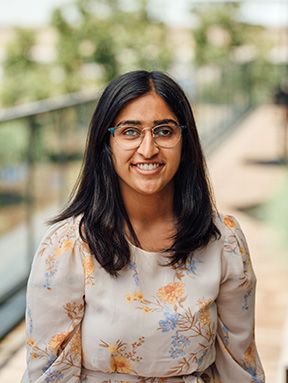 TRISHA KULKARNI: For a moment I want to take you to another event. Our national student division is hosting a regional seminar where we bring students from across the country to engage in resource sharing and mentorship. On the last evening of our event, we are debriefing and reflecting on our experiences. A student shares that before this event, they had never learned to dream big as a blind student. But after attending the seminar, they wanted to reassess their career.
There is no doubt that in the National Federation of the Blind, we encourage people of all backgrounds to dream big. That is why I am on this stage today. However, I think about how many circumstances had to align for this moment to be possible. The student had to find our organization. The student had to secure funding to be able to attend. And the student needed to see their experiences reflected in the other people attending the event. But what if these circumstances didn't align? Our first commitment to innovate is to invest in continuing to evolve our program and initiatives to increase opportunity, lower barriers, and raise expectations for blind people.
DENISE: Thank you, Trisha. Sanho?
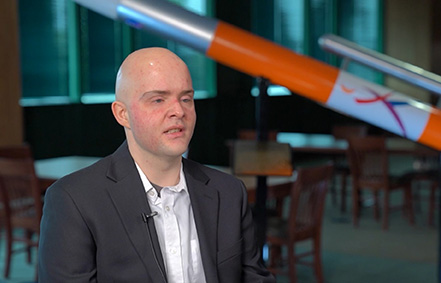 SANHO STEELE-LOUCHART: Hello and good morning Convention 2023. I am the legal program coordinator and the Oklahoma affiliate president. One of the titles that was not read today is that I'm also the LGBT+ group head here at the NFB. [applause]
Now, let me be clear. I will say my pronouns are he/him/his. And let me be clear that this is not an LGBT issue. This is an issue that involves all of us. Inclusion is a commitment that the Federation aspires to. We've come so far but yet have so far to go. It is sometimes easy to underestimate precisely how far we've come because we're still working every day that we are in this organization, finding and celebrating diverse voices, while also working on the things that we don't know that we don't know.
So personally, the way that this came up for me was that in September of 2005 at twelve-years-old and in the seventh grade, I realized I had a crush on a boy, and I didn't know what to do, and I didn't know any gay people. My parents were not gay people let's say. So that raised some questions.
Then a month later in October of 2005 I suddenly went blind. I had been fully sighted. I had no preparation. No anticipation that I would ever be blind.
So as you might imagine, all of my friends vanished. My family became distant. No one knew quite what to do with me because of having two minority identities in my case, one of them was a bridge too far.
Well, then I met the NFB. And from the first NOMC with whom we had that conversation where I talked about a boyfriend or used a gendered pronoun when discussing my personal life, I was accepted: as a blind person, as an LGBT+ person.
Well, that trend continued. What I learned over time within the Federation is that even though we are still doing that work, people are willing to learn and to listen and to, in fact, do the work.
Now having just turned thirty and been involved in so many ways, I see the National Board and steering committee has this value “to include,” meaning we include people of all identities, LGBT+, people from different faiths, people of color, we include everyone who wants to come to us and live our philosophy of blindness. That includes members, staff, affiliates. Really the way that they define it is that, in fact, the National Federation of the Blind commits to foster a culture that is welcoming, that is inclusive, that seeks and values diversity within this organization because we know that through diversity, we are stronger. [applause]
DENISE AVANT: Commitment 3 is “collaborate” and that is Lisamaria Martinez.
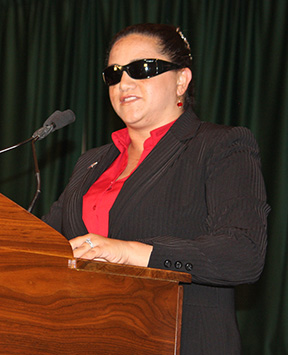 LISAMARIA MARTINEZ: Innovate, inclusion, and now collaborate. To collaborate is to leverage our community of allies, including employers, policymakers, donors, synergistic organizations, and strategic partners. To maximize impact and effect lasting change.
This commitment is 100 percent my jam. I very much believe in collaboration. I am a connector. I love to connect people with each other and see the synergy create magic.
I love to dream big, and I love to play the “What If” game. What if a blind person can get to the moon? What if a blind person could be the President of the United States? What if? [applause]
So to collaborate, we need to establish storytelling initiatives that raise awareness of blind people for their contributions across all sectors of society. To collaborate means to leverage our expertise to build relationships with synergistic organizations to advance access and opportunities. To collaborate means to develop curriculum for educators that promotes greater understanding about blindness and affirms the capacity of blind people.
So I encourage you, better yet—I challenge you, I dare you to dream big. I dare you to think of innovative, inclusive projects that we can do. I already believe that we as blind people are the experts. I already believe that. So I'm ready to take that belief a step forward and collaborate with the rest of the world to ensure that everybody in the world knows that the NFB, or the blind of the world, are just as capable as anybody else. Thank you. [applause]
DENISE AVANT: Thank you. With the final commitment, dedicate, is Denise Brown.
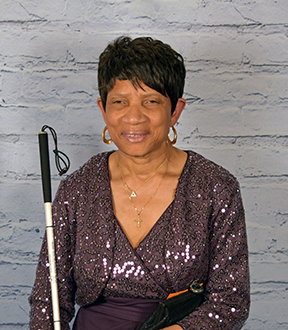 DENISE BROWN: Good morning, everyone. As Denise said, the fourth pillar is “dedicate.” We must devote the financial and human resources required to realize our strategic priorities.
So let's start with the human resources. Can everybody out there just say “I”? That is the first word of our pledge. In this strategic part of the plan, we must recruit, retain, and build leaders. For those in recruiting, it is not just up to the officers and the membership chairs and the membership coordinators. It is up to all of us to find members for this organization. And where can we find members for this organization? Everywhere. Because everywhere is where blind people go. You meet them on the plane. You're at the sporting event. You're at the theater. You're in the airport. When you find these people, get their contact information. You can give them yours too, but you get it so that you can follow up with them and get them to a chapter meeting or a chapter event.
Okay. Once we recruit them, we want to retain them. Let's give them a reason to stay and be productive in the organization. Make sure they have a mentor so that they can understand this organization and continue to prosper in it.
Let's build leaders. We have leaders who have been in positions for very long times. And there's nothing wrong with that. But we have to build our organization with new leaders. We need everybody to want to do more, to gain the position.
When we talk about the National Federation of the Blind, we love blind people. We dream big. You've heard about the museum. And the dreaming big with the museum, we need financial friends to help us with our museum. But guess what? Say “I” again! That includes you too. If we are asking others to invest in what we see in our future, it would be nice if you were investing too.
Also we do many programs in the Federation. And we need to evaluate those programs that we are doing in each of your chapters, in each of your divisions. Are they working? Is there something that you need to do to change it so that more people come to the next event? Let's evaluate it and try to make it better.
And I know all of you are going to read the strategic plan and you're going to read it again so that you get a better understanding of it. But guess what? We have to support the plan among this organization. If you don't seem like you're in favor of it, how do you think your members feel? So give this plan a chance. We're working together to build the National Federation of the Blind because we want to be the best. And I'm going to turn this over to Denise Avant to close us out. [applause]
DENISE AVANT: Thank you, Denise, Lisamaria, Sanho, and Trisha. This plan is a framework, and it is what the incoming board will be using to guide our organization. But as members, we can't sit on our hands and do nothing. We have to be active participants. This plan represents the promise that together, with love, hope, and determination, we turn blind people's dreams into reality.
Thank you, President Riccobono. Thank you, fellow Federationists. [applause]