Celebrating Fatherhood: An Interview with Michael Hardin
by LaShawna Fant
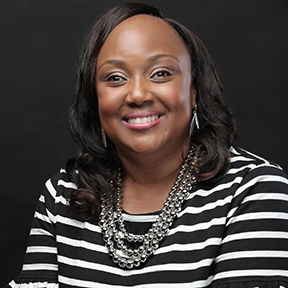 From the Editor: Dr. Fant has been a real source of helping us get to know people who deserve to be known. In this article she had intended that this recognition be published in June because she commemorates a father. June was big, and this article is one that can easily extend our celebration of fatherhood into July.
LaShawna Fant: Hello, Michael! Thanks for this opportunity to talk with you. Please share a little about yourself with our NFB family.
Michael Hardin: Hello, my name is Michael Hardin Sr. I am from Indianapolis, Indiana. I have lived here for the better part of my life, excluding two years when I lived in Raleigh, North Carolina. I have three beautiful children: Makiyah, seventeen; Michael Jr, fourteen; and Makenzie, ten. I worked in a previous career as a diesel technician before losing my vision in 2018. I am still very handy due to working in my field of study for about seven and a half years. I can change a flat tire, hang blinds, mount a TV on the wall, and much more. I am a senior in the BSW program at Indiana University Indianapolis, pursuing my bachelor's degree in social work. I immediately plan to join the master's program and obtain my master's degree in social work, and I am an active member of the NFB's Circle City Chapter.
LF: Please talk to us about what life was like for you before becoming blind.
MH: I worked as a diesel technician for the largest truck dealership in Indiana, Truck Country (formerly Stoops Freightliner), for about seven and a half years before losing my vision. In my leisure time, I spent a great deal of time spoiling my three children and participating in various chess tournaments around Indianapolis.
LF: Since becoming blind, you have joined the Circle City Chapter in Indianapolis. How has this been supportive for you?
MH: The Circle City Chapter has been the difference between life and death for me. I say this as I was at my lowest point in life when I joined, and after a failed suicide attempt, the Circle City Chapter helped pull me up by my bootstraps and provided me with the highest altitude of support. This showed me that life was not over due to me losing my vision. Successful, like-minded individuals surrounded me and changed my outlook on living with blindness.
LF: I am glad you have so much support within your local chapter. You also won a national scholarship within our organization. What was this prized opportunity like?
MH: Yes, I won a national scholarship in 2022 at the convention held in New Orleans. This was such an honor, since I was able to bask in my successes with my blind brothers and sisters and represent my chapter all at the same time. I had the opportunity to take my three children and my fiancé with me, and this was our first convention as a family. It was remarkably busy, and I enjoyed being what I would call a sponge, as I had the chance to soak up all the knowledge from the various vendors, chapters, and blind individuals in general. The only downfall was that my fiancé caught COVID during the convention while assisting attendees.
LF: Why did you choose social work for your field of study?
MH: I chose social work because I wanted to be the voice for others who could not speak up for themselves or did not have the opportunity to do so. I also wanted to provide others with motivation and be a resourceful advocate. I feel my resiliency makes me the ideal individual to work in social work since I have seen good and bad times and am alive to talk about them. I have hit the ground running, given I have had the opportunity to intern at major companies in Indianapolis, such as Eskenazi Hospital, Lutheran Child and Family Services, and Foster Success. I am a part of three honor societies at Indiana University Indianapolis and am paving the way for future blind students in Indiana.
LF: It is great to have a heart for serving people in this manner. How did being trained to use alternative skills help you adjust to blindness?
MH: I must say that my mobility instructor, Mrs. Brenda Jenks, has been the lifeline to my success at Indiana University Indianapolis. She has worked alongside me with my cane travel since day one at IUI, practicing my routes to and from classes and with general orientation and mobility. I have retained my knowledge of cane travel around campus and other buildings I frequent. I attended BOSMA Enterprises, completing a rigorous training schedule within the assistive technology department, and I continue to use the skills I learned daily.
LF: What has the journey of being a father been like for you?
MH: As previously stated, I was a diesel technician and have always spoiled my kids rotten. I have always been involved in and outside my children's schools, helping them with homework and special projects before and after blindness. To keep it all the way one hundred percent, my support system has not been what I need it to be as a blind father, which is one of the things that lit a fire under my behind to get up and make something happen for my family. If some of you do not know my work ethic, I can honestly say that my three children do. This has been the catalyst for the unconditional love that my children have for me and the bond that we share. My children have been my biggest support since I have been blind, and if they encounter another blind individual, they will know exactly how to engage with them.
LF: The unconditional love you and your children share is priceless. How have your children adjusted to you being blind, and how has this affected you as a father?
MH: From my perspective, my children have been affected more than I have from my blindness, because they had depended on the fruits of my labor one hundred percent, and that had been abruptly halted. I did go into a period of isolation when I initially lost my vision, and my children experienced the repercussions of this, because I did not engage the same way as I did before losing my vision. I no longer felt comfortable attending the after-school activities that I was normally the heart of. The proud parent who participated in the multitude of school programs had now barricaded himself inside his home for weeks and months at a time. My children frequently reminded me that everything was okay and often placed a band-aid on my self-esteem to motivate me not to give up, as they had noticed a change in my daily activity. It was not until after my failed suicide attempt that I attended blindness rehabilitation and began to salvage my life and family for what it now is. My children went through the rehab process with me, and this brought us back to the normal engagements we had as a family again. I was again attending games that my children participated in, and I had begun to come out of my shell.
My children were very resilient during this process. They learned the proper techniques to be a sighted guide and became my eyes while out in public. I trained them on things to advise me of, and they would often pull and guide the grocery cart while I held onto the handle and followed their lead throughout the grocery store. My youngest daughter would frequently say, "Dad, I can't wait until you get your vision back so we can do this or that," often referencing fun things we used to do prior to me losing my vision. This would hit me so hard that I would compare it to someone punching you in your stomach when you least expect it. She was five at the time and eventually grew out of saying these things; little did she know I would be standing there trying my best to hold back tears. I knew deep down she did not understand the pain that it caused me when she would mention how she could not wait until I got my vision back. My son and oldest daughter just hopped right in there with no questions asked and adjusted to life's changes as if they had been pre-trained to deal with what was my new normal. My oldest daughter is now driving. I remember her at age twelve persistently begging me to teach her how to drive. I recall telling her no, to wait, and once I lost my vision, I swallowed those words. Because there had been many times that we had to depend on others to take us here and there, I had five cars sitting outside but was unable to drive due to my blindness. I remember riding in the car with my daughter for the first time after she obtained her license, and I thought, wow, she is really a good driver. Another time I can recall was when we were in the car, and she jumped on the highway. The thought I had in my head was, "OMG!" I was almost afraid to talk and could not wait until she took the exit near our home. But in all reality, my oldest daughter has matured so much and will graduate from high school this summer, 2024.
LF: What things do you enjoy doing recreationally with your children?
MH: The most enjoyable thing I like to do with my children is hit the trail near my home for a walk or bike ride. We spend a lot of time on the trail, as we have two Cane Corsos, and they love to go on long walks. My children and I also like to have game nights where we play games like Left-Right-Center, Pass the Trash, UNO, and Monopoly. I also love having movie nights with my children and shopping at the Fashion Mall.
LF: That truly sounds like a lot of fun! Please share with us what sources of inspiration have been for you as you navigate fatherhood.
MH: My children are the most inspirational thing that keeps me going. I am determined to remain a positive role model in their lives despite being blind. The next thing that keeps me going is the inspiration I give others from my successes and my obligation to show the world that blindness is not the characteristic that defines me.
LF: Michael, do you have any encouraging words you would like to leave with any father reading this article?
MH: Yes, I would say to believe in yourself and not let fear or doubt limit your success. Because despite being blind or visually impaired, you are still the same person. So, get out there and show the world that you do not have a disability but a different ability. As in life, you must play the cards you are dealt until it is your turn to deal.