Taking Seniors Where They Are and Providing the Resources They Need
by Sandy Halverson
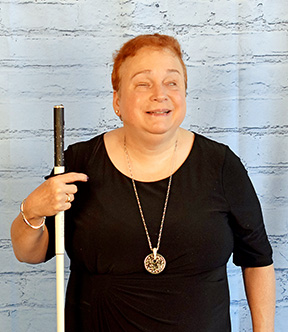 From the Editor: When Sandy Halverson decided to come to the Missouri convention that was being held in Kansas City, Sheila Wright, our state president, took advantage of the opportunity to get her on the agenda. We who heard her were inspired by her words and left with some concrete actions we can take to recruit seniors who can benefit so much from what we have to offer. In turn, we can benefit tremendously from what they have to offer. Here is what Sandy said:
My first interaction with seniors took place during the two years that I worked as a rehab teacher for Missouri Rehabilitation Services for the Blind. I didn’t know nearly as much then as I know now, and I can admit now that I didn’t know much about services needed by those with low vision. I naively thought they should just use the techniques I used, which is definitely not taking seniors where they are.
I don’t consider myself an expert today, but I’ve attended several national NFB Seniors Division virtual retreats, and most of the seniors I work with in Virginia have low vision.
How can we leverage our positive attitudes toward blindness, the extensive resources of our membership organization—with its specialized groups, divisions, and committees catering to various interests—and our friendships and support to engage this community once we identify them?
It is estimated that over one million persons in the US are blind, and each year over 50,000 will become blind. Studies show that only AIDS and cancer are feared more than blindness. The National Academies of Science found people who are fifty years of age or greater are more likely to experience symptoms linked to social isolation or loneliness. Twenty-five percent of the target population demonstrated these symptoms before the pandemic. The symptoms are exacerbated by older adults who experience sight loss later in life.
That being said, how can we in the NFB bring hope to this population, and how do we address loneliness and isolation? After all, most seniors do not text, but they’ll chat with you forever if you let them—but more about that later.
When our NFB Seniors Division was organized, I was sure there was nothing in it for me. After all, I was sure I wasn’t a senior yet (probably in denial), and there certainly wasn’t anything more I could learn about blindness. Wrong again! I don’t remember when I attended my first Seniors Division meeting, but I actually learned a few things. Jim Willows, a very competent, employed, totally blind man from California talked about hearing loss and the problems he experienced when his audiologist eliminated background sounds which were assumed to be a distraction until Jim pointed out that he needed some sound cues for orientation and to engage with his coworkers and the public. There was discussion about the public perception that the combination of blindness and advanced age increased the probability of falling. There were probably other things that I heard then that I don’t remember now, but those misperceptions about blindness could be applied to me, and I didn’t like it. I don’t wear hearing aids but might need to someday, and when I do, I want to get ideas and direction from my blind friends who are willing to share their experience; I have not fallen, but if I do, my blindness won’t cause that to happen.
I think we would all agree that as members of the NFB, we have observed many changes over the years, but a primary focus has remained building membership; and if seniors are living longer, we need them and they need us so they can also live the lives they want.
When I learned about a seniors program our Texas affiliate conducted, which was based on their modifications of our BELL® curriculum, I was intrigued and wanted that in Virginia. And while some may believe if you build it, they will come, you still have to find the “they!”
I can remember when I lived in Missouri, there were television ads inviting people to learn about the advantages of living at John Knox Village, which I never did because I really was younger then; I also had a rehab client who lived at Fountains at Greenbriar, I think it was called, in North Kansas City. I’d be willing to bet that both of those communities have low-vision groups that meet periodically, and a discussion of positive attitudes about blindness and vision loss is not likely to be among their agenda topics unless one of us helps that happen. If you find either an activities director or a chaplain at those retirement communities, you’ll get connected with and have an opportunity to share not only our positive message about blindness with those groups but demonstrate NFB-NEWSLINE®, Pilot Bravo pens for low vision, bold-lined paper for low vision, bump dots, and things that talk from clocks to glucose monitors. There are also visually impaired people groups who need to know about us and that low vision isn’t the end of the world. There is also more to life than waiting for the right research to come along that will solve your lack of vision. I hear stuff in those groups that just makes me cringe sometimes, but I remember when my expectations were low, and a lot of those folks have never been around a totally blind person.
I used to think if I shared with a prospective member all the great stuff the NFB does, that person would be hooked. I was often disappointed when that person rarely accepted an invitation to a chapter meeting or other program. I figured out that I had overwhelmed him or her, so I decided to change my approach. I became a better listener and tailored my approach to the interests of the person I wanted to recruit. Can’t read the newspaper or other recreational material? NFB-NEWSLINE and the National Library Service; let me help you get registered. Gardening? I know two master blind gardeners; let me get you connected. Movies and tv? Audio description and accessible programming at plays and in movie theaters. Photography? Capturing and Sharing Your World by Judy Dixon, a totally blind iPhone user. I have not read the book and don’t have to but I’m providing resources of interest to the person. I think you get the idea.
So how many members have we gained? I honestly don’t know. We have conducted eleven long-weekend retreats with groups ranging from sixteen to twenty blind and low-vision seniors, and I can think of three or four participants from each group who are now active in our at-large and other local chapters. At our 2023 state convention, we decided to hold what we called our Seniors Retreat Dinner, and you can’t get more family reunion than that! All participants were invited, many came, and many are now participating in our legislative activities among other things. And a couple will even be attending their first national convention in Orlando. They see the value of being with people like themselves, our philosophy makes sense, and they understand there is a lot to learn but that they must just get started somewhere!
Seniors who think there is no hope are excited by the problem-solving we offer and are amazed by our lived experiences as blind people. I don’t think of myself as amazing, but if you think I am, let me show you how you can live the life you want, and we’ll be amazing together! That’s the community they need to be a part of, and we need them in our family.
It’s gratifying to observe the fear transition to excitement about what’s possible and cheering them on after their first success, whether using a cane to go up and down stairs or slicing vegetables in the kitchen without cutting their fingers.
A seniors’ division isn’t necessarily the right answer unless there are several people who are passionate about finding seniors, meeting with them, and introducing them to some of the tools we use to live safely and independently.
Let me conclude this presentation with some participant quotes.
Peggy, age eighty-four: “When I walked in here, I was a wreck. Everybody had a stick, and I did not. It was intimidating. I was unarmed. After three days of jumping sticks, I’m not afraid of sticks any more. You taught us skills which we would have learned eventually the hard way. What you gave to us is there is not a person here who is a downer. You could not come as a downer and leave as a downer.” In Britain, it’s a stick (referring to the cane).
Nancy, age eighty-six: “The best thing was learning how to walk with a cane. It was an entirely new experience. It was pretty scary. Another best was home management. I learned a lot of tips. I cook for myself. That was helpful to not cut your finger. A good part is meeting other people who have similar experience to mine. I have low vision that started four years ago, and it is getting a little worse.”
Thomas, whose age I forgot to look up: “Up until this weekend, I was embarrassed to be blind. I didn’t want to have a white cane. I was always that blind guy. That whole feeling of embarrassment went away. There’s a lot of things that people do other than sitting in a chair and listening to books on tape, but you can do a lot more. I was not at that stage. People here are doing lots of things, and you can do that.”
Teresa, sighted spouse: “I got to witness a lot of things. I am getting a better understanding to relay to family members and friends who are trying to understand vision loss, resources, and connections.”
Klaus, eighty-five: “I looked on this weekend as a Mount Everest challenge, whether I could handle the business of going to and from locations in a place I didn’t know. It went very well. Thank you for the goodies which were unexpected. I was blown away by the Braille thing. Another benefit: My wife has dementia, and our son has been staying with her this weekend. I am gratified to hear that Alexa and JAWS will give me things to do so amen, brother!” Klaus called me later to tell me his wife had fallen, broken her hip, and would be in a rehab facility for a prolonged stay. The Braille he had learned a few days earlier made it possible for him to find his floor in the elevator and his apartment by the number on the door, when he had previously depended on his wife for those tasks.
Millie, age sixty-four sent this text: “This weekend was incredible, and I want to personally thank you for all your hard work, energy, focus, kindness, support, and dedication to our cause. I have a new attitude, which surprises even me” which was followed by three thank-yous and three grinning face emojis.
And with that, I thank you for asking me to present this afternoon. I hope some of what I said will be helpful, and I shall sit down now. [prolonged applause from a grateful audience]