Raising Expectations at Social Security: The Influence of the Organized Blind in Improving and Modernizing Essential Programs
by Roderick Hairston
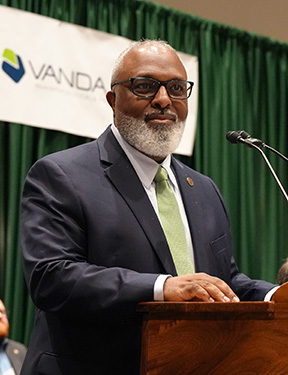 From the Editor: We are always engaged in a dialogue with the Social Security Administration to improve services for blind people. It is more than just benefits; it is access to its website, kiosks, and the way the agency communicates with us. Mr. Hairston’s presentation dramatically shows how our work is paying off with a greater emphasis by the Social Security Administration in being responsive to the needs of blind consumers. Here is what the deputy associate commissioner for the Office of Electronic Services said to our 2024 National Convention on the morning of Monday, July 8, 2024:
Thank you for having us here at the National Federation of the Blind convention. We really appreciate the invite and including us, and this includes thanks for our partnership.
Today, as I was introduced, I’m Roderick Hairston, and I had to come all the way to the NFB conference to meet my cousin, Ever Lee Hairston, which was a treat—A complete treat. She knows all of my relatives. Did you know that the Hairstons are the largest family in America? You probably know that if you know Ever Lee.
I am wearing a navy suit, a blue and white striped shirt, and a green tie. I’m vertically challenged, [chuckling] and a very proud member of the Hairston family.
It’s also good to see my peeps from Virginia and North Carolina. That’s where most of the Hairstons hail from. [Cheering] Good to see you.
The team and I are very excited to be here with you this week, and we hope you had a few moments to stop by our exhibit that was mentioned earlier with our check-in kiosk. With me here is my wonderful team of folks that have been here with you all week: Heather Gray, Jeremy Rouse, and Angela Love. Let’s give them a hand. [Applause]
I do believe it was a steady flow of folks who were coming through. I do believe we probably saw upwards of a thousand folks over the whole time. What was great about it was that it was a steady flow, and they got an opportunity to really work hands on, one on one, with a lot of you in terms of introducing the features at all of the kiosks. I’ll be telling you a little bit more about that. If you didn’t get to the exhibit, I’ll tell you a little bit more to tease you, and you’ll probably want to go to your [Social Security] office and find out more about it.
During the last few days, we have had the privilege to provide you with the opportunity to interact with a replica of the visitor check-in kiosk. As part of our commitment to making our benefits, services, and technology accessible to everyone, we have been very excited to share the kiosk with you this week.
As early as 2018, the Social Security Administration began the process of testing and working to modernize the kiosk by which visitors across the nation check in to Social Security offices. In doing so, we analyzed usability for users from various populations with varied types of disabilities. In tandem we continue to work on software improvements and enhancements to increase customer satisfaction and decrease cognitive overload while using our check-in equipment.
As mentioned in the introduction, my career started around twenty-nine years ago with the Social Security Administration. At that time, we assisted customers with paper tickets. Boy, am I dating myself.
At that time we had no way of knowing anything about the customer before we began our interaction. Customers didn’t have the ability to let us know if they had special needs, why they were visiting, or if we needed to provide any accommodation to ensure they had the highest quality of service available. As technology has evolved, we’ve continuously sought out partnerships with various communities to ensure the way we serve the public—make sure that it fits the needs and meets and exceeds the expectations of our customers.
We are continuing to enhance our public facing technology to provide an accessible experience, not only for customers who are blind or have visual impairments, but also for visitors with other accessibility concerns.
In 2023 we developed a truly accessible kiosk that would allow for an individual experience—an equal experience for all.
Our goal remains to offer a universally accessible kiosk system that ensures 100 percent equal access for all users, thereby promoting equity in service accessibility and user experience. Consistent with this commitment, we have installed new visitor check-in kiosks with enhanced accessibility features. Additionally, we’ve provided extensive training to our field office managers and staff on how to use the new kiosk, and we have taught them all about the new accessibility features. Our customers’ ability to check in at Social Security offices is now easier than it's ever been, regardless of a customer’s accessibility needs.
You may have had the opportunity to stop by the exhibit during the conference, but in case you didn’t, in case you missed it, I want to share a few other features. The kiosk cabinet itself is designed to meet accessibility needs of all field office visitors. The design includes specific features based on your input, government regulations, academic research, and user studies performed by the Social Security Administration. These studies and our continued testing of high-volume tasks related to Social Security services emphasize a user-centric approach to identify and address usability challenges, thereby fostering inclusive and accessible services.
The touchscreen, the buttons, and the Braille instructions are all set at an angle appropriate for all visitors. For durability the Braille instructions are printed on a steel plate. All components are mounted internally for security and provide a smoother surface for visitors to explore by touch. There are no sharp edges. To protect privacy, there is a headphone socket but no speakers. We supply complimentary headphones at the kiosk.
Plugging in headphones launches the audio interface and should be the only modification a user may need to enhance their check-in experience.
To serve customers who are blind or low-vision, JAWS has been installed on all kiosks. [Cheers and applause] It activates its audio feature when they plug in their headphones. During the check-in session, the audio interface tells customers what is on the screen and describes how to complete the tasks, for example, how to use the keypad to answer questions. The navigation keypad has a 3.5-millimeter headphones socket in the upper right-hand corner with an audio label in Braille above it. Although customers may have their own headphones, we also supply complimentary ones like I mentioned earlier. The navigation keypad can also be used without activating audio. This feature helps our customers in a wheelchair by providing an option much closer to them than the touchscreen. The keypad mirrors many modern TV remotes.
Along with the accessibility features of the kiosk, SSA has also dedicated an email address for you to report any accessibility concerns that you might have when interacting with the kiosk itself. That email is [email protected]. That can be found on a Braille sticker on the kiosk itself.
In addition to that, we offer customers the ability to check in to our offices via their personal mobile device—mobile check-in. This means regardless of a customer’s need, they can use their personalized settings on their own device to navigate the check-in process according to their own preferences. [Applause] This allows for a truly personalized accessible experience even without the need to interact with our kiosk.
Since October 2023, more than twenty-two million customers have visited our offices already and interacted with our check-in kiosk and mobile services. I think that’s amazing. [Applause] And I’ve got to make a plug for our online services, in addition to our in-office services. There we provide several types of things that you can do to apply for many different Social Security benefits: retirement, spouse's benefits, disability benefits. You can apply for Medicare only and extra help with Medicare prescription drug costs. You can access our publication and our program rules to learn more about our services, including provisions for working while receiving benefits.
It may be important to note that there are provisions specific to customers who are receiving disability benefits on blindness and return to work. This information can be found in our publication titled “If You Are Blind or Have Low Vision, How We Can Help.” That was available in our booth this week, and you can also find that publication on our website at SSA.gov/pubs/en-05-10052.pdf. If you did not have a chance to pick up one of those publications during the week, you can go there to find it. It’s offered in audio format as well as in languages other than English. Since everyone’s situation is different, whether you're on SSI or Disability Benefits, we suggest either reviewing our specific work-related publications or contacting your local field office and other resources to get personalized assistance.
Speaking of personalized information, if you haven’t already, we encourage you to set up your own My Social Security Account by visiting SSA.gov/myaccount. I hope many of you already have that. It’s a great way to access services securely. This is a free and secure My Social Security Account that provides personalized tools for everyone, whether you receive benefits or not. I think you can already tell I’m a tech geek. I’m talking about my tools here. You can use your account to access certain notices online, request a replacement Social Security card, check the status of an application, get an estimate of future benefits, or manage the benefits you already receive. You can do all of that. You can make changes or update your benefits record, like your address or your direct deposit.
We also offer options for specialized notice formats to persons who are blind or visually impaired. These are notices that you can receive in other communications and formats other than standard print, including but not limited to options such as Braille notices, data CDs that have notices in Word format, large print notices, and audio CDs. You know, technology continues to change rapidly, so a lot of folks aren’t using CDs anymore, but we are assessing those types of advances continuously, evaluating and looking to make changes and updates in that regard. This allows our agency to make sure that we are serving the needs of all of our customers, so look for updates in that arena.
More than seventy million people depend on Social Security benefits, and millions more reach out each year for other services like requesting a new Social Security card. We’re working hard to provide our customers with the service that they expect.
In February 2024, Commissioner Martin O’Malley launched something called “Security Stat.” If you haven’t heard about that, it’s a performance measurement tool. He used it when he was mayor of Baltimore. He used it when he was governor of the state of Maryland, and he’s brought that right into his work as the Commissioner for the Social Security Administration. That tool is helping Social Security set goals. It’s helping us choose actions that are priorities and helping us track the progress in meeting these challenges. For information about these goals—you can find them, and you can also see our progress in each one of these areas on our website—again, SSA.gov.
In discussions with NFB leadership, we understand that some of the areas of interest of NFB members are disability processes, return to work provisions, as well as overpayment remediations. We would also like you to know that these are some of the agency’s areas of focus with Security Stat. Commissioner O’Malley has implemented Security Stat to place emphasis and focus on these specific areas as well.
As part of Security Stat and to be transparent with the public, our progress is regularly updated on our website. Again, I’m talking about ssa.gov/securitystat . You will be able to find that information for yourselves. Here you will find great information about the steps that the agency is taking to be more effective for the customers that we serve. You will learn about these things on which we already have begun to make progress: our work to reduce a number of pending hearings to the lowest level in over thirty years. [Applause]
Part of this success comes from our changes to policies involving disability determinations. We’ve updated the way we review a person’s relevant work history when making decisions on applications for disability benefits. There are a number of considerations in disability applications processes. In addition to reviewing medical records, we review the ability to continue to engage in work that will provide a substantial gainful income, or what some may know as SGA. Previously, we considered the past fifteen years of work when determining whether a person has the work experience to continue to earn SGA since the date their medical condition first affected their work activity. Moving forward we will now consider only the past five years of work experience in the disability determination process. [Applause] That’s a big one.
Also on Security Stat, you will learn about how we’ve changed our calculations for determining SSI eligibility and subsequently the SSI payment amount. Since SSI is a needs-based program, we have guidance on how to consider informal assistance that a person receives on a monthly basis. This informal assistance is sometimes counted as a form of income, thereby reducing the monthly SSI payment. However, we are updating these guidelines. For example, beginning September 30, we will no longer count assistance with food expenses as a type of informal income. [Applause] Yes! This change will bring more consistency in an individual’s monthly SSI payments and reduce some documentation requirements at the same time.
Additionally, Security Stat has information on how SSA is working to address improper payments, adjusting the way that we collect repayments, as well as implementing steps to reduce the backlog of pending underpayments to our claimants. Along with this information, you can also find information on how our agency is simplifying our processes with technology enhancements where we can. We are working to reduce the paper burden on both our customers and our employees.
These efforts will help streamline and modernize our workloads, ultimately resulting in better service to the public. We continue to strive for the utmost level of service to our customers, and we continue to lean into new technology and processes. We believe there is a bright future ahead, and we look forward to continuing our partnership with you to get to that future. [Applause]
In closing, again, I want to appreciate the National Federation of the Blind for inviting Social Security this week, allowing us to share with you the work that we’ve been doing to try to improve on the services we are providing, and we look forward to continuing the work with you and your membership for future endeavors. Again, we hope that you have the opportunity to interact with our accessible kiosk and hope you have a wonderful time during the remainder of this last day of your conference. Thank you so much for the opportunity. [Applause]