Telling Our Stories: A Conversation about Blindness, Justice, and Shattering Misconceptions from the Federal Bench
by Judge David Tatel and Deepa Goraya
From the Associate Editor: On the afternoon of July 8, 2024, the final presentation of the 2024 National Convention prior to the banquet was a conversation between Deepa Goraya, a leader in the National Association of Blind Lawyers, and Judge David Tatel, who retired from the United States Court of Appeals for the District of Columbia Circuit in 2023 and recently published a memoir entitled Vision. The court on which Judge Tatel served is one of the most influential in our nation, other than the Supreme Court of the United States, because it has original jurisdiction over many cases in which the regulations and other activities of federal agencies are litigated. The conversation was both a fascinating glimpse of Judge Tatel’s personal and professional lives and a bracing reminder of how the advocacy of the National Federation of the Blind has changed history and why it will continue to be crucial if the blind and others with disabilities are to remain equal under the law. Judge Tatel not only reminded us of our progress but called us to work harder and more strategically at all levels of our government.
In introducing the presentation, President Riccobono pointed out that before Judge Tatel’s appointment to the federal bench, one of his jobs was heading the Office of Civil Rights in the Department of Health, Education, and Welfare (HEW), now the Department of Health and Human Services, during the Carter Administration. At that time, although the Rehabilitation Act (including its critical Section 504 banning disability discrimination in federal programs) had been passed in 1973, both the Nixon and Carter administrations had refused to issue regulations interpreting and enforcing it. The National Federation of the Blind was one of several disability advocacy organizations who sued HEW to force the release of the regulations. This is important context for understanding the part of the conversation in which President Riccobono participates toward its end. Here is the presentation:
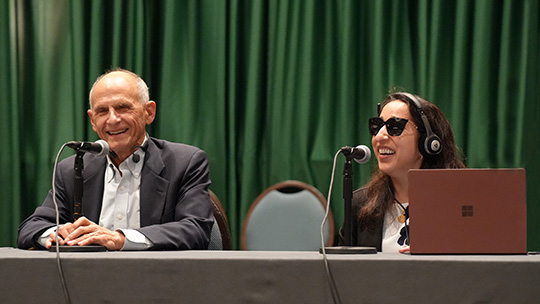
DEEPA GORAYA: Thank you, President Riccobono. Good afternoon, Federation family. [Cheers] I’m Deepa Goraya and I’m here with Judge Tatel. Good afternoon, Judge Tatel. I wanted to start out by asking you about your book. I’m in the middle of reading your book. It’s called Vision, and it’s on Audible and also on Amazon, and there is a QR code that gives 20 percent off to NFB members. So, I highly recommend it. And Judge Tatel, I wanted to ask starting out, is this your first NFB convention by the way?
JUDGE DAVID TATEL: Yes. [Cheers]
DEEPA: Awesome!
JUDGE TATEL: And I'm very pleased, I’m very—Edie and I are just totally delighted to be here.
DEEPA: Great to have you here. I wanted to start out by asking: you started to lose your sight as you became an adult, and in your book you talk about how you’re not known as the blind judge, but you regret not making that known. Can you talk about that inner struggle?
JUDGE TATEL: Deepa, you went right to the heart of the book awfully fast. [Laughter]
DEEPA: We only have twenty minutes. [More laughter]
JUDGE TATEL: I’m going to answer your question, but I want to thank President Riccobono for this wonderful opportunity to talk about my book. He already introduced my wife Edie, but I want to introduce her again. Much of this book is about Edie and me together and our lives together. And I also want to introduce my guide dog Vixen, who is right here next to me. [Cheers] So as I said, Deepa went right to the heart of the book. I was diagnosed with RP when I was fifteen years old in 1957. Like other people with RP, I had trouble seeing at night up until then, and no one knew what it was. This was a very long time ago. I was finally diagnosed at the National Institutes of Health. I was fifteen years old, and I tell the story in the book that I didn’t want to talk about it. I look back on that... that was sixty years ago. I can almost look back at fifteen-year-old David Tatel as if he's someone else. And I ask myself, why did he do what he did? Well, he was fifteen, he wanted to be like his friends. Kids want to be like their friends. I developed all kinds of techniques for covering up my growing visual disability, techniques that expanded as my sight declined more. When I went to college and law school, I was functioning as a sighted person, although problems at night were growing, my peripheral vision was declining, and I was struggling to find other ways to deal with it without having to discuss it. Finally, when I was thirty-five and director of the Lawyers Committee for Civil Rights under Law, the same job by the way that Kristen Clarke had years later, I finally couldn’t really function anymore sighted and I learned to use Braille and started using readers. So that's the background. In 1994, when President Clinton nominated me to the DC Circuit, I was using a cane, but I was still—it wasn’t much of a subject of conversation for me. And I wanted to be on the DC Circuit. It was the thrill of a life, but I wanted to be known as a judge who happened to be blind, not as a blind judge. And I would say that I’ve been in the court for thirty years until I retired, I had written over seven hundred opinions. And I like to think, I hope people think that I succeeded in those years in proving that I was a judge who just happened to be blind.
[Applause] And if I could say one more thing, Deepa, because it brings me to the point I want to make, which is that people ask, “Well, why did you write this book?” It’s not a book I really wanted to write. I was convinced by people who I care about that my story could be inspirational, not just to blind people, but to sighted people who hire blind people. And I hope that the story the book tells will demonstrate to the world, to both blind and to be honest mostly sighted people, that blind people can function at the very highest levels, and that the David Tatel who served on the DC Circuit for thirty years was a judge who just happened to be blind. So that’s my story.
DEEPA: Thanks for that. Going along with that, do you think your career would have been any different had you disclosed your blindness sooner, and have you experienced any discrimination in the workplace because of your blindness?
JUDGE TATEL: [Laughs] Sorry to laugh, but Deepa probably read this book more carefully than anybody so far. [Laughter] Deepa, I actually don’t know the answer to that question. And I think—I would really be interested to know what people think who read the book. When I was struggling with increasing deterioration of my sight, it was a very different world than it is today. Not as different as it should be, but still very different from it is today. I worried—this was in the 1970s, a long time ago, when I was beginning to practice law, going through law school and beginning to practice law—I worried that my employment opportunities would be limited if people knew I had a visual disability. It was that clear to me at that time. And I actually don’t think, as I look back on the experience, that thirty-year-old David Tatel was unjustified in thinking that. [Light applause] So Deepa, I don't know. I do know this: as hard as I worked to downplay my declining vision, people who knew me and who worked with me, they knew. As I wrote this book, I interviewed some old friends, quite a few of them, and I asked them, you know the old famous question, what did they know and when did they know it? [Some laughter] And they were aware of my declining sight long before I was prepared to talk about it. So, I guess the bottom line is I still don't know the answer to the question. I do know this: I talk in the book about how important role models were to me. Lawyers who were the kind of civil rights lawyer I wanted to be when I grew up. They were very important to me, because they gave me a symbol of what I wanted, but they were also helpful in my career. What I did not have when I was thirty years old was any role models who were blind. None. There were no blind appeals court judges that I knew of. There were no partners in law firms who were blind that I knew of.
So, I didn’t have that kind of a role model. And one of the reasons, I think, why I wrote this book is that I hope that people who are at the same stage of vision loss today that I was fifty years ago will see my story and my career as a role model for them. [Applause]
DEEPA: Thanks for that. A lot of us do experience this inner struggle where we try to figure out how much to disclose blindness and when, or in the workplace and not in the workplace, and especially those of us who have low vision or are not in that stage where we’re ready to make our blindness visible, the book really highlights that struggle, and I recommend people read that to understand that and know you're not alone in your struggle. In the book you talk about being a parent of four children and how your children kind of took your blindness in stride and did stuff, but that came naturally to them, like describing things, going on hikes with you. Was wondering if you could talk about your experiences as a blind parent and how that was, if you encountered any struggles with that.
JUDGE TATEL: By the time our first child Rebecca was four or five years old and aware of things around her, I at that point—I wasn’t using a cane, but I was learning to use recorded books and I was beginning to function more visibly as someone with a visual disability. I mention that only because all four of our children, their only experience was with a dad who had limited vision. We have four fabulous kids. They’re all parents. One is even a grandparent now. They’re four fabulous human beings and great parents. And we asked them at the beginning of the process, we sent them a questionnaire that Edie and I wrote, a dozen questions, and they all responded with written memos, which are just total treasures to us. And we learned a lot from them.
And I quote in the book in different places their observations about growing up with a blind dad. And there’s lots of them throughout. I’ll just mention two of them. One of them said... she went out with some friends, parents drove somewhere, and she came back, and she said to her siblings, “I didn’t know that dads drove cars.” Because in our house, Edie drove the car. And Emily, our youngest, tells a story that still moves both of us so much. She said one of her friends asked her, “What’s it like to have a blind dad?”
And she said, “It’s just like having any other dad. He loves us just the same way any other dad does.” She said, “I felt loved, and it didn’t make any difference to me.”
From my side of it, being a parent, I was more dependent—well, two things I want to say. One is at the same time we were having children—and it was the time when parents read to their children—I was learning to use talking books at the Library of Congress, and I learned to listen to books with the children. And that was magic. All four of the children grew up reading bedtime stories with me with talking books. I loved it and they loved it. And I don’t think I lost anything as a dad with limited sight because of the wonderful books. And I did it with my grandchildren too; it’s gone one after the other. And the other thing I will say is, you know, I was more dependent on my children than sighted dads are, both for just moving around. It was natural in our family for the children to take an arm when I needed it. And I never even had to ask, by the way, which has gone on to the next generation. Even the littlest grandchildren still do that in the Tatel family. And the book is full of stories about that. Probably the most dramatic example of a dad depending on his children is my years of skiing in Colorado with the BOLD program, and probably a lot of you know about BOLD in Colorado. But the end, the last four or five years of skiing, two of my children became my guides, and talk about a dramatic example of parents relying on their children, me skiing down the big berm led by my teenage daughter and son was about as dramatic an example you can find of anything. [Applause]
DEEPA: I’m learning how to ski myself.
JUDGE TATEL: We’ll talk about that afterwards. [Laughter]
DEEPA: I want to get to an important question before we run out of time. A big one. What problems do you see stemming from the Chevron decision that came out a few days ago from the Supreme Court for disability rights, and how can the blindness movement come together to combat these problems? [Laughter]
JUDGE TATEL: Do we need to say what Chevron is?
DEEPA: Sure, why don’t you?
JUDGE TATEL: Do you want to do it?
DEEPA: No, you go ahead.
JUDGE TATEL: Deepa asked an important question for our country as a whole, but also for the disability community. Chevron is the doctrine, named for a Supreme Court opinion, it’s not a gas station. [Laughter] It’s a major Supreme Court opinion, Chevron versus the Natural Resources Defense Council, from I think sometime in the 1980s, a unanimous decision of the Supreme Court, which said that when a court like mine reviews a regulation issued by an agency—let’s make this specific to the issue that everyone is concerned about. Let’s take, for example, the regulations issued by federal agencies under Section 504 and the ADA, all right? I mean, those are the regulations we all care about in this room. What Chevron says is that when the agency issues those regulations, or when it announces interpretations of them, and they’re challenged in court, which they always are, right? The Court has to ask two questions. The first is does the statute—that is 504, the ADA, whatever the statute is—does the statute clearly make the regulation invalid? In other words, has the agency exceeded its authority under the statute? And if so, the Court has no choice but to vacate it. But those are very rare cases. The second part of Chevron is, if the statute is unclear, if it’s ambiguous because it uses general language, then the courts have to defer to the agency's reasonable interpretation of the statute, okay? So, let’s take, for example, the disability laws, right? They're very general statutes. They speak in very general terms. Thou shalt not discriminate on the basis of a disability. [Applause] That’s what it says.
And the agencies, in my case HEW or Justice Department, interpret that general language by issuing specific regulations saying exactly what that means in practice. What exactly do the schools and universities have to do to accommodate blind students? What do they have to do in terms of Braille? What do they have to do in terms of readers? What exactly is their obligation? They flesh out the statutory language. When those get challenged in court, since obviously statute language says you can’t discriminate based on disability, does it clearly prohibit the agency from saying schools have to provide readers for the blind? The question is, is that a reasonable interpretation of the statute? And one of the reasons why I think the agencies that enforce these laws have been so successful—not as successful as they should be yet, but still successful—is because the courts have deferred to the agencies under those. That’s what happened for the past forty years. These agencies, these regulations that flesh out the general language of disability laws have survived legal challenge because the courts have deferred to them. The Supreme Court last week overruled Chevron. That’s no longer the law. So now the question will be, judges like me who have these cases will have nothing to go on but the general language of the statute. We'll have the agency’s interpretation, but we’ll have no obligation to “defer” to it. We can read it as we would a brief, but it has no binding effect on us. My worry is there will be a huge amount of litigation in the next few years challenging agency regulations, not just from the disability field but throughout, and the courts will strike down lots of these, because the language is so general. The courts will say—I’m talking about conservative courts—their view will be that unless Congress specifically authorizes something, the agencies can’t do it. And this is very dangerous right now, because it’s bad enough without Chevron, but our federal courts are becoming increasingly hostile to federal agencies and the regulations they issue, and I think it’s going to be a huge battle for civil rights advocates, whether under Title VI [of the Civil Rights Act of 1964] or the disability laws to defend the progress made with all of these regulations. I think this is a serious turning point. It’s going to be a major challenge for the lawyers working in the disability community to what has been accomplished and keeping agencies aggressively enforcing disability laws in the future. It’s a serious problem.
DEEPA: Do you have any ideas on what we can do as the organized blind movement or other disability groups, you know, combating these?
JUDGE TATEL: This isn’t the first time in my career we’ve faced a challenge from hostile courts. We faced it before. This is actually the worst, I think. It’s going to require superb lawyering. I’m looking at this from the point of view of a lawyer. There are so many things that groups like NFB can do in terms of organizing and bringing attention to the problem and raising money. But the fact is the battle is going to be fought out in the courts, and it’s going to require superb lawyering. So, the simple answer is, Deepa, people should go to law school. People should learn to litigate.
DEEPA: More lawyers, yep. [Applause]
JUDGE TATEL: And NFB and other groups should develop the toughest, most aggressive legal groups you can. Because they’re going to be badly needed. Can I say one more thing? One more thing I will add here. And this may sound naive, but our government has three branches of government, not just one. It’s not just the courts. It’s Congress and the president. And although it seems like an uphill battle, both of those branches can be a check on the courts. And so one thing we should be focusing on is Congress. We should be getting Congress to write legislation that is specific enough to support what the agency is doing, so it’s very clear that when the agencies issue strong disability regulations, it’s supported by the law. Same thing when it comes to presidential elections. You should be voting for presidents that understand what their obligations are to faithfully enforce the law. Then there is the entire fifty-state government system and state and local governments, which aren't affected by these regressive Supreme Court cases. A huge amount could be done at the state and local level. So that takes organizing state by state. It takes raising money. It takes electing good members of state legislatures. It takes supporting legislative activities of those bodies. It takes working with the governors’ offices, mayors’ offices, city councils. A huge amount can be done to protect civil rights at the state and local level in this country. [Applause]
DEEPA: More advocates, legal and otherwise.
PRESIDENT RICCOBONO: That’s right.
DEEPA: I don’t know how much time we have left, but I have a couple more questions.
PRESIDENT RICCOBONO: No time left, [Laughter] but there are many questions we could ask, so I hope this won’t be the last opportunity. But I do think, Judge Tatel, we should ask you to give a minute or a minute and a half to what role the National Federation of the Blind has played in your success, because I know you have had many intersections with the Federation over the years, and particularly one service can be but there might be others.
JUDGE TATEL: I think the point you made right at the beginning—when I became OCR director, it was the beginning of the Carter administration, which if you remember your history followed the Nixon-Ford administration, and the Nixon-Ford administration had done everything it could to close down the civil rights programs and even refused to issue the Section 504 regulations, and the civil rights groups, including the National Federation of the Blind sued HEW/OCR. So, when I became the director, I became the defendant in the lawsuit brought by the NFB to force HEW/OCR to issue the regulations and enforce the law. The reason that is so important is that it’s a great example of how advocates on the outside could work with advocates on the inside to do things that neither could do alone. I could not have gotten the 504 regulations issued or the policy interpretations we issued under them, I couldn’t have got that done without the pressure of NFB and the other civil rights groups. Because when I would make the case in the Carter administration for issuing these regulations and get pushback, my answer would say, “Well, you can push back all you want, but there is a federal judge supervising what we’re doing, and he’s going to rule against us if we don’t issue the regulations.” So it was a great example, as I said, of how powerful advocacy groups like NFB can shape how government agencies work, particularly if your allies take jobs in the administration. It’s a great combination.
PRESIDENT RICCOBONO: Thank you for being an ally, Judge Tatel. [Applause] We do need to say, though, that you are one of the most avid users of NFB-NEWSLINE®. I know that is a daily tool that you have used, and it’s talked about in the book, and Judge Tatel probably many questions we would love to ask. We’re pleased that you and Edie will be at the banquet tonight. But I want to point out an important moment here, speaking of NEWSLINE, in his book, Judge Tatel recognizes a number of people. One of them is one of our staff who works on NFB-NEWSLINE. This will be his final convention as a staff member, as he is retiring later this week. So we should give a round of applause to Bob Watson. [Applause] So Judge Tatel, there are many other topics that would be great to talk with you about. We’re going to give you the last word, okay? We will give you the last word. Let me say one more thing. Which is before you leave the stage, I just want to say, you know, the National Federation of the Blind has taken on many things, and you talk about some of those intersections in your book. One of the things that we did you discuss in your book is accessible currency, and we undertook in 2009, a little bit before that, to get the first ever US coin to have real readable Braille on it, the bicentennial silver dollar. So before you leave the stage we are going to give you a Louis Braille bicentennial silver dollar. [Cheers and applause] You get the last word, Judge Tatel.
JUDGE TATEL: In addition to thanking you for this wonderful opportunity, I want to say, and Edie will vouch for this, I probably spend three hours a day, seven days a week, with NEWSLINE. From the very beginning. And I don’t know how many times over the past many years I have sent emails to Bob Watson and Scott White. For all I know, all those emails to Bob, maybe one of the reasons he’s retiring is just to get away from them. [Laughter] But NEWSLINE is the best example I can think of, just a phenomenal program that allows blind people to function totally independently. I love it.
PRESIDENT RICCOBONO: Thank you for being here. I encourage you to read the book, and we look forward to having you at the banquet and look forward to the continued relationship to get your wisdom as we do our advocacy with the courts, and as we get out to vote to make sure we are represented in all the halls of power.