Will the US Supreme Court's Loper Bright Decision Burn Blind Students?
by Carlton Anne Cook Walker
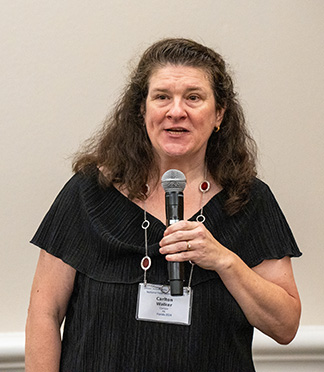 From the Associate Editor: This article is reprinted from the Summer 2024 issue of Future Reflections, the magazine of the National Organization of Parents of Blind Children. Here is what its editor, Deborah Kent Stein, said to introduce the article:
From the Editor: As many readers of Future Reflections are aware, Carlton Walker is a fierce and tireless advocate for the rights of blind children. As an attorney, a teacher of blind students, and the parent of a blind child, she brings many layers of experience and expertise to the challenges blind children face today. In this article she explains a recent ruling by the US Supreme Court and ponders how blind students may be affected.
School is out, but the summer of 2024 has kept me and other education advocates very busy! While we monitor the provision of Extended School Year (ESY) services to our students, we also support our families with ideas for summertime learning and fun.
Summertime also brings the annual convention of the National Federation of the Blind (NFB), as well as the annual conference of the National Organization of Parents of Blind Children (NOPBC) and the annual meeting of Professionals in Blindness Education (PIBE). (Both NOPBC and PIBE are divisions of the NFB.) This summer also marked the inaugural class of NFB’s IEP Advocacy Academy, and several participants presented IEP (Individualized Education Plans) workshops at the NFB Convention.
As I eagerly prepared for the NFB Convention, the US Supreme Court issued a decision that seemed to change the very foundation of federal law. As you may know, federal law provides the basis for IEPs—the documents that guide the educational access, instruction, and tools for students with disabilities, including blindness and low vision. In addition, federal law serves as the bedrock of civil rights laws that secure the right to both reasonable accommodations and freedom from disability-related discrimination.
In recent years the US Supreme Court issued three opinions that have expanded the rights of students with disabilities (Endrew F. v. Douglas County School District (2017), Fry v. Napoleon Community Schools (2017), and Perez v. Sturgis Public Schools (2023). None of these decisions had a dissent. Each justice agreed with the judgments of the Court—judgments that solidified the rights of disabled students. Endrew F. clarified that IEPs must be “appropriately ambitious in light of [the student’s] circumstances.” Fry opened the door to allowing students with disabilities to enforce their civil rights to reasonable accommodations—even when the IEP team refuses an accommodation. The unanimous Perez decision further empowered disabled students with IEPs by removing a longstanding hurdle to enforcing their civil rights outside the IEP process.
As an advocate for blind/low-vision students and their families, I eagerly embraced each of these rulings. Taken together, these three decisions strengthen my clients’ positions as we advocate for a free and appropriate public education (FAPE), including instruction in blindness skills such as Braille, Nemeth Code, tactile graphics, assistive technology, and orientation and mobility. The fact that the US Supreme Court reached each of these judgments unanimously served to reinforce the principles of these cases.
Meanwhile, the NFB has continued its tireless advocacy for blind individuals, including public school students. These efforts have resulted in notable federal protections for our students, including federal regulations and positive administrative regulatory guidance from the US Department of Education and the US Department of Justice (through Dear Colleague Letters, factsheets, and other publications). These documents help clarify the rights of blind/low-vision students to IEPs, Braille, assistive technology, and more in public schools, including public charter schools. These guidance documents have also clarified the right of students of all ages attending public or private schools or colleges to accessible curricular materials, effective communication, etc.
On June 24, 2024, the US Department of Justice’s final rule regarding “Nondiscrimination on the Basis of Disability; Accessibility of Web Information and Services of State and Local Government Entities” became effective. Wow! And, in just a few days, the NFB Convention would bring together thousands of blind people and allies. NFB IEP Advocacy Academy participants would be presenting their first IEP workshops. Despite the suffocating heat of June, buds of equity abounded in the garden of blind students’ rights.
Yet, on June 28, 2024, before those buds had a chance to bloom, our US Supreme Court issued an opinion that threatens to scorch those buds and leave the garden wilted and weak. This case, Loper Bright Enterprises v. Raimondo, upended four decades of jurisprudence in the area of administrative law. In non-lawyer speak: Loper Bright diminished the power of many of the educational and civil-rights protections that blind/low-vision students enjoyed prior to June 28.
In Loper Bright, the Court expressly overruled its own June 25, 1984, unanimous decision, Chevron v. Natural Resources Defense Council, which recognized the expertise of regulatory agencies (such as the US Department of Education and the US Department of Justice) and directed the courts to give deference to reasonable agency interpretations of Congressional statutes in cases where those statutes were ambiguous. This interpretation became known as the Chevron Rule, and it served as the basis of administrative law for more than forty years.
While we still do not know the full impact of the Loper Bright decision, we do know some things. Loper Bright does not have an impact on case law (court decisions) or federal law passed by Congress. Instead, Loper Bright removes the Chevron Rule, so courts will no longer defer automatically to federal agency regulations or guidance. Nevertheless, Loper Bright instructs that courts may use regulations and agency guidance to help determine the appropriate interpretation of ambiguous Congressional legislation.
For blind students, Loper Bright will likely impact civil rights (reasonable accommodations and freedom from disability-related discrimination) more than educational rights (IEPs). Congressional law, the Individuals with Disabilities Education Act, plainly sets forth many IEP rights, including broad definitions of assistive technology devices and services, least restricted environment, members of an IEP team, and the explicit inclusion of orientation and mobility services as related services. Moreover, the IDEA statute (Individuals with Disabilities Education Act) includes the Braille Provision, which ensures the rights of blind/low-vision students to Braille use and instruction unless such is deemed “inappropriate” for the student. Loper Bright does not impact these important educational rights. In addition, as noted above, other recent Supreme Court decisions have bolstered students’ educational rights.
Loper Bright will likely have far more impact in the area of civil rights. At its core, Loper Bright argues that the Chevron Rule stripped courts of their duty to interpret Congressional statutes and major civil rights statutes such as the Americans with Disabilities Act (ADA) and Section 504 of the Rehabilitation Act of 1973. These statutes tend to be less detailed and more controversial than is the IDEA. In particular, businesses and governments may well seek to use Loper Bright to challenge the long-awaited Web Accessibility rules referenced above. Other regulations and guidance relating to reasonable accommodations may face challenges as well.
Back to our initial question: “Will the US Supreme Court’s Loper Bright Decision Burn Blind Students?” I have to offer the typical lawyer answer, “It depends.” I do not expect Loper Bright to shake the foundations of educational rights for blind students. However, I fear that it will “burn” individuals who rely on civil rights protections contained in the ADA and the Section 504 regulations for guidance, including blind individuals of all ages. Let us be ever hopeful and ever vigilant!