Expect Much, Give Much, Get Much!
by Ronza Othman
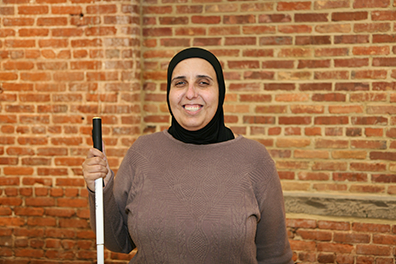 From the Editor: Ronza Othman serves as president of the National Federation of the Blind of Maryland (NFBMD). Below is the introductory remarks she made in the Presidential Report she gave at the NFBMD convention on February 17, 2024. When placed alongside the remarks by President Riccobono and the comments I’ve written about being a self-advocate and a person committed to educating the public, this should either be very instructive or give some of us the desire to sit down and write an article that supports very different views. Here is what Ronza said to our Maryland convention:
As a kid, I wanted to be a cartoon character when I grew up. I loved the way cartoon characters experienced a challenge, and through their own pluckiness and creativity overcame that challenge. They made it all look easy, often with a clever or wisecracking sidekick along for the ride. My favorite cartoons were those that had an anvil fall on their head and then they jumped up and went on to the next adventure.
As an adult, I can reflect on the fact that I was attracted to the concept of wanting to be a cartoon character because of the unapologetic way cartoon characters occupy their space and their resilience in times of adversity. Road Runner never apologized for existing. Buster and Babs Bunny never worried about what society thought of them. I wanted that for myself, and I slipped into a world of cartoons and imagination because, as a blind child, I didn’t know how to make that my reality. I still want to be a cartoon character when I grow up, but maybe without the anvils.
The blind share a desire to want to feel a sense of belonging in society. This desire to belong is natural—everyone wants to belong. But for us, our desire to belong is rooted in the sense of exclusion many of us feel as a result of society’s low expectations about us due to our blindness.
Society’s low expectations shouldn’t be our problem, but we in the National Federation of the Blind of Maryland will continue to fight them as long as it takes to annihilate them.
One afternoon, I stood at a street corner with a four-way intersection waiting to meet a friend so we could travel together. Time has dulled my recollection of where we were going or what we were going to do when we got there. But more than a decade later, I can still feel the sun on my face and the breeze wrestling my clothes. I can still smell the exhaust fumes from cars and buses going by and the scent of weed that together make up that unique but recognizable city smell with which we are all familiar. I can still hear the air brakes on a city bus and the horn of a vehicle too impatient to wait the five seconds it’ll take people to get off the bus. I can still taste the Pepsi that I undoubtedly held in my hand.
That afternoon, as I waited at that street corner, leaning on a lamp post, a random stranger walked up to me, and she said with pity in her voice, “Don’t worry, hon, I’ll help you cross the street.”
I thanked her politely and said I didn’t want to cross the street. She persisted.
“It’s OK, hon, I’m willing to help you. I have a few minutes to spare.”
I persisted some more, but she continued to offer help crossing the street.
In my mind, I had an internal debate that went something like this:
“Self?”
“Yes?”
“Why does she think I want to cross the street?”
“I don’t know.”
“Is it the way I’m standing?”
“Maybe.”
“Is it the way I’m leaning against this pole?”
“Maybe.”
“Is it that people don’t just stand around in public?”
“I don’t know about that—I’ve seen a lot of people standing around in public.”
“Is it that blind people can’t just stand around in public?”
“Yes, that’s probably what she thinks. She thinks I’m lost.”
“But I’m not asking for help, so why does she think I’m lost?”
“Probably because she can’t imagine a blind person could be alone in public and not be lost.”
“Why are her assumptions my problem?”
“Because I’m the one in her space right now.”
“But it’s my space. I was here first.”
“But blind people don’t get to own space if it rubs up against what well-meaning sighted people think is supposed to be happening.”
Meanwhile, the random stranger and I continued to politely debate whether or not I needed help crossing the street.
“Self?”
“Yes?”
“Why are we still having this conversation with her?”
“Because I don’t want her to think I’m rude.”
“So what if a random stranger thinks I’m rude?”
“Well, then she’ll think all blind people are rude.”
So, eventually I gave in and let her escort me across the street, mostly to keep the peace. We started at the southwest corner and crossed directly in front of us, so we were at the southeast corner of the intersection.
She asked me where I was going next.
Here’s the discussion that went on in my head.
“Self?”
“Yes, still here.”
“Why does she want to know where I’m going? She’s a stranger.”
“Because she thinks I can’t get there on my own.”
“Is it safe for me to tell her?”
“No, probably not, because she’s a random lady chatting up a stranger on a street corner.”
“But why does she get to ask a random stranger where I’m going and actually expect me to tell her? Isn’t that a bold thing to do to someone you don’t know?”
“Yes, if the same rules applied to me that apply to everyone else.”
“They should.”
“But in her mind, her low expectations about blind people mean she gets to violate social norms.”
“Again, why is that my problem?”
“Because I’m occupying the same space as her.”
“What if I tell her I’m going to my job as a circus juggler?”
“She won’t believe me.”
“Well, what if I told her I was going to visit my Baltimore Ravens player millionaire fiancé?”
“She won’t believe me.”
“What if I told her I was going to a meeting of the Board of Directors for the Fortune 500 company I lead?”
“She won’t believe me.”
“What if I told her I was going to court to try a case as the lead attorney?”
“She won’t believe me.”
“But that one could be true. All of them could be, but that one is sometimes true.”
“Her low expectations for blind people mean she thinks I am going either somewhere where I can be taken care of or nowhere at all.”
Then I got a brilliant idea.
I answered the stranger that I was crossing the street kitty corner from where I’d come from. As I expected, my new friend decided she had to help me cross the street.
So, we crossed and now I stood at the northeast corner of the intersection, diagonally from where we started.
Predictably, she asked me where I was going next, and this time I was ready for her.
I told my new best friend that I was crossing the street and pointed at the opposite corner. She was thoroughly confused. I could practically hear the conversation she was having with herself in her head.
“Random stranger?”
“Yes?”
“This poor pitiful blind girl doesn’t realize she could have crossed just one time instead of three times to get there.”
“I know. She must not be very bright.”
Once we got to the northwest corner, my new best friend asked where I was heading. I told her I was going to cross the street and pointed to the corner where we’d started.
With a deep sigh, she “helped” me cross the street. We were right back where we started.
“Ummm…hon, do you realize we’re right back where we started?”
“Yes,” I responded.
“Where do you want to go,” she asked?
“Exactly right here,” I answered confidently.
“Then why did we cross all four corners,” she asked completely puzzled and a little annoyed?
“Because you insisted, so you must have needed a walk.” I answered cheerfully.
It could have gone one of two ways—she could have reacted badly and given me the business for wasting her time, or, she could have learned from what I was trying to make a teachable moment.
Fortunately, she, after a moment of processing what had just happened, began to laugh and said, “I was pretty insistent, wasn’t I?”
We were able to chat about her low expectations for me because I was blind and my own capitulation so as to not offend her. In the end, she said, “Oh, hon, if I’m being a total idiot, please, offend me.”
This is one example of how we let society tell us that we don’t belong and that we shouldn’t occupy the same space as others. There I was, minding my business, just literally standing there leaning against a pole on a busy city street. But because I was blind, this stranger assumed I was lost and needed help. Then, though I tried for a bit to disabuse her of that notion, in the end I gave up and went with what she wanted in order to keep the peace. How many times have each of us done something because society wanted us to conform to their misconceptions about us? We belong in this world, and we deserve to exist in our space. And yet, because society’s expectations for us are low, we find ourselves falling into the pattern of “going along to get along.” There’s no shame in that—we all do it. But I’m here to tell you that you belong in this space and in any space you choose to occupy.