Is Mobile Voting our Final Shot at Saving Democracy? Interview with Bradley Tusk and Mark Riccobono
by Gina Healy and Jennifer Woodall
From the Editor: Another election cycle has come and gone, but the fight for private, independent, and accessible voting continues so that hopefully the voting experience improves for the blind in subsequent cycles. This article, reprinted with permission from ABILITY Magazine, addresses what the future of voting might look like and how it could fundamentally change the voting experience not just for blind voters, but for all voters, in a positive way.
The article features Mark Riccobono, President of the National Federation of the Blind, who expresses his views as the elected representative of blind Americans. The other participant in the interview is Bradley Tusk, who is funding an effort to advance mobile voting and has written a book about why he believes it is important, not just for accessibility but for saving our democracy. His opinions about the state of our political system are his own. ABILITY Magazine would like our readers to know about its other web resources: https://abilityjobs.com, a job board for job seekers with disabilities; https://abilityjobfair.org, an online career fair for job seekers with disabilities; and https://abilityE.com, which connects actors with disabilities to the entertainment industry. Here is the interview:
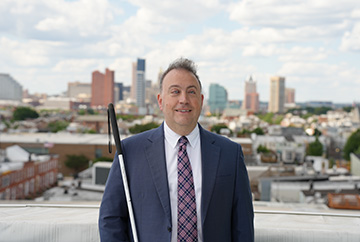 When people think about disenfranchised voters through the course of history, one overarching theme presents itself: accessibility. Fair access to voting has been fought for tooth-and-nail by marginalized groups across various backgrounds, and a certain group of people are lobbying for what they feel is the next step towards a truly equitable voting system—mobile voting. In Bradley Tusk’s most recent book Vote With Your Phone: Why Mobile Voting Is Our Final Shot at Saving Democracy, he speaks to the positive impact mobile voting could have on our current system. Working in tandem with Mark Riccobono, President of the National Federation of the Blind, Tusk is driving the initiative towards more inclusive voting.
ABILITY Magazine’s Gina Healy and Jennifer Woodall joined Riccobono and Tusk in a virtual interview to discuss mobile voting security measures, voter fraud, enacting the mobile voting platform on the federal level, and how to change the system.
Jennifer Woodall: Hey Bradley, how are you doing?
Bradley Tusk: Hey, I’m good.
Woodall: Hello, Mark. How are you today?
Mark Riccobono: I’m doing well. Thank you.
Woodall: My co-interviewer Gina is here as well.
Gina Healy: Hi, everyone.
Tusk: Nice to meet you.
Riccobono: Hey, Gina.
Woodall: Bradley, can you give us some background on how you got to where you are now?
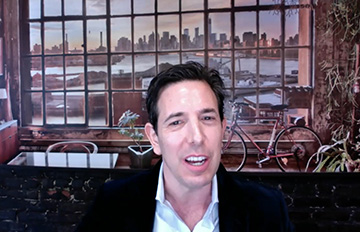 Tusk: Sure. I’m a venture capitalist. I’m in politics. Actually, I’ll just walk through it this way. Started my career in politics, was Mike Bloomberg’s campaign manager when he ran for mayor of New York, worked for him at City Hall. I was the Deputy Governor of Illinois for four years, ran the state’s legislation budget policy operations and communications. Spent a couple of years on the Hill in DC as Chuck Schumer’s communications director in the senate. Started my first company, Tusk Strategies, a political consulting firm, in 2010. We run all kinds of big campaigns for companies, candidates, nonprofits all over the country. Started working in tech in 2011 with Uber, ran most of the campaigns around the US to legalize ridesharing. That worked. Did it again with CLEAR to get them to airports. That worked. Then launched my first venture capital fund in 2016. We invest in early-stage technology companies that face different regulatory issues. We’re investing out of our third fund right now and raising our fourth. Separate from that, I got really lucky in that when I did Uber, I took my fee in equity because they couldn’t afford me because they were such an early startup at the time, and it became Uber.
I was able to start a family foundation out of that. We do two things, mobile voting, which we’ll discuss today. The other is hunger. We fund and run campaigns around the country to pass legislation requiring universal school meals. So far, we’ve passed twenty-five bills in twenty states. About thirteen million more people have access to food on a regular basis, and about seven [sic] of our money has helped to lock about $2 billion in new government funding for school meals. Separate from that, I teach at Columbia Business School. I own a bookstore on the lower side of Manhattan called P&T Knitwear. I host a podcast called Firewall. Write a column for the New York Daily News, write a Substack, and tomorrow is my third book coming out, Vote With Your Phone: Why Mobile Voting Is Our Final Shot at Saving Democracy. The first book, The Fixer, was a memoir, and the second, Obvious in Hindsight, was a novel about how to legalize flying cars. So that’s me.
Woodall: That’s a lot. Busy man.
Tusk: [laughs] Yeah, I have a very short attention span.
Woodall: I understand that for sure. And how about you, Mark?
Riccobono: I serve as President of the National Federation of the Blind. My business degree was from the University of Wisconsin, and I was going to go into marketing and economics. Because of my advocacy work at the grassroots level in the state of Wisconsin, I got noticed by the State Superintendent of Public Instruction, and started directing a state agency for blind children just short of my twenty-fourth birthday. I had no background in the education of blind children, except I knew everything not to do because that was my educational experience in the public schools as someone who was blind, but mostly wasn’t passed over by the educational system. I got very deeply into educational reform issues for blind children and did that for three-and-a-half years before I came to work for the National Federation of the Blind to build research and training programs, which had me doing everything from education programs to technology development to putting together research programs that were centered on blind people. As part of that, I oversaw our work on the Help America Vote Act. We got into the Help America Vote Act—in 2001—a requirement that nonvisual access had to be included in voting machines in federal elections.
This is the first time that there was an affirmative requirement that polling places—at least in federal elections—had to provide equal access in a real meaningful way to blind people. We have had a project ever since then. One of the things that I established and have been overseeing is we survey the experience of blind voters every year since 2008 in every major election. We have the longest-standing longitudinal data on the experience of blind voters. On the technology side, what I’m most noted for, is I got handed a project to help build a car that a blind person could drive. There’s a long story there, but one of the intersections of that story is I ended up being the person asked to represent the Federation to do the public demonstration of that technology, which was at the Daytona International Speedway. A lot of people know me as “the blind driver.” I’ve had quite an interesting set of things I’ve worked on. In 2014, I was first elected President of the National Federation of the Blind. In order to be elected, you have to be a blind person. You have to be a member of our organization, and you have to be able to get elected at our national convention. I’ve been re-elected every two years since. It’s important that I keep doing a good job for blind people. In this capacity, obviously, I work on all variety of things, but most importantly, staying centered on what blind Americans need, want, and hope for, and then go out and make it happen.
Woodall: Thank you both for those introductions. Bradley, you recently wrote a book called Vote With Your Phone: Why Mobile Voting Is Our Final Shot at Saving Democracy. Can you give our readers a brief synopsis of what this book’s about?
Tusk: Yeah. I mean, the book makes the case that we have a government and a democracy in crisis, and that if we want to fix it, we’ve got to really change the way that we allow people to vote. I think people with disabilities—especially Mark who has been one of our best partners and a true visionary—it really has been incredible in understanding what needs to be done here and being at the forefront of it. I think that in many ways, the people who are going to read this interview know what everyone really should know, which is voting is just too difficult. It’s too difficult if you are a person with disabilities, but it’s too difficult for everybody, simply by the fact that most people just don’t do it because of gerrymandering, which is the process by which most legislative districts are already set as Democrat or Republican, so only really the primary matters. Primary turnout, depending on the year in the elections, is about ten to twenty percent. So who are they? They’re the furthest left, or they’re the furthest right, or they are special interests who know how to move money in votes in low-turnout elections.
As a result, small groups of people pick who our officials are and then dictate what they’re going to do in office, and it gives us one of two types of government: either the total chaos and dysfunction that defines Washington, DC, or totally one-sided government, whether it’s the state of Texas on the right or the city of San Francisco on the left. In my view, none of that is democracy, and none of that is effective. When I ran the campaigns to legalize Uber and ridesharing, what I saw was millions of people were advocating on our behalf and through the app telling their elected officials, “Hey, I like this ridesharing thing. Please leave it alone.” And it worked. We wanted every single market in the country and started wondering, “Would they vote that way, too?” Maybe. They certainly aren’t voting now in those state and local primaries. But maybe if you make it really easy. So we started the Mobile Voting Project in 2017 and started off by funding elections in seven different states where either people with disabilities or deployed military voted in actual elections—Mark, again, was one of our most important partners on that—and it worked.
Turnout increased materially. National Cyber Security Center audited all of them. They came back clean. Jocelyn did a poll when she was running Denver’s elections and found now, no shock me, that 100 percent of people said, “Yeah, I’d rather press a button than go somewhere.” That would be weird if it wasn’t 100 percent, but a lot of the cryptography community felt like the tech that was already out there just wasn’t secure enough. Our view was, we didn’t want that to be an excuse to not move forward, so we decided to build our own mobile voting technology and began what we’re now in year four of a process. We are building technology that is end-to-end encrypted, end-to-end verifiable, air-gapped, has multifactor authentication, has biometric identification, and is open-sourced—that’s in accordance with the recommendations from the U.S. Vote Foundation—and when we finish building the tech next year and we go through all the certifications, the next step to make it free and open-source so anyone can use it, anyone can improve on it. Then the really hard work begins. That’s why I wrote this book and why Mark contributed an essay to it, which is changing the laws so that everyone has the option to vote on their phone.
We’re not trying to take away any current form of voting, we’re just trying to give people an additional option, but we’re going to get a lot of opposition because people who have power currently don’t like the idea of making it easier to risk losing power. So whether you’re a Republican, Democrat, lobbyist, union, trade group, if you like things the way they are, you’re going to have concerns about what we’re doing. I wrote this book to try to start building a movement of people all over the country, people with disabilities, civil rights leaders, military families, Gen Z, all these different groups who can hopefully demand that we be given this right. What we’ve seen throughout history is that really pivotal movements and moments in American democracy, like the Americans with Disabilities Act or same-sex marriage or civil rights, all happened because people stood up and said, “I refuse to accept the status quo.” So that’s the beginning of the next phase. The book is basically the story of, “Where are we now? Why are we here? How did we get here? How can we fix it? What did we build? And what comes next?” Is that your question?
Woodall: Yes, very thoroughly, thank you. It touched on a couple of the things that I want to ask about as well, but we can go into them a little bit deeper. When we talk about mobile voting, how do you approach the concerns about voter fraud?
Tusk: So there’s voter fraud and there’s security more broadly. I have to say, voter fraud is one of these things that gets attention, but doesn’t exist all that much in reality. As I mentioned, I worked in Chicago politics, so that’s as ugly as it could possibly get, and even there, you don’t really see it. The Heritage Foundation, which is a conservative think tank, did a report and found that 0.000006 percent of votes are impacted by voter fraud. So basically zero. Then the question is security because this is a new type of voting and it’s on the internet. Therefore, people have every right to be concerned. Maybe I could just walk you through how it works, which is if you are a voter, you download the app from your local election jurisdiction. The first thing they do is make sure that you’re voting in the right precinct in place, and then they identify that you are you. Every jurisdiction has different ways that they do that. Some use biometric screening, like an iris or a fingerprint or facial recognition scan, some use digital signature matching. In every case, we use multifactor authentication. So just like with Google or Amazon or whatever, you get a code sent to you that only you can access to verify that you’re you. Once it’s established that you’re you, the app looks like any voting thing you’d see on the internet because the goal is to make it as easy to use as possible, where it’s a little different is compared to other forms of voting, there’s no risk of hanging chads or stray pencil marks or undervoting or overvoting or anything like that. Once you’ve completed your ballot and you decide it’s what you want, you review everything, you hit send, it’s immediately encrypted. You get a tracking number that then says, “Okay, here’s how you can follow the progress of your ballot throughout the process.” They then go to the election official’s office and they then decrypt, they take it offline, it’s called air gapping, to remove it from the internet because the only way to hack something is to be able to access it through the internet, so if something’s not on the internet, you can’t do that. And they only decrypt it once it’s taken offline. A paper copy of the ballot is then printed out. The ballots are anonymized and randomized. Then for the voter, you have the tracking numbers. You can see when your ballot was submitted, when it was received, when it was decrypted, when it was printed, when it was tabulated. Because all the code is open-source, anyone who knows how to do this stuff can check for bugs in the code or anything that could potentially go wrong in an election. So, there’s multiple layers of both security and accountability and auditing. So does that explain it?
Woodall: It does. Yeah. Thank you. We actually recently interviewed Ken Block, who was actually hired by the Trump administration when they were alleging voter fraud to do the research on it as a neutral party. He had some interesting information about how voting is conducted so differently state to state. I’m interested to see how something like this technology would work in states that are so different from each other with how they’re conducting voting, and how they’re collecting voting.
Tusk: Yeah. I mean, for better and for worse, because voting is run at the local level, everyone’s going to have their own processes, rules, requirements, everything else. We have built this app so they can adapt to whatever it is. If you’re a jurisdiction that says, “I want biometric screening,” great, we can do that. If you’re a jurisdiction that says, “We have ranked choice voting here,” great, we can do that. We can adapt to whatever rules are because we’re not in a position to set all the different rules. When we polled mobile voting before 2020, we found that about 75 percent of Democrats and independents and Republicans all said, “Yeah, if it’s secure, we should have this.” Then, after 2020, we polled again. It stayed in the mid-70s with Democrats and independents and fell into the 40s with Republicans. That’s clearly the influence of what we saw coming out of the 2020 election. Look, we have built this to be totally non-partisan. In the seven states where we’ve done this, three of the seven were very Republican states: West Virginia, Utah, and South Carolina. But it’s also possible that blue cities and states warm up to this faster than red, and they adopt it first. Our goal is to work with anybody who wants to do this.
Healy: To follow up on that a little bit more, it does seem like the states with the most restrictive voting measures would be the ones who would be least likely to adopt this versus the liberal ones. How would you ensure that this would be enacted on a national level?
Tusk: Yeah, absolutely. So, I have two answers: one is, sometimes we think that—even take Georgia, which is one of the states that really has had the most restrictive voting laws—we actually think Atlanta as a city is one of our best targets, in part because like the disability community, another community that feels very strongly that the current system is unfair is the civil rights community. So, for example, I’m going to Atlanta next week, and I’m doing an event at the Carter Presidential Library with Martin Luther King III, making the case for mobile voting because he believes that the best way to fight voter suppression is to let people vote on their phones. When you’re pressing a button in your living room, no one could turn you away because of the color of your skin. So, the first thing is, I think finding blue cities in red states is one path there. The second is more broadly like what I’ve seen in my career in technology, which is once you take the genie out of the bottle, you can’t put it back in. Everybody everywhere runs their lives on their phones these days. We do our banking, our health care; people do their love lives, so many different things. They’re not really willing to say, “Oh, my cousin in this state can have access to this app and tech, and I can’t.” Yes, I don’t think it’s going to happen in all fifty states at the same time, but everything that I’ve ever seen as a venture capitalist and a technology investor is once the genie is out of the bottle, once the product is out there in the market, it’s very, very hard to roll it back. That’s also why we’re going to need to be able to organize and mobilize millions of people. Yeah, those political fights in the red states will probably be tougher than the blue states, but you know what? Having worked in a lot of blue-state politics—New York, Illinois, Pennsylvania—in my career, those aren’t going to be easy either.
Woodall: It’s still in development, the mobile voting platform?
Tusk: Yeah, we’re like 85, 90 percent done. We have a team of experts who are just running test after test, and then we’re going to go to organizations and ask them to review it. Then also the important thing is keeping it open-source. It’s not the end-all deal we put up online. Other people could then from there build on it and make it even better. But yeah, it doesn’t do any of us any good to put something up that is not as bulletproof as possible.
Healy: So you would give the technology to the states?
Tusk: Yeah, it’s free.
Woodall: Oftentimes when companies are developing tech, specifically for accessibility, they fail to have disabled contributors in their research and development teams. Is that something that you’ve been able to do while you’re developing this platform?
Tusk: Yes. Very much so.
Healy: Mark, it seems from what I saw that Provision 2 of the ADA either builds on HAVA (Help America Vote Act) or supplements it. I was wondering how mobile voting would add to that, to make it that even better.
Riccobono: Well, in the National Federation of the Blind, we pushed very hard on the idea that the entire voting program has to be accessible. The Help America Vote Act did a lot—really opened up making sure that polling places in federal elections were fully accessible—but it didn’t really address absentee voting. What we saw also is that after less than a decade, a lot of states wanting to go away from electronic voting machines back to paper. I think this synergizes pretty well with what Bradley said. Once the genie is out of the bottle, at least for blind people, we said, “Well, wait a minute. We’ve had private independent voting for the first time where no one interferes with our ballot. We don’t have to rely on someone else marking the ballot. We’re not going back.” At the same time, we recognized that there were other forms of voting that were not available. So, nondisabled people had actually more options. You could vote absentee. We sued the state of Maryland, and Maryland said, “Well, we make voting available to you at the polling places. Sorry, if you got to be out of town on Election Day, too bad for you.”
If you were a person without a disability, no problem, you’d have access. We were able to establish that actually the Americans with Disabilities Act guarantees us access to the entire voting program, not just a particular aspect of voting. The problem is that the states don’t do too well at really planning for and thinking about accessibility. Case in point is the 2020 election. Now, I sent a letter to every state in the nation in September 2019 saying, “We have a big election coming up in 2020. You should be ready to make sure that your entire voting program, including absentee voting, is accessible to voters with disabilities.” Now, I’m not particularly good at predicting the future. I wrote that letter from an advocacy point of view, but what happened six months—a year later, every single state was rushing like mad for mail-in ballots, not because of accessibility, but because of a worldwide pandemic. Virtually no state paid attention to my letter in September 2019. We ended up pursuing almost two dozen states in terms of lawsuits or other actions because their absentee voting processes had no accessibility in them. One of the reasons that mobile voting is important, and it’s important that the initiative of this movement is being built with accessibility from the beginning, is it will give states a tool that they know has accessibility built into it, and it has the flexibility to be accessible in all of the ways that might be needed.
That’s one of the key aspects of voting that is really continuing to be missed. We have states, even today—North Dakota is a great example—they’re permitted to do delivery of ballots to people with disabilities. It’s in their law, but they’re just not doing it. A lot of states aren’t even thinking about accessibility still in absentee. Really, people with disabilities, not unlike other classes of people, really have a limited set of choices when it comes to truly voting privately and independently in an election. Mobile voting presents the option to make level that playing field, provide all the options to voters with disabilities that other people have.
Healy: I read in your essay that the NFB (National Federation of the Blind) has a mobile voting working group. Is that what you referenced earlier?
Riccobono: Yeah. So we have worked really from the beginning—even going back earlier than the Mobile Voting Project—pulling together thought leaders and others who have been thinking about this idea of mobile voting. It’s something that we’ve helped curate some of the conversation, knowing that if anybody is going to be talking about new forms of voting, we want to do exactly what this project that we’re here talking about today has done, which is making sure that accessibility is baked in from the beginning. That it’s not an afterthought. Our mobile voting working group has really been to get people thinking and talking about what the future of voting is and how it can be built to be accessible from the beginning.
Healy: Is it also an advocacy group?
Riccobono: Well, really, the advocacy comes in our grassroots network and what we do. It informs our advocacy efforts, I would say, because in our advocacy efforts, we’re not advocating, in many cases, for a specific approach to voting. We’re advocating for making sure that the voting methodology is accessible and also trying to, again, expand the franchise of voting. Absentee voting is already available to overseas military voters in ways that it’s not available to people with disabilities. We spend a lot of time advocating that those methods be open to us. If you’re on the International Space Station, you can vote from space. But apparently, we’re not smart enough to figure out how to make that happen for people right here in the country. It doesn’t make sense to me. What it says to me is, if you’re an astronaut, you’re important. If you’re a person with a disability, you’re not. So that’s where the advocacy comes in.
Healy: You said you’ve been elected every two years. How did that voting go? Did you guys use mobile voting?
Tusk: That’s a really good question.
Riccobono: Well, it could be, but our voting does happen in person at our national convention. It’s a little bit different in that our national organization is a little bit more representative democracy in that the delegates at the convention are voting, but they’re all elected by people at the local level. It’s a little different. We certainly are interested in if there are applications for the mobile voting technology for other things that we do.
Healy: Yeah, I would imagine. It sounds [like] it would be an incredibly powerful tool for so many people, more than the disabled, more than the civil rights movement. It’s service workers, moms who have to work with small children—
Tusk: A few others, too, just throw them in there. Obviously, college students. For example, we dropped off our daughter at college a few weeks ago for the first time, and when we moved her in, she got her room key, she got a bike room key. It didn’t occur to me [till] later that mail—mail, room, mailbox—never came up once. I literally don’t think she would know what to do with a piece of mail, but if you let her vote on her phone, I guarantee she’s already checked her phone twelve times since we all started this conversation. People in climate emergencies, especially because of hurricane season now. It’s just like it’s getting worse and worse and people are getting displaced. People in Native American tribal areas. There’s lots and lots of different groups that could really benefit. But to your point, Gina, the reality is, why wouldn’t we want to make voting easy for everybody if we can?
Woodall: Since the platform is still in development, do you have a projected date when you imagine this being completed?
Tusk: Yeah. So I would say probably Q3 of 2025 for the rollout, but that includes a series of different testing events and activities over the course of 2025, DEFCON being probably the most high-profile one in that cyber world. But at the same time, we’re also going to start running legislation in different cities around the country that would permit people to vote on their phones once the tech is ready and certified and everything else. We’re going to get the movement-building process going now. We’re going to get the legislative process going now. We’re going to finish the tech completely and make it open-source in 2025. My hope would be that by 2026, ’27, ’28, municipal elections, maybe some state elections. Then if it’s all working, we can start to expand things like congressional primaries from there.
Woodall: Am I remembering correctly that you said you’ve been testing the mobile voting in seven states so far?
Tusk: We did mobile voting pilots in seven states, not with the tech that we built. We were using the existing tech on the market, which actually, in fairness to them, works really well, but because it’s not open-source, because these are private companies with proprietary information, it couldn’t meet the security requirements that the experts put out there. That’s why we decided to build our own tech.
Healy: Do you think mobile voting is the only radical change needed to strengthen or to increase access to voting?
Tusk: No. In fact, it’s funny. There’s a whole chapter in the book, specifically, about a lot of the other reforms out there. I believe that we should have as much early voting as possible. I think states should have opt-out instead of opt-in for mail-in voting. I think that there’s something to say here about the idea of making Election Day a holiday. On top of all that, I think we just need more types of political reform: open primaries, final five, ranked choice voting, national popular vote. There’s a lot of good stuff out there, and I think we should do all of it.
This was great. It was a really thoughtful interview.