A Brief Report of the Meeting of the National Federation of the Blind Board of Directors Held December 6 and 7, 2024
by Gary Wunder
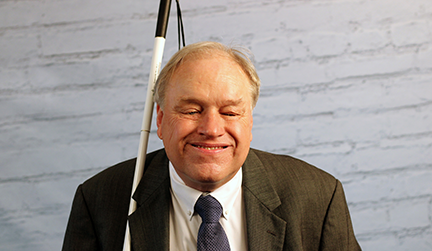 On December 6th and 7th, 2024, the National Federation of the Blind Board of Directors met in person at the NFB Jernigan Institute to discuss current programs of the Federation, our successes, and our challenges for the future. After reviewing the minutes of meetings held since the last in-person meeting, board members talked about the reasons for their commitment to and faith in the work of the National Federation of the Blind. Some were inspired by the need, while others were empowered by the commitment shown by our members and leaders to help one another. Every person who spoke made it clear that real progress for blind people comes through the collective action we choose to take together and that they are grateful and uplifted by the confidence that has been placed in them as leaders.
The fundraising landscape has been drastically changed as the importance of mail through the United States Postal Service has diminished and electronic forms of communication have superseded it. We have been the beneficiaries of a robust mailing outreach program that has not only generated funds in response to our informational mailings but has also planted our name in the hearts and minds of donors who end up adding us as beneficiaries on their deaths. The decline in revenue through the mail has been evident for some time but is increasing at an alarming pace. Since we do not borrow money, our programs must function on the revenue we generate, and a failure to do this on our part will necessarily mean fewer programs and less money for those we continue to support. How we will replace this revenue and continue to expand our programs must be the responsibility of every Federationist to think about, offer suggestions, and help us devise a way of seeking substantial donations from members of the public. The problem we face is not for Baltimore or for the “national” to solve. This problem and solutions to it belong to us.
We will continue working to build the Museum of the Blind People's Movement with the understanding that much of the concept work will be wrapping up in May of 2025, and further progress will have to wait until funds are available. We are still interested in the ideas of members about what should go into the museum and what should not. Anyone having items they think should be a part of our exhibits is encouraged to contact President Riccobono. The longer we wait to do the physical construction, the more it will cost, but until we are ready to fund that construction, we must wait and continue to work on financing.
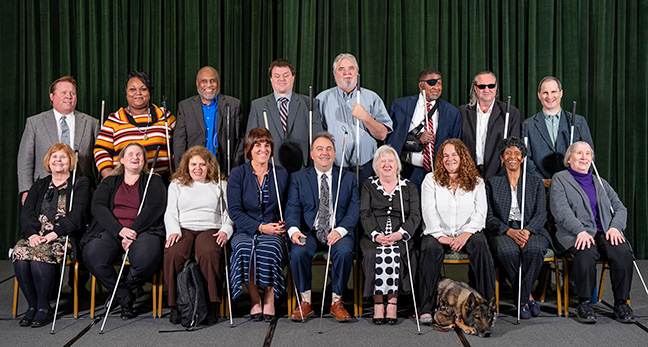
Our Jernigan Fund continues to grant many people the opportunity to attend their first national convention. In addition, it is helping support our Kenneth Jernigan Leadership in Service cohort.
We continue to certify Braille transcribers for the National Library Service. A task before us is to develop the code curriculum for mathematics using Unified English Braille. The team is working on developing strategies for creating tactile graphics for the American Printing House (APH) to use in building a library that can be viewed using the Monarch.
For very young children, we have our Braille Reading Pals Program and our Early Explorers Program. In both we teach parents to be teachers, offering to their children initial instruction in Braille with Braille/print books, and cane travel through providing a cane and guidance on beginning skills that the parents can teach.
Our NFB BELL® (Braille Enrichment through Literacy and Learning) Academy program continues to help children learn Braille and other skills during the summer. “I Can Lead” was the theme for 2024, with eighteen affiliates hosting twenty-three programs. The program saw eighty-eight new students and served a total of 222 students. The program thrived not only because of the support of our membership but also because of the generous donation of time by 214 mentors/volunteers/coordinators.
The STEM-2-U Program works with blind students to show that these fields are as possible and as lucrative for blind people as for the sighted. This has meant coming up with innovative approaches to teach blind people what others gain through vision. Programs have traditionally been held at the Jernigan Institute, but this year fourteen affiliates hosted programs that served 117 students. The theme was the James Webb Space Telescope, and ninety-one mentors/volunteers/coordinators made it happen.
The Teachers of Tomorrow Program links teachers of blind students with the real-life experiences of blind people. This year we selected twenty participants from a pool of fifty-five applicants. It takes twenty-five mentors to run this program and the support of all who help fund our Federation.
The Individualized Education Plan (IEP) is the most important document in mapping out what a blind primary or secondary student will need from school and measuring whether the needed services have been provided. Participating in negotiations with school districts is not something that is second nature. It requires training, confidence, and support. This year we offered the training to sixteen people who have pledged to be advocates anywhere they are needed. We thank our partners: the Professional Development Research Institute on Blindness (PDRIB) and the National Organization of Parents of Blind Children. We also wish to thank the Lavelle Fund for the Blind for their generous financial support.
Because employment is a significant goal, we have several programs to target acquiring skills and learning the ropes of getting and keeping a job. This year we had 760 people participate in our virtual and in-person career fairs, Where the Blind Work webinars, and training sessions.
Jonathan Mosen made his first presentation to the in-person meeting in his new role as Executive Director for Accessibility Excellence. We are working on outdoor and indoor travel technology, autonomous vehicles, and making a real effort to collaborate with product developers before their products hit the market. We need to remember that our “big stick” can be used for more than travel. We are actively working with Google, Microsoft, Amazon, Apple, and Facebook. With this latter company we have seen many regressions that make the platform much more difficult and less pleasurable to use. Talks are ongoing and encouraging, but the real test is what happens, or fails to happen, as a result. More aggressive action may need to be taken if real progress is not evident soon.
Open AI, one of the most prominent players in the artificial intelligence space, is consulting with us, and this is a testament to who we are in the community given that so many organizations dealing with technology for the blind, such as Be My Eyes, are pressing this company for contacts and services. When a company comes to us, one of our major offerings is market intelligence. They know their products, but we know the people who need and will buy them. When we act, we are much more persuasive than a petition, no matter the number of signatures it may have.
One area where we must make progress is in hearing aids. Our hearing is essential, but too few companies are creating controls that work with screen-reading technology. While some settings are done by an audiologist, others such as adjusting the directionality and volume are under user control if one can see.
Infrastructure isn't always the most exciting thing to read about, but without it little tasks become big ones and big ones become impossible. John Berggren told the Board about updating our computer security, the updated wireless system in the building, and the replacement of ten-year-old printers with ones that are faster, cheaper, and have more functions. Our bandwidth is now 400 percent more than last year. The next major upgrade is our phone system, which we expect to move to the cloud. This will cut cost and increase reliability. To stay up-to-date, we replaced nearly three dozen laptops for the staff. Square is a system we now use to process credit cards, whether at the Jernigan Institute in our Independence Market or at our annual national convention.
Reporting for our Advocacy and Policy Department, John Paré briefly discussed the status of bills and the importance of doing what we can before the new Congress takes office on January 3. This year we will again be introducing the Medical Device Nonvisual Accessibility Act, the Websites and Software Applications Accessibility Act, and the Blind Americans Return to Work Act. We will again begin the work of finding sponsors and cosponsors, and as the Congress becomes more comfortable with these legislative concepts, our bills get ever closer to becoming the law of the land. We will continue to support the Access Technology Affordability Act as well as the Transformation to Competitive Integrated Employment Act. We strongly support an appropriation for distribution of the Monarch, the dynamic Braille and tactile graphics tablet which we have helped create along with the American Printing House for the Blind and HumanWare. Autonomous vehicles will remain a priority for us as we work to see that they are usable for the blind and become acceptable in the states. In some localities this will involve changing laws that currently require all persons operating a vehicle have a driver’s license.
Currently, twenty-three states have endorsed a full or partial phaseout of section 14(c) of the Fair Labor Standards Act, meaning that businesses can no longer pay disabled people less than the minimum wage. We are continuing to work diligently for blind people to have the right to vote privately and independently. In addition to the systemic changes we seek, we are also involved in directly helping blind people with issues such as Social Security, with seventeen people being the beneficiaries of our work.
NFB-NEWSLINE® continues to be an important resource for blind people, and as with other changes in technology, it is moving to the cloud. Currently an Android version of the app is being tested, and we hope it can be released soon.
Stephanie Cascone, our Director of Communications and Marketing, made her presentation to the board. She reminded us that at the core of what we do must be the telling of our stories. Once we have told them, we must be strategic in seeing that they are not only preserved but actively shared and passed down. We must ensure that we use all of our publication assets in coordination to send our message.
Our branding has been updated, and it can be found at nfb.org/brand. Although several articles have been written about it in the past, it is always helpful to review the page and to have it available, either through memory or reference, for those we meet.
We are continuing to build Mark AI as another resource for people to use to learn more about the National Federation of the Blind. Currently the system reports having 4,476 memories it can use in conversing with people who want to know more about the Federation. Every person using it and building it will be helpful. We are doing research on other AI opportunities as well.
The organization generates a tremendous amount of material, and one of our jobs must be to see that it is retained in such a way that is easily findable and usable. The National Association of Blind Students, the Performing Arts Division, and the National Federation of the Blind of Pennsylvania each generate a quality podcast, and a number of affiliates have important speeches and presentations that they feature. Though the staff of the communications group does not coordinate these, it should be involved to see that branding, advertising, and retention have a high priority.
Our followers on social media continue to grow, and this provides one of the fastest and most effective ways to be involved in current discussions of importance to the organization. It is important that our members respond when questions and issues arise.
All of the presenters had much more to say than can be included in this report. It is clear that the work we have to do is extremely important and far from done. On the stairs to true equality, we continue to make impressive progress, and although our organizational knowledge and resources are greater than they have ever been, each step upward requires more planning and energy. Loving and respecting our traditions, addressing our current problems, and being a part of shaping the future are all commitments that the members of the Board of Directors embrace as representatives of our organization. With the spirit of optimism, commitment, and tremendous gratitude for being allowed to work together, the annual fall board meeting was adjourned.