Shaping Twenty-First Century Rehabilitation Systems: Leadership, Partnership, and High Expectations
Moderator: Anil Lewis
From the Editor: The panel discussion that follows was moderated by Anil Lewis, Executive Director for Blindness Initiatives for the National Federation of the Blind. He was joined by Cassondra Williams-Stokes, President, National Council of State Agencies for the Blind (NCSAB); and Stephen Wooderson, Chief Executive Officer, Council of State Administrators of Vocational Rehabilitation (CSAVR). Keep in mind that this was a free-flowing conversation that, were it transcribed verbatim, would probably do more to obscure than to clarify the issues and innovations described. We have therefore taken more liberty in editing than we normally would in transcripts of speeches. Those wishing to hear the original audio can find it by going to www.nfb.org/convention and then clicking on Past Conventions.
This is what President Riccobono said in introducing the panel:
This next topic is rehabilitation. This crowd provides a lot of expertise to the rehabilitation process, right? Yeah, we know a lot about it, because we live it every day, and in some states we have been successful in getting separate agencies for the blind, and those agencies come together under the National Council of State Agencies for the Blind that we have had the opportunity to work with in a number of ways. In other places within general agencies for the blind, it’s been harder, but we have found ways to raise expectations and create understanding about blindness. We talked in the Presidential Report about the work that we’re doing to build some training materials for affiliates related to agencies. Those agencies come together in this Council of State Administrators of Vocational Rehabilitation.
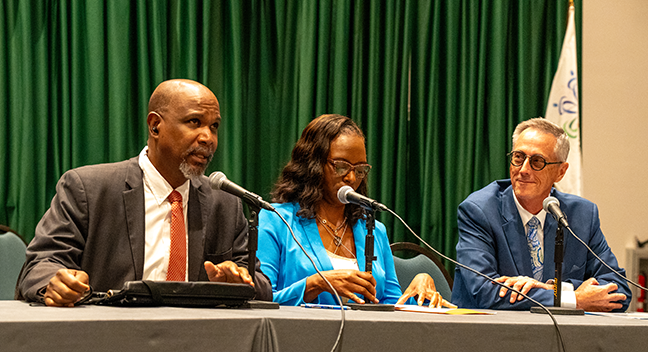
Increasingly we are finding ways not just to advocate with agencies but to find ways to partner with them, to help them in their pursuit of quality outcomes by being the organization that provides them with that expertise through youth programming or transition youth programming or other things. Our organization brings that expertise. We thought it would be appropriate to invite both of the overarching organizations that bring agencies together to a conversation here at this convention, and here to introduce the panel and lead the conversation is our Director of Blindness Initiatives. Part of his background is in the Client Assistance Program, so he knows a lot about vocational rehabilitation. Here to introduce the panel is Anil Lewis!
[Applause]
ANIL: Good morning. Thank you, President Riccobono. During my report from the [Jernigan] Institute on the Blindness Initiative Programs, you saw we are putting a lot of emphasis on partnering with blindness professionals. One of the best ways to do that is to partner with organizations that help bring together blindness professionals.
So I’m very pleased that our panelists today accepted President Riccobono’s invitation to be with us at our convention, and I’m optimistic that we will continue to have ongoing discussions throughout the coming years to make sure we can improve the quality of rehabilitation services to blind and low-vision consumers across the country.
So I’m going to introduce our first panelist, Dr. Cassondra Williams-Stokes. I met her when I was serving as national representative for the Arkansas affiliate. We all know how some agencies come, and they have representation for just the thirty minutes they’re there to present. Cassondra was there the whole time. She’s been a really good, tremendous friend of ours already, and now in her capacity as director of services for the blind in Arkansas and recently elected as the president of the National Council of State Agencies for the Blind. Here, to introduce herself, is Dr. Cassondra Williams-Stokes.
CASSONDRA: Thank you, Anil, for that, and thank you, President Riccobono, for the invitation to NCSAB. I’m honored to be here to speak on behalf of NCSAB and the state of Arkansas, as well as all the directors of blind agencies today. I really appreciate the opportunity to engage in our partnership. This is probably my eighth convention I have attended. [Applause]
I’ve been with the state of Arkansas Services for the Blind about fifteen years. I served as director for six of those, so I’m really honored to be here and thankful for the opportunity.
ANIL: Tell us a little about NCSAB.
CASSONDRA: Yes, thank you. Our primary goal is to promote and advocate for individuals who are blind or visually impaired. We do not lobby. I just want to go on record to say that.
ANIL: That’s okay; we’ll continue to advocate in Congress.
CASSONDRA: Our purpose is to educate and promote advocacy. I am one who really believes in independence. All my life I have lived with a disability. I am hearing impaired, so these acoustics are really killing me right now. Just bear with me.
ANIL: You’re doing fine.
CASSONDRA: We just want to make sure that independence is absolutely a priority for all of our consumers who are reaching and striving for that goal, and our role is to make sure that we are there to support them. This is not just for Arkansas for sure; it’s nationwide, so we are available. If there is anything that we can do right now, my platform is just to make sure that the partnerships are strong and making sure that our legislators are aware of our needs. Because there are so many. I know we’re going to get into that, so that is the primary reason for NCSAB to provide that support.
ANIL: Thank you very much. I just wanted to introduce our second panelist and then we’re going to engage in a little conversation. I’m very pleased to have Stephen Wooderson with the Council of State Administrators for Vocational Rehabilitation. Just to make it clear, not every state, as President Riccobono said, has a direct agency serving blind people. There are general agencies to serve VR, and they are responsible for serving blind consumers in the whole area of disability. But the thing I love about Stephen is that he has been a longtime partner. Back when I used to work on the Advocacy and Policy side of the shop under John Paré’s leadership, serving in the capacity for the education of Congress that Cassondra was begging out of, Stephen was right there with us on the issues around subminimum wage, Section 511, etc. Again, please, Stephen, glad you were able to accept our invitation. Please take a little bit of time to introduce yourself and tell us about CSAVR.
STEPHEN: Well, thank you, Anil. I’m a newcomer. This is my first time, and I am absolutely impressed. [Applause]) Thank you, Anil, for the invitation. President Mark, thank you for the coffee this morning and the conversation. It was good to get to know you a little bit more.
I am the chief executive officer for the Council of State Administrators of Vocational Rehabilitation. We’re the sister agency to NCSAB. I’ll try not to use a lot of initials today, but we’ll probably get into that pretty quickly.
We have seven full-time staff that work across the country. We all work remotely. But the bottom line is I work for Cassondra; I work for the other seventy-seven state vocational rehabilitation agency directors. I think a couple have been in the room maybe today or over the last few days: Robert Doyle from Florida is our treasurer. Cassondra sits on our executive committee, so we’re very well represented by agencies for the blind. As Anil mentioned, CSAVR is the broad organization that represents all state vocational rehabilitation agencies, all seventy-eight of them. Twenty-two specifically serve folks who are blind, another twenty-two serve others than those who are blind, and then the balance are combined, so it’s all job seekers with disabilities seeking VR services in those state agencies.
I am proud to be able to say, Anil, I am a lobbyist. I can lobby. That’s a part of our organizational structure, so it was a great opportunity and continues to be a great opportunity to partner with you all.
Personally, I have been in the business, as we sometimes say back home, since Pluto was a pup. I began as a counselor in Rolla, Missouri. I’ve got some Missouri folks back there—good old folks—good to see you. I was there twenty years, and then I went to the great state of Iowa, my second home, where I ended up being state director. I live in Minnesota now. I’ve got the middle of the room out there represented, and it’s good to be able to reconnect with good friends like Jim Marks. I saw him this morning and of course he is from Montana. Thank you for all the work that you guys are doing. That’s who I am and where I come from and a little bit about CSAVR.
ANIL: Thank you for sharing. I love the way you’re trying to win the crowd. So establishing this relationship, let’s start with perspective, and we’ll probably go pretty quickly because I have more intense questions. Can you both share your perception of the National Federation of the Blind, and let us know what you feel our role is in the rehabilitation process?
CASSONDRA: Absolutely. I’ll tell you. Just so you know, I’m neutral. I attend all the Arkansas Council of the Blind meetings as well. That’s why I didn’t show up the other years; I was at the American Council of the Blind conference. I will tell you my experience with NFB really has been just looking at strong advocacy in education and accountability. I don’t necessarily need NFB Arkansas to keep me accountable, but they do. I can tell you that. I know they’re over there listening.
But over the years, NFB really has been a partner for us at the state level for sure. I know that at the national level, NFB executive leadership has shown up for those meetings in Arkansas, and I know that they really believe in advocacy, making sure that every consumer has an opportunity to be independent.
So for me, I think that has really helped me understand more about what my role is. I just want to add that one of the great opportunities that I have had in Arkansas is that, because we are an independent commission, this means that our agency is managed and operated by a board. That autonomy has been very important. The voice of consumers, blind or visually impaired consumers, actually runs our agency. Everything that we do is on behalf of the individuals that we serve.
I just want to say that I think that NFB represents you well, making sure that any challenge that is put before our consumers is addressed. That is what I have seen. I know that the partnership and being able to refer individuals to NFB, whether in Arkansas or at the national level, has served our consumers well and has helped to remove many barriers. So I want to thank you and Arkansas NFB for making sure that we are able to move forward with any challenges presented to us.
ANIL: We definitely wear those hats proudly. How about you, Stephen?
STEPHEN: Honestly, Anil, for my first twenty plus years, my association with NFB was somewhat secondhand. It was through representatives on the State Rehab Council, and the state Independent Living Councils, that I became acquainted with the power of NFB. At that point, frankly, I didn’t fully appreciate it until I met you and John Paré, and we began working together on the Hill, as you mentioned, and recognized the power of the voice of NFB. Working thirty years in a general agency, then coming to the national level helped me in understanding the power of the voice of your organization. I think it’s important for me to say, as one who doesn’t work daily in the blind community, that NFB is really a good representative of the observation that “A rising tide floats all boats.” What you do for the blind community is good for all. And that is the power of NFB.
ANIL: We’re proud of that.
STEPHEN: I really have learned that, Anil, and I appreciate so much what you all do. That’s my take.
ANIL: Thank you.
So let’s get right to the big elephant in the room. A lot of our members have expressed some concerns, and we know that within the agencies that the Pre-Employment Transition Services (PRE-ETS) as implemented through the Workforce Innovation and Opportunity Act (WIOA) has really had a rocky start. Maybe some things are smoothing out, but we're just curious to know what you are encouraging your membership agencies to do to address Pre-Employment Transition Services for blind and low-vision youth.
CASSONDRA: Well, the first thing: You know that in 2014, we all encountered the WIOA, and that put us in a position where we had to reeducate ourselves about what was important. Absolutely, the Pre-Employment Transition Services funding is very important to all of our states. I know with NCSAB, that we are making sure that all of our states understand the importance of reaching out to our Technical Assistance Centers to ensure that they understand how to implement the pre-employment program. Right now we are looking at states that are turning money back because they can't spend it. I don't like that. I know in Arkansas we are able to spend our funding, and I think that part of the issue is there are restrictions where states aren't able to implement the program.
I know several of the directors around the country bring students here to NFB. I'll tell you that, as a result of my experience on my first trip here to NFB years ago, I was a little intimidated. I ran into a group of students who were really outspoken, active, and I had never seen anything like it. I was just so impressed. I really was. With that, I know the importance of teaching our young people the importance of advocacy and their advocating for themselves, and how essential it is that they be advocating for what they want in life. I know that is really important.
The other thing that we are looking at is making sure our states understand about fiscal forecasting and what that is. It is making sure that you have a plan in place to implement the pre-employment program, making sure that you understand how you are going to spend those dollars so that you don't have to turn those back to the Rehabilitation Services Administration.
Those are two of our concerns for NCSAB, and making sure that we continue to receive those dollars to support our young people.
ANIL: Thank you. [Applause] Stephen.
STEPHEN: I agree with Cassondra and that problems in smoothly implementing the Pre-Employment Transition Program came from not fully understanding what states could and could not do under WIOA. I hope that through the National Technical Assistance Center on Transition and the collaborative of nearly forty-five agencies, some of this will be clarified, and states can proceed to offer quality programs with the knowledge that they are complying with the law. They are sharing good examples of things that are happening and ways to increase the numbers of students and youth who are blind. I might mention that PRE-ETS numbers are improving. We're engaging more students and youth. We are having more services provided and more outcomes. At the same time, numbers don't tell the whole story.
I also want to mention that another model that I would encourage us to consider is kind of a regional approach. The states of Kentucky, Minnesota, Michigan, and Delaware—I understand they are working across state lines, virtually bringing blind students and youth together to have experiential kinds of events online to build that sense of community and capacity building as well.
The last thing that I want to mention to respond to Anil is our concern about community providers having the expertise to meet the needs of our PRE-ETS programs. I know that it impacts all across the board. I suspect there is even greater impact in the blind community as well. Our goal is really stepping up our efforts to identify those competencies, those skills that are needed to be able to deliver these services for those in our pre-employment programs. We’d like to see or develop a training module to help in this.
ANIL: Excellent, and hopefully we can expand on our partnership, because at this convention we have eleven students from Mississippi who are pre-employment transitioning students, and I think Nebraska has fifteen students here. We can continue to build on that because this is not just a one off. When the students get here, they get ongoing support, develop peer relationships, etc. Because one of our biggest problems is that many of the agencies are interpreting PRE-ETS as one offs: like, well, you have had your module on self-advocacy. And that's just not the way it works; we have to continue to involve ourselves in their lives and continue to have them involved. Thank you for what you are doing, and hopefully we can build on that.
One of the other concerns that our members have expressed is that, in the effort of many of the agencies to focus on employment—and we recognize that's the mandate—but we as the National Federation of the Blind also recognize that actual acquisition and mastery of the alternative skills of blindness are important. That's Braille, access technology, independent travel, but it also includes activities of daily living, you know, being able to manage a household, cook and clean for yourselves, but many members find it much more difficult to get support from the agencies for those particular services in order to be the well-rounded individuals they need to be to seek competitive integrated employment. I'm just curious as to whether you recognize that as a problem and what you have done to brainstorm a strategy?
CASSONDRA: Well, one thing is I think that we need to make sure that agencies are educated about how to use the VR process. If there is a consumer who actually needs a particular ADL (activity of daily living) skill, that needs to be shared with their counselor. That's one thing we want to make sure we are doing is getting the message out to all of our membership and all directors in all the states: make sure you understand and know how to use the VR process. If ADL is part of meeting an employment goal, it should not be any different from any other type of resource that you would need to get to your goal.
For OIB (Older Individuals Who Are Blind), I know that we are really working hard. Part of the problem with the Older Individuals Who Are Blind Program, for that matter, is that we don't have enough funding. I know that this has been true for many years. In 2023, Carlos Serván from Nebraska, our former president, wrote a letter to our House and Senate Appropriations Subcommittees for additional funding for the OIB program and VR. Just this year, I did the same. So, we are really looking at how we can increase the funding for these programs that are serving our consumers. Right now, the current funding level for the Older Individuals Who Are Blind Program is $33 million. Now that sounds like a lot, but many of these states who can receive these funds are getting less than $300,000, and Arkansas is one of those. It's been a challenge, but we do everything we can to make sure that our membership understands.
At our spring and fall conferences, we try to have workshops that are one, appropriate; and two, relevant. I think that's key. I know it's key, because a lot of issues are coming forward. I have learned how to utilize the resources by using the Technical Assistance Centers, and we don't turn money back. We spend all of our money for Pre-Employment Transition Services and for VR. That is because I and the staff who work with me have learned how to use the process of making sure that we are maximizing every dollar that we can for our consumers.
I think that we can continue the conversation to make sure that we understand how important the resources that need to be available to our consumers truly are and that they are there. That's one message that we're trying to get out.
ANIL: Great. Thank you. [Applause]
ANIL: Stephen.
STEPHEN: Before I speak to that, I want to acknowledge that I didn't see Carlos over there earlier. He's another one of my bosses. Carlos, thank you very much. I would hate to walk out of here and then there be an important vote along the way, and you voted against me because I didn't call your name out. And then you mentioned Mississippi—Dorothy Young—and I know her coming into her role with NCSAB is important as well.
On this particular question, I think that Cassondra probably has a much deeper appreciation for the community and the challenges there. Maybe I will take a little different view or angle on it and speak to the issue of CIE (Competitive Integrated Employment), and the fact that a lot of this rests, I think, in our proper movement to the vocational rehabilitation program being responsible for services that lead to competitive integrated employment outcomes. In my observation, across the country you see more and more community providers moving in that direction. It's hard to believe, but perhaps the legislation may have moved so fast that other services that needed to fill this void have not completely matured. That is a bit of my view of the world.
To get to the question, the need for ADL and other basic skills need to be there before we can get to getting people into competitive integrated employment, and our state agencies need to see this as a strategy that is essential to employment. Maybe agencies for the blind can help educate our other agencies more in understanding that there is a need for these services.
ANIL: Nice. We'll start doing a better job of making sure we encourage and empower our members to do exactly that. Thank you for that advice. I just got updates saying we also have PRE-ETS students from Washington and from Texas. Cassondra, you already addressed the older blind question I was going to ask. I just wanted to see if Stephen had anything to add around older blind services.
CASSONDRA: The one thing I'm going to say is that I did want to talk about partnerships. That's one of the reasons I know I'm here today to represent NCSAB. We are looking to increase our partnerships: one, because it makes sense. There are so many states that are challenged with the lack of funding or resources. It makes sense to partner with organizations who are doing the same things or have a similar goal, even when we don't always agree on each and every point. It makes sense for us to partner so that our dollars will go further to serve consumers.
And two, the other thing I want to mention is that the Older Individuals Who Are Blind Program funds that are channeled into the states sometimes are the only source of funding for services for independent living. That's huge. In Arkansas we are a retirement state. I'm sure Florida is. We have an overwhelming number of individuals who are fifty-five and older who are experiencing vision loss or some type of blindness issues. It is important for us to look at our partnership opportunities to make sure that, if we can't provide a service due to the lack of funding, we can make a referral to a partner who is at the table and who does have those resources.
STEPHEN: Again, you have the inside track on OIB. Generally speaking, it's a tough market right now, a very tough market. That partnership Cassondra is speaking to is so critical in our lobbying or educating with members of Congress. I do want to give NFB a shout out when it comes to partnering. Recently I had a conversation with the AbilityOne Center provider, SourceAmerica, and I appreciate how NFB and SourceAmerica have worked together in advocating for legislation. Quite honestly, I'm not going to speak for you all, but I think this is a newer relationship and partnership that is having great impact, seeing two major voices come together. CSAVR is pleased to be part of that.
ANIL: And the Federation stands ready to help advocate for more money for older blind services. That's another way to enhance our partnership moving forward.
I want to take the last few minutes to talk about the future. The Workforce Innovation and Opportunity Act is going to be up for reauthorization soon. I don't know whether you guys have heard anything on the Hill as to when, but we should start strategizing now on how we can work together to make sure we address the problems that exist and put pieces in place that are more forward thinking to innovate the Workforce Innovation and Opportunity Act.
CASSONDRA: NCSAB does not have a paid executive director, so all of our services and relationship are all from volunteers. [Applause]
ANIL: We recognize the power of volunteering here in the Federation.
CASSONDRA: To me that really speaks to the people who, over the years, have addressed the challenges and who stand ready to address them today. We are working toward getting a full-time executive director, so hopefully in the near future we will be able to do that.
But as we consider the reauthorization of WIOA, NCSAB hopes we will consider clarifying outstanding issues that make it difficult for agency administrators. One issue has to do with competitive integrated employment. Some agencies place consumers in work settings in which the Rehabilitation Services Administration lets the agency take credit for a placement while other such placements that seem similar are not allowed. Then we have the issue of subminimum wages. Some agencies are in states where this is accepted, and they make the placements while others cannot. Again, what we need in the reauthorization is clarification so administrators know what we can and cannot do, and this clarity is what NCSAB hopes will come out of the reauthorization.
One thing that is certain and unambiguous is that at NCSAB we really look at pre-employment; it's high on our list, because our young people are the future. They're the present as well. We need to be training them now if they are going to be in position to be leading NFB one day.
ANIL: We're always looking for new leaders.
CASSONDRA: We need to address the restrictions some states are under, with the goal of helping them provide the best service possible with the money that is available.
I didn't mention the Randolph-Sheppard Act. That is a huge issue I am working on this year with our executive committee, to look at how we can educate our states and let the elected committees and the state licensing agencies know more about Randolph-Sheppard and get more funding if we can. We are trying to partner with George Washington University to gather more support and training.
ANIL: All key points we're interested in working with you on. Stephen, bring it home.
STEPHEN: CSAVR is very pleased to be able to support NCSAB on the Randolph-Sheppard advocacy effort. We have a director of legislative affairs, Tonia Ferguson, working very closely with Catriona Macdonald, who is helping with advocacy in that arena as well. We don't have that expertise, so we provide some financial resources to be able to expand that capacity with those that do have the expertise.
Specific to WIOA, of course, there are two bills on the floor right now. They do not address specifically the Rehabilitation Act Title IV of WIOA, but there are provisions in the bills that could impact the VR program and the WIOA. No language requires that state agency directors, blind or general agency, serve on the state workforce board. We think that's wrong. We think that, in order for us to be well represented, the state director must be appointed to that state workforce board. That is how we get full representation. [Applause]
ANIL: And I know that we have a history of working well together on the Hill, and we are looking forward to doing that and moving forward. Someone is asking if there is going to be a Q&A opportunity; unfortunately not. What I encourage people to do who have questions is reach out to me or John Paré because we will be continuing this dialogue with both of these stellar individuals. Again, thank you guys for attending and presenting.