The 2025 Washington Seminar: New President, New Congress, New Approach
by Chris Danielsen
 Every two years a reconstituted Congress comes into power and every four years our nation elects a president. Longtime legislative advocates in the National Federation of the Blind know these routine changes always necessitate an adjustment in our legislative priorities and our strategy for seeking their enactment. All of this is not new. But the second administration of President Donald J. Trump came to power promising sweeping changes to government policies, programs, and priorities. As we gathered for our fifty-second Washington Seminar, the new administration had already set a frenetic pace of change, with an unprecedented flurry of executive orders signed and the Department of Government Efficiency (DOGE) Service seeking to implement dramatic staff, spending, and infrastructure reductions across many federal agencies. The week before we gathered at the Holiday Inn Washington Capitol National Mall, the White House Office of Management and Budget issued a memorandum ordering what it described as a temporary pause of all government grants. This sparked alarm and confusion across the country, not least in our community, where programs like vocational rehabilitation and Medicaid rely on federal funds. The memorandum implementing the pause was quickly rescinded and the courts have since intervened, but the status of many federal grant programs remains unclear, and the drama of the pre-seminar week did not stop there.
On the night of Wednesday, January 29, a passenger plane collided with a military helicopter at Washington’s Reagan National Airport. The next morning, although an investigation was just commencing and no official conclusions had yet been reached about the cause of the horrific crash, which killed sixty-seven people, President Trump speculated that a disability hiring policy of the Federal Aviation Administration might be to blame. This prompted a rebuke from disability advocates including the National Federation of the Blind that is reprinted later in this issue of the Braille Monitor.
 With all of this in mind, President Riccobono and our Advocacy and Policy team felt that a different message to members of the 119th Congress was in order. Blind Americans depend not only upon new legislative initiatives to improve our lives, but on continuity in policies and programs that have served us for years and are critical to the well-being of thousands of blind Americans. It was therefore decided that our efforts this year should focus more on what is currently in place than on what is needed in the future. Discussion of this new approach dominated both of the legislative trainings, one for affiliate presidents or their legislative leads and one for the rest of the Washington Seminar delegations, which took place respectively on the morning and afternoon of Monday, February 3, the first day of the event. In addition to these trainings, this opening Monday also featured the annual midwinter gathering of the National Association of Blind Students and a career fair sponsored by the National Federation of the Blind of the District of Columbia and the National Federation of the Blind Employment Committee.
The Great Gathering-In
The traditional and always electrifying opening gathering of the Washington Seminar was gaveled to order precisely at 5 p.m. Monday evening. Federationists packed the Capitol Ballroom, and the overflow crowd listened in over Zoom in the nearby Congressional Ballroom. President Riccobono kicked off the event with opening remarks inspired by the Preamble to the United States Constitution, noting the synergy among its fifty-two words, our fifty-second Washington Seminar, and the fifty-two affiliates of the National Federation of the Blind. His address is reprinted following this article. The room was then treated to a brand-new Federation song, performed by Kayleigh Brendle and Tim Elder, which was received with great enthusiasm. The song drew on our traditional chant of “Who are we? NFB!” for its rousing chorus, which everyone readily joined in shouting and singing. The recorded track should be available soon.
President Riccobono introduced the dignitaries present in the ballroom, including the national officers and members of the NFB Board of Directors and Sachin Pavithran, the executive director of the federal government’s Access Board. He invited Chris Danielsen, a member of the staff communications group and editor of this magazine, to share our communication protocols and an exciting new source of Federation content. Having reminded everyone of the social media hashtag #NFBinDC and urged the sharing of Washington Seminar stories by email to [email protected], Chris then asked audio/visual guru Will Schwatka to play an audio trailer for the newly established National Federation of the Blind Radio Network (NFBRN). Now available on Amazon smart speakers, the Victor Reader Stream, NFB-NEWSLINE®, and various radio streaming platforms, NFBRN presents a twenty-four-hour rolling selection of audio content including Braille Monitor articles, Kernel Book stories, NFB podcasts, classic speeches, and more. NFBRN will also host live events such as the Presidential Release Live and National Convention; indeed, the Great Gathering-In was at that moment being streamed to a worldwide audience.
Following this presentation, President Riccobono announced that it was time for special recognition of a member of Congress who had come to be with us. He recalled that he first met Representative Pete Sessions of Texas’s Seventeenth District at the March for Independence, which was part of our 2008 Convention in Dallas. President Riccobono had the assignment to stay close to the congressman and engage him in conversation about our movement, and he joked that if Federationists were nervous about upcoming conversations in congressional offices, they should try keeping up with an active and engaged man who wanted to hear from all of the blind people he was meeting. In the 118th Congress, Representative Sessions sponsored the Blind Persons Return to Work Act and co-sponsored all our other legislative initiatives. In recognition of this outstanding championing of our cause, President Riccobono presented the congressman with the Distinguished Legislator award. The beautiful wooden plaque bore text in print and Braille reading:
Presented to Representative Pete Sessions for sponsoring the Blind Americans Return to Work Act and for cosponsoring other legislation to advance the lives of blind people.
In the 118th Congress. Your leadership, hard work, and dedication for blind Americans were unparalleled. Together with love, hope, and determination, we transform dreams into reality.
February 3, 2025
Representative Sessions humbly accepted the award and shared a few remarks on his years of advocacy for the blind and others with disabilities, noting that his son Alex has Down syndrome and that another family member has retinitis pigmentosa. He recalled writing to the board chair of Apple when we had concerns about the accessibility of that company’s products and services. The congressman expressed his cautious optimism that, in what he described as a new era in Washington and the nation, the desire of blind Americans to learn, to work, and to propose solutions will create the opportunity for our legislative priorities to be embraced.
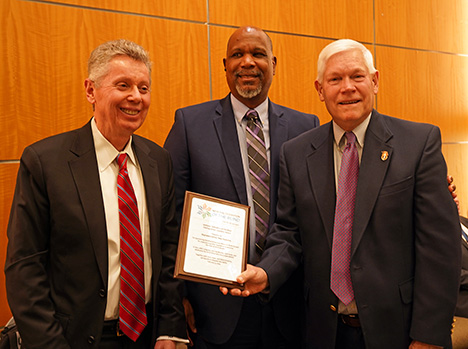
He concluded by saying, “And so on behalf of myself, my family, my office, I will tell you this: Please always feel free to tell any member of Congress that Pete Sessions is with us, and we would like to have you too. And if you do that, we can make it.”
Anil Lewis, our executive director for Blindness Initiatives, was the next speaker to be invited to the lectern by President Riccobono. Anil began his remarks as follows:
I am honored to be here. I was contemplating how I would bring this to you this evening considering some of the ways people are feeling in this current climate. I want everybody to just stay focused and stay strong. So I will offer it to you this way. In this space, we come together on one characteristic: blindness. In this space, all the other stuff doesn't matter. We know through our history that it's a collective movement; that one characteristic of blindness makes us powerful.
I love quoting “Power concedes nothing without a demand.”
Well, that's spoken from the perspective of those who are powerless.
We have power. Our perspective is power works with the shared relationship in a way that transforms the world. That's what we're doing, transforming the world.
And we do that through collectively working shoulder to shoulder. But I, as well as you, know it's the heart of the Federation that really gives us our true power. So I say shoulder to shoulder, and you say heart to heart.
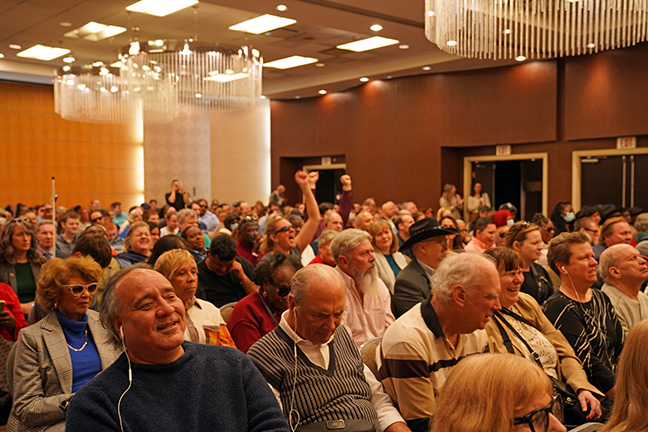
Anil cheerfully repeated the “shoulder to shoulder” call throughout his brief remarks, and the audience responded “heart to heart” each time. He described each of the programs he oversees briefly and gave updates where appropriate; for example, he reminded the audience that the next Jacobus tenBroek Law Symposium will take place March 20-21 at the NFB Jernigan Institute, and that the coming months will once again bring NFB BELL® academies and STEM programs. He also recognized the current Teacher of Tomorrow and Kenneth Jernigan Leadership in Service cohorts.
President Riccobono then asked Sandy Halverson to come to the lectern. Sandy and her husband John have long led the effort to staff the office that used to be housed in the Mercury Room, before the hotel removed its name and redesignated as simply room 275. The President joked that in his mind the room’s name will never change, and a member of the audience suggested that we make our own sign for it. Name change or not, the functions of the room remain much the same, although advances in technology, especially the creation of an online Washington Seminar portal, mean that there do not need to be as many volunteers in the room as before. Affiliate presidents or legislative directors use the online portal to report the results of their meetings with members of Congress, specifically to indicate the level of support for each of our legislative issues. The volunteers in room 275, however, still accept verbal reports, add them to the portal, and collect the business cards of congressional staff, because following up directly with these individuals is just as important as with the representatives and senators themselves. Since white canes do occasionally get broken while traveling the halls of Congress, the room can also supply new ones and is also where lost items should be brought so that their frantic owners can hopefully retrieve them. Sandy went over all these logistics with some important notes: the room would be open only during certain hours each day, and only cash could be accepted as payment for a new cane. She also reminded all of us of our pledge to support the programs of the Federation, with our dollars as well as our hearts, and commenced the passing of the traditional buckets for cash donations. Audience members also had the option of taking a card with a QR code that they could scan to take their phone directly to our donation web page, a handy new addition to the process since many of us no longer regularly carry cash.
President Riccobono updated the gathering on an important development following from our Rideshare Rally in October of 2024. Uber has now rolled out a feature where blind people who use guide dogs can voluntarily include that information in their profiles and choose whether they would like for drivers who are matched with them to have that information. If a driver cancels the ride after learning of the rider’s service animal, the app will warn them that cancellation will violate Uber’s policy of accepting service animals and give them a chance to rescind the cancellation. The hope is that this new feature will make it easier for Uber to identify drivers who are refusing rides to guide dog users. The intent is also to make it easier for such riders to make complaints if they are denied service. President Riccobono emphasized that no guide dog user is required to use this new feature, and declining to do so in no way changes Uber’s legal obligation to accept a rider’s service animal. The new policy is described in more detail later in this issue.
President Riccobono then reminded us that the Federation is experiencing tight finances at this time and urged everyone to ask a friend to contribute to our movement. He also reminded members that we are still seeking ideas for the Museum of the Blind People’s Movement, which may be slightly further off in our future than originally planned but is nonetheless still a big, bold dream that we plan to undertake. Ideas can be sent to Alison Tyler at [email protected].
The President then introduced Jonathan Mosen, the new executive director for Accessibility Excellence, for some remarks on the progress that we are making with the big players in the technology industry. Jonathan particularly emphasized that Meta, the company that owns Facebook, has reinstituted a method whereby desktop computer users can access the more accessible mobile interface for the popular social media platform, after causing much consternation in the blind community by deprecating its original basic mobile web page. Jonathan emphasized that the goal is for the full Facebook site to be more accessible so that an alternate access method is not needed but noted that this step represents significant progress for the time being. He also commended the company for rolling out accessibility improvements to its iOS app. Finally, he shared that we are working with Meta to make its Ray-Ban Smart Glasses, which have already taken the blind community by storm, an even more powerful accessibility tool. He advised that all of us can notify the Center for Excellence in Nonvisual Accessibility (CENA) of any challenges we are experiencing with products and platforms, as well as access a self-advocacy toolkit to reach out to companies on our own, by visiting https://nfb.org/cena.
He also reminded everyone that CENA is a source of information as well as a gatherer, mentioning the ongoing availability of the International Braille and Technology Center (IBTC), the free virtual accessibility boutiques and trainings, and the new Access On podcast. He closed with these words: “I can predict something with absolute certainty: blind people will not be passive about our destinies. The blind will shape the products we use, and, as a result, tomorrow will be better than today. I know this. I know this because we are the National Federation of the Blind, and that's what we do.”
Everette Bacon, second vice president of the National Federation of the Blind and chairperson of the Dr. Jacob Bolotin Award Committee, was introduced to remind members to nominate individuals and organizations that are a positive force in the lives of blind people. He urged that those wishing to make or support nominations visit https://nfb.org/bolotin, noting that the web application has been improved so that it is easy to toggle between making a nomination or simply supporting an existing nomination with a letter of recommendation.
President Riccobono made a few more administrative announcements, including a reminder of our upcoming national convention and the Access Board town hall that will be a part of it, which he had just confirmed with Sachin Pavithran. He said the following, in part, to introduce our Advocacy and Policy team:
Let me just say that we decided in the last week that we should revise our strategy knowing that this enthusiastic team of great advocates would be on the Hill. It's been said many, many times that the F [in NFB] is Flexible. You know, our priority is not simply to come to Washington, DC, and spout facts and figures. We're looking to get real stuff done, as Congressman Sessions said. We want to get bills passed. And we also want to take advantage of the opportunities with where the leadership and the nation are. And we want to make sure that all of you are well informed about what's happening. In the last couple of weeks, there's been a lot of speculation, especially about meaningful programs for blind people. And we want to make sure that we can identify those members of Congress that are with us and those that are not with us. We know how to count votes, right? And if we can find our friends, we can build up our friends to help us get those votes. And so John Paré and the team are going to talk more about this. They've been doing a tremendous amount of work. I would say it's a small but mighty team. If you have not gotten to know them, you should. But you will know them really well after the next three days. So here is our Executive Director for Advocacy and Policy, John Paré.
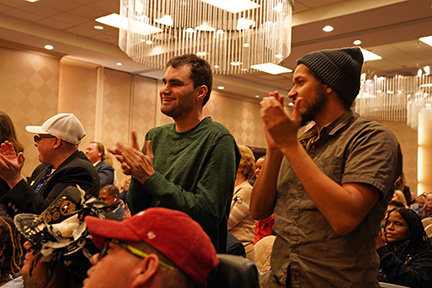 John then took the microphone to introduce our revised, flexible approach. He explained that a new fact sheet had been added to the packets that Federationists would give to members of Congress. The double-sided fact sheet listed the laws on which blind Americans depend on one side, referencing their most critical provisions, and seven critical funding streams on the other. The three laws listed, unsurprisingly, were the Rehabilitation Act of 1973, the Americans with Disabilities Act (ADA), and the Individuals with Disabilities Education Act (IDEA). The federal funding streams were the $15 billion in special education grants provided under IDEA, the 79 percent of all vocational rehabilitation funds provided under the Rehabilitation Act, Free Matter for the Blind, funding for the National Library Service for the Blind and Print Disabled and the Institute of Museum and Library Services, older blind programs, funding for state protection and advocacy agencies, and Medicaid. John Paré noted that the total number of the years the three civil rights laws have been in effect is 137. With respect to funding, he noted that the amounts are relatively small compared to the total federal budget but have big effects with respect to blind individuals, and urged the audience to emphasize, especially to Republican representatives and senators, that these programs “spend a little and save a lot” because they ultimately reduce the number of blind people who are dependent on SSI, SSDI, Medicaid, and other federal benefits. For example, a few months of vocational rehabilitation training can result in a lifetime of employment. He urged us to focus on this fact sheet and answer all questions about it, even if it meant not getting to our other legislative issues in the time allotted for the appointment with the Congressperson or their staff. John closed with the reputed words of Admiral John Paul Jones: “Surrender? I have not yet begun to fight!” before turning the microphone over to Kyle Walls, who also has a critical role in the logistics behind Washington Seminar.
Kyle focused on the details that needed to be reported through the Washington Seminar portal by affiliate delegations to facilitate follow-up in the coming months. These include who the delegation spoke with in each office and the specific reaction to each issue that was discussed, as well as notation of which issues, if any, were not discussed at all. Kyle also reminded everyone of the Congressional Reception taking place the following evening and the legislative debrief planned for Wednesday evening.
Kyle then gave the microphone back to John, who briefly discussed the first of the three legislative issues that our President and board of directors designated for action this year. This was the Websites and Software Applications Accessibility Act. The fact sheet about it, as well as those about the other two issues follow this article. He urged the assembled advocates to focus heavily on the aspects of the bill that might make it attractive to politicians, primarily Republicans, who wish to support small business, noting that the bill provides for a Technical Assistance Center and increases accountability for third-party web developers that many small businesses hire to build their web and mobile presences. While we should not hide that the bill requires new regulations, John said, we should not always make that the first thing that we mention. He then turned the lectern over to Justin Young to discuss the Medical Device Nonvisual Accessibility Act.
Justin urged members to tell their individual stories of being unable to operate medical devices with visual digital interfaces. He also provided an example story of John from Minnesota, who is unable to use his CPAP machine independently. These machines are used by individuals who have sleep apnea, a common but serious condition in which critical REM sleep is constantly interrupted because the patient’s airway is temporarily blocked and they must wake to get more oxygen. CPAP devices use air pressure to keep the airway open, allowing for better sleep. They also keep statistics on how well the process is working, which the patient is expected to monitor and report to their physician. John can neither independently set up and operate his machine nor adjust its settings if they are accidentally changed when it is moved, making the device unreliable for him and contributing to the long-term health problems that are associated with sleep apnea. There are many more such stories, including the many blind people with diabetes who are struggling with inaccessible devices that are supposed to help them regulate it. Therefore, Justin emphasized that accessible medical devices are critical to living the lives we want, and we must make that clear to members of Congress.
Jesse Shirek was next to the lectern to discuss the Blind Persons Return to Work Act. Jesse was not the first speaker to address the unusual climate in which the Washington Seminar was occurring and the anxiety that it was producing in some of our members, but his remarks were eloquent and provided hope as a reminder of our collective strength. He said in part:
I've been hearing from a lot of members who are experiencing a lot of anxiety coming up this week to the Washington Seminar.
I want to be transparent. For me, last week was a tremendously stressful week. I think it's been a tremendously stressful week for all blind Americans. I woke up on Friday feeling hopeless, feeling scared, worried about my future and the future for my blind wife and the future of our members. The executive orders halting money for programs like vocational rehabilitation, the older blind program, and special education rattled my reality, as did the disparaging comment around the inherent value of blind and disabled employees following the tragic midair collision miles from this hotel. Blind brothers and sisters in the movement, I wondered at the time: Are we powerless? Wondered if everything we hold dear could be stripped away from us. It only took moments for me to think about the fact that the funding freeze was halted. It was halted because we reached out to our governors and legislators and reached out to our senators. We said these policies will harm us. We told the government that, sure, this might save money in the moment, but it will increase the number of us who are no longer in the workforce, increase the number of us relying on benefits, sacrificing our future. This is not the American way. Thankfully, we speak with one voice, we walk in syncopation, and we walk in collective action. This is how we exercise our power. I was taught this lesson at my first Washington Seminar five years ago, in this very room. We just have to follow a simple recipe. We talk about the problem. We tell a story, painting the picture with our words, and make the problem real for our members of Congress. We illustrate our lived experience. And we put forth our solution. I hope again we will succeed because nobody advocates better than the National Federation of the Blind. Nobody prepares their members to fight for change like we do. When we're prepared, nobody will stop us.
Jesse then shared the details of the Blind Persons Return to Work Act. He emphasized how the legislation, if enacted, will improve government efficiency by reducing SSDI and SSI dependence and by eliminating or synthesizing unnecessary and conflicting regulations that separately govern the SSDI and SSI programs. It will do this through a pilot project that will sunset in ten years and therefore not grow government permanently.
After John Paré closed the Advocacy and Policy presentation with a final reminder of the Congressional Reception, President Riccobono introduced Marilyn Green to encourage members to participate in our Pre-Authorized Contribution (PAC) Plan. Staying with the theme of funding our movement, Patti Chang, our director of outreach, was then introduced to encourage members to leave a legacy gift to the National Federation of the Blind through our Dream Makers Circle. Patti also reminded everyone that they can obtain more information about how to fund our movement at https://nfb.org/donate. President Riccobono thanked Marilyn and Patti and then acknowledged a generous contribution from the autonomous vehicle company Waymo. In the past, this partner has sponsored our Congressional Reception, but this year it asked if it might sponsor the entire Washington Seminar, an offer we gladly and gratefully accepted. Noting that Waymo is once again testing its autonomous robo-taxis in DC, President Riccobono speculated that we might be able to take them to the Hill next year.
A few final announcements wrapped up the Great Gathering-In. The first came from the National Association of Blind Students, which promoted its fundraising auction planned for later in the evening that featured some truly impressive items. The second and final announcement concerned which affiliates had won a raffle for an extra box of the Krispy Kreme donuts that the DC affiliate always generously provides for the consumption and follow-on sugar high of Washington Seminar attendees. With the business of the evening concluded, the Great Gathering-In closed with President Riccobono urging, “Let’s go and let the voice of the blind be heard!”
The Congressional Reception
Tuesday evening, February 4, saw a goodly crowd of Federationists in the Kennedy Caucus Room of the Russell Senate Office Building for the Congressional Reception, a tradition at in-person Washington Seminars since 2015. About half an hour before the reception was to begin at 5 p.m., with many already in the room, we learned that the entrances to the Russell Building were being closed due to a suspicious package. Although this sounds ominous, it is not uncommon. Everyone who could quickly communicated to their Federation family members who had not yet arrived that they could get to the reception by entering either the Hart or Dirksen Senate Office Buildings and then using the tunnel system underneath the Capitol complex to get to the basement of Russell. It was thus that, in true Federation fashion, the reception got started on time and with a room packed with blind Americans waiting to hear from some of our representatives and senators.
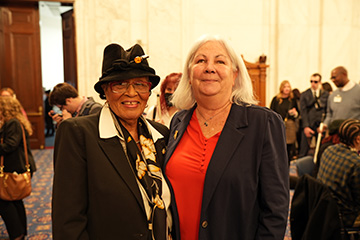 After folks had a chance to mingle and enjoy food and drink, the presentations started at 5:30 as planned, with President Riccobono introducing Representative Alma Adams of North Carolina. The congresswoman’s district encompasses the city of Charlotte and Mecklenburg County. She was delighted to attend her second Congressional Reception and stated that our issues are near and dear to her heart because her sister had low vision, and through her the congresswoman came to know of the many ways in which accessibility still needs to be improved. As a member of the Education and the Workforce Committee, Representative Adams committed to continuing to learn from our advocacy and to work with her colleagues to advance our goals.
President Riccobono next introduced Senator John Boozman of Arkansas, a longtime friend of the Federation who, our President announced, had already agreed to sponsor the Access Technology Affordability Act once again in the Senate of the 119th Congress. Although not one of our top three legislative priorities this year, the Federation continues to seek passage of this bill, which would provide a $2,000 refundable tax credit to blind Americans for the purchase of devices like screen readers, Braille displays, and low-vision aids. The senator said in part:
Thank you all. It is great to be with you. And as many of you know, I'm an optometrist. My brother was an ophthalmologist. We practiced together for many, many years and one of the things that I spent a lot of time doing was low vision. So I'm very, very aware of the unique problems that you have as a group, as you try and just do everyday things. So I will help you, any way I can help you. The way that you can help me—and this is really important, listen up for me—the way that you can help me is do just what you're doing: be here. The fact that we've got a room full of people is wonderful. There's no substitute for that. We're working hard to try and get your legislation passed, but that depends on other legislators knowing about it and voting for it. You're the ones that have to help us educate.
President Riccobono introduced another member of the Senate with these words:
This gentleman has a long history with the National Federation of the Blind going back to our president, Kenneth Jernigan, who was a leader in the state of Iowa. This gentleman serves as the senator from the state of Iowa. He has a long history of being a supporter of ours. In the 119th Congress, he serves as president pro tempore. He knows about the true experience of blindness because he has engaged directly with blind constituents and listened to our concerns and perspectives. He most recently was with us at our Great Gathering-In a couple years ago. Really honored to welcome this evening, from the great state of Iowa, Senator Chuck Grassley.
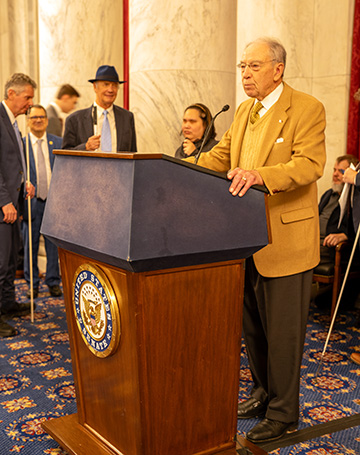 Senator Grassley addressed the gathering with his own fond memories of Dr. Kenneth Jernigan, whom he said he first met sixty-four years ago. He noted that, long before President George W. Bush coined the memorable phrase “the soft bigotry of low expectations,” Dr. Jernigan taught him the importance of high expectations for blind Americans. The senator praised the National Federation of the Blind’s recent work by helping to build consensus around the enabling legislation for the Marrakesh Treaty, which was signed into law by President Donald J. Trump in 2018. Senator Grassley expressed that he was honored by the award the National Federation of the Blind gave him for his work with us on that legislation but noted that accessibility issues persist even with the tremendous progress that the Marrakesh Treaty represented. He said that he looked forward to working with us in the 119th Congress and that, Lord willing, he expected to see many of us again next year. Following these heartfelt remarks, President Riccobono suggested that the National Federation of the Blind will want an interview with the senator as part of our oral history project for the Museum of the Blind People’s Movement.
The next speaker was Congressman Gus Bilirakis, who represents Florida’s Twelfth Congressional District, which includes the greater Tampa Bay area. Like many members of Congress who take particular interest in our agenda, Representative Bilirakis has a personal connection to our community in that he has low vision. He noted that he serves on the Energy and Commerce Committee and chairs its Subcommittee on Commerce, Trade, and Manufacturing. “The subcommittee has jurisdiction over the National Highway Traffic Safety Administration,” he said, “and we've been a long advocate for pursuing policies that enable innovative technologies that help individuals with visual impairments or blindness live more independent, fuller, and richer lives.” He recalled our collaboration on the Space Available legislation to allow 100 percent service-disabled veterans, including the blind, to access extra space on military flights.
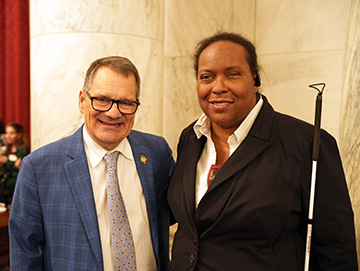 Representative Bilirakis promised to continue working on the Self-Drive Act, which will prohibit licensing requirements that prevent blind people from owning or operating autonomous vehicles (AVs) and set national standards for AVs that include accessibility. Representative Bilirakis said he had traveled in an AV just that past weekend and knew that he would need to use or own such vehicles in the future. Like many speakers, he thanked the National Federation of the Blind for showing up to tell our stories, since he felt that there was no substitute for our kind of advocacy. He also thanked Waymo for sponsoring the Washington Seminar and for its outstanding work on accessible autonomous vehicles.
Two freshman members of Congress visited us during the reception. The first was Congressman Johnny Olszewski, Jr. “Johnny O,” as he is affectionately known, is in his first term representing Maryland’s Second Congressional District. Prior to that, he served for many years as the executive of Baltimore County, and before that as a delegate in the Maryland General Assembly. He has also been a public-school teacher. Although he was familiar with the National Federation of the Blind, particularly the Maryland affiliate’s Baltimore County Chapter, the reception was the first time he met President Riccobono in person. After our President announced him and they exchanged greetings, the congressman shared his pride that the National Federation of the Blind is headquartered in Baltimore, part of which he represents.
“Since my time in the Maryland General Assembly and later as Baltimore County executive, I have had the great honor to see firsthand the incredible work of the National Federation of the Blind, what it has done and what it continues to do,” he said in part. “And so I know that I'm a newbie here in the halls of Congress, but my pledge is that as a new United States congressman, I'm ready to roll up my sleeves and continue to fight for our shared priorities. At the federal level, that means collaborating with anyone to make life better for all Americans. It means strengthening the Americans with Disabilities Act so that accessibility is guaranteed. It means expanding resources for blind students in our classrooms. It means ensuring that assistive technology and public spaces are truly accessible to all.”
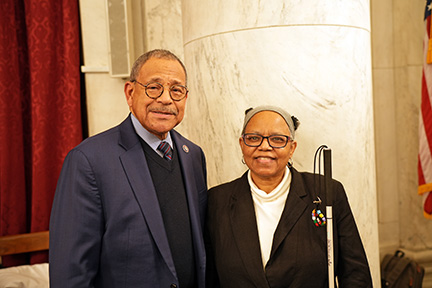 The next speaker in line was Representative Sanford Bishop of Georgia, but before giving him the microphone, President Riccobono, having learned that it was the congressman’s birthday, insisted that we all serenade him. Congressman Bishop thanked us and shared that he first learned of the challenges of low vision through a childhood friend named Marvin. Marvin, he said, was always selected last when the neighborhood children played sports, because he tended to miss balls thrown in his direction. Later, Congressman Bishop’s mother hired Marvin to do yard work and noticed that he did a poor job weeding her flower beds. She asked couldn’t he see the weeds, and he replied that he saw none, so she got permission from his parents to take him to the Bishop family’s optometrist. This single act, the congressman said, changed Marvin’s life trajectory. Once Marvin had proper services to cope with his low vision, his high school grades improved, he went to college on a scholarship and eventually became a respected minister. Congressman Bishop told this story to illustrate how, as Dr. Jernigan observed, it was the stigma of blindness that held back his friend Marvin and holds back so many others. Congressman Bishop then promised that, as he had in the 118th Congress, he would again co-sponsor the Access Technology Affordability Act, the Medical Device Nonvisual Accessibility Act, and the Websites and Software Applications Accessibility Act. He went on to discuss how he and other members of Congress are working to monitor the effects of the sweeping actions being taken by President Trump, noting that the attempt to freeze federal grants had locked up services for the older blind and training for interpreters for the deaf and deafblind. Congressman Bishop emphasized that this was why our efforts to bring our needs to the attention of his colleagues were so crucial. “It is the squeaking wheel that gets the grease and the crying baby that gets the milk,” he observed. He closed in part with the following: “As Dr. Jernigan said, ‘Accomplishments are made of dreams and drudgeries, of hope and hard work. The blind of the nation are now moving toward a destiny, a destiny of full equality and full participation in community life.’ Congress and the federal government must continue to be a reliable partner with the National Federation of the Blind so that people like my friend Marvin Lanham can tap the fullest potential and optimistically face a good future.” It is hard to capture in this brief capsule of his remarks the fervor with which Congressman Bishop delivered them. He spoke with the cadences and passion of a minister like his friend Marvin, and the effect on the room was electric.
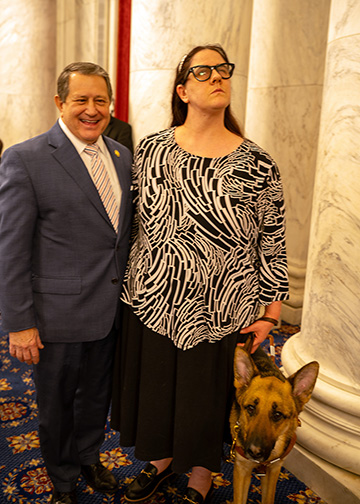 Representative Joe Morelle of the Twenty-fifth District of New York, which includes Rochester, and a prior co-sponsor of our website and medical device legislation, clearly felt that electricity. “I feel a little bit like I ought to just say I agree with Sandy Bishop and … sit down,” he said. The good congressman soldiered on, though, and his presentation was substantive. Congressman Morelle serves with Congressman Bishop, whom he called a good friend, on the House Appropriations Committee and is the ranking member of the House Administration Committee, which oversees the Capitol complex. In that latter role, he promised to continue his work to make the Capitol and its institutions welcoming to the blind and to all Americans, mentioning specifically the Smithsonian Institution and the Library of Congress. Regarding NLS, which is housed in the Library of Congress, Congressman Morelle promised to help the service continue to expand its collection of accessible materials and its other activities.
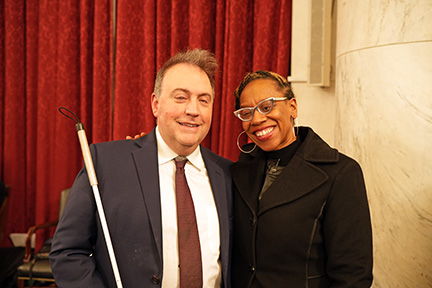 The next member of Congress to speak to the reception attendees was also the second freshman representative. In introducing her, President Riccobono noted that despite her freshman status, she is a friend of the blind, since as far as he knows, she is the first blind woman to be elected to the House of Representatives, where she now serves the Twelfth District of California. This was Congresswoman Lateefah Simon, and she began her remarks by stating how she was deeply moved and overwhelmed to be among so many of “my people,” as she put it. Her remarks focused on how she became aware early that too many spaces, including the Capitol, are not welcoming blind people. She shared that, when she had the honor of addressing the Democratic National Convention at the invitation of Vice President Kamala Harris, the print on the teleprompter was too small for her to read, even though she had flagged this concern and been assured it would be addressed. Congresswoman Simon demonstrated her advocacy early in her new role once she came to Washington. She wanted to make sure that her office would be fully accessible to people with disabilities. Freshman representatives traditionally get their offices assigned through a lottery, having no seniority, but Congresswoman Simon was not going to leave her office space to chance, and she let House Speaker Mike Johnson, whom she noted was not of her party, know that she needed accessible office space. She expected to be rebuffed, but Speaker Johnson called her within the hour of receiving her request and gave her an hour to look at a particular office. If she liked it, he said, it was hers; otherwise she would go to the lottery. She found the space satisfactory and took it. She noted that she still faces other challenges, such as being unable to read the board on which vote tallies are shown, but she will fight for equal access in the Congress and beyond. She mentioned specifically that she would fight for transit justice, including not only public transportation but the advancement of AVs, and would fight to protect the Department of Education and its vocational rehabilitation and special education components. Once again, it is impossible to capture here the fiery tenor of her remarks, but it was abundantly apparent to the audience that Congresswoman Simon is and will be a fierce and fearless champion for the rights of blind and disabled Americans.
The last member of Congress to address the gathering was Representative Glenn “GT” Thompson of Pennsylvania’s Fifteenth Congressional District. He emphasized his support for increased utilization of the AbilityOne program by the Department of Defense and for full funding of the Individuals with Disabilities Education Act, which he lamented has never been fully funded in its fifty years of existence. Congressman Thompson supports legislation to remedy this.
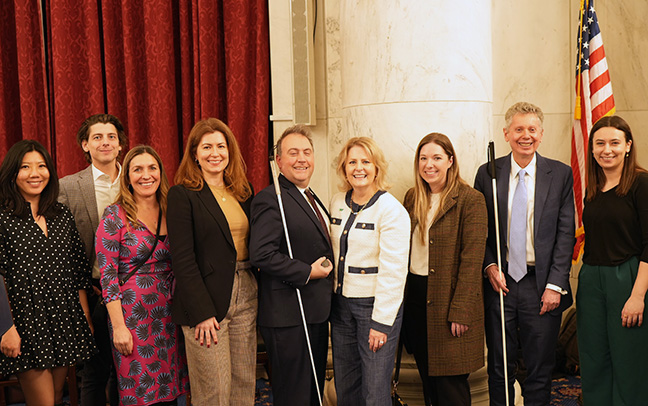
The last speaker of the evening was Michelle Peacock, representing our Washington Seminar sponsor Waymo. She told the gathering that the company’s autonomous robo-taxi service, Waymo One, provides 150,000 rides a week in four major cities. The service will soon officially expand to two more cities and is or will be testing in ten more, including Washington, DC. Peacock attributed this outstanding success in large part to the support of the National Federation of the Blind and thanked us for our legislative advocacy and for helping to develop the service’s accessibility features. She announced that the newest of these include the ability to get turn-by-turn walking directions from the vehicle to the door of the destination, if needed, and a new sound (other than a horn honk) so that blind riders can locate our assigned vehicle. She closed by looking forward to our continued collaboration to get national AV standards passed.
Some Final Thoughts
At this writing, Representative Pete Sessions has introduced the Blind Americans Return to Work Act, as promised, with Kweisi Mfume of Maryland’s Seventh Congressional District, the home district of the NFB headquarters, as its lead co-sponsor. According to initial information gathered from members (including at the February 5 legislative debrief that capped the final evening of Washington Seminar), representatives and senators were receptive to our message of protecting what we have. There is, of course, always constant back and forth between the president’s administration and the Congress, so vigilance will continue to be necessary as everyone involved navigates uncharted waters constantly being churned by an unusually active and aggressive executive branch. Nonetheless, the traditional bipartisan support for blind Americans is still in evidence, and we will move forward with hope and determination to see that it bears fruit.